


L6 lithium battery system · LiFePO4
L6 lithium battery cabinets for UPS: 50 Ah LiFePO4 modules in parallel.
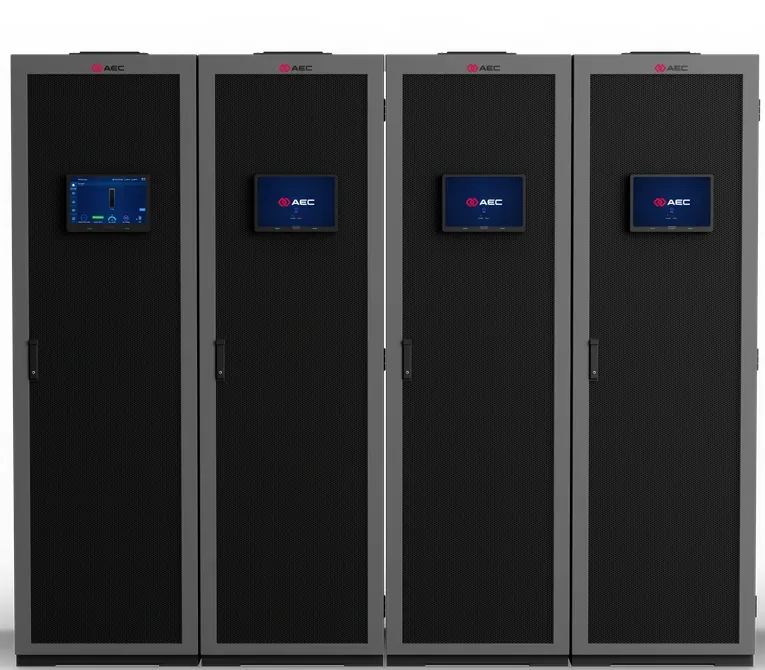
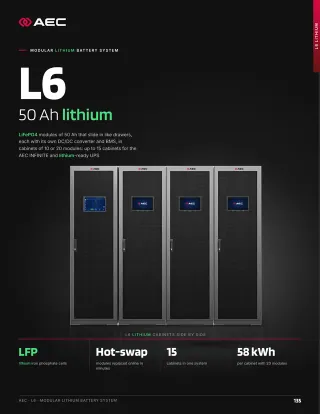
The AEC L6 is a modular LiFePO4 lithium battery system for UPS: 50 Ah modules of 2.88 kWh in parallel, each on its own DC/DC converter and hot-swappable, so a fault stays in one module and the load stays on. One cabinet of 20 modules gives 15 minutes at 200 kW; up to 15 cabinets run in parallel.
The main feature · Parallel, not series
Every module works on its own.
Each AEC module has its own DC/DC converter and joins the bus in parallel: hot-swappable, redundant, and new modules can sit beside old ones. In a series string, one module down stops the whole string; in parallel, the other modules carry on. Make one fail and see.
All 8 modules on line · the load is protected
All 8 modules on line · the load is protected
Watch the power flow from the batteries to the UPS. Then make one module fail.
| What happens | In series | AEC, in parallel |
|---|---|---|
| One module fails | The string opens: no battery at all until it is repaired | That module drops out; the other seven keep the load |
| Replacing a module | With the string switched off | Hot-swap: slide it out and in, the load stays on |
| Old and new modules | A string wants matched modules | New beside old: each runs on its own converter |
| Adding runtime | Add a whole string | Add modules: up to 3 in an ETHERNO, 20 in an L6 cabinet |
| Sharing the current | One current through every module | Each converter takes its share; cabinets share within 3 % |
| Safety | The full string voltage runs through every module | Isolated DC/DC: low voltage inside, a fault stays in its module |
Why L6
What lead-acid costs, and what the L6 does instead.
Lead-acid, and lithium built as one series string, share the same weak point: one bad block or pack affects all of it. The L6 keeps every module on its own.
Floor area and floor load to check for a VRLA battery cabinet beside the UPS.
No health analysis and no early warning before a block fails.
About three sets of batteries in one UPS life: replaced about twice.
The whole string is serviced, and checked at least twice a year.
From the comparison with a UPS and a VRLA battery cabinet in the AEC L6 lithium catalog (2026), which gives the lead-acid side as indicative limits, not a test. The same catalog gives the L6 a 15-year life and 5,000+ cycles.
Safe
A fault stays where it starts.
- Isolated DC/DC in every moduleA fault stays inside its module, and the low voltage inside keeps high-voltage arcs out.
- Fire protection per moduleTemperature is watched module by module: a fault is answered where it starts.
- On-line insulation monitoringChecked while the system runs: a leak is located before it becomes a short circuit.
- A failed module drops outOn its own, while the other modules and the UPS carry on.
Smart
Every cell in view.
- Three-level BMSA BMS in every module, one in every cabinet and one for the system, reporting to the touchscreen and the UPS.
- Cell-level dataVoltage and temperature of every cell, with the faulty one located.
- Old and new side by sideAdaptive state of charge: new modules work beside old ones, and cabinets share current within 3 %.
- On-line battery testModules are tested in groups while the system runs.
Simple
Minutes, not hours.
- Hot-swapA module is replaced in about 5 minutes with the load on; a series string is switched off for about 180 minutes.
- Grows with the loadAdd modules, or cabinets: up to 15 cabinets in one system.
- Matches the UPS240 V, 480 V or ±240 V output, to suit the UPS DC bus.
- Fits the roomCables and switches reached from the front; a combiner cabinet joins three or more cabinets.
 Drag to turn
In 3D
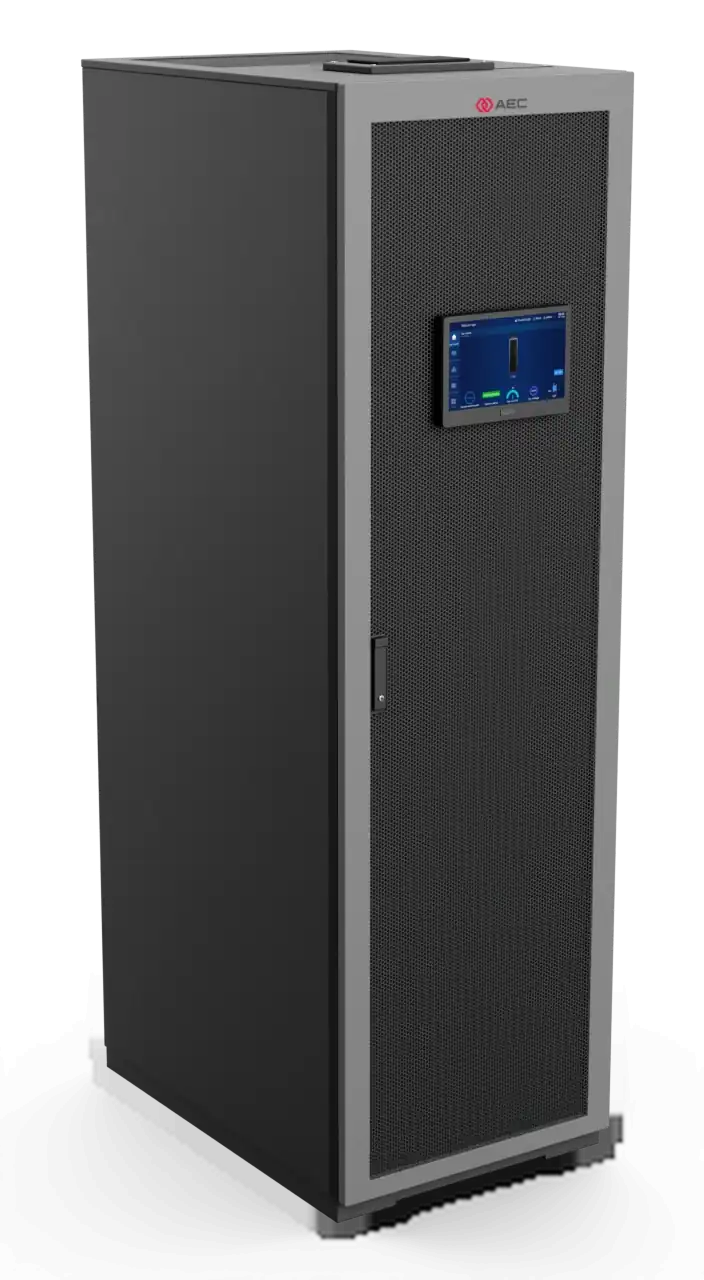
Look around the L6 cabinet
Drag it round, swipe on a phone or use the arrow keys. X-ray makes the enclosure see-through, so you can see what sits behind the panels.
Rendered from AEC's 3D model of the L6 lithium battery cabinet. The full 3D view zooms in, opens the unit and names every part.
Hands on
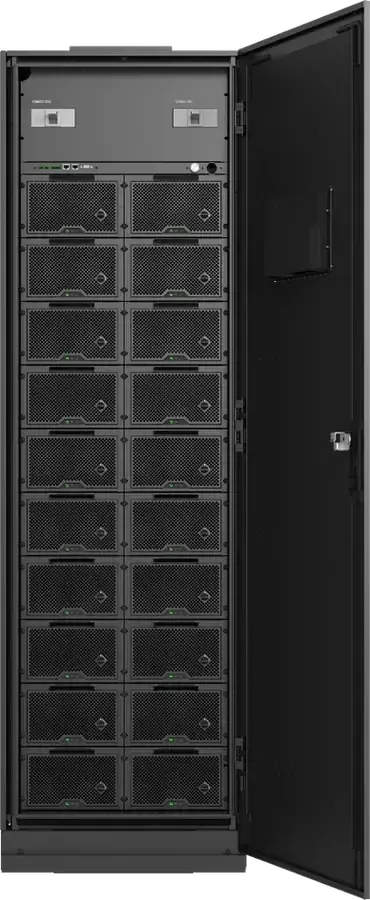
Open an L6 cabinet.
The catalog's own photos: open the door, pull modules out while the load stays on, and watch the runtime change.
L6 lithium cabinet · LiFePO4 · for INFINITE
Twenty modules in parallel. Pull one, the rest keep going.
Each 50 Ah module joins the DC bus through its own DC/DC converter, so every module works on its own: one out or one failed, the others keep the load on. New and old modules can sit side by side.
- 7-inch touchscreen on the door: voltage, current, charge and temperature of every module
- Three-layer BMS: in every module, in the cabinet, for the whole system
- Up to 15 cabinets in parallel
All 3 numbered parts
Inside the module
One 50 Ah module, opened.
The same LiFePO4 module runs in the ETHERNO and in the L6 cabinet. Turn it, open it, click a number.


The same module goes in the ETHERNO (up to three) and in the L6 cabinet (up to twenty): 50 Ah, 2.88 kWh, 223 × 665 × 152 mm.
Plan it
How many cabinets for your UPS?
Pick the UPS and the minutes: cabinets and 50 Ah modules from the L6 backup tables, with new modules. Runtime grows module by module, so nothing is oversized.
Backup at a glance
Every rating of the L6 backup tables, with new 50 Ah modules: each block is a cabinet, filled by its modules.
Range
The 50 Ah module and its cabinets.
From the 2026 catalog, for the US market: cabinets of 10 or 20 modules, and the combiner cabinet that joins three or more.
- Cells
- 18 × 3.2 V LiFePO4 · 57.6 V
- Energy
- 2.88 kWh
- DC/DC output
- 10 kW
- Cabinet
- 20 modules · 58 kWh
- Backup, one cabinet
- 15 min at 200 kW
- Charge current
- 0.1 to 1 C (0.5 C as set)
- DC/DC output voltage
- ±240 V, 240 V or 480 V
- Current unbalance
- within 3 %
- Noise
- 58 dB
| Model | Description | Size (W × D × H) | Weight |
|---|---|---|---|
| L6-CAB-10×50LI | Lithium cabinet with 10 × 50 Ah modules, BMS and smoke detector | 23.6" W × 33.5" D × 78.7" H (599 × 851 × 1,999 mm) | 1,356 lb (615 kg) |
| L6-CAB-20×50LI | Lithium cabinet with 20 × 50 Ah modules, BMS and smoke detector | 23.6" W × 33.5" D × 78.7" H (599 × 851 × 1,999 mm) | 2,172 lb (985 kg) |
| L6-COMBINER | Combiner cabinet: joins three or more lithium cabinets to the UPS | 15.7" W × 33.5" D × 78.7" H (399 × 851 × 1,999 mm) | 309 lb (140 kg) |
| L6-CAB-EMPTY | Empty lithium cabinet with BMS and smoke detector, for up to 20 × 50 Ah modules | 23.6" W × 33.5" D × 78.7" H (600 × 850 × 2,000 mm) | 540 lb (245 kg) |
| L6-MOD-50LI | LiFePO4 module, 50 Ah · 2.88 kWh, with its own DC/DC converter | 8.8" W × 26.2" D × 6" H (223 × 665 × 152 mm) | 82 lb (37 kg) |
The cabinet's own screen
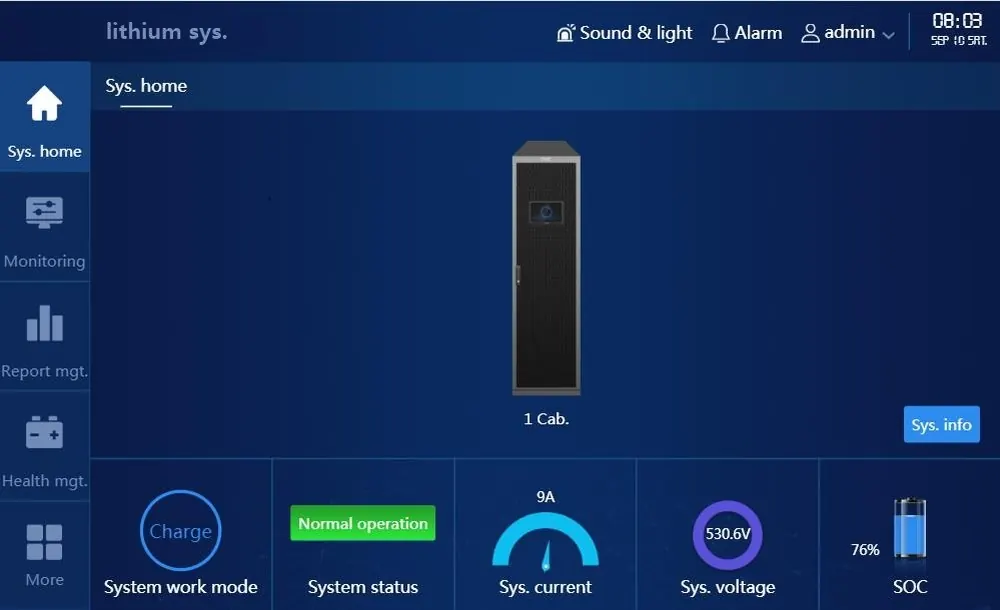
The L6 BMS display.
The real touchscreen from the user manual: its cabinets, modules, cells, alarms and health pages; pick a page or touch the screen as on the cabinet.
L6 lithium cabinet · the real screen
Home
The cabinets with their color (blue normal, yellow alarm, red protected, gray not connected), the system work mode, status, current, voltage and SOC. Tap a cabinet for its monitoring pages, or Sys. info for the system extremes.
Lithium UPS
UPS with lithium inside.
From a 2U rack unit to 1,500 kVA, with LiFePO4 built in or in L6 cabinets.
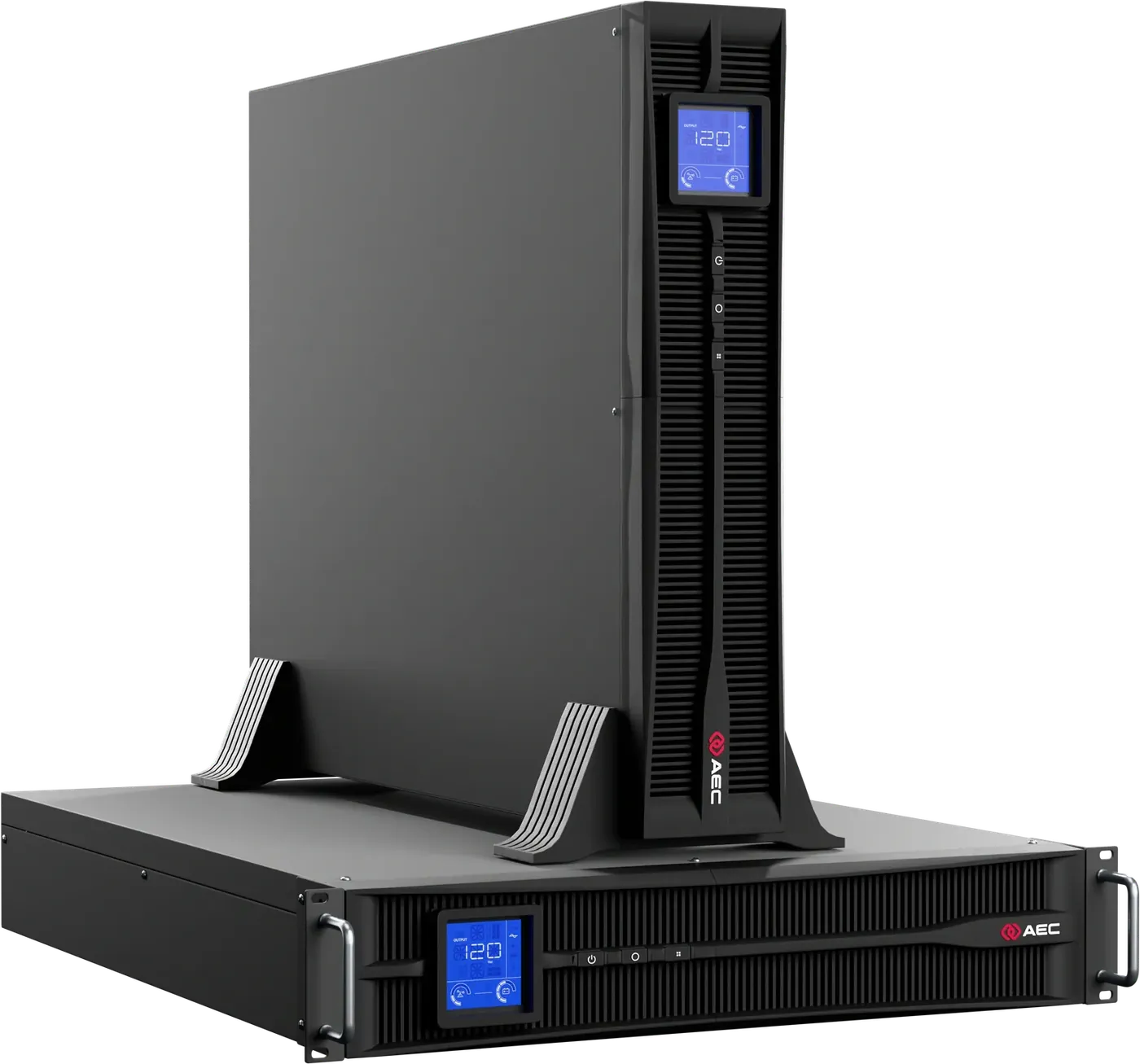
LUMINA
Online double-conversion UPS for single-phase 120 V loads from 1 to 3 kVA, in a 19-inch rack, with internal LiFePO4 lithium batteries.
View series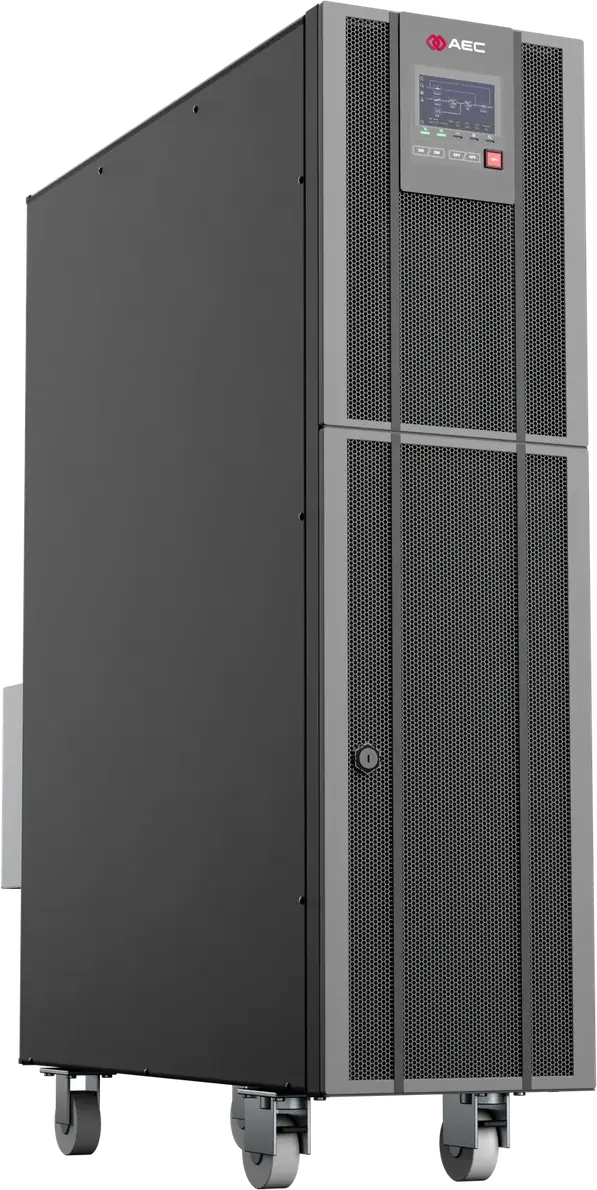
ETHERNO
Online double-conversion UPS for three-phase 208 V loads from 10 to 30 kVA, in a tower cabinet, with hot-swappable 50 Ah lithium modules.
View series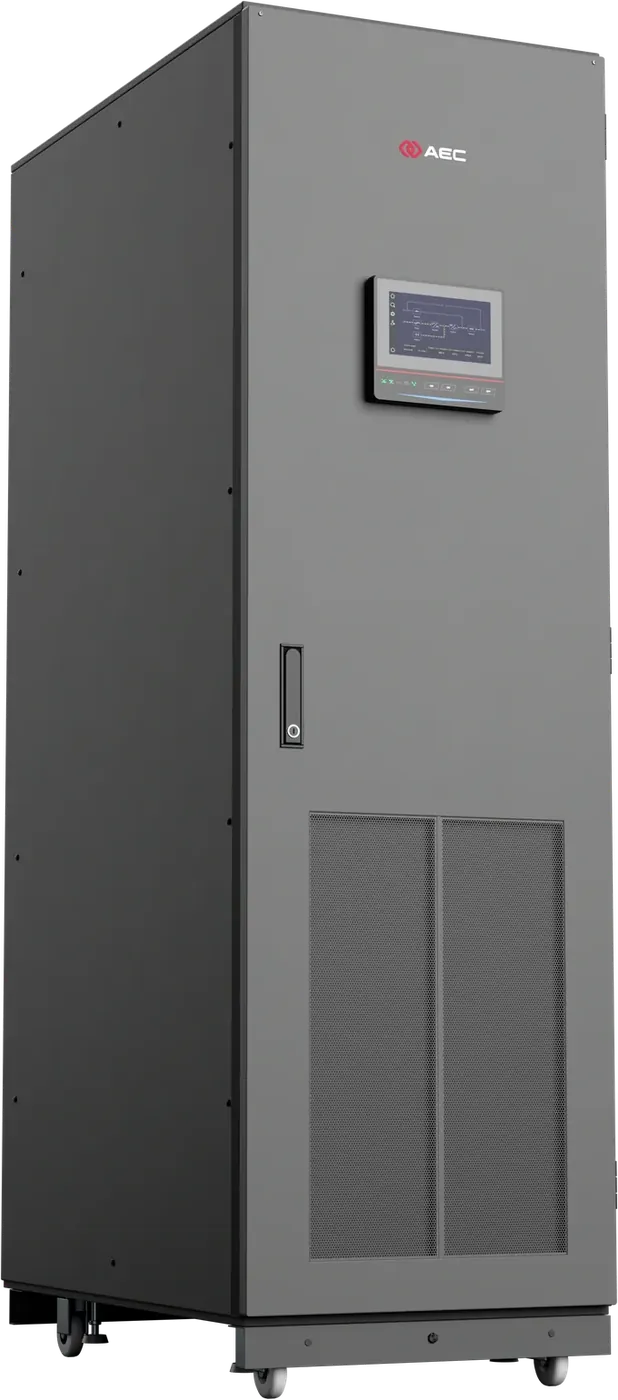
INFINITE
Modular online UPS with room for N+1 redundancy for three-phase 480 V, 3-wire loads from 100 to 600 kVA, with external lithium battery cabinets.
View series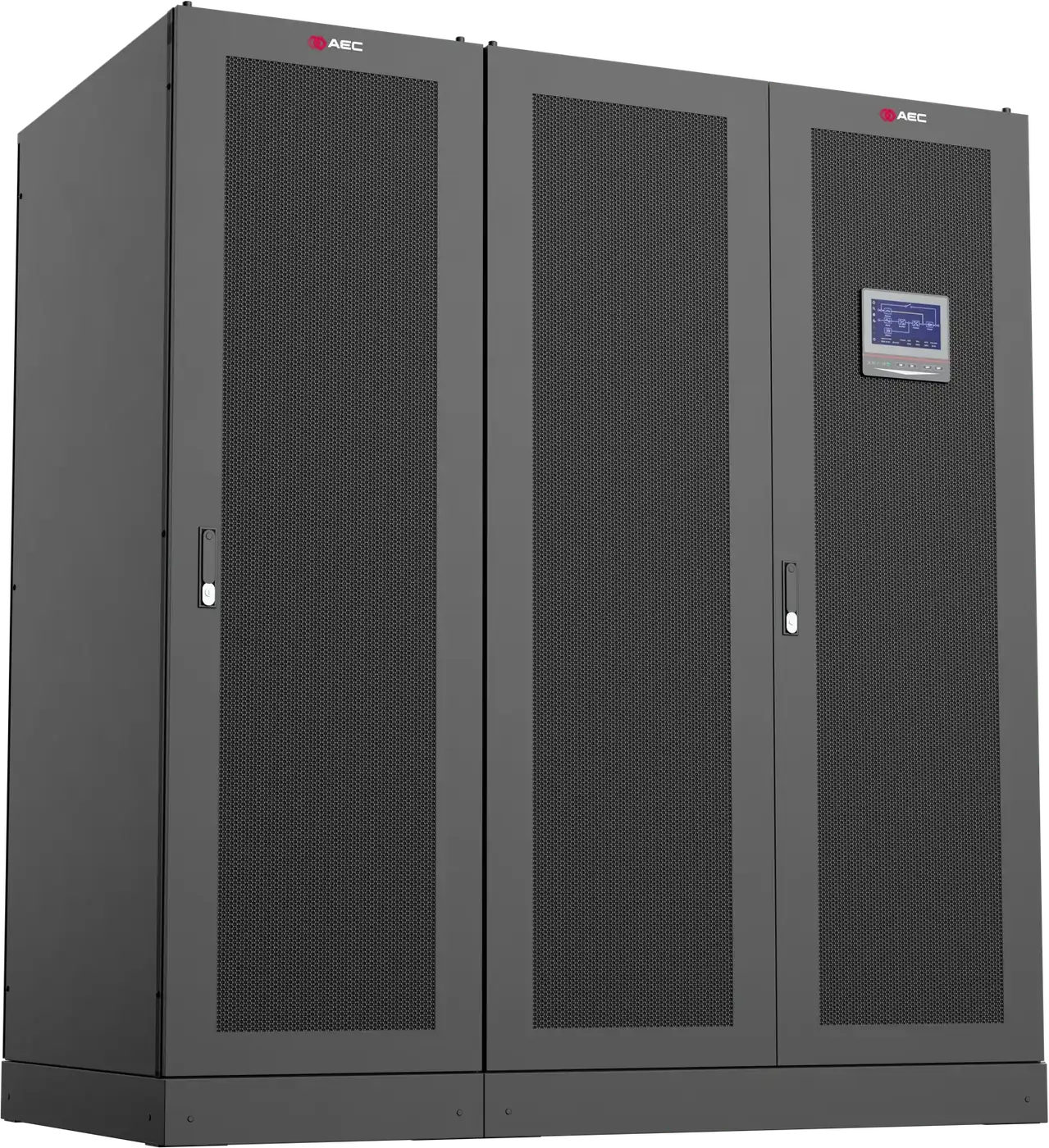
INFINITE 1.5MW
Modular online UPS with room for N+1 redundancy for three-phase 480 V, 3-wire loads from 750 to 1,500 kVA, with external lithium battery cabinets.
View seriesQuestions
Questions people ask
How long does one L6 cabinet run a UPS?
About 15 minutes at 200 kW from one cabinet of 20 modules of 50 Ah: each module is rated 10 kW for 15 minutes, 2.88 kWh nominal. Runtime grows module by module, and up to 15 cabinets run in one system.
How long does an L6 lithium battery last?
The AEC L6 lithium catalog (2026) gives a 15-year life and 5,000+ cycles; the cabinets carry a 5-year warranty with their batteries.
Can an L6 module be replaced with the load on?
Yes: each module reaches the UPS through its own isolated DC/DC converter, so one is slid out and a new one slid in with the load on, in about 5 minutes. New modules work beside old ones.
Which listings and tests does the L6 hold?
The AEC L6 lithium catalog (2026) gives the modules as UL 1973 listed, and UL 9,540A and UN38.3 tested.
Which AEC UPS run on L6 cabinets?
INFINITE (100 to 600 kVA) and INFINITE 1.5MW (750 to 1,500 kVA) run on external L6 cabinets, or on a lead-acid bank. ETHERNO takes the same 50 Ah modules inside its tower, up to three.
Documents

Size a lithium system
Tell us the UPS, the load and the minutes: we size the modules and cabinets.