Why do data centers use 480 V?
At the same power, current falls as voltage rises. 100 kVA draws about 278 A at 208 V and about 120 A at 480 V, so cables, breakers and switchgear get smaller. That is why US data centers distribute at 480 V and step down near the racks. The 208 V or 480 V guide does the arithmetic.
How does modular N+X give redundancy without a second UPS?
A modular UPS is a frame of identical power modules sharing the load. With one module more than the load needs (N+1), any module can fail or be swapped while the load stays on the inverter.
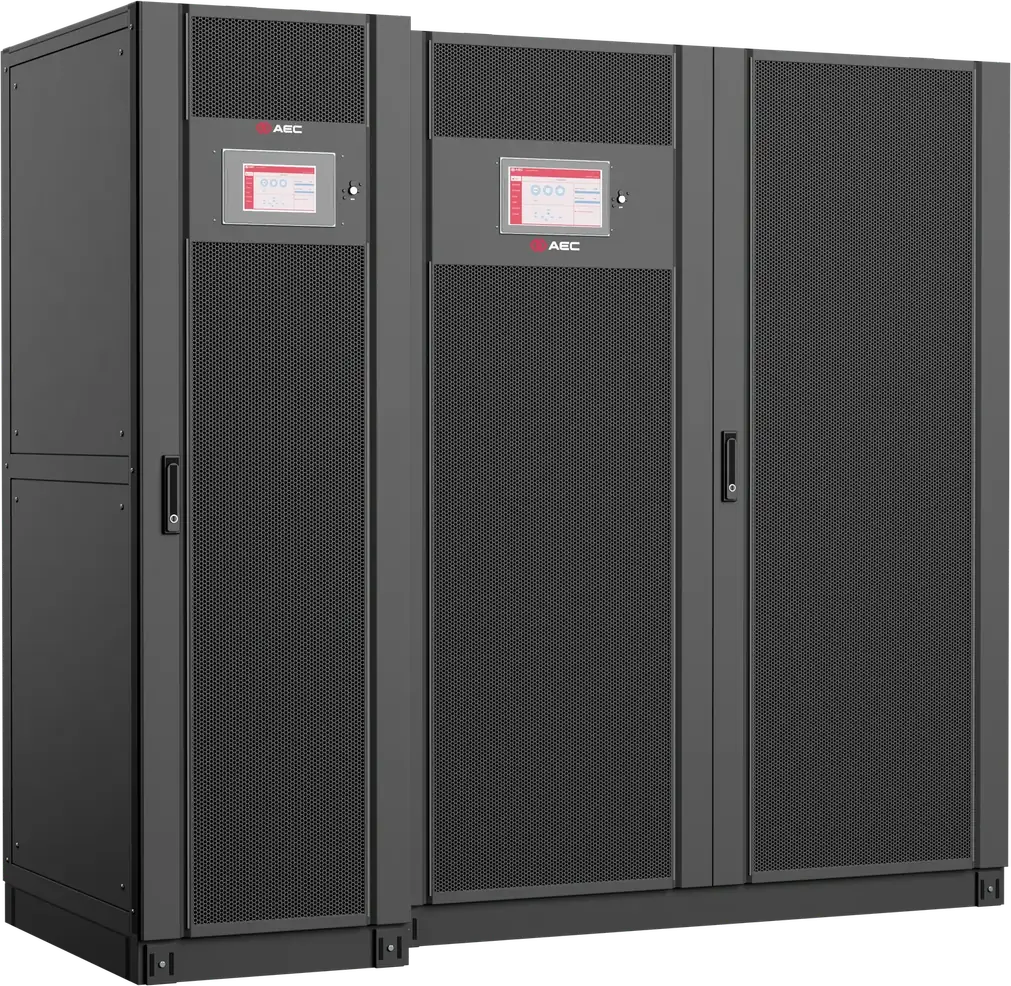
- CIRRO: 480/277 V, 60 kVA modules on the 360 frame and 100 kVA modules on the 600 to 1,600 kVA frames, up to 97 % efficient.
- INFINITE: 480 V, silicon-carbide (SiC) 100 kVA modules, N+1, 100 to 600 kVA, up to 97.3 % efficient, up to three 200 kVA frames in parallel.
- INFINITE 1.5MW: the same SiC design in one 1,500 kVA frame of 125 kVA modules, 750 to 1,500 kVA, up to 8 frames in parallel.
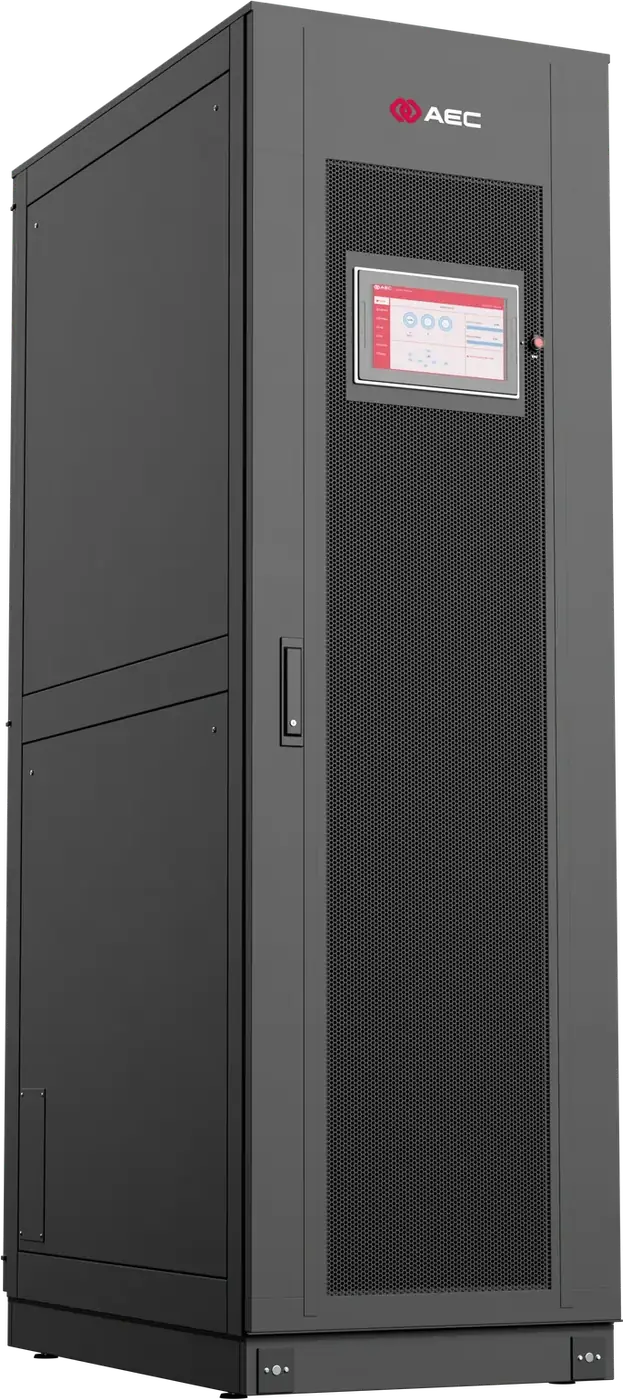
- CIRRO-IB and RADIANT-IB: modular with the VRLA battery inside the cabinet, for edge rooms from 20 to 150 kVA.
What is efficiency worth in kilowatt-hours?
The losses of a UPS are the load times (1 ÷ efficiency − 1), and they come out as heat the cooling must remove. At a steady 500 kW load:
| UPS efficiency | Losses | Losses in a year |
|---|---|---|
| 94 % | 31.9 kW | about 279,600 kWh |
| 97 % (CIRRO) | 15.5 kW | about 135,500 kWh |
| 97.3 % (INFINITE) | 13.9 kW | about 121,500 kWh |
Those are the catalog's peak efficiencies; real efficiency depends on the load level. The efficiency page explains how SiC gets there.
What do lithium cabinets bring?
INFINITE and large systems use external L6 lithium cabinets: 10 or 20 LiFePO4 modules of 50 Ah, an integrated battery management system and smoke detector, rated for 15 years and over 5,000 cycles. Against VRLA they take less floor, weigh less and are far less sensitive to a warm room; see how long UPS batteries last.
How does a data center UPS grow to megawatts?
Start with the modules the first phase needs and add them as racks arrive, up to the frame's rating; beyond it, parallel frames. See a containerized system on the containerized UPS page.
Worked example: 400 kW on day one, 800 kW later
A data hall opens with 400 kW of IT load on a 480 V supply, needs 15 minutes on lithium, and is planned to reach 800 kW.
- Day one. Kept at 80 %, 400 kW needs 500 kVA. The INFINITE INF-600 is three 200 kVA frames in parallel with two 100 kVA modules each; 400 kW is 67 % of it. Each frame takes a third module (2+1), so every frame is N+1 on its own.
- Battery. One 20-module L6 cabinet (58 kWh nominal) carries 200 kW for 15 minutes. The INF-600 bundle has three cabinets, 60 modules and 174 kWh nominal, the catalog's 15-minute set-up for 600 kVA: about 22 minutes at 400 kW with new modules, and still 15 minutes when the load reaches 600 kW.
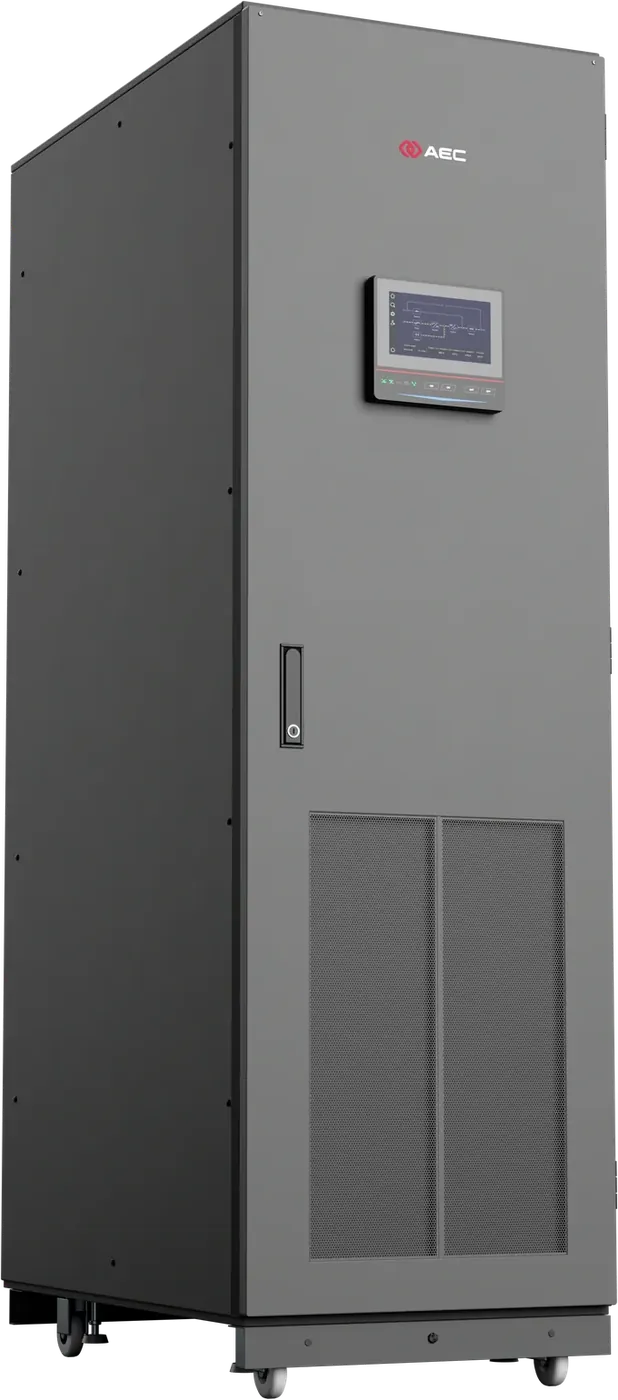
- Past 600 kW. INFINITE stops at three frames. The next step is INFINITE 1.5MW: the INF15-1000+1 has nine 125 kVA modules in one frame, carries 800 kW at 80 %, and runs on six or eight L6 cabinets on an L6 combiner, the catalog's set-ups for that model. Six cabinets hold 120 modules, 348 kWh nominal: about 22 minutes at 800 kW with new modules.
If the plan is to grow in place inside one frame, CIRRO is the other route: its 600, 800, 1,200 and 1,600 kVA frames take 100 kVA modules, and the catalog lists frames and modules on their own, so a frame can start part-full. CIRRO runs on a VRLA bank, at up to 97 % against INFINITE's 97.3 %.
The UPS sizing tool runs this check for your own load, minutes and N+1, and the room fit tool checks the clearances, the NEC working space and the way in for the model you pick.
What does the UPS ask of the generator?
A data center UPS spends part of every year on generator power: during outages, and during the monthly tests. The input figures decide how well the two get on. INFINITE 1.5MW draws its current at a power factor above 0.99 with THDi at or below 3 %, so the generator sees an almost resistive load, and accepts 336 to 552 V and 40 to 70 Hz at its input (408 to 552 V at full load). A wide window keeps the UPS on generator power while the engine settles after a load step, instead of falling back to the battery. Size the generator with the engineer of record and the generator maker, with the UPS input current, the battery recharge and the mechanical loads it also carries.
What does a 2N design do to efficiency?
In a 2N design two complete systems share the load, so each runs at 50 % or less, and lower still on day one. Efficiency is a curve: a UPS sized for 1 MW that carries 300 kW sits at 30 %, below its best point. Modular frames help here. With fewer modules in each frame, the modules that run work harder and closer to their peak; the efficiency curves show each series at your load.
What do the floor and the room need?
- Weight. The INF-600 bundle with its three L6 cabinets weighs 8,597.2 lb in all; a 20-module L6 cabinet alone weighs 2,171.6 lb on a 23.6 × 33.5 in footprint. Check raised-floor ratings early.
- Fire code. One 20-module cabinet holds 58 kWh nominal, past the 20 kWh line of NFPA 855 for lithium-ion. See the lithium UPS guide.
- Monitoring. INFINITE 1.5MW speaks Modbus RTU, Modbus TCP/IP and BACnet as standard, for the building management system and the DCIM.
Which mistakes cost the most?
- Sizing the UPS to the IT nameplates instead of the measured or planned load, and running it for years at 30 %.
- Buying the full frame and every module on day one when the racks arrive over years.
- Planning lithium cabinets without the fire marshal, and redrawing the room late.
- Treating N+1 inside one frame as 2N: the modules still share one frame, one bypass and one feed.