What happens in the 10 seconds a generator leaves open?
In a US hospital the essential electrical system runs on generators, and the life safety and critical branches must be back on generator power within 10 seconds (NFPA 99 and NFPA 110, Level 1). Ten seconds is short for a building and long for a computer: servers, network switches, the electronic health record, nurse call, pharmacy dispensing, lab analyzers and building controls all reboot if they drop for even a fraction of one.
An online double-conversion UPS removes that gap. The load always runs on the UPS inverter, so when the utility fails nothing switches: the battery carries the load until the generator is up, and the UPS goes back to the generator's power, cleaning its voltage and frequency on the way.
What does a UPS not replace?
- The generator and the transfer switches. The code-required sources of the essential electrical system stay as they are; the UPS sits downstream of them.
- The equipment maker's rules. Imaging systems (MRI, CT) and life-support devices come with their own power requirements and often their own UPS. Follow them.
- The engineer of record. Where a UPS goes on a branch circuit is a design decision for the facility's electrical engineer.
Which codes shape the design?
- NFPA 99, the Health Care Facilities Code, sets the categories of care and the essential electrical system each one needs. A hospital's Type 1 system has three branches: life safety, critical and equipment.
- NEC Article 517 covers the wiring of health care facilities, including the essential electrical system and the receptacles of patient care spaces.
- NFPA 110 covers the generators: a Level 1 system, where a failure could cost a life, must take its loads within 10 seconds (Type 10), and is tested under load every month.
- NFPA 111 covers stored-energy emergency and standby power systems, the standard for a UPS that is itself part of the emergency supply.
- UL 1778 is the product-safety standard of the UPS itself. INFINITE 1.5MW, for example, is UL 1778 listed (UL file E543003).
The UPS itself is fed from a branch of the essential electrical system, the one the engineer of record assigns to its loads, so that the generator picks it up after the 10 seconds and the battery only covers the gap.
Worked example: a clinic's server room on 208 V
A clinic's server room draws 12 kW on a 208 V panel of the essential electrical system. The UPS must cover the generator gap, carry the load through the monthly generator test, and give 15 minutes to close the servers in order if the generator fails to start.
- Rating. At 80 %, 12 kW needs 15 kW: a 20 kVA / 20 kW ETHERNO, at 60 % load.
- Runtime. At 60 % the catalog tables give 23 minutes with two 50 Ah lithium modules (ETH20-2X50A-LI) and 34 with three (ETH20-3X50A-LI). Two modules meet the 15 minutes with margin.
- Fire code. Two modules hold 5.76 kWh nominal, three 8.64 kWh: both well below the 20 kWh of lithium-ion at which NFPA 855 applies to the room.
- Monitoring. ETHERNO has Modbus and dry contacts as standard; with an SNMP card the alarms reach the building's monitoring and the IT team.
Worked example: a practice with no generator, on 120/240 V
A medical practice has a 120/240 V split-phase service and no generator. Its front desk, workstations, network and phones draw 5 kW, and the staff want time to finish the visits in progress and close the systems: about half an hour.
- Rating. A 10 kVA FERRUS SP carries 5 kW at 50 %, hardwired to the sub-panel, with its isolation transformer and its maintenance bypass built in.
- Runtime. Its own 16 batteries give 7.5 minutes at 50 %. With a BB4US cabinet of 32 blocks the catalog table gives 30 minutes; with 64 blocks, 57.
- Current. 10 kVA at 240 V is 41.7 A on each leg at full output; the input breaker and the cables come from the installation manual.
The isolation transformer also gives the load a neutral of its own, separated from the building's, which cuts the common-mode noise sensitive electronics pick up; see isolation-transformer UPS.
Which UPS goes where, from the front desk to the data room?
| Where | Supply | AEC series |
|---|---|---|
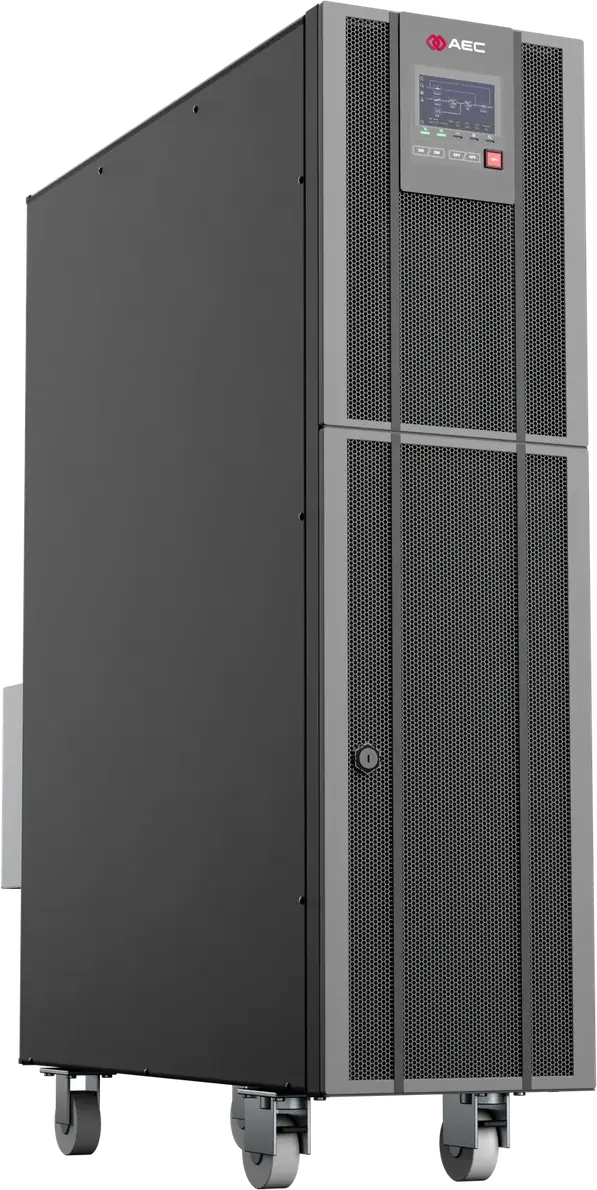
| Reception, nursing station, a rack of network gear | 120 V | LUMINA lithium 2U, FERRUS tower |
| A medical practice or outpatient clinic panel | 120/240 V split phase | FERRUS SP 6 to 20 kVA, with isolation transformer |
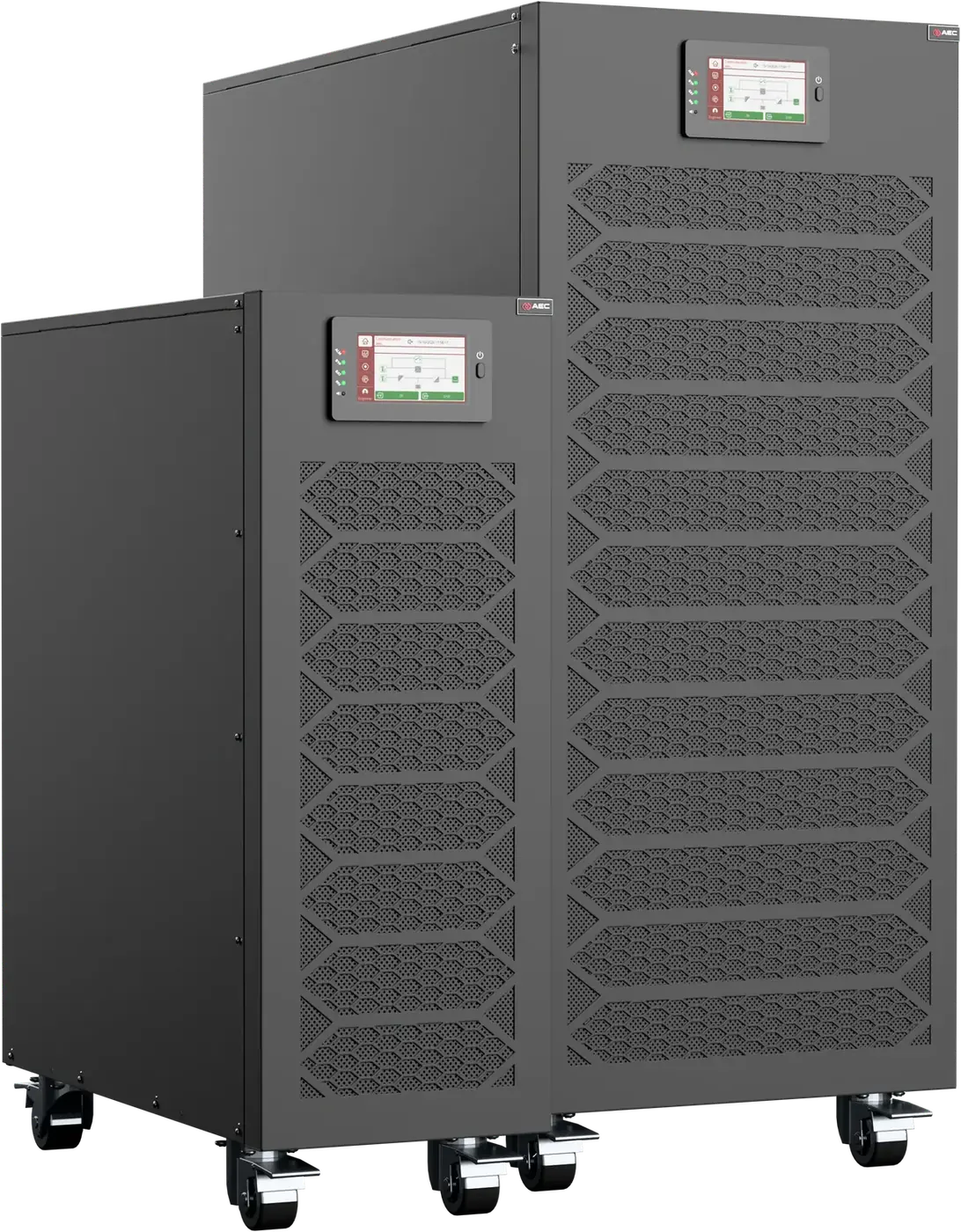
| The clinic's or the floor's server room | 208 V three-phase | ETHERNO lithium 10 to 30 kVA, RADIANT modular 15 to 90 kVA |
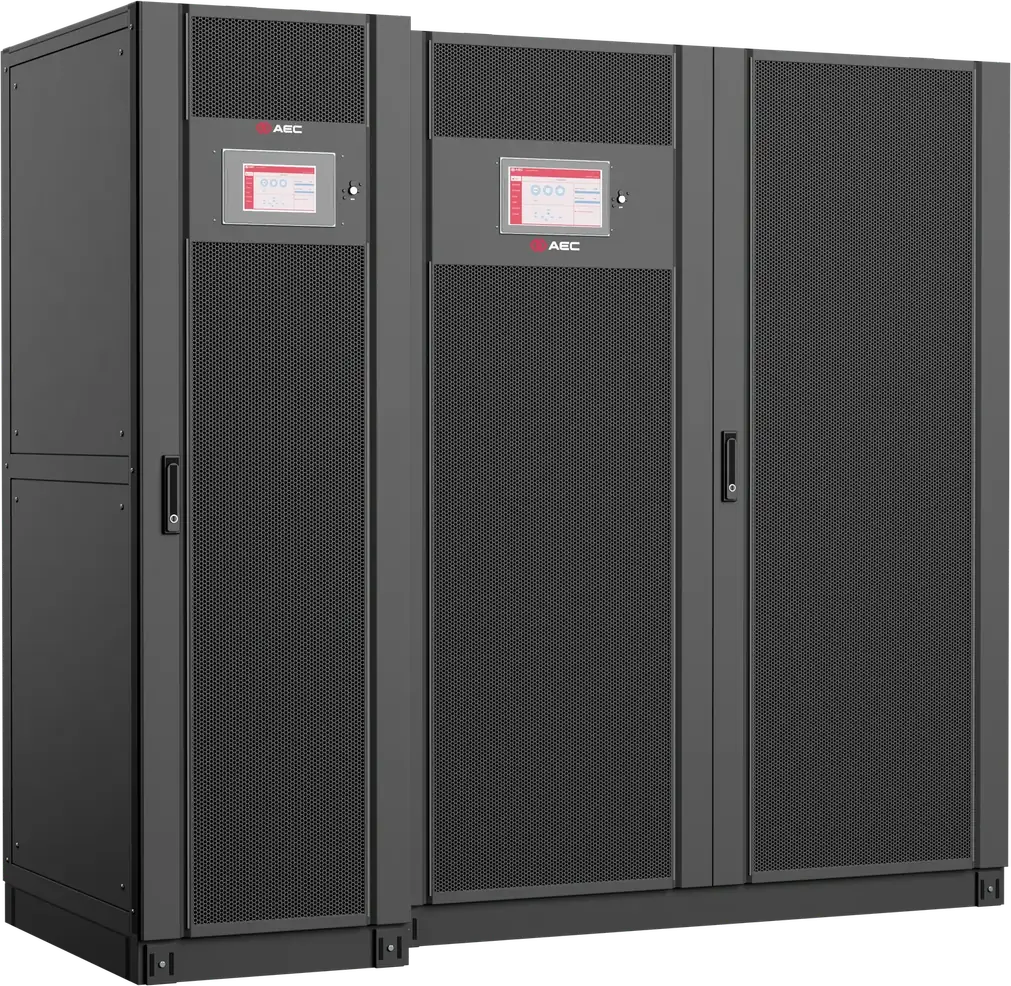
| The hospital data center | 480 V three-phase | CIRRO modular to 1,600 kVA, INFINITE SiC 100 to 600 kVA and INFINITE 1.5MW 750 to 1,500 kVA |
Why do healthcare engineers ask for modular and lithium?
- Redundancy inside one frame. RADIANT and CIRRO run N+X: one power module can fail, or be swapped, while the others carry the load.
- Fewer battery replacements. LUMINA's LiFePO4 battery is rated for 12 to 15 years; ETHERNO's modules are hot-swappable and its warranty is five years, batteries included. See how long UPS batteries last.
- Monitoring. SNMP cards report every alarm to the building's monitoring and by email; see UPS monitoring.
What goes wrong in healthcare installations?
- A UPS on the wrong receptacle. A plug-in UPS on a normal-power receptacle loses its input with the utility and is not picked up by the generator: it runs to empty in a ten-second event that the building rides through.
- Runtime sized for the whole outage. Where a generator carries the building, the UPS covers seconds plus the time to close the systems if the generator fails. Hours of battery add weight, floor and fire-code work for no gain.
- No one watching the bypass. After an overload or a fault, a UPS on static bypass passes raw generator power and has no battery behind it. The alarm must reach the facility team, not only a beep in a closed room.
- Battery dates nobody tracks. A VRLA string aged by a warm room fails the first real test. Record the installation date and the yearly test results; see the UPS maintenance checklist.
- Generator tests the UPS was not part of. The monthly NFPA 110 test under load is the best time to watch the UPS go to battery, accept the generator and recharge.
Where do you start?
Bring the load in kW, the supply at the panel and the minutes needed to reach the generator or an orderly shutdown. The sizing tool does the first pass; our engineers check it against the single-line diagram.