What are the two US three-phase supplies?
- 208Y/120 VThe supply of most US commercial buildings: 208 V between phases, 120 V from phase to neutral for the receptacles. Server rooms, offices, retail, clinics.
- 480Y/277 VThe service of large commercial and industrial buildings: 480 V between phases, 277 V to neutral for lighting. Transformers step it down to 208Y/120 V for the receptacles.
- The rule of thumbA UPS goes on the voltage of the panel it feeds. Large loads are usually cheaper to carry at 480 V, then stepped down close to the racks.
How much current per kVA?
Three-phase current is the power divided by (√3 × voltage):
| UPS rating | At 208 V | At 480 V |
|---|---|---|
| 30 kVA | 83 A | 36 A |
| 100 kVA | 278 A | 120 A |
| 300 kVA | 833 A | 361 A |
Less current means smaller cables and breakers, which is why loads past roughly a hundred kVA usually move to 480 V.
What does it mean for the feeder?
A UPS feeder carries a continuous load, so the National Electrical Code, NFPA 70, sizes its conductors and breaker at 125 % of the current. Take 150 kVA:
- At 208 V: 416 A per phase, 520 A at 125 %. That is usually two parallel sets of conductors in two raceways, and a large frame breaker.
- At 480 V: 180 A per phase, 226 A at 125 %: one set of conductors.
Voltage drop follows the same way. For the same power on the same cable, the drop in percent scales with 1 ÷ V², so at 480 V it is about a fifth of what it would be at 208 V ((208 ÷ 480)² = 0.19). On a long run from the switchgear to the UPS room, that alone can decide the voltage. The final sizes belong to the engineer of record, from the NEC tables and the installation manual.
Where does the transformer go?
Most 480 V buildings still feed their receptacles at 208Y/120 V, through a step-down transformer. The UPS can sit on either side of it:
- UPS at 208 V, transformer upstream. The UPS goes on the 208 V panel of the room. Simple, and the usual answer for a server room in an existing building.
- UPS at 480 V, transformer downstream. The UPS sits near the switchgear and feeds power distribution units with their own transformers, close to the racks. The usual answer for data centers: the long runs carry 480 V, and the transformer creates the new neutral the 120 V loads need.
Which 30 kVA UPS: 208 V or 480 V?
At 30 kVA both supplies are common, and AEC offers a UPS for each. From the 2026 catalog, new batteries:
| Model | Supply | Build | Current at 30 kVA | Runtime at full / 75 % load |
|---|---|---|---|---|
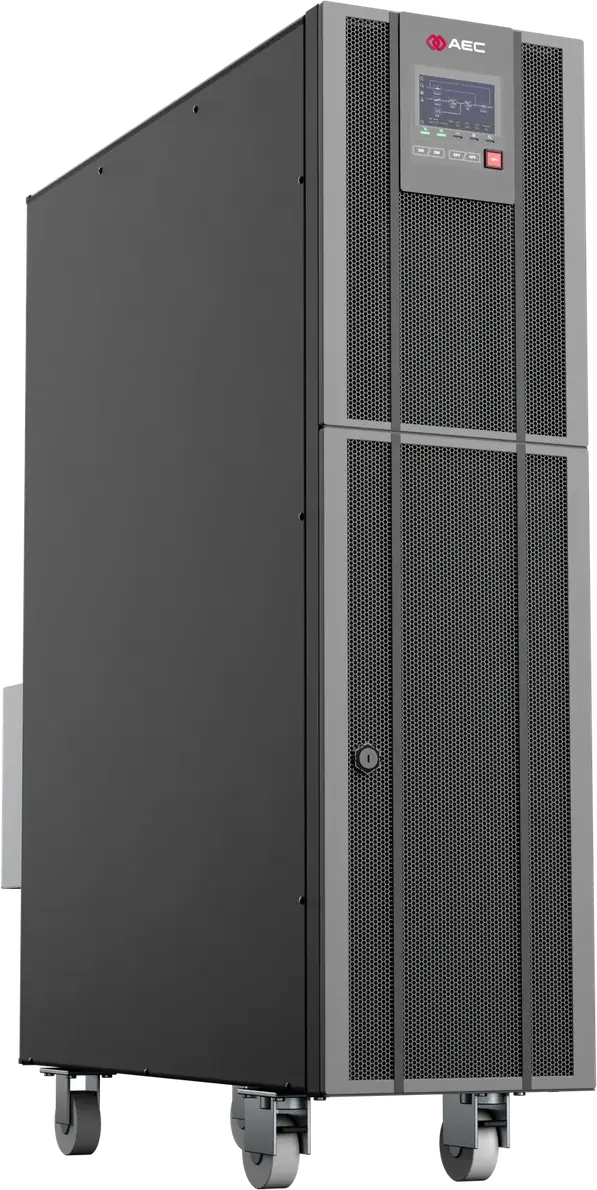
| ETH30-3X50A-LI | 208 V, 4-wire | Tower, three 50 Ah lithium modules | 83.3 A | 14 / 17.5 min |
| AUR30-80X9A | 208 V, 4-wire | Tower, 80 VRLA blocks | 83.3 A | 4 / 7 min |
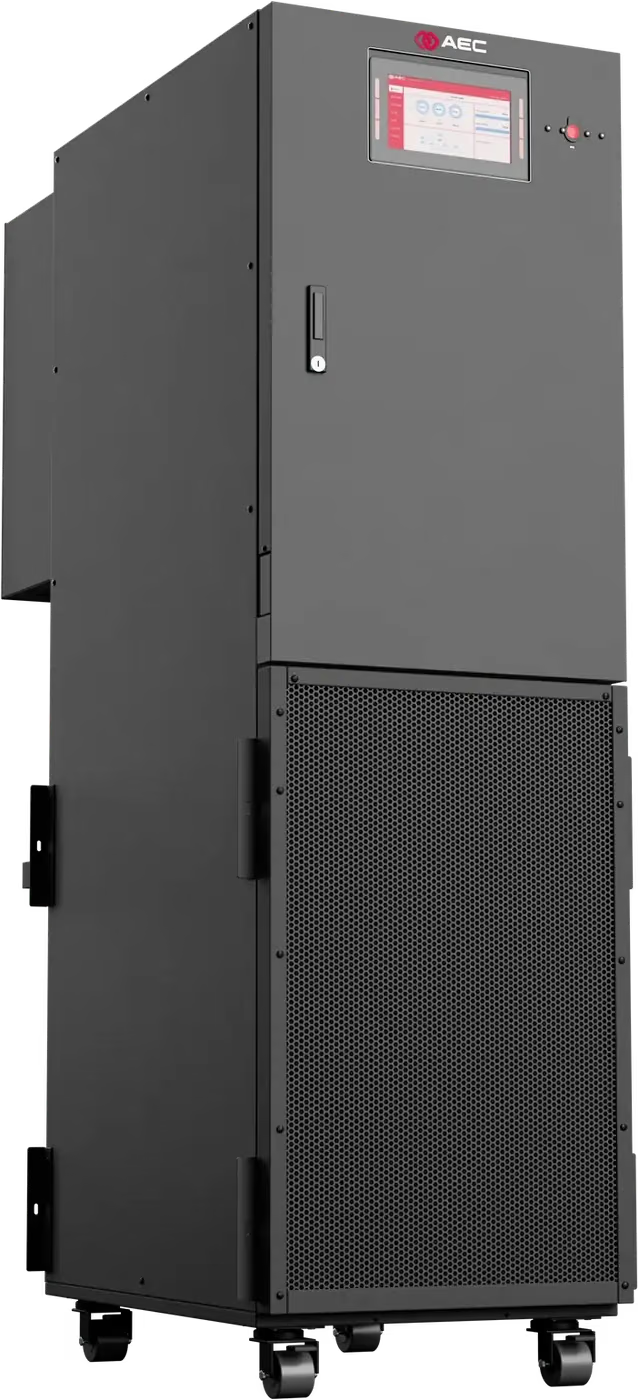
| RAD90-2X15 | 208 V, 4-wire | Modular, two 15 kVA modules, external bank | 83.3 A | Sized with the bank |
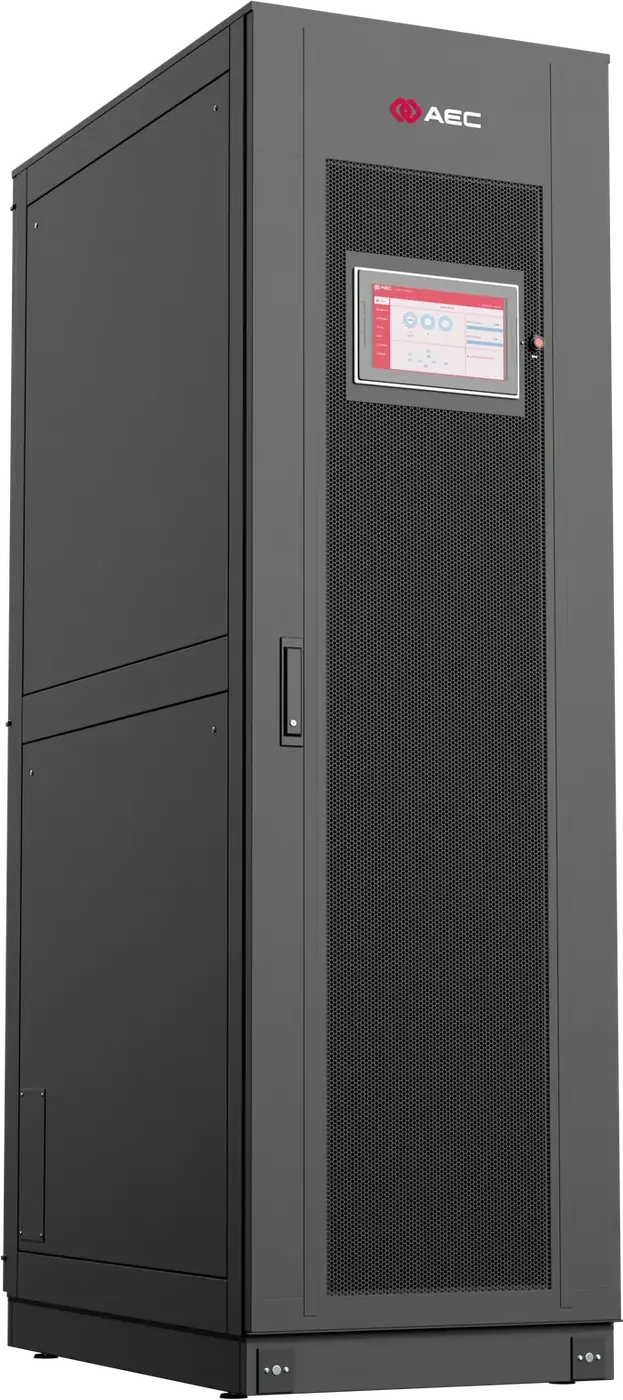
| CIRIB150-1X30 | 480/277 V, 4-wire | Modular, one 30 kVA module, VRLA trays inside | 36.1 A | 14 / 25 min |
A 30 kVA modular UPS at 480 V carries less than half the current of a 208 V one, and the CIRRO-IB frame has four free slots for growth to 150 kVA. At 208 V, the RADIANT frame grows to 90 kVA in 15 kVA steps.
3-wire or 4-wire?
A 4-wire supply carries a neutral; a 3-wire one does not. CIRRO and CIRRO-IB are 480/277 V, 4-wire. INFINITE is 480 V, 3-wire: loads that need a neutral are fed through a transformer downstream. RADIANT takes 208/120 V three-phase in and gives three-phase or single-phase out.
Which AEC UPS fits each supply?
| Supply | Power | AEC series |
|---|---|---|
| Single-phase 120 V | 1–3 kVA | LUMINA, FERRUS, FERRUS RT |
| Split-phase 120/240 V | 6–20 kVA | FERRUS SP, FERRUS SP RT |
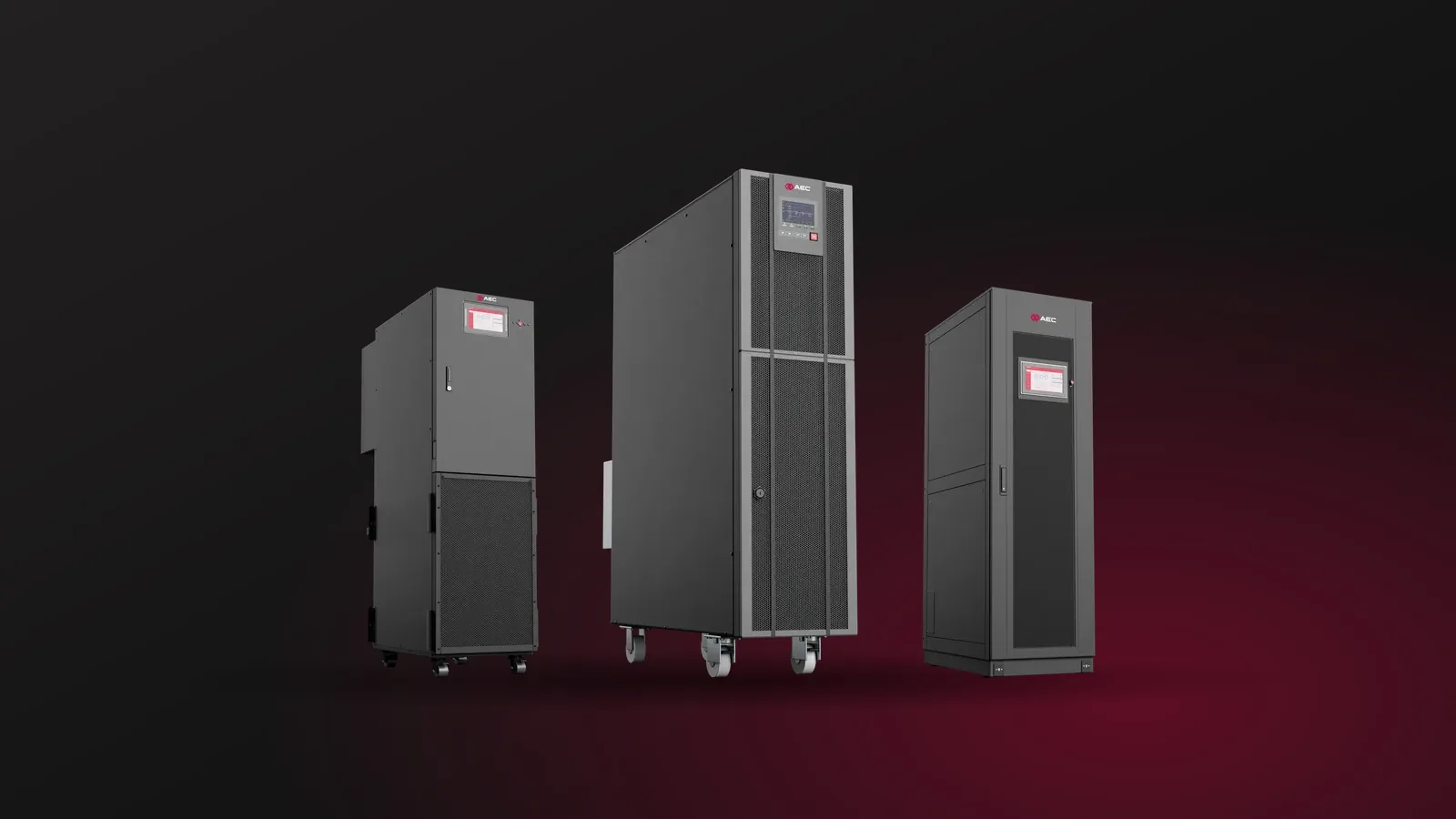
| Three-phase 208 V | 10–100 kVA | ETHERNO, AUREON, RADIANT, RADIANT-IB |
| Three-phase 480 V | 30–1,600 kVA | CIRRO-IB, CIRRO, INFINITE, INFINITE 1.5MW |
Which one should you choose?
- Up to about 100 kVA in an ordinary building: 208 V, on the panel that feeds the room: ETHERNO or AUREON (10 to 30 kVA), RADIANT (15 to 90 kVA), RADIANT-IB (20 to 100 kVA).
- Large loads, data centers, plants: 480 V: CIRRO-IB (30 to 150 kVA), CIRRO (60 to 1,600 kVA), INFINITE (100 to 600 kVA) and INFINITE 1.5MW (750 to 1,500 kVA).
- Between the two: ask us with the single-line diagram; the answer depends on where the switchgear and the loads sit.
The UPS sizing tool takes the supply voltage, the load in kW, kVA or amps and the minutes, and lists the AEC models that fit.
What mistakes come up with US voltages?
- Reading 208 V as 220 V or 240 V. 208 V is the line-to-line voltage of a 120 V wye; 240 V is a split-phase or delta service. ETHERNO is rated 208 V (220/208 V); a 240 V split-phase panel takes a FERRUS SP instead.
- Using the wrong voltage in the formula. Three-phase current uses the line-to-line voltage: 208 or 480, never 120 or 277.
- Forgetting the neutral. A 3-wire 480 V UPS has no neutral at its output. Loads at 277 V or 120 V need a 4-wire UPS such as CIRRO, or a transformer.
- Ignoring the generator. If the generator and its transfer switch are 480 V and the room is 208 V, the step-down transformer sits between them, and its inrush and losses go into the plan.