What is the formula?
- Losses (kW) = load (kW) × (1 ÷ efficiency − 1)
- Heat (BTU/h) = losses (W) × 3.412
- Cooling (tons) = BTU/h ÷ 12,000
How much heat do AEC models give off at full load?
At each series' top efficiency from the 2026 catalog. Real losses are a little higher at part load and while the battery recharges, so leave margin in the cooling.
| Model | Load | Efficiency | Losses | Heat | Losses in a year |
|---|---|---|---|---|---|
| LUM1000RT-2U-LI | 0.9 kW | 91.7 % | 81 W | 280 BTU/h | 710 kWh |
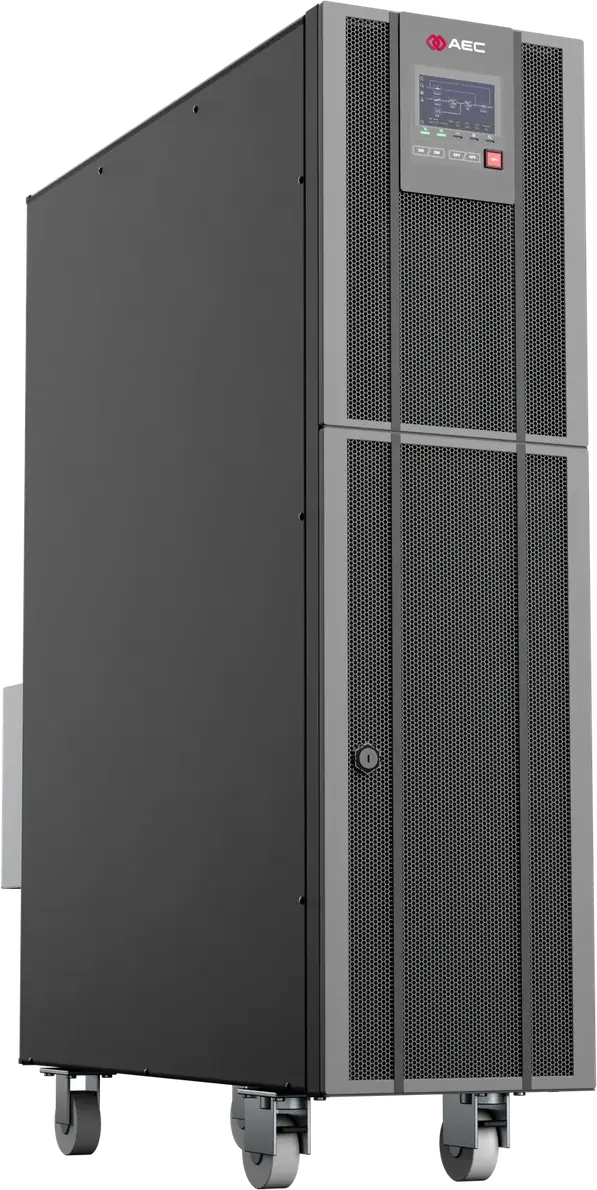
| FERSP20000-40X9 | 20 kW | 93 % | 1.5 kW | 5,140 BTU/h | 13,190 kWh |
| ETH20-3X50A-LI | 20 kW | 94 % | 1.28 kW | 4,360 BTU/h | 11,180 kWh |
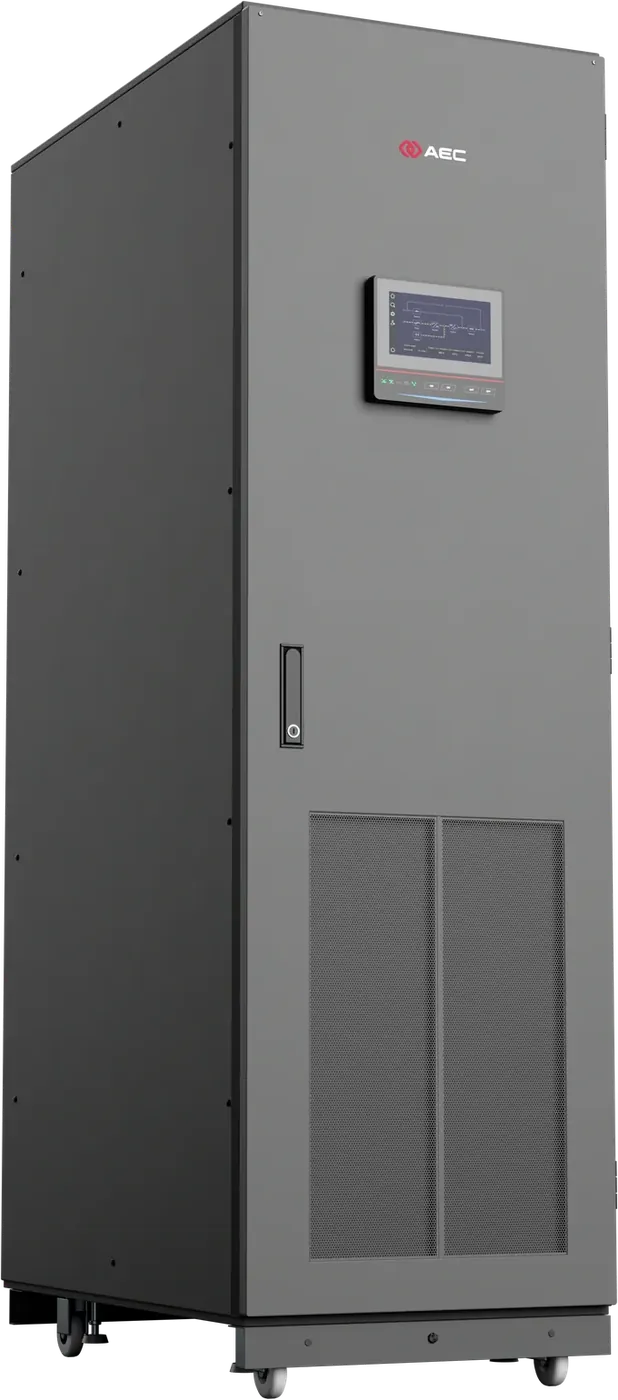
| RAD90-6X15 | 90 kW | 94 % | 5.7 kW | 19,600 BTU/h | 50,320 kWh |
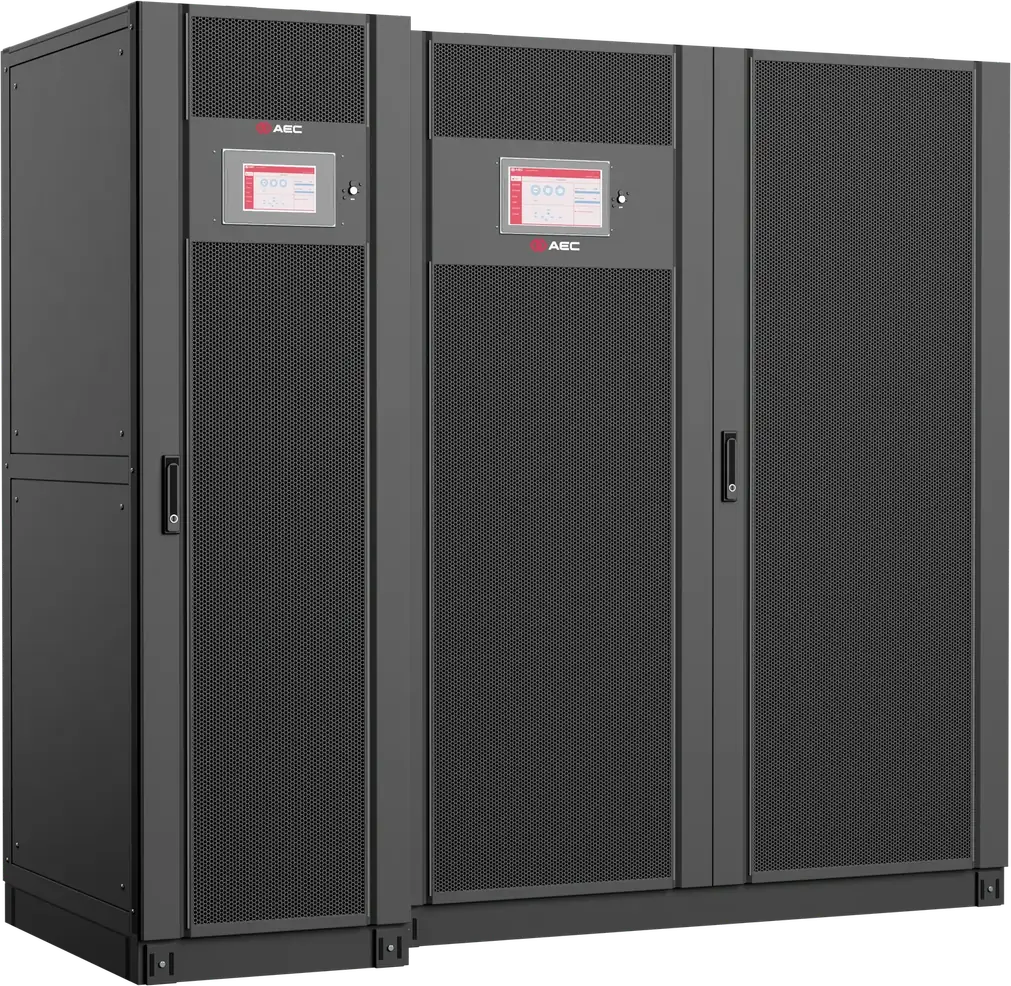
| CIR600-6X100 | 600 kW | 97 % | 18.6 kW | 63,320 BTU/h | 162,560 kWh |
| INF15-1500 | 1,500 kW | 97.5 % | 38.5 kW | 131,230 BTU/h | 336,920 kWh |
Losses in a year assume full load around the clock (8,760 hours); scale them to your real load. At an assumed $0.12 per kWh, the INF15-1500's losses cost about $40,000 a year, and every point of efficiency on a megawatt system is worth thousands of dollars more, before the cost of the cooling that removes the heat.
Worked example: the cooling for a 15 kW server room
A server room carries 15 kW of IT load on an ETH20-3X50A-LI at 94 %.
- The IT load. Nearly every watt a server draws ends up as heat: 15,000 W × 3.412 = 51,180 BTU/h.
- The UPS losses. 15 kW × (1 ÷ 0.94 − 1) = 0.96 kW, about 3,270 BTU/h.
- The total. About 54,450 BTU/h, 4.5 tons of cooling, before the lighting, the people and the heat through the walls. The UPS adds 6 % to the room's IT heat; on a 97 % system it would add about 3 %.
Size the cooling with margin, and on redundant units if the room cannot stop: the UPS keeps the servers running in an outage, but if the cooling is on the generator only, the room warms during the generator gap.
Which units does the cooling engineer use?
| From | To | Multiply by |
|---|---|---|
| W | BTU/h | 3.412 |
| BTU/h | W | 0.293 |
| kW of heat | tons of cooling | 0.284 (1 ton = 12,000 BTU/h = 3.517 kW) |
| Losses in kW | kWh a year | 8,760 at a constant load |
Mechanical engineers often size in kW of cooling rather than tons: the heat in kW is the cooling in kW, before the cooling plant's own efficiency.
What does silicon carbide change at 600 kW?
At the same 600 kW, the CIR600-6X100 at 97 % loses 18.6 kW; an INFINITE INF-600 at 97.3 % loses 16.7 kW. The 0.3 points of efficiency are 1.9 kW less heat, all day: about 16,700 kWh a year at full load, and 6,500 BTU/h less for the cooling to remove, for the same load.
Why is part load different?
"Efficiency up to" is the best point of the curve, usually at mid to high load. A UPS has losses that do not shrink with the load: control electronics, fans, the magnetizing current of a transformer. At light load they are a larger share, so efficiency falls and the heat per kW of load rises. A 2N system, where each UPS runs at 50 % or less, or an oversized UPS on a small day-one load, sits on that part of the curve. Read the curve of your series at your load on the efficiency page rather than the peak figure.
Two other sources add heat for a while. After an outage the charger recharges the battery, and its own losses add to the UPS's. A UPS with an isolation transformer, such as FERRUS SP (up to 93 %), carries the transformer's losses at every load.
Why are the big systems more efficient?
Efficiency rises with the power stage: ETHERNO and RADIANT, with 3-level IGBT inverters, reach 94 %; CIRRO, also 3-level IGBT, reaches 97 % in its large frames; INFINITE's silicon-carbide (SiC) stage reaches 97.3 %, and 97.5 % on INFINITE 1.5MW. See the efficiency curves for each series at your load.
How should the room be planned?
Add the UPS heat to the IT load's heat when you size the cooling, and keep the battery area near 77 °F (25 °C): heat shortens battery life (see how long UPS batteries last). Every AEC model page gives its own heat figure under Quick answers, and the room fit tool checks the clearances, the NEC working space and the way in for the model you pick.
What mistakes skew the heat estimate?
- Working from the UPS rating instead of the load. A 30 kVA UPS carrying 12 kW gives off the losses of 12 kW, at the efficiency of 40 % load.
- Using the peak efficiency for a UPS that will run at 20 % for its first years.
- Forgetting the battery room. VRLA batteries are rated at 77 °F, and the UPS's heat in the same small room works against them.
- Counting the UPS losses but not the IT load the UPS feeds, which is many times larger.