When does the fire code apply to a lithium UPS battery?
The International Fire Code, Section 1207, and NFPA 855, the Standard for the Installation of Stationary Energy Storage Systems, treat a battery as an energy storage system (ESS) above a threshold that depends on the chemistry. In the 2024 IFC, Table 1207.1.3:
| Battery technology | Threshold (IFC 2024, Table 1207.1.3) |
|---|---|
| Lithium-ion, including LiFePO4 | 20 kWh |
| Lead-acid, all types (VRLA included) | 70 kWh |
| Nickel-cadmium | 70 kWh |
The footnote to the table sets how the energy is counted: the nameplate energy the battery can store, not the usable energy, and for a battery rated in amp-hours, rated voltage × amp-hours ÷ 1,000. NFPA 855, whose current edition is 2026, gives the same 20 kWh for lithium-ion in its Table 1.3, as the aggregate capacity per fire area or outdoor installation, with nominal rated voltage × amp-hours ÷ 1,000 for batteries rated in amp-hours. Each state and city adopts its own edition of the IFC or NFPA 855, sometimes with amendments: confirm the edition in force with the authority having jurisdiction (AHJ), usually the fire marshal, before the layout is fixed. This page summarizes the model code text for planning; it is not a code review of your project, and the AHJ decides.
How much energy does each AEC lithium UPS hold?
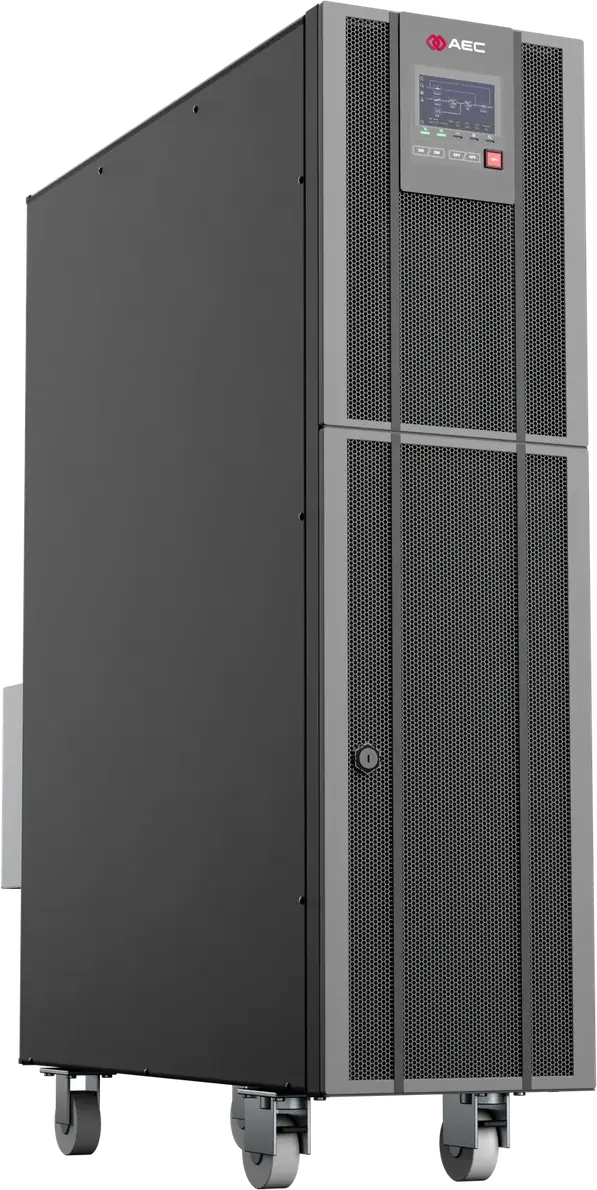
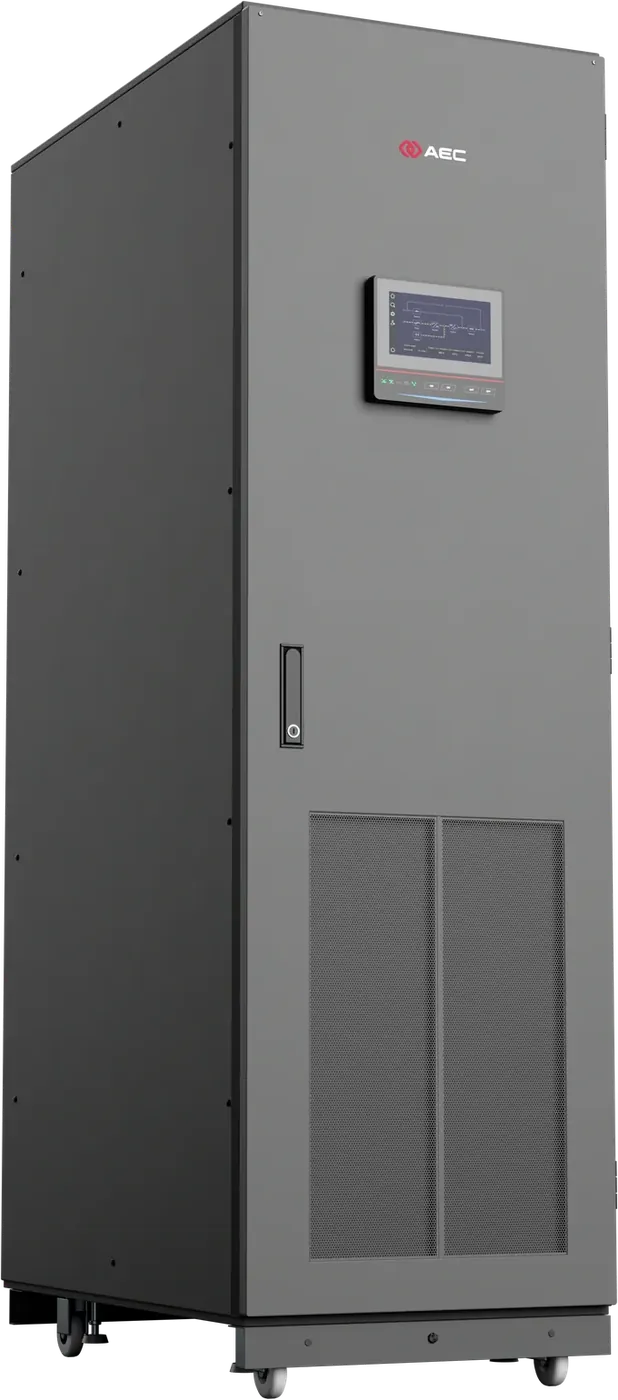
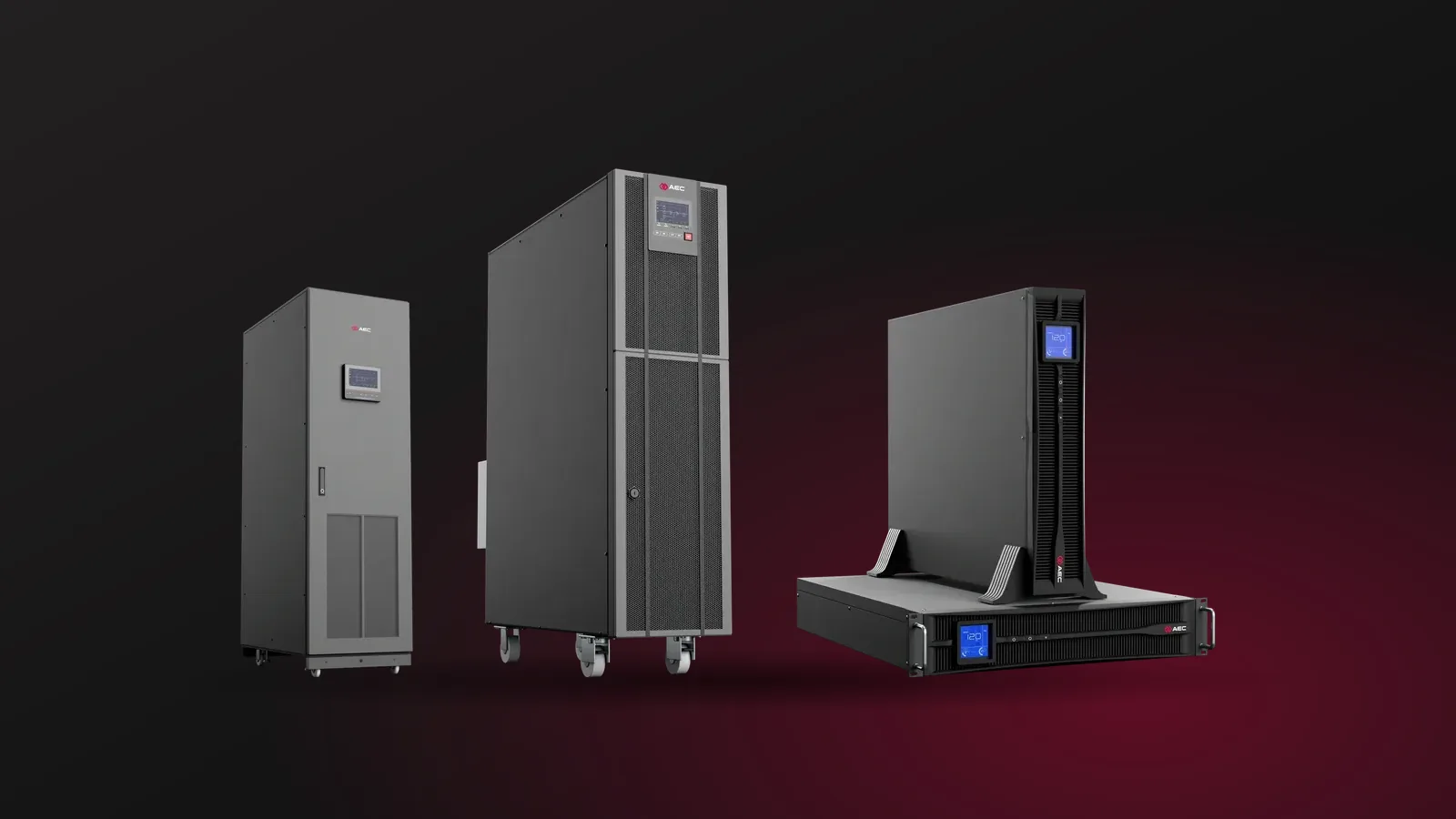
AEC's three-phase lithium is built on one LiFePO4 module of 50 Ah at 57.6 V nominal: 57.6 × 50 ÷ 1,000 = 2.88 kWh on the nameplate. The same module goes into the ETHERNO tower and the L6 cabinet. LUMINA uses its own internal pack.
| Configuration | Lithium inside | Nameplate energy | Against 20 kWh |
|---|---|---|---|
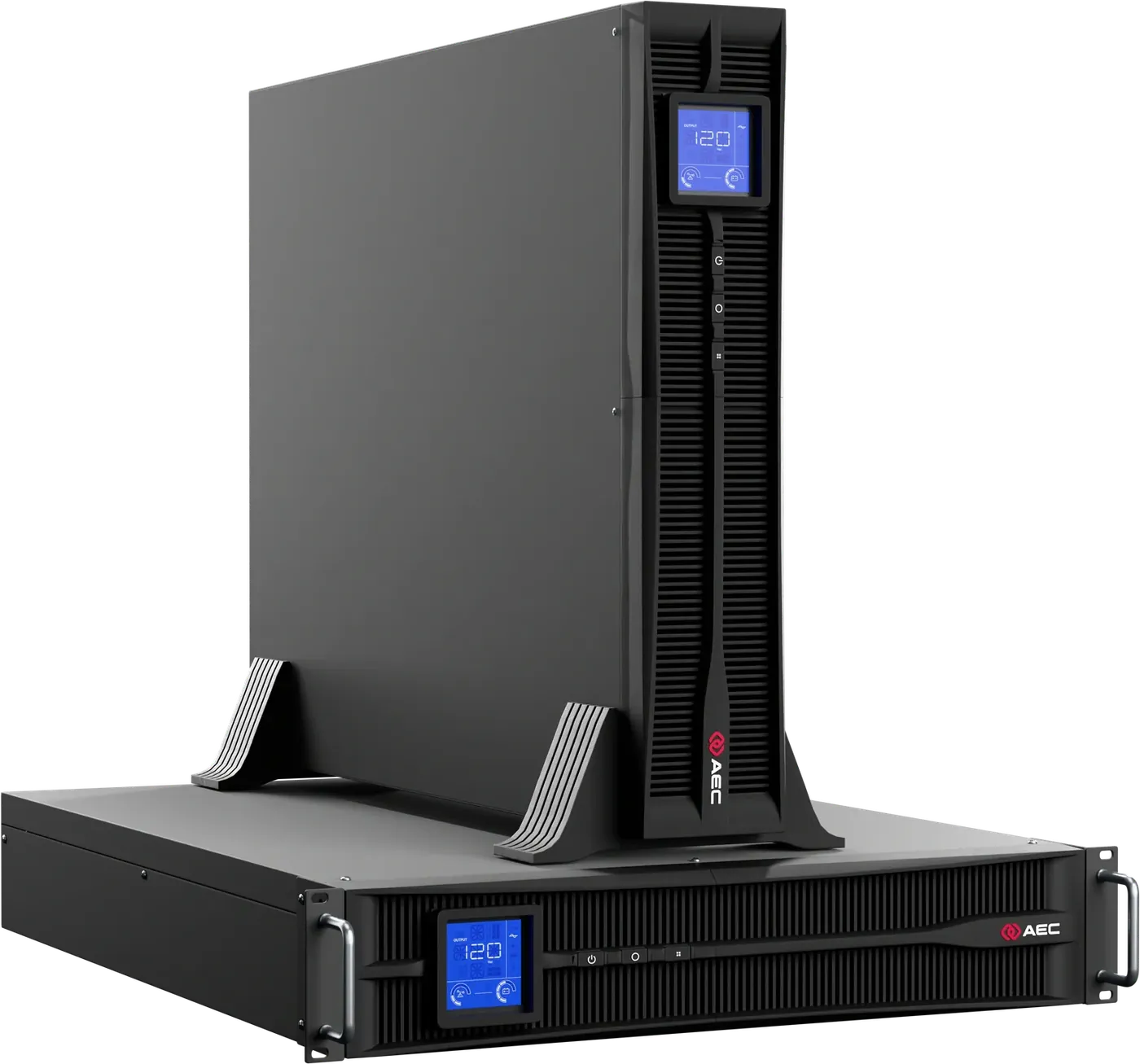
| LUMINA 1 to 3 kVA, one unit | internal pack, 10.2 or 13.6 Ah | 0.24 to 0.98 kWh | below |
| ETHERNO, 1 module | 1 × 50 Ah | 2.88 kWh | below |
| ETHERNO, 2 modules | 2 × 50 Ah | 5.76 kWh | below |
| ETHERNO, 3 modules (the most a tower takes) | 3 × 50 Ah | 8.64 kWh | below |
| L6 cabinet, 10 modules (as in the INF-100+L6-CAB-10x50LI) | 10 × 50 Ah | 28.8 kWh | above |
| L6 cabinet, 20 modules (as in the INF-200+L6-CAB-20x50LI) | 20 × 50 Ah | 57.6 kWh | above |
| INF-600 with 3 L6 cabinets | 60 × 50 Ah | 172.8 kWh | above |
| INFINITE 1.5MW with 4, 6 or 8 L6 cabinets | 80 to 160 × 50 Ah | 230.4 to 460.8 kWh | above |
Every ETHERNO and LUMINA, alone, sits below the line. Every L6 cabinet, even half full, sits above it. The figure decides whether Section 1207 applies to the installation at all.
Do several lithium UPS in one room add up?
Under NFPA 855, yes: its threshold is the aggregate capacity in each fire area. The IFC table gives one figure per ESS, and Section 1207.5.2 limits the lithium-ion in a fire area to 600 kWh (Table 1207.5) unless the fire code official approves more on the basis of a hazard mitigation analysis and large-scale fire testing. Ask the AHJ how they count it on your project. With AEC towers, added together:
- Two ETH30-3X50A-LI in one room: 17.28 kWh, below 20 kWh.
- Three of them: 25.92 kWh, above. The third tower changes the room's rules.
- Twenty-one LUMINA 2.2 kVA units at 0.98 kWh each pass 20 kWh too; a rack room full of small lithium UPS is counted the same way.
Growth counts as well. An L6 cabinet bought with 10 modules goes from 28.8 to 57.6 kWh when it is filled, and an ETHERNO grows from one module to three: size the room's documents for the final energy.
Why is a lead-acid UPS battery treated differently?
Two reasons. Its threshold is 70 kWh, not 20. And the IFC's listing rule, Section 1207.3.1, asks every ESS to be listed to UL 9540 except, among others, lead-acid battery systems in UPS listed and labeled to UL 1778 and used for standby power. The scope of UL 9540 (clause 1.5, as published for comment on the joint US–Canada edition in 2024) agrees: lead-acid and nickel-cadmium systems within the scope of UL 1778 that only serve a UPS are outside it, and a note adds that the fire codes and the ESS installation standard do not exclude UPS with other chemistries. In that text the UL 1778 exception names lead-acid only, so it does not cover a lithium battery. AEC's VRLA ranges, AUREON, RADIANT-IB, CIRRO and the lead-acid option of INFINITE, fall under the lead-acid rules; lithium or VRLA weighs the two.
Which standards will the reviewer name?
- UL 1778: safety of the uninterruptible power system itself. AEC ETHERNO, AUREON and INFINITE 1.5MW are UL 1778 listed (UL file E543003, AEC UPS USA LLC); LUMINA is ETL Listed to UL 1778 and CSA C22.2 No. 107.3.
- UL 1973: batteries for use in stationary and motive auxiliary power applications, UPS included in its scope: the battery system and its modules.
- UL 9540: the energy storage system, with its storage and its protective functions evaluated together. IFC 1207.3.2 asks chargers, inverters and energy storage management systems to be part of that listing or listed separately.
- UL 9540A: a test method for thermal runaway fire propagation, not a listing. The IFC refers to it for large-scale fire testing (1207.1.7), and on such testing the fire code official may approve larger quantities or smaller separation (1207.5.1, 1207.5.2). Its 6th edition, published on 13 March 2026, adds a large-scale fire test method aligned with the guidance of NFPA 855 (2026), Annex G.11.
Ask AEC for the certification documents of the configuration you plan to install: the UPS model, the battery cabinet and the number of modules.
Which L6 facts go into the submittal?
| Item | For an AEC L6 installation |
|---|---|
| Stored energy, per cabinet and per room | 2.88 kWh per module, 57.6 kWh per full cabinet (table above) |
| Chemistry | LiFePO4 (lithium iron phosphate), 18 cells of 3.2 V per module |
| Detection inside the equipment | a smoke detector in every L6 cabinet; temperature watched module by module |
| Battery management | a BMS in every module, every cabinet and the system; cell voltage and temperature; on-line insulation monitoring; a failed module drops out on its own |
| Fault containment | an isolated DC/DC converter in every module, so a fault stays inside its module |
| Floor | concrete or another non-combustible floor; 2,171.6 lb per full cabinet on 23.6 × 33.5 in |
| Clearances | 31.5 in in front and behind, 19.7 in above, cabinets bolted side by side |
| Shutting it down | the battery breakers inside each cabinet; the EPO switches every module off |
| Labels | the L6 manual asks for warning labels around the system: "Disconnect the L6 battery system before working on the wiring." |
The rest of the submittal is the building's: separation of the room, sprinklers or other suppression, ventilation or explosion control, signage and an emergency response plan, as the adopted code and the AHJ require. Sizing an L6 lithium battery gives the module count and the room in more detail.
What mistakes come up with lithium UPS and the code?
- Counting usable energy. The threshold is on nameplate energy: 2.88 kWh per 50 Ah module, not the 2.5 kWh the L6 manual gives to the load.
- Counting one unit. Three ETHERNO towers with three modules each pass 20 kWh together.
- Treating the UL 1778 listing as an exemption. The exception in IFC 1207.3.1 names lead-acid UPS batteries; lithium is not in it.
- Planning for day one. A half-full L6 cabinet doubles its energy when it is filled.
- Calling the fire marshal last. Separation, suppression and spacing change the room; settle them before the equipment is ordered.