How does a UPS work?
Every UPS has the same parts: a charger that keeps a battery full, the battery, and an inverter that turns the battery's direct current back into the alternating current equipment needs. What changes from one type to another is when the inverter works.
- Rectifier converts the utility supply to DC, feeding the inverter and the battery charger.
- Battery sealed lead-acid (VRLA) or lithium iron phosphate (LiFePO4), carrying the load when the utility is lost.
- Inverter builds the output sine wave from the DC bus.
- Static bypass moves the load to the utility automatically if the inverter is overloaded or faulty.
- Maintenance bypass lets technicians service the UPS while the load stays powered.
What are the three types of UPS?
The international standard for UPS performance, IEC 62040-3, classes a UPS by how much its output depends on the utility: VFD (voltage and frequency dependent), VI (voltage independent) and VFI (voltage and frequency independent). In everyday words:
| Type | IEC 62040-3 | How it works | Transfer to battery | Typical use |
|---|---|---|---|---|
| Offline (standby) | VFD | The load runs on raw utility power; a relay moves it to the inverter when the utility fails | A short break | Home computers, small office equipment |
| Line-interactive | VI | Adds an autotransformer that corrects sags and surges without the battery | A short break | Network closets, point of sale |
| Online double conversion | VFI | The rectifier and the inverter work all the time; the battery sits on the DC bus | None: zero transfer time | Servers, data centers, hospitals, industry |
Every AEC UPS series is online double conversion, from the 1 kVA LUMINA to the 1,600 kVA CIRRO: sags, spikes, noise and frequency drift stop at the rectifier, and the load never sees the utility directly.
What does a UPS protect against?
- Outages, from a fraction of a second to many minutes.
- Sags and surges: voltage that drops or rises for a few cycles, as when large motors start.
- Noise and harmonics on the supply.
- Frequency variation, common on generator power.
- The generator gap: the seconds a standby generator takes to start and take the load.
What happens, second by second, when the power fails?
Take a server room on an online UPS, in a building with a standby generator. At the instant the utility fails, the rectifier loses its input and the battery, already connected to the DC bus, starts feeding the inverter. The load sees nothing: the inverter was building its sine wave before the failure and goes on building it. The display and the network card report "on battery", and the runtime countdown starts.
A few seconds later the generator is up to speed and the transfer switch moves the building onto it. The rectifier accepts the generator's power, takes the load off the battery and starts recharging it. When the utility returns, the transfer switch moves back and, again, the load notices nothing. If the generator does not start, the battery carries the load for its runtime, and the shutdown software closes the servers in order before the battery is empty.
What happens when the UPS is overloaded or fails?
The static bypass takes over. If the load is more than the inverter can carry, or the inverter develops a fault, the UPS moves the load to the bypass line, the utility supply, without a break, and raises an alarm. Before that, every UPS carries an overload for a limited time: the datasheet of INFINITE 1.5MW, for example, gives 105 % continuously, 110 % for 60 minutes, 125 % for 10 minutes and 150 % for 1 minute. On bypass the load still has power but no battery behind it. A UPS left on bypass after an alarm no longer protects anything, so the alarm must reach someone.
How big is a UPS?
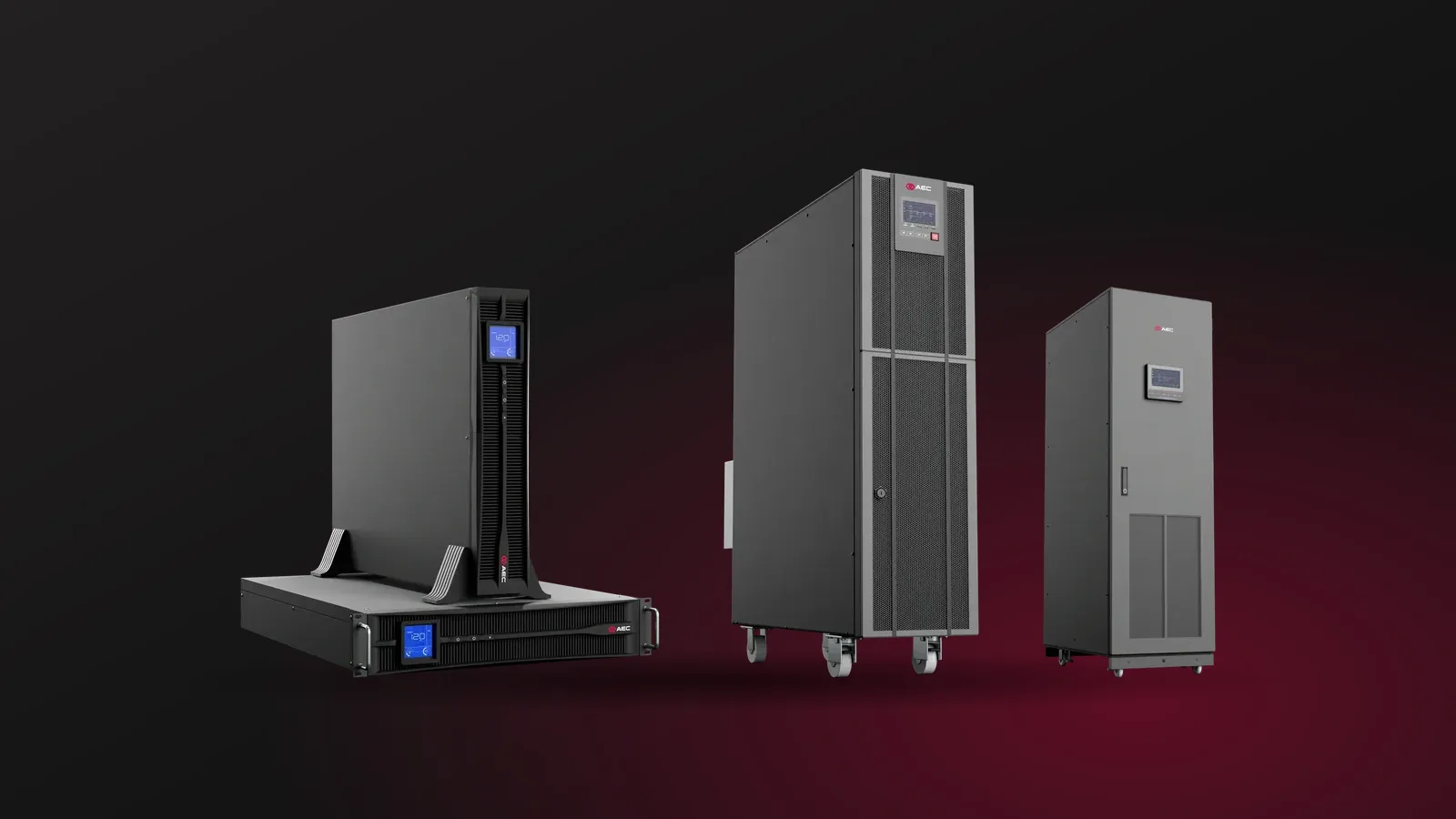
From a 2U box in a rack to a row of cabinets. Three AEC examples from the 2026 catalog:
| Where | Model | Rating | Size (W × D × H) | Weight | Battery |
|---|---|---|---|---|---|
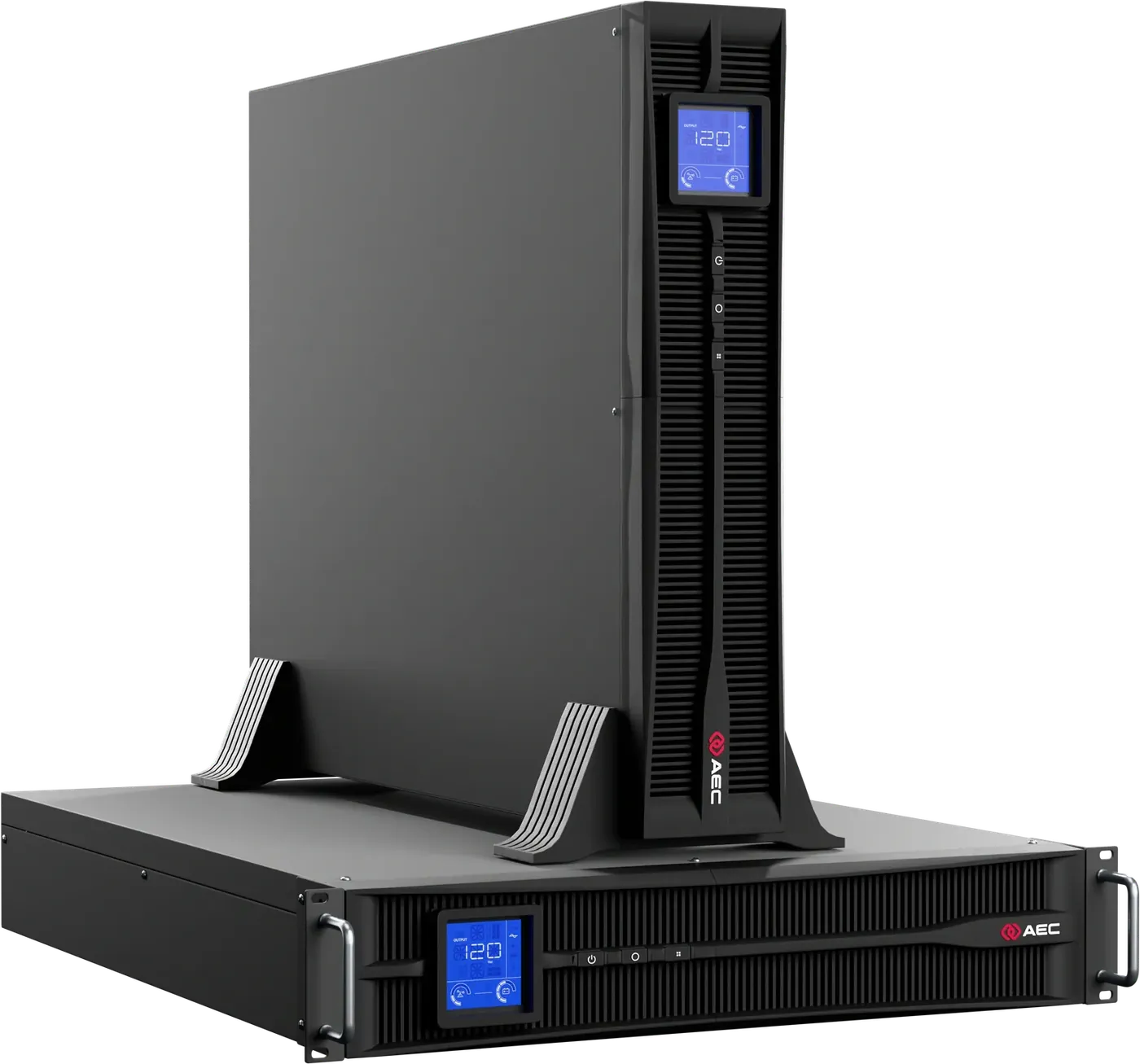
| Network rack | LUM1500RT-2U-LI | 1.5 kVA / 1,350 W | 17.2 × 22.6 × 3.4 in (2U) | 32.4 lb | Internal lithium, 11 min at full load |
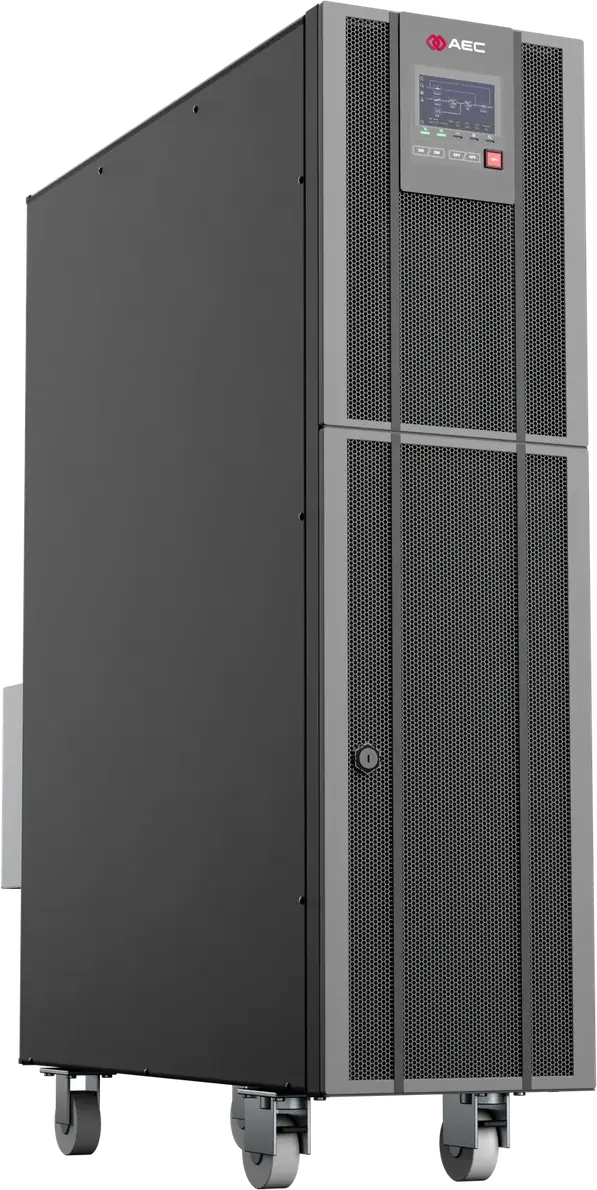
| Server room | ETH20-3X50A-LI | 20 kVA / 20 kW | 12.6 × 39.1 × 49.2 in tower | 471.8 lb | Three 50 Ah lithium modules, 20 min at full load |
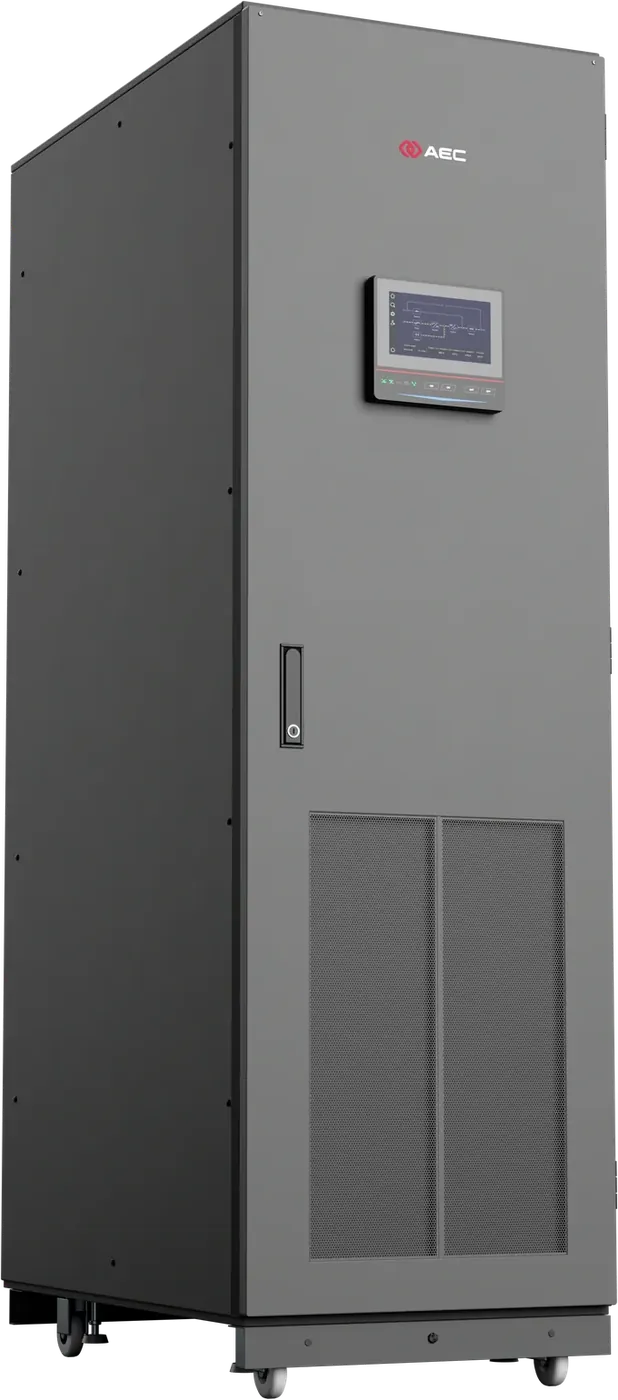
| Data center | INF15-1500 | 1,500 kVA / 1,500 kW | 70.9 × 39.4 × 78.7 in frame | 6,170.7 lb | External L6 lithium cabinets or lead-acid |
The battery is most of the weight of a small or mid-size UPS: the same ETHERNO 20 kVA tower weighs 227 lb without its modules and 471.8 lb with three.
Tower, rack or modular?
A rack UPS such as LUMINA or FERRUS RT mounts in the 19-inch rack beside the equipment it feeds. A tower such as FERRUS or ETHERNO stands on the floor. A modular UPS such as RADIANT, CIRRO or INFINITE is a frame of identical power modules that share the load: modules are added as the load grows, and one more than the load needs lets any one fail or be swapped while the others carry on. See N+1 redundancy.
What does a UPS not do?
- It does not replace a generator for long outages: its runtime is minutes, sized by its battery.
- It does not fix the wiring upstream. A poor ground or an overloaded branch circuit stays what it is.
- It is not meant for heating loads. Laser printers and space heaters draw large currents that eat the battery and can overload a small UPS.
- It protects only what is connected to its output. A server on the UPS with its network switch on a wall receptacle still goes offline.
Where does the UPS sit in the building?
On a one-line diagram the UPS sits between the switchboard (or the transfer switch that chooses between utility and generator) and the distribution that feeds the critical loads, often a power distribution unit (PDU). The static bypass and an external maintenance bypass let the load stay powered while the UPS is serviced. In US practice the product-safety standard for a UPS is UL 1778, and the National Electrical Code covers where a UPS may serve as a source: emergency systems under Article 700 must have power within 10 seconds, legally required standby systems (Article 701) within 60.
UPS, generator or surge protector?
| Surge protector | Standby generator | Online UPS | |
|---|---|---|---|
| Spikes and surges | Yes | No | Yes |
| Short outages | No | No: it needs seconds to start | Yes, with zero transfer |
| Long outages | No | Yes, for as long as there is fuel | For its battery runtime |
| Clean, stable output | No | Not always | Yes |
Critical sites use both: the UPS carries the load through the gap and the generator for the hours after.
Which UPS fits which supply?
A UPS must match the panel it feeds. In the US that is 120 V single phase for racks and desks, 120/240 V split phase for small commercial panels, 208 V three phase for server rooms and 480 V three phase for large buildings: see three-phase UPS systems.
| Supply | Power | AEC series |
|---|---|---|
| Single-phase 120 V | 1–3 kVA | LUMINA, FERRUS, FERRUS RT |
| Split-phase 120/240 V | 6–20 kVA | FERRUS SP, FERRUS SP RT |
| Three-phase 208 V | 10–100 kVA | ETHERNO, AUREON, RADIANT, RADIANT-IB |
| Three-phase 480 V | 30–1,600 kVA | CIRRO-IB, CIRRO, INFINITE, INFINITE 1.5MW |
Lead-acid or lithium?
VRLA batteries cost less up front. Lithium lasts longer, weighs less for the same runtime and needs less cooling. The lithium-ion UPS guide compares the two, and how long UPS batteries last gives the years and cycles.