


Technology · how it works
Online double-conversion UPS: how it works
Every AEC UPS rebuilds its output from scratch: the mains is rectified to DC, the inverter makes a new, clean sine wave, and the battery sits on the DC bus, so a mains failure changes nothing at the output.
Six operating modes
Pick a mode. Watch the power move.
The diagram follows the power; beside it, the real INFINITE touchscreen in that mode, with the note from its user manual.
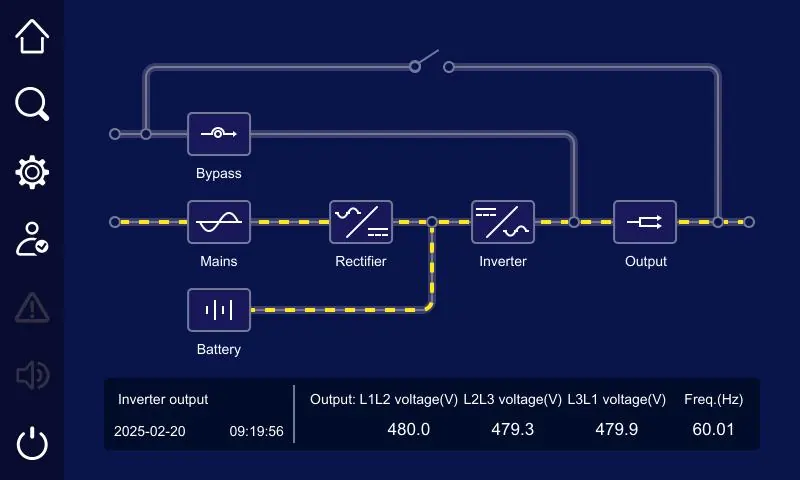
Mains → rectifier → inverter → output, the battery charged at the same time. Tap any block of the diagram for its readings.
SS: static switch. M.BYP: external maintenance bypass. Screens and notes: the INFINITE 480 V user manual, from the app's simulator.
What happens inside, stage by stage?
Rectifier. The input stage turns the utility's AC into a regulated DC bus. In current AEC designs it is an active, power-factor-corrected rectifier: the RADIANT-IB user manual gives an input power factor above 0.99 and a current THD of 3 % or less, and the INFINITE 1.5MW catalog page gives the same figures. The building sees an almost resistive load, so the cables, breakers and generator upstream carry little reactive or harmonic current.
DC bus and battery. The battery sits on the DC bus through its charger, a bidirectional DC/DC stage in the modular series. When the utility fails, the rectifier stops and the battery holds the bus up with no break: the inverter never sees a change of source.
Inverter. The inverter builds a new 60 Hz sine wave from the DC bus and regulates its voltage whatever the input does. AEC uses three-level IGBT inverters in FERRUS, ETHERNO, AUREON, RADIANT and CIRRO, and silicon-carbide (SiC) semiconductors in INFINITE and INFINITE 1.5MW; the efficiency page explains what each changes.
Static switch. Thyristors on each phase join the bypass line to the output. They conduct only when the inverter cannot carry the load, or when the operator chooses bypass.
Online, line-interactive or standby: how does IEC 62040-3 class them?
IEC 62040-3, the international performance standard for UPS, classes a UPS by what its output depends on. VFD (voltage and frequency dependent) is the standby or offline UPS: the load runs on the utility and the inverter starts when it fails. VI (voltage independent) is the line-interactive UPS: it corrects the voltage but passes the utility's frequency through. VFI (voltage and frequency independent) is online double conversion: output voltage and frequency are the UPS's own.
The full code adds two letters and three digits, as in VFI SS 111. The letters say the output is sinusoidal in normal mode and on battery; the digits are the dynamic performance classes on a change of mode, a step of linear load and a step of non-linear load, 1 being the tightest. The RADIANT-IB manual lists IEC 62040-3, VFI SS 111, among its design standards. For North America the safety standard is UL 1778: ETHERNO and AUREON hold a UL 1778 certificate of compliance (UL file E543003), INFINITE 1.5MW is UL 1778 listed under the same UL file and LUMINA is ETL listed to UL 1778.
From the catalog
Diagrams, explained.
Click any diagram to open it large.
Why online
Zero transfer time, by design
Because the inverter is always the source of the output, there is nothing to switch when the mains fails: the battery is already on the DC bus. The output voltage and frequency are the UPS's own, whatever the mains does: sags, surges, frequency drift and noise stay on the input side.
| Mode | Load fed by | Battery |
|---|---|---|
| Normal | Rectifier → inverter | Charging |
| Mains failure | Battery → inverter | Discharging |
| Static bypass | Bypass line | Charging |
| ECO | Bypass, inverter ready | Charging |
| Frequency converter | Rectifier → inverter, bypass off | Charging |
| Maintenance bypass | Mains, UPS isolated | Off |
What does the bypass do, and when is the load unprotected?
The static bypass is the safety net. When the inverter is overloaded, too hot or faulty, the static switch moves the load to the bypass line, and back once the inverter is ready. With inverter and bypass in step the transfer has no break; out of synchronism, the RADIANT-IB user manual gives an interruption of less than 3/4 of a cycle (12.5 ms at 60 Hz).
The inverter carries an overload for a time before it hands over: 110 % for 1 hour, 125 % for 10 minutes and 150 % for 1 minute in the RADIANT-IB manual; 105 % continuous, 110 % for 60 minutes, 125 % for 10 minutes and 150 % for 1 minute on the INFINITE 1.5MW catalog page. A transformer's inrush or a motor start beyond those limits goes to the bypass: plan for it on the one-line rather than find it at commissioning.
On static bypass, on maintenance bypass and in ECO mode the load runs on the utility as it comes, with no protection from sags, surges or frequency drift. ECO saves the inverter's losses, but if the bypass fails the inverter takes the load back in less than 10 ms (RADIANT-IB manual): leave ECO off for loads that cannot ride that break.
Why does it matter on a US site?
Generators. A standby generator needs seconds to start, and its frequency moves as loads step on. The National Electrical Code gives emergency systems (Article 700) 10 seconds to restore power and legally required standby systems (Article 701) 60 seconds; an online UPS carries the load through that gap on its battery, then runs from the generator without passing its frequency swings to the load. The RADIANT-IB manual suggests a generator rated at least 1.5 times the UPS input power, to cover the battery recharge as well, and wires a generator contact to a UPS input, for example to limit the charging current while the generator runs. Power walk-in, in the diagrams above, has the rectifier take the load back gradually, so the generator never takes it in one step.
50 Hz equipment. In frequency-converter mode the UPS accepts 40–70 Hz at its input and delivers 50 or 60 Hz, with the static bypass disabled (RADIANT-IB manual): the way to run 50 Hz machines from a 60 Hz supply.
Code-driven rooms. Critical operations power systems (NEC Article 708) call for selectively coordinated overcurrent devices, and IT equipment rooms built under Article 645 for a disconnecting means that also disconnects a UPS in the room (see monitoring). The UPS is one part of that design: bring the one-line diagram to the first meeting.
How do you specify an online UPS?
- Topology: online double conversion, VFI under IEC 62040-3, and UL 1778 for the US market.
- Power in kW, not only kVA: most AEC series are rated at unity power factor (kVA = kW), LUMINA at 0.9. Size on the kW the loads draw (kVA vs kW).
- Supply: 120 V, 120/240 V split phase, 208 V, 480 V 4-wire or 480 V 3-wire. The UPS follows the panel.
- Input: power factor and current THD at your load, the input voltage window, running on a generator.
- Overload and bypass: the overload times, a separate bypass feed if the design has one, and an external maintenance bypass that isolates the whole cabinet.
- Runtime at the real load, not at full load (runtime calculator).
- Communication: network card, Modbus, dry contacts and remote EPO.
Mistakes to avoid
- A separate bypass feed on another neutral. Main input and bypass input must share the same neutral (RADIANT-IB manual).
- No external maintenance bypass. The UPS's own maintenance bypass keeps the load on during service, but dangerous voltage stays on its terminals and busbars. To isolate the whole cabinet, the one-line needs an external maintenance bypass.
- Ground-fault breakers on the UPS feeds. The manual does not recommend them; where ground-fault monitoring is required, it goes upstream of the common neutral bonding point.
- Breakers sized on the nameplate current. A UPS is a continuous load: overcurrent devices at 125 % of the continuous current (NEC 215.2, 215.3), rounded up to the next standard rating (NEC 240.6).
How does each AEC series do it?
Every AEC series is online double conversion. They differ in supply, power and build:
- 120 V single phase: LUMINA (2U rack, lithium inside), FERRUS (tower) and FERRUS RT (rack), 1–3 kVA.
- 120/240 V split phase: FERRUS SP, 6–20 kVA, and FERRUS SP RT, 6–10 kVA, with an isolation transformer inside.
- 208 V three phase, towers: ETHERNO (lithium) and AUREON (VRLA), 10–30 kVA.
- 208 V three phase, modular: RADIANT, 15–90 kVA, and RADIANT-IB, 20–100 kVA.
- 480/277 V 4-wire, modular: CIRRO-IB, 30–150 kVA, and CIRRO, 60–1,600 kVA.
- 480 V 3-wire, modular with SiC modules: INFINITE, 100–600 kVA, and INFINITE 1.5MW, 750–1,500 kVA.
Not sure which? The UPS sizing tool starts from your load and supply, and what is a UPS covers the basics.
Talk to an engineer
Tell us the load, the voltage and the minutes you need. We answer with the model and the batteries that fit.