Why does halving the load double the minutes, or more?
Runtime is not a straight line. A battery delivers more of its stored energy when it is discharged slowly. The AEC catalog runtime tables show it:
| Model | Battery | 100 % load | 50 % load | 20 % load |
|---|---|---|---|---|
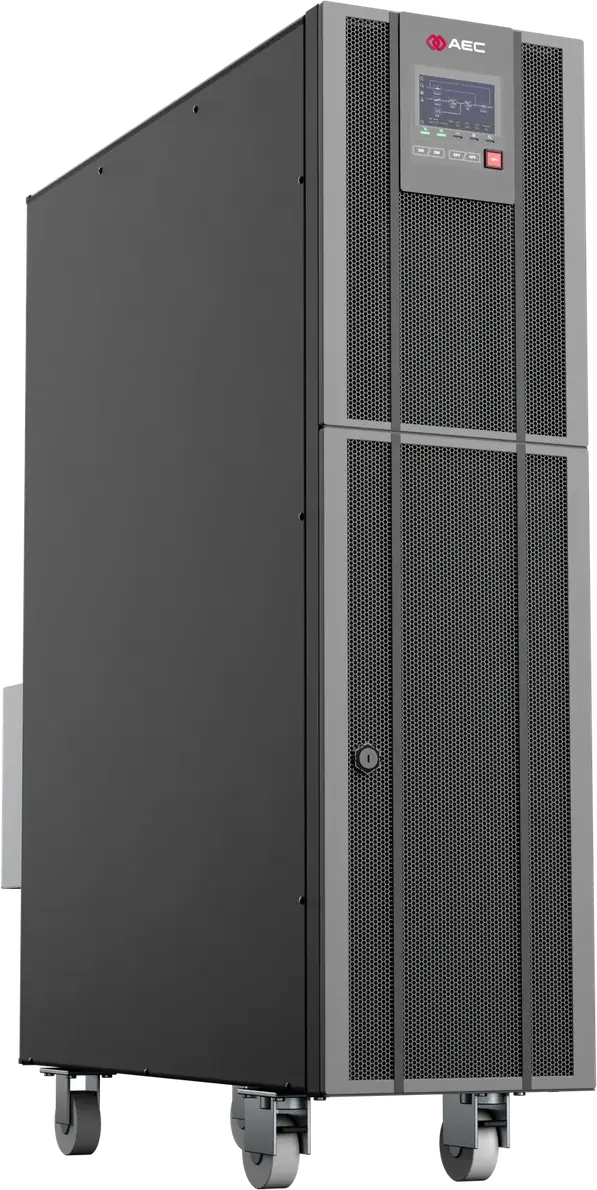
| ETH10-1X50A-LI | 1 × 50 Ah lithium module | 14 min | 27 min | 66 min |
| AUR10-40X9A | 40 × 12 V 9 Ah VRLA | 7 min | 25 min | 85 min |
| AUR10-80X9A | 80 × 12 V 9 Ah VRLA | 20 min | 60 min | 175 min |
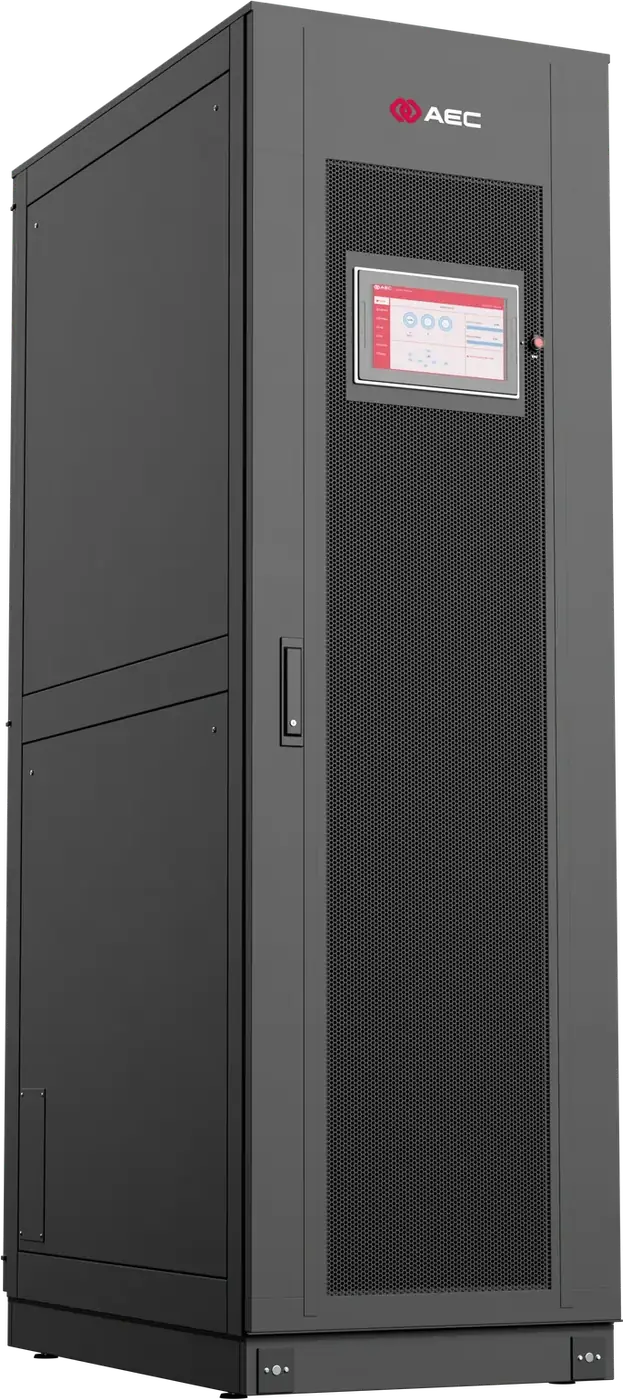
| RADIB100-1X20 | 240 VRLA blocks, internal | 32 min | 85 min | 220 min |
The lithium module nearly doubles its minutes from full to half load (14 to 27); the VRLA string more than triples them (7 to 25). Lead-acid gives up more of its capacity at high discharge rates, so a VRLA UPS sized for long runtime at full load needs more batteries than the half-load figure suggests.
How much of the stored energy reaches the load?
Dividing the battery's energy by the load gives the minutes an ideal battery and a lossless inverter would deliver. The catalog tables show how far real runtimes fall from that, and why lithium and lead-acid behave so differently:
| Model | Stored energy | Load | Ideal minutes | Catalog minutes | Share delivered |
|---|---|---|---|---|---|
| ETH10-1X50A-LI | 2.88 kWh (one 50 Ah module) | 10 kW | 17.3 | 14 | 81 % |
| 5 kW | 34.6 | 27 | 78 % | ||
| AUR10-40X9A | 4.32 kWh (40 × 12 V × 9 Ah) | 10 kW | 25.9 | 7 | 27 % |
| 5 kW | 51.8 | 25 | 48 % | ||
| 2 kW | 129.6 | 85 | 66 % |
The lithium module delivers about four fifths of its energy whether it is discharged in 14 minutes or in 27. The lead-acid string, rated in amp-hours at a slow discharge, gives a quarter of that energy at a 7-minute rate and two thirds at a slow one. That is why a VRLA battery bank holds more kWh on paper than a lithium bank of the same runtime, and why its minutes jump when the load falls.
How many minutes do more modules add?
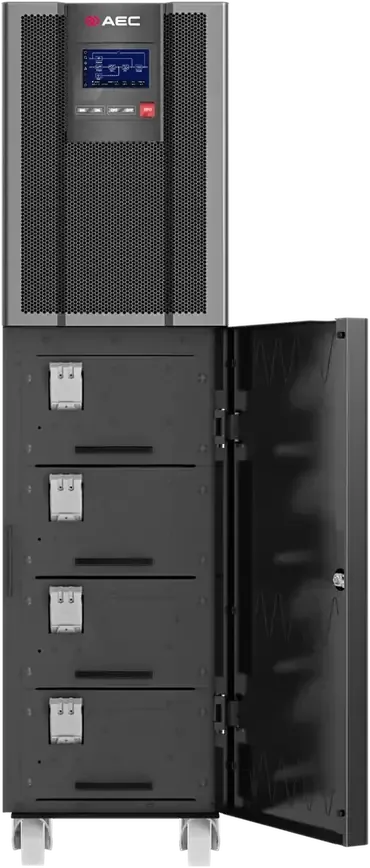
With hot-swappable lithium modules the runtime grows in steps. An ETHERNO 10 kVA runs 14, 27 or 41 minutes at full load with one, two or three 50 Ah modules: each module adds about the same time. See every ETHERNO runtime.
Large lithium systems follow the same logic with a simpler rule. Each 50 Ah module of an L6 lithium cabinet holds 2.88 kWh nominal and is rated 10 kW for 15 minutes, which is 2.5 kWh delivered, so the minutes at a load are about the modules × 2.5 kWh × 60 ÷ the load in kW. One 20-module cabinet (58 kWh nominal) gives 15 minutes at 200 kW with new modules, and the catalog's 30-minute table puts the same 20 modules on a 100 kVA UPS.
How do you read a runtime between two table points?
Catalog tables give the minutes at set loads: 25, 50, 75 and 100 %, and more points in between. For a load that falls between two of them, the minutes fall between the two figures, a little below a straight line drawn between them, because runtime falls faster than load rises. An example: an ETH20-3X50A-LI at 13 kW is at 65 %, between 34 minutes at 60 % and 27 at 70 %, so about 30 minutes. The model pages and the battery runtime tool do this reading for you.
- Age. Catalog runtimes are at the start of battery life. A VRLA battery is at its end of life, by the usual definition (IEEE 1188), when its capacity has fallen to 80 %; by then the minutes have fallen with it.
- Heat. VRLA batteries are rated at 77 °F (25 °C). A common rule of thumb: their service life roughly halves for about every 8 °C (14 °F) above that. Keep the battery room cool.
- A growing load. Ten more servers in the rack is a higher load percentage and fewer minutes. Re-check the runtime when the load changes.
How much runtime do you need?
Enough to start a generator and transfer (usually seconds, sized with a margin to a few minutes), enough to shut servers down in order (often 5 to 15 minutes), or enough to ride out the outage, which takes the most batteries. Decide which before you size. The sizing tool reads the minutes of every AEC model at your load.
Worked example: minutes for an orderly shutdown
A server room draws 12 kW at 208 V and has no generator. The shutdown script closes the applications, then the virtual machines, then the storage, and the IT team has timed it at 8 minutes.
- Time needed. 8 minutes of shutdown, plus 2 minutes before it starts, so a short flicker does not close the room: 10 minutes.
- Margin for age. The battery will reach the end of its life at 80 % of its capacity: 10 ÷ 0.8 = 12.5 minutes as a first pass on the tables of new batteries.
- The model. A 20 kVA ETHERNO at 12 kW is at 60 %: 23 minutes with two modules (ETH20-2X50A-LI). The 12.5 minutes are met with room for the load to grow.
- The setting. Start the shutdown at a fixed time on battery or at a remaining-runtime threshold, whichever comes first, through the network card.
What mistakes cost minutes?
- Reading the runtime at full load as the runtime of the site, or the reverse.
- Counting the minutes of a new battery for the whole of its life.
- Adding equipment to the UPS and never reading the runtime estimate again.
- Replacing high-rate UPS blocks with general-purpose ones of the same size: the published runtimes are based on high-rate cells.