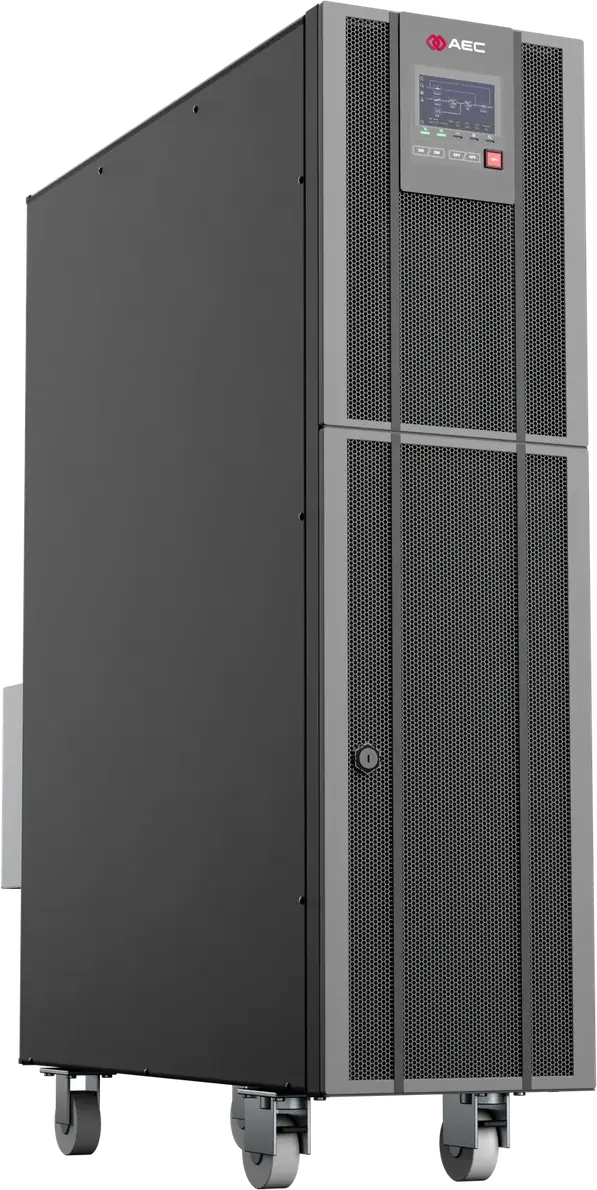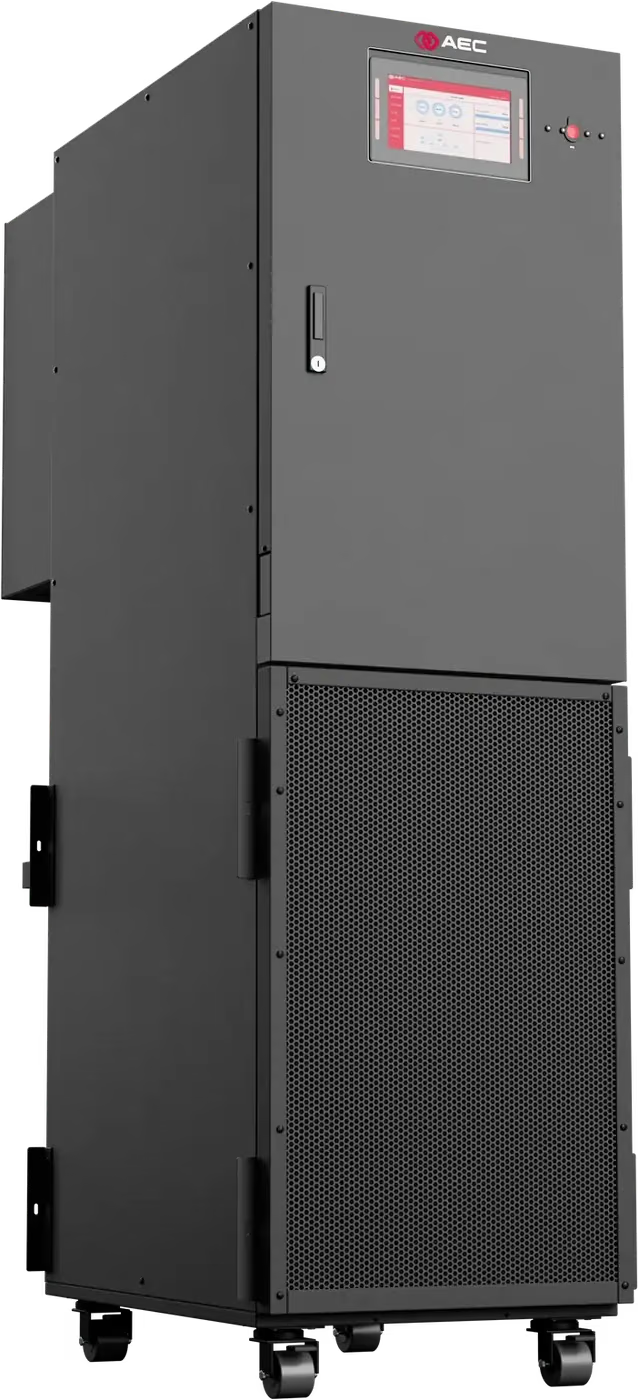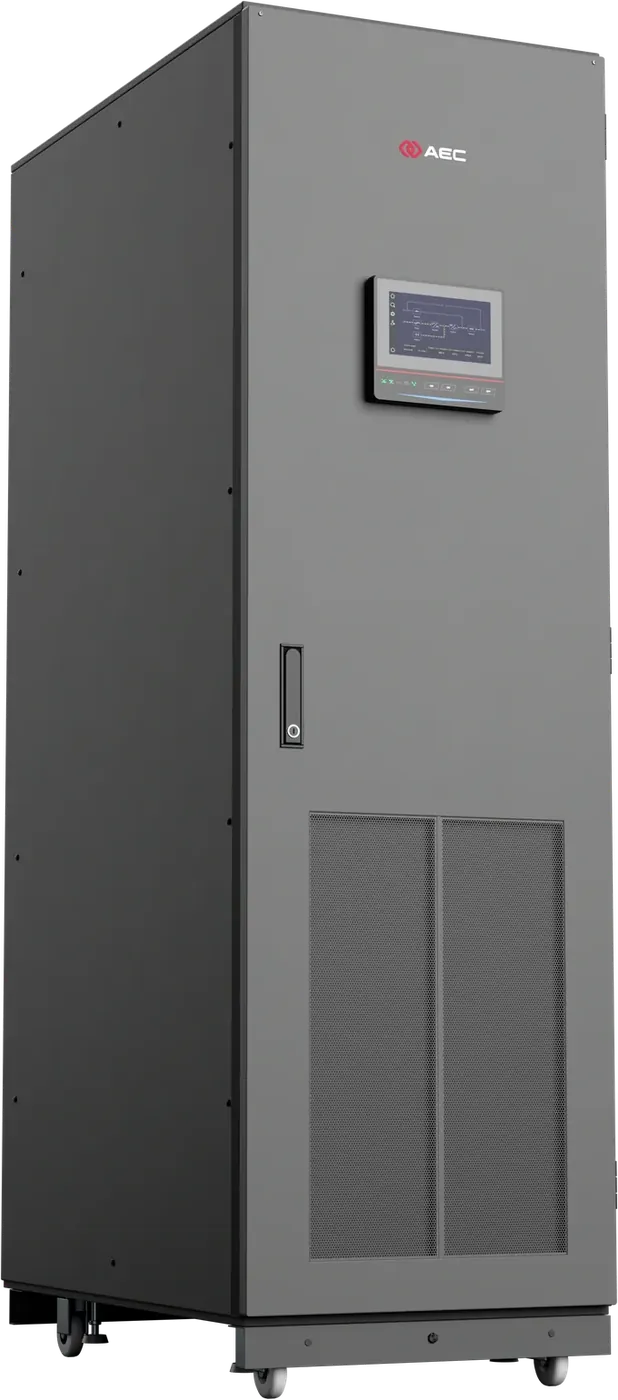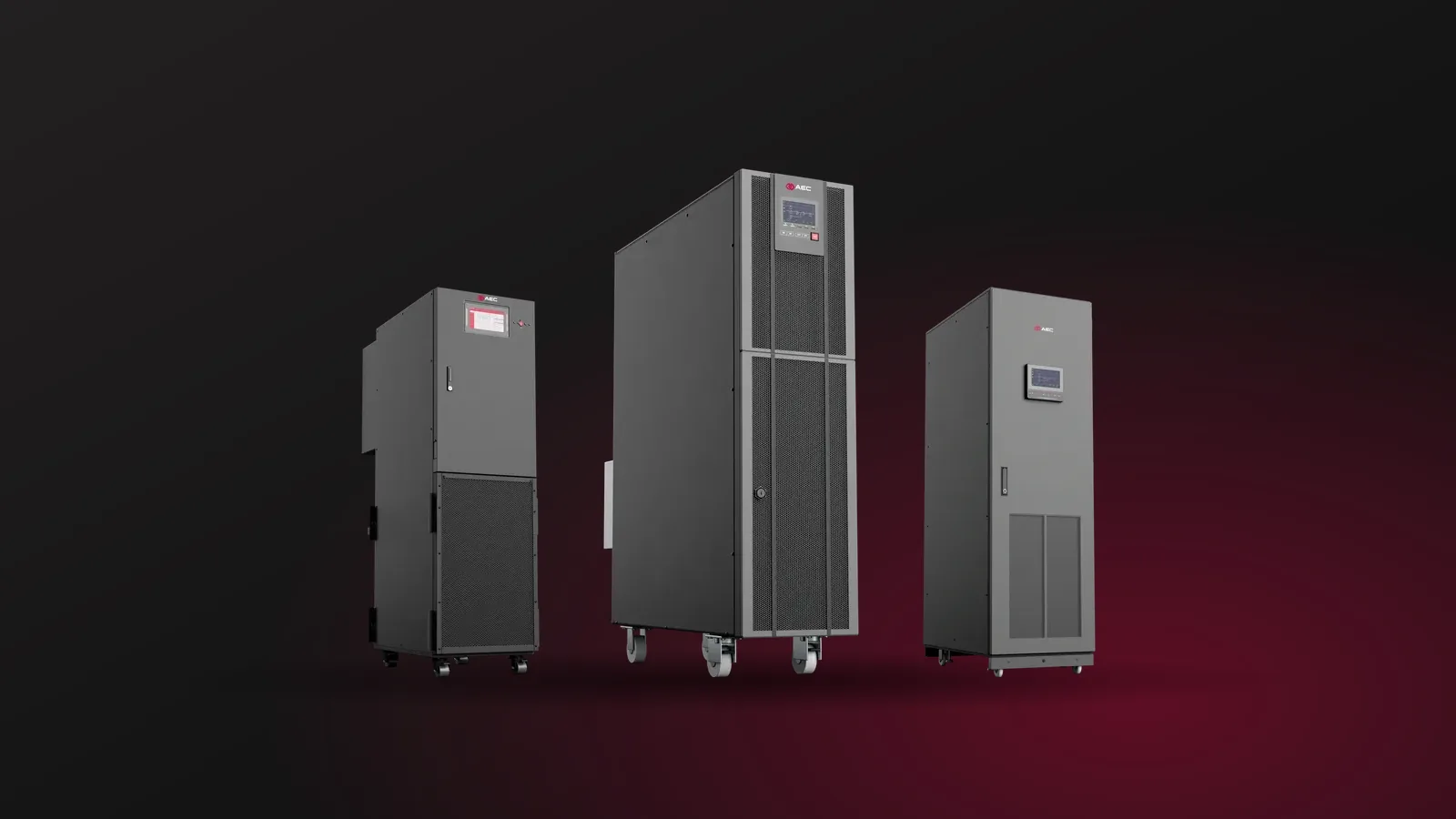
| Line | ETH20-3X50A-LI | What it tells you |
|---|---|---|
| Rated power | 20 kVA / 20 kW | What the UPS can feed. Size by kW; see kVA vs kW. |
| Output power factor | 1.0 | kW = kVA × power factor. At 1.0, the kVA and kW are the same. |
| Input / output | 208 V, 4-wire (3P+N) | The supply it connects to: three phases and a neutral. It must match the panel. See 208 V or 480 V. |
| Topology | Online double conversion | The load always runs on the inverter: no transfer time. See what a UPS is. |
| Efficiency, up to | 94 % | The best point of the curve, not every load. It sets the heat; see UPS heat output. |
| Battery DC bus | 240 V DC | The voltage of the battery string; external batteries must match it. |
| Battery | Lithium LiFePO4, internal | Chemistry and where it sits. See lithium vs VRLA. |
| Runtime at 50 % / 100 % load | 41 / 20 min | At the start of battery life; see runtime explained. |
| Dimensions (W × D × H) | 12.6 × 39.1 × 49.2 in | The floor space, the doors and elevators on the way in, and the service clearance. |
| Net weight | 471.8 lb | With the footprint, the floor load. Raised floors have a limit. |
What lines does a large UPS add?
A megawatt system's datasheet goes further, because its input, its overload and its room matter to the whole building. The AEC INF15-1500 (INFINITE 1.5MW):
| Line | INF15-1500 | What it tells you |
|---|---|---|
| Input voltage | 336–552 V (408–552 V at full load) | How far the supply can sag or rise before the UPS goes to battery. The generator and the feeders are sized for the low end. |
| Input frequency | 40–70 Hz | How much generator frequency drift the rectifier accepts without using the battery. |
| Input power factor | >0.99 | The current drawn is almost all real power: smaller feeders, an easier load for the generator. |
| THDi | ≤3 % | How little harmonic current the UPS sends back into the supply. |
| Overload | 105 % continuous, 110 % for 60 min, 125 % for 10 min, 150 % for 1 min | How long the inverter carries a step of load, an inrush or a downstream fault before it goes to bypass. |
| Battery DC voltage | 600 V DC nominal (360–600 V settable) | The string the battery must make: a set number of VRLA blocks or L6 cabinets. |
| Charger | 100 A per power module, settable (20 A default) | How fast the battery comes back after an outage, and how much the input draws while it does. |
| Enclosure, noise, ambient | IP20, <78 dB at full load, -5 to 40 °C (23 to 104 °F), up to 2,000 m | Indoors only, in a room with its own noise and cooling plan; above 2,000 m (6,560 ft) ask about derating. |
| Certification | UL 1778 listed (UL file E543003); FCC Part 15 Subpart B, Class A | The US product-safety standard for UPS, and the radio-emission class for commercial and industrial sites. |
How do you read the battery lines?
A datasheet may describe the battery by its DC bus, by its blocks, or by the minutes it gives, and they are three different things. CIRRO, for example, has a DC bus of ±240 V (480 V DC in all), 40 blocks of 12 V by default, selectable from 30 to 50 on the 600 to 1,600 kVA frames. A replacement battery or a new cabinet must match the bus and the block count the UPS is set for. "Frame only" or "external only" means the battery is not included: the AEC AUR-30 weighs 282 lb as a frame, and the AUR30-80X9A, the same tower with its 80 blocks, 750 lb.
How do you compare datasheets from two makers?
- Same mode. Some makers state efficiency in an ECO or high-efficiency mode, where the load runs on the bypass. Compare the double-conversion figures with each other.
- Same load. A runtime "at half load" beside one "at full load" means nothing. Read both at your load.
- Same power. A unit rated at a power factor of 0.9 gives 10 % fewer kW than one of the same kVA at 1.0.
- Same weight. With or without batteries, with or without the packaging.
- Same source. A runtime from a published discharge table and one from an estimate are not the same kind of figure; ask which one a datasheet gives.
To set an APC, Vertiv or Eaton model beside an AEC one, type its model number into the UPS sizing tool: it lists the AEC models that carry the same load, closest size first, with their runtime.
What does a datasheet not tell you?
The input current and breaker size, cable sizes, heat at part load, noise and the clearances for service are in the installation manual. Ask for it with the datasheet, and see UPS amps from kVA for the output side.
What do "up to" and "at the start of life" mean?
Two phrases matter. "Efficiency up to" is the peak of the efficiency curve; at light load it is lower. Runtime figures are for a new battery at 77 °F (25 °C); an aged or hot battery gives fewer minutes. Specify with margin on both.
Where are the datasheets of every AEC model?
Every model page has its full datasheet. For a project, every model page links its catalog pages and manuals. The whole range is also published as data: CSV and JSON.