1. Add up the load in watts
List every device the UPS will protect and add up the watts from the nameplates, or better, measure the real draw. Include what you plan to add in the next few years.
There are three ways to get the figure, from best to worst. A measurement: a clamp meter on the circuit, the readout of a metered rack PDU, or the display of the UPS being replaced, which shows its own load. The power the equipment reports: servers, storage and switches show their draw in their management interface. The nameplate: a power supply's label gives its maximum input, usually well above what it draws in service, so a sum of nameplates oversizes the UPS. A switch with Power over Ethernet is the one place to look further than the switch itself: count the power its phones, cameras and access points take.
2. Turn watts into kVA
A UPS has two ratings: apparent power in kVA and real power in kW, linked by its power factor (kW = kVA × power factor). Most AEC series have a power factor of 1.0, so kVA equals kW; LUMINA has 0.9, so the 1 kVA model delivers 900 W. Keep the load at about 75 to 80 % of the rating for headroom, a common practice.
Two kinds of load need care. Motors, compressors and transformers draw an inrush current when they start, several times their running current: keep them off a small UPS, or check the overload the UPS carries and for how long. Older equipment without power-factor correction draws more current than its watts suggest, so check its kVA as well as its kW; see kVA vs kW.
3. Match the voltage and the phases
The UPS must match the panel it feeds: 120 V single-phase for racks and desks, 120/240 V split-phase for small commercial panels, 208 V three-phase for server rooms, 480 V three-phase for large facilities.
| Supply | Power | AEC series |
|---|---|---|
| Single-phase 120 V | 1–3 kVA | LUMINA, FERRUS, FERRUS RT |
| Split-phase 120/240 V | 6–20 kVA | FERRUS SP, FERRUS SP RT |
| Three-phase 208 V | 10–100 kVA | ETHERNO, AUREON, RADIANT, RADIANT-IB |
| Three-phase 480 V | 30–1,600 kVA | CIRRO-IB, CIRRO, INFINITE, INFINITE 1.5MW |
Check the connection as well as the voltage. A 120 V UPS plugs in, and its plug sets the circuit it needs: the LUMINA 2 and 2.2 kVA models come with a NEMA 5-20P plug, the FERRUS 3 kVA models with a NEMA L5-30P. FERRUS SP is hardwired to its output terminal block by an electrician. The current each rating draws is in UPS amps from kVA.
4. Decide the runtime
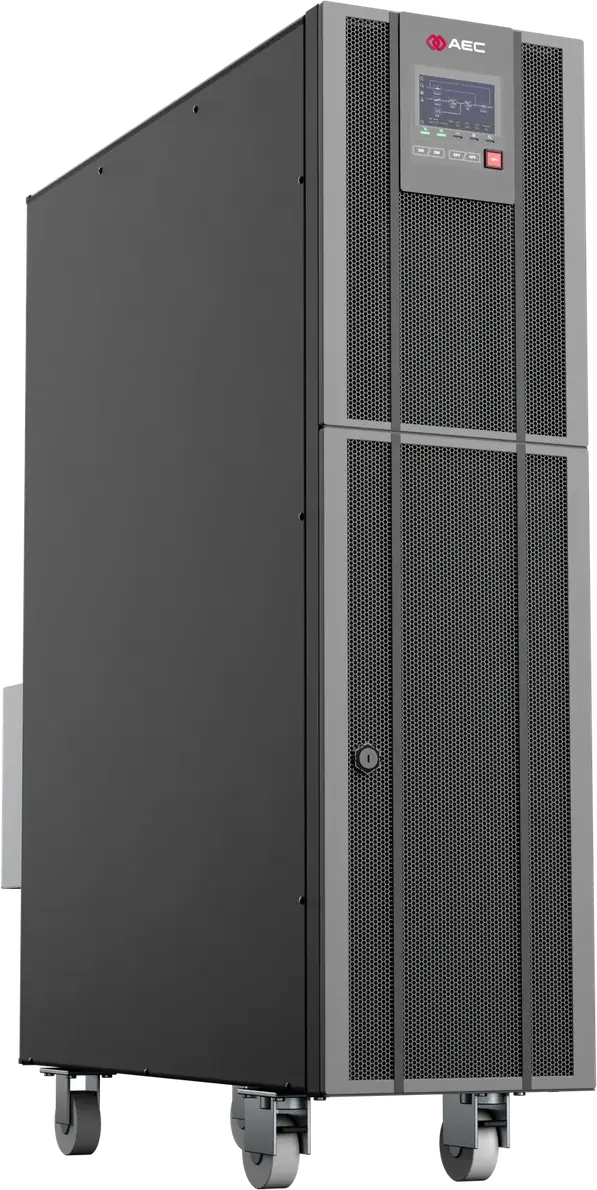
Runtime is how long the battery carries the load. Enough to bridge to a generator start, to shut servers down in order, or to ride through the outage. Runtime falls faster than load rises: an ETHERNO 20 kVA with three lithium modules runs 100 minutes at 20 % load and 20 minutes at full load.
Read the minutes at your load, not at full load, and leave margin for age. Catalog runtimes are for new batteries at 77 °F (25 °C), and a VRLA battery is at the end of its life, by the usual definition, when its capacity has fallen to 80 %. See runtime explained.
5. Leave room to grow, and for redundancy
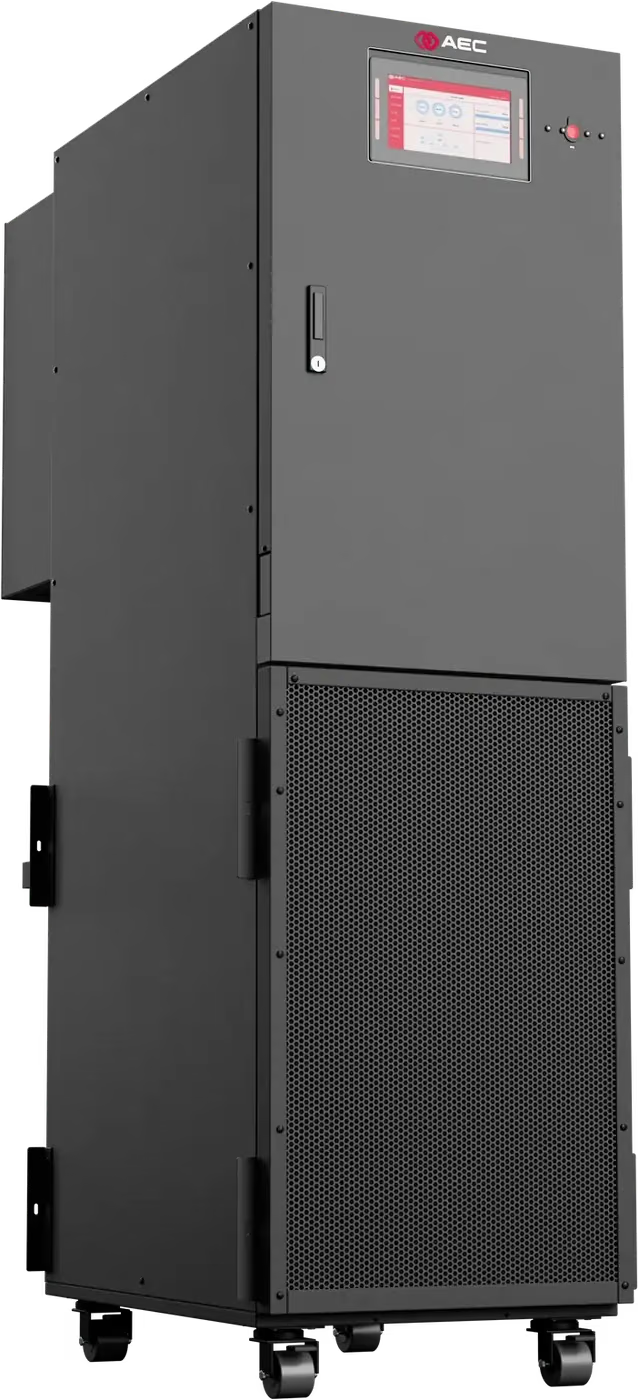
Modular systems such as RADIANT and CIRRO add power modules in the same frame, and keep running if one module fails (N+X). Tower UPS such as ETHERNO and AUREON can run in parallel with a parallel kit.
Growth decides the frame. A RADIANT frame takes six 15 kVA modules (90 kVA), a RADIANT-IB frame five 20 kVA modules (100 kVA), a CIRRO-IB frame five 30 kVA modules (150 kVA). Buy the modules the load needs today, plus one for N+1, and fill the free slots as racks arrive. A tower has one rating: past it, the answer is a second unit in parallel or a larger model.
Worked example: 15 kW for 15 minutes at 208 V
A server room on a 208 V three-phase supply draws 15 kW and needs 15 minutes on battery.
- Rating. Kept at 80 %, 15 kW needs a UPS of at least 18.75 kW. ETHERNO has a power factor of 1.0, so the 20 kVA model gives 20 kW, and 15 kW is 75 % of it.
- Runtime. The 2026 catalog runtime table of the ETH20-2X50A-LI, with two 50 Ah lithium modules, gives 17.5 minutes at 75 % load, with new batteries: the 15 minutes are met. For more margin as the batteries age, the ETH20-3X50A-LI, with a third module, gives 26.5 minutes at the same load.
- Current. At 15 kW the output carries 41.6 A per phase: 15,000 W ÷ (1.732 × 208 V). The input draws more: at the catalog's 94 % efficiency the UPS takes about 16 kW from the supply, about 44 A per phase, plus the charger after an outage. The input breaker and cables come from the installation manual.
The answer: an ETHERNO ETH20-2X50A-LI, or the ETH20-3X50A-LI for margin. The sizing tool runs the same check against every AEC model, VRLA ones included.
Worked example: a 1,500 W rack at 120 V for 20 minutes
A network rack draws 1,500 W, measured on its PDU, and the phones must stay up for 20 minutes.
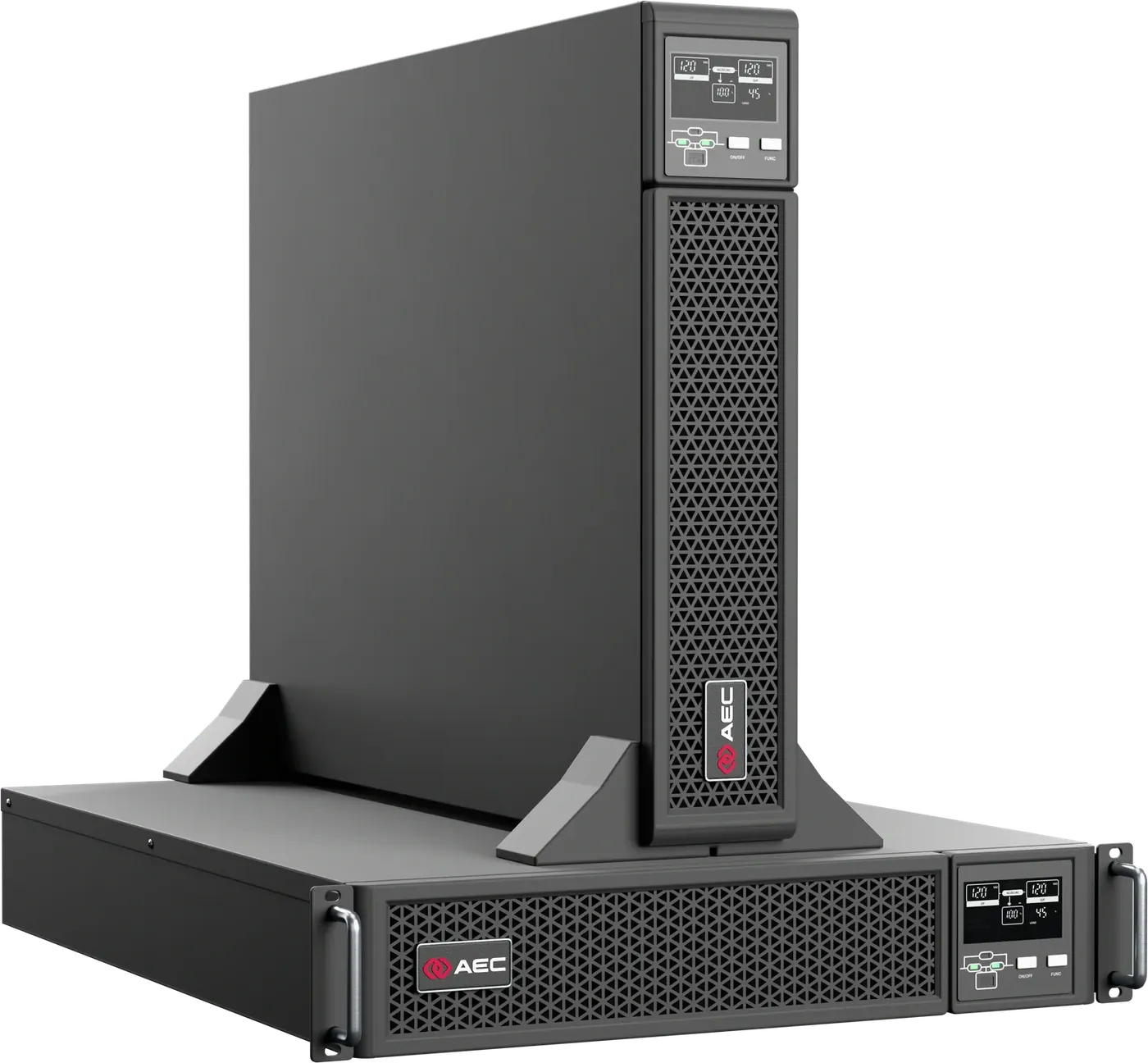
- Rating. Kept at 80 %, 1,500 W needs at least 1,875 W. LUMINA's power factor is 0.9: the 2.2 kVA model gives 1,980 W (the load is 76 % of it), the 3 kVA model 2,700 W (56 %).
- Runtime. The LUM2200RT-2U-LI table gives 34.5 minutes at 75 % and 32 at 80 %, so about 33 minutes at this load. The LUM3000RT-2U-LI gives 27 minutes at 50 % and 24 at 60 %, so about 25. Both meet the 20 minutes. The smaller unit runs longer because it carries more battery: 979.2 Wh of lithium against 734.4 Wh.
- Circuit. The LUM2200RT-2U-LI comes with a NEMA 5-20P plug: the rack needs a 20 A circuit and a 5-20R receptacle.
The answer: the LUM2200RT-2U-LI. At 76 % it has about 80 W of room before it reaches 80 %, so a rack that will grow takes the 3 kVA model, which gives up some minutes and leaves 660 W before it reaches 80 %.
Worked example: 300 kW at 480 V for 15 minutes on lithium
A data hall on a 480 V supply carries 300 kW of IT load and needs 15 minutes on lithium.
- Rating. Kept at 80 %, 300 kW needs 375 kW. INFINITE comes as 100, 200, 400 and 600 kVA systems; the INF-400 is two 200 kVA frames in parallel with four 100 kVA modules, and 300 kW is 75 % of it.
- Battery. Each 50 Ah module of an L6 lithium cabinet is rated 10 kW for 15 minutes, 2.5 kWh. 300 kW for 15 minutes needs 30 modules. The INF-400 bundle with two 20-module cabinets has 40 modules, which deliver 100 kWh at the 15-minute rating (40 × 2.5 kWh; 116 kWh nominal): 100 kWh ÷ 300 kW = 20 minutes with new modules.
- Room. Each 20-module cabinet stands 23.6 × 33.5 in on the floor and weighs 2,171.6 lb, and the two hold 116 kWh nominal, well above the 20 kWh line where NFPA 855 applies. See the lithium UPS guide for the codes.
What are the common sizing mistakes?
- Adding up nameplates instead of measuring, and buying a UPS twice the size the load needs.
- Reading the VA on a box as watts. A 3 kVA UPS at a power factor of 0.9 gives 2,700 W, not 3,000.
- Reading the runtime at full load when the load is 40 %, or at 40 % when the load will grow to 80 %.
- Forgetting the circuit: a 3 kVA UPS at 120 V delivers 25 A at full output, more than a 20 A circuit can carry.
- Sizing for the day of installation, with no free slot or parallel option for the next racks.