What is the difference between a modular and a monolithic UPS?
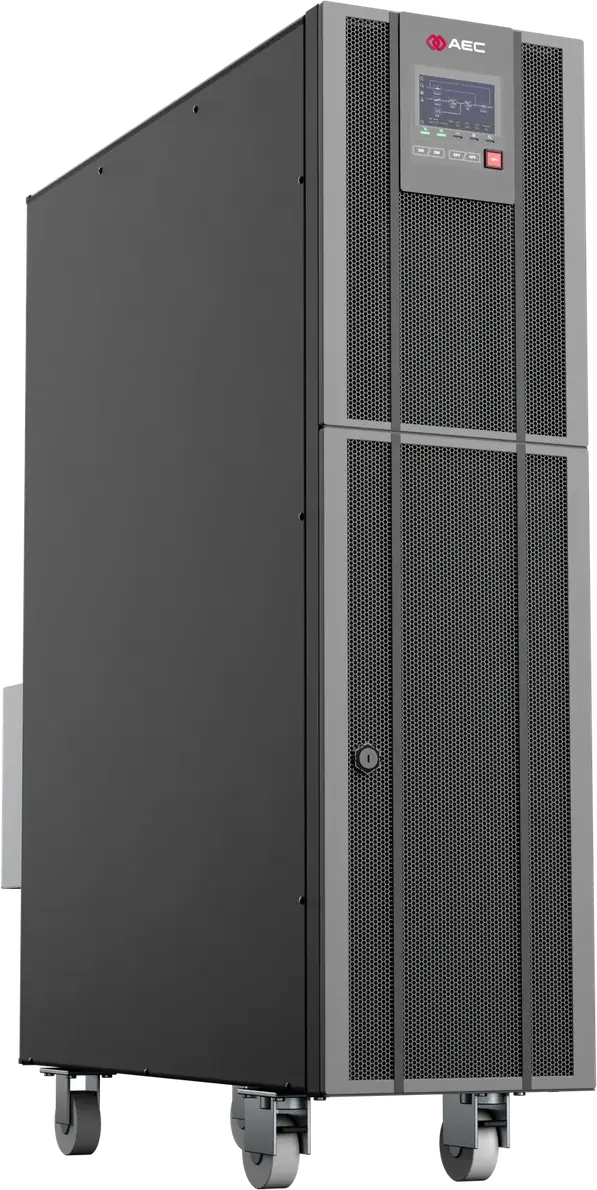
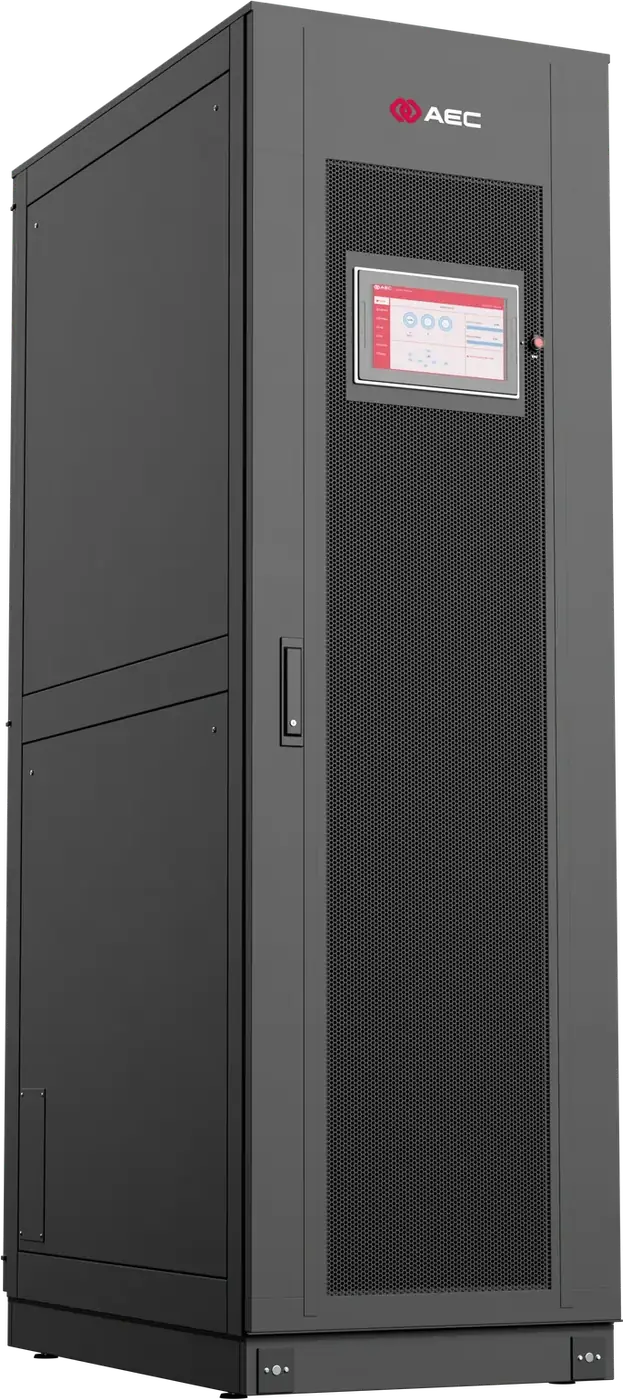
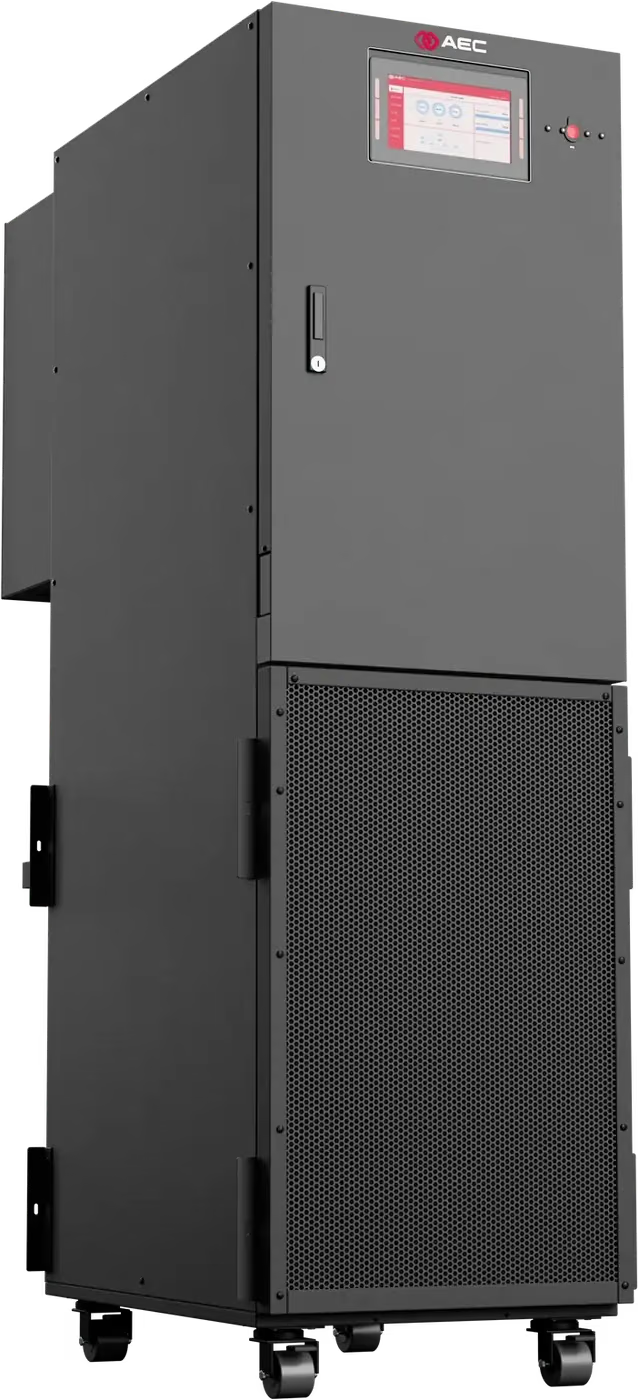
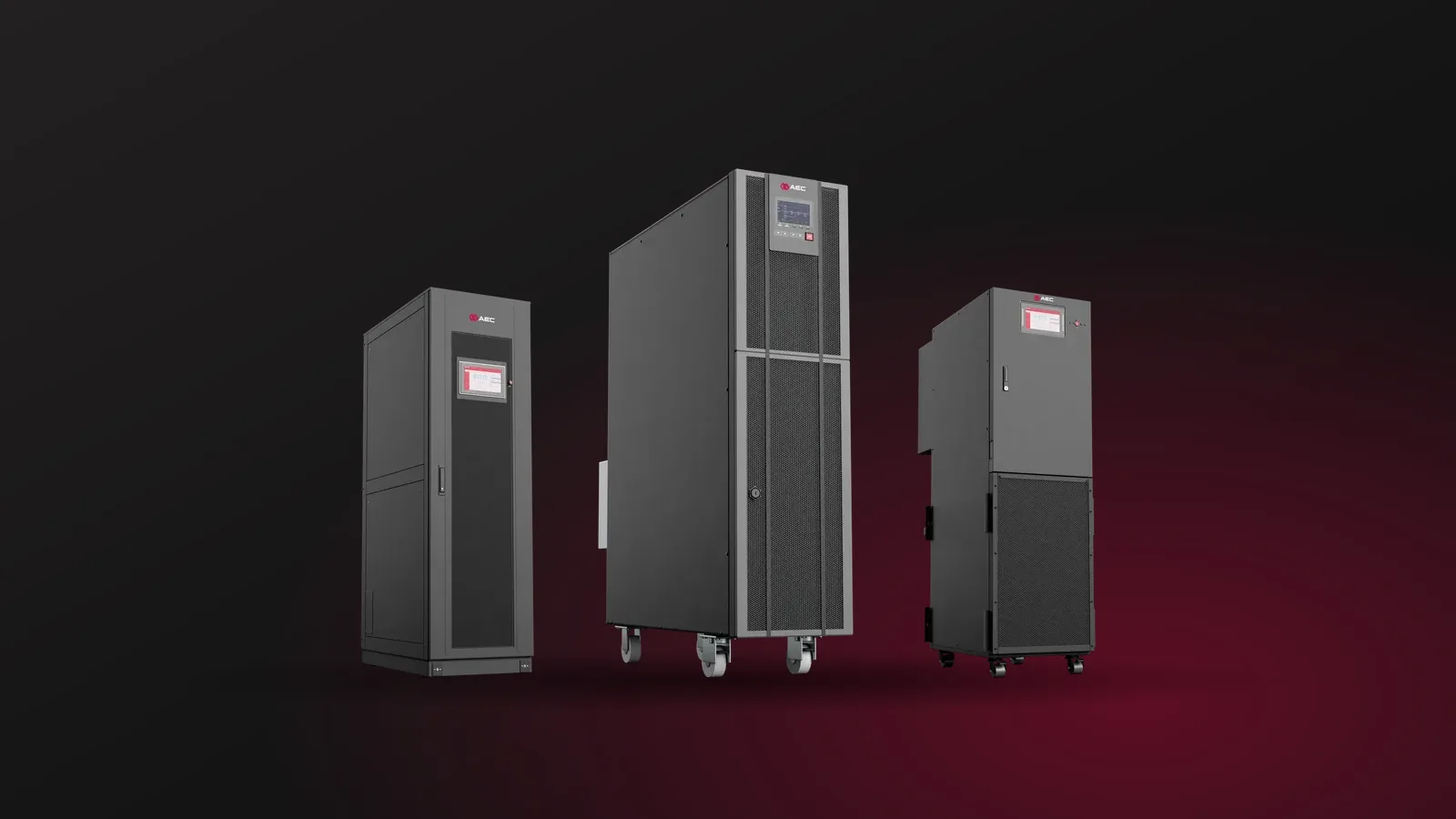
A monolithic UPS has one rectifier, one inverter and one static bypass sized for its rating. It grows, and gets redundancy, by adding whole units in parallel. A modular UPS has a frame with a shared static bypass, controls and battery connection, and slots for power modules, each a complete rectifier, inverter and charger. It grows by filling slots, and gets N+1 by holding one module more than the load needs. AEC builds both at 208 V:
| At 208 V | Type | Rating | Size (W × D × H) | Footprint | Battery | Parallel |
|---|---|---|---|---|---|---|
| ETHERNO | Monolithic tower | 10, 20 or 30 kVA | 12.6 × 39.1 × 49.2 in | 3.4 ft² | 1 to 3 lithium modules inside | up to 4 units |
| AUREON | Monolithic tower | 10, 20 or 30 kVA | 14.9 × 39.1 × 49.2 in | 4.0 ft² | up to 80 VRLA blocks inside | up to 4 units |
| RADIANT | Modular, 6 × 15 kVA | 15 to 90 kVA | 17.4 × 33.1 × 59.4 in | 4.0 ft² | external VRLA | up to 4 frames |
| RADIANT-IB | Modular, 5 × 20 kVA | 20 to 100 kVA | 23.6 × 39.3 × 78.7 in | 6.4 ft² | 240 VRLA blocks inside | up to 3 cabinets |
Which takes less floor space for N+1?
Below one tower's rating with no redundancy, the tower: one ETHERNO 30 with its lithium is 3.4 ft². Once N+1 is asked, the monolithic answer is a second complete UPS, and the floor doubles; the modular answer is one more module in a slot already there. The same 208 V loads, self-contained units with their batteries inside:
| Load with N+1 | Towers in parallel | Floor, weight | Modular cabinet | Floor, weight |
|---|---|---|---|---|
| 30 kW | 2 × ETH30-3X50A-LI | 6.8 ft², 970 lb | RADIB100-3X20 (2 + 1) | 6.4 ft², 2,086 lb |
| 60 kW | 3 × ETH30-3X50A-LI | 10.3 ft², 1,455 lb | RADIB100-4X20 (3 + 1) | 6.4 ft², 2,130 lb |
| 80 kW | 4 × ETH30-3X50A-LI (3 + 1), the most ETHERNO runs in parallel | 13.7 ft², 1,940 lb | RADIB100-5X20 (4 + 1) | 6.4 ft², 2,174 lb |
The towers win on weight: lithium inside, about 142 lb/ft² on the floor against 324 to 338 lb/ft² for a RADIANT-IB full of lead-acid. The modular cabinet wins on floor as soon as the load passes one tower, and keeps the same 6.4 ft² from 20 to 100 kVA. Without batteries inside, a RADIANT frame is 4.0 ft² for up to 90 kVA, plus its battery cabinet: a 20-block cabinet is 37.4 × 18.5 in, 4.8 ft².
How much runtime does each give at 30 kW?
- Two ETH30-3X50A-LI share the load, 15 kW each, 50 % of their rating: 27 minutes from the catalog table, with 17.28 kWh of lithium between them.
- RADIB100-3X20 carries 30 kW at 50 % of its 60 kVA: 21.5 minutes from its 240 internal blocks.
In both, the battery is shared by the units or modules: N+1 adds power, not minutes. UPS runtime explained covers why.
Is a modular UPS more efficient?
Not by itself, at 208 V in AEC's range. The catalog curves of ETHERNO, RADIANT and RADIANT-IB are within 0.3 points of each other: 92.5 to 92.8 % at 25 % load, 93.9 % at 50 %, 94.0 % at 75 %. What changes the losses is how hard each unit works. Two towers sharing a load each run at half of it; a modular frame can let its spare modules sleep, so the running ones work nearer their best point, and the load stays in double conversion. UPS ECO mode compares sleep with ECO on a RADIANT.
Is a modular UPS less reliable because it has more parts?
More parts can fail, and the frame's shared parts (static bypass, controls, output bus) are not duplicated inside one frame. But availability depends on how long the load is without protection as well as on how often something fails. In a modular frame a failed module stops sharing, the others carry the load, and the module is replaced with the load on: a RADIANT module weighs 30.5 lb and a RADIANT-IB module 44 lb. In a pair of towers the second tower carries the load while the first is repaired on site. For the parts N+1 does not cover, N+1 redundancy explains when 2N is the answer.
Which one should you choose?
- One tower when the load fits one unit, N+1 is not required and floor and weight are tight: an ETHERNO 10 to 30 kVA with lithium inside and a 5-year warranty including the batteries.
- Towers in parallel for 30 kW with N+1 where the floor cannot take over 320 lb/ft², or where the two UPS should stand in different places.
- A modular frame when the load will grow, when N+1 is required above one tower's rating, or when service should be a module swap: RADIANT for 15 to 90 kVA with the battery outside, RADIANT-IB for 20 to 100 kVA with it inside.
- At 480 V AEC's three-phase range is modular: CIRRO-IB, CIRRO and INFINITE. Growing a modular UPS covers their frames.
What mistakes come up in this choice?
- Comparing one tower with a full frame. Compare the same load with the same redundancy, as in the table above.
- Buying towers for a growing load. Each step adds a unit, a feeder and floor space; ETHERNO and AUREON stop at four in parallel.
- Forgetting the floor. A RADIANT-IB with its batteries is over a ton on 6.4 ft²: check the slab or the raised floor.
- Wiring a frame for day one. The manuals size the breakers and cables of a modular frame for its final build.
The UPS sizing tool gives both answers for your load, and the room fit tool checks them in your room.