



















20 October 2026 · updated 17 November 2026 · 9 min
UPS heat output: BTU, cooling and room temperature
UPS heat output is equal to the UPS losses: the difference between the power it takes in and the power it delivers to the load. To find it, work out the losses in watts from the efficiency, then multiply by 3.412 to get BTU/h for the cooling engineer.
A 20 kW load on a UPS running at 96% efficiency gives off about 0.83 kW of heat, or about 2,840 BTU/h.
In brief
- Heat output (W) = load (W) × (1/efficiency − 1). Every watt lost becomes heat in the room.
- Convert to cooling units with W × 3.412 = BTU/h.
- AEC's IST7, IST9 and IST6 120 ranges operate from −5 to 40 °C, but the batteries set the real target: about 20-25 °C.
- VRLA battery life roughly halves for every 8 °C above 25 °C.
- Respect the front, rear and top clearances, and check altitude limits before you plan the room.
Why a UPS produces heat
An online double-conversion UPS turns the mains into direct current (DC) and then back into alternating current (AC). Each conversion stage loses a little energy. That energy does not disappear: it leaves the cabinet as heat, carried out by the fans.
Efficiency (η) is the ratio between output power and input power. A UPS with 96% efficiency delivers 96 W to the load for every 100 W it takes from the mains. The missing 4 W, measured against the input, is the heat you have to remove from the room.
AEC puts it plainly on its IST7 10-40 kVA page: losses become heat, and you pay for them twice, once on the electricity bill and again in the room cooling. That is why efficiency and cooling belong in the same conversation. Our guide to UPS efficiency and ECO mode covers the energy side in more detail.
How to turn UPS losses into BTU/h
You need two numbers: the real power of the load in kilowatts (kW) and the UPS efficiency at that load. If you only know the load in kVA, convert it first with kW = kVA × power factor. Our guide to kVA, kW and power factor explains the step.
Then use two formulas:
- Losses (kW) = P × (1/η − 1), where P is the load in kW and η is the efficiency as a decimal.
- Heat (BTU/h) = losses (W) × 3.412. BTU/h (British thermal units per hour) is the unit many air-conditioning units are rated in.
Our guide to UPS efficiency derives the loss formula and applies it to the energy bill; here the same losses become a cooling load.
Worked example: IST7 10-40 kVA at 20 kW
The IST7 10-40 kVA range is rated at up to 96% AC/AC efficiency in double conversion and 99% in ECO mode. Take a 20 kW server room load.
- Double conversion: 20 kW × (1/0.96 − 1) = about 0.83 kW of losses.
- Convert for the cooling engineer: 833 W × 3.412 = about 2,840 BTU/h.
- ECO mode: 20 kW × (1/0.99 − 1) = about 0.20 kW, or about 690 BTU/h.
- The IT load turns its own 20 kW into heat in the same room, about 68,240 BTU/h, so the UPS adds about 4% to it in double conversion. Add the other heat sources (see below) before you size the cooling.
Two points matter here. First, these figures use the peak efficiency AEC publishes; at light load, efficiency is usually a little lower, so losses per kW are a little higher. Second, ECO mode feeds the load through the bypass while the mains stays within a set window, so it is a choice about protection as well as heat.
Heat per 10 kW of load
The table uses the double-conversion and ECO efficiencies published for each AEC range. Scale it to your load: for 30 kW, multiply the row by three.
| Range | Mode and efficiency | Losses per 10 kW | Heat per 10 kW |
|---|---|---|---|
| IST6 120 kVA | Double conversion, 97% | 0.31 kW | about 1,050 BTU/h |
| IST7 60-200 kVA | Double conversion, 96.5% | 0.36 kW | about 1,240 BTU/h |
| IST9, IST7 10-40 kVA | Double conversion, 96% | 0.42 kW | about 1,420 BTU/h |
| IST9, IST7, IST6 120 | ECO mode, 99% | 0.10 kW | about 345 BTU/h |
UPS operating temperature and room cooling
The UPS itself is quite tolerant. The IST7, IST9 and IST6 120 ranges are specified for an operating temperature of −5 to 40 °C, with relative humidity of 0-95% non-condensing. For the IST7 10-40 kVA, AEC recommends 20-25 °C.
Running near the top of the range is allowed, but it is not where you want to live. Fans run faster, components age faster, and the batteries next to the UPS suffer most. Plan the room for the comfortable middle of the range, not the edge.
What else heats a UPS room
The UPS losses are only part of the heat load. A cooling engineer will also add:
- battery charging losses, which are highest during recharge after an outage;
- external transformers, switchgear and distribution panels;
- lighting, people during maintenance, and heat through walls, roofs and windows;
- any IT or control equipment that shares the room.
Give the engineer the UPS losses in kW and BTU/h, the hours of operation and the target room temperature. Leave them to add these other sources and a margin.
Battery room temperature for VRLA batteries
Valve-regulated lead-acid (VRLA) batteries are the most common UPS batteries. They are far more sensitive to heat than the UPS. The widely used rule of thumb is that battery life halves for about every 8 °C above 25 °C.
AEC's Oz Power VRLA data puts this in numbers: 100% of design life at 25 °C, about 43% at 35 °C and 19% at 45 °C. The 40-200 Ah long-life models have a 12-year design life in float service at 25 °C, but only if they are kept cool. In practice, service life is often shorter than design life; see our guide to UPS battery maintenance.
Cold is a problem too. On the IST7 60-200 kVA, AEC gives 20-30 °C as the best battery temperature: below 20 °C autonomy drops, above 30 °C battery life shortens. An optional temperature probe lets the UPS adjust the charge voltage to the battery temperature (by default 3 mV/°C per cell).
So the practical target for a combined UPS and battery room is around 20-25 °C. If the UPS and the batteries are in separate rooms, the battery room is the one that needs tight control.
Ventilation and hydrogen in battery rooms
Lead-acid batteries can release small amounts of hydrogen and oxygen, mainly while charging. VRLA batteries recombine almost all of this gas inside the cell: AEC's Oz Power batteries are rated at 99% gas recombination. "Almost all" is not "all", so a battery room or cabinet still needs ventilation.
The European standard for this is EN IEC 62485-2, which covers the safety of stationary lead-acid batteries, including the air flow needed to keep hydrogen well below dangerous levels. The required ventilation depends on the number of cells, the battery capacity and the charging state. A qualified designer should apply it to your installation.
Keep three ideas in mind. Ventilation for hydrogen is a safety requirement, separate from cooling. Boost or overcharging releases more gas than float charging. And a faulty charger or a failing cell can raise gas output, which is one more reason to monitor battery temperature. AEC battery cabinets have ventilation slots and optional forced ventilation with automatic fans.
Clearances, airflow and altitude
A UPS needs free space around it to pull in cool air and push out warm air. Blocking the vents is one of the fastest ways to overheat a well-sized UPS. The clearances below come from AEC's installation data.
| Range | Free space | Altitude |
|---|---|---|
| IST7 10-40 kVA | at least 300 mm behind the rear panel; 300-500 mm at the rear and sides for ventilation | up to 2000 m; derating above, to IEC 62040-3 |
| IST7 60-200 kVA | at least 800 mm at the front, rear and above; air in at the front, out at the rear | see the datasheet |
| IST7-T 100–200 kVA | at least 700 mm at the front and rear for heat dissipation and service | 1000 m without derating (20-80 kVA); 1500 m (100-200 kVA) |
| IST6 120 kVA | at least 800 mm front and rear, 500 mm above | up to 2000 m; derating above, to IEC 62040-3 |
| IST9 | see the installation manual | up to 2000 m |
Altitude matters because thin air carries less heat. Above the stated limit, the UPS must deliver less than its full rating so that it does not overheat. This is called derating. IEC 62040-3, the UPS performance standard, sets how it is applied.
Front-to-rear airflow also shapes the room layout. Do not place the exhaust side of one cabinet facing the intake of another. Where the room has several cabinets, keep a cool side and a warm side, as data centres do.
The room fit tool checks an AEC UPS and its battery cabinets against the room: the manuals' clearances, the operating gangway, doors, floor load and ventilation.
Checklist for planning UPS room cooling
- Measure or estimate the real load in kW, today and in a few years.
- Take the UPS efficiency for the mode you will use, from the datasheet.
- Calculate losses in kW and convert to BTU/h (× 3.412 per watt).
- Add batteries, transformers, distribution, lighting and building heat.
- Set the room target around 20-25 °C if VRLA batteries share the room.
- Plan ventilation for the batteries under EN IEC 62485-2, separately from cooling.
- Respect the manufacturer's front, rear and top clearances.
- Check the site altitude against the UPS limit.
- Decide what happens to cooling during a power cut: is the air conditioning on the UPS, the generator, or neither?
- Fit a battery temperature probe and send high-temperature alarms to someone who will act.
Common mistakes
- Using the UPS rating instead of the load. A 200 kVA UPS carrying 60 kW gives off heat for 60 kW, not 200 kVA.
- Forgetting the cooling during an outage. If the air conditioning stops but the UPS keeps running, the room warms up. On a long runtime this can trip over-temperature protection.
- Designing for 40 °C because the UPS allows it. The UPS may cope; the batteries will age much faster.
- Treating hydrogen ventilation as optional for sealed batteries. VRLA reduces gas release but does not remove the need for ventilation.
- Pushing cabinets against the wall. Missing rear clearance traps hot air at the exhaust.
- Ignoring dust. Clogged filters and fans reduce airflow. Several AEC ranges run timed self-dedusting cycles, but they do not replace a clean room and regular service.
How this applies to AEC ranges
All AEC three-phase ranges publish the efficiency you need for the heat calculation. The IST7 60-200 kVA reaches up to 96.5% in double conversion and 99% in ECO mode, uses forced-air cooling from front to rear, and runs a self-dedusting cycle every 360 hours by default.
The IST7 10-40 kVA and the IST9 rack/tower UPS reach up to 96% in double conversion and 99% in ECO mode. On the IST7 10-40 kVA, fan speed follows the load, which reduces noise and extends fan life at partial load. The IST6 120 modular UPS reaches 97% in double conversion and up to 99% in ECO mode, and has a battery temperature sensor input for charge compensation.
For battery rooms, AEC batteries and battery cabinets include Oz Power AGM VRLA blocks with published temperature and life data. To check how much runtime you need before you size the battery, try the backup time calculator. For a full room plan, including heat output for your actual load, ask AEC's engineers.
Questions
Questions people ask
How much heat does a UPS produce?
A UPS gives off heat equal to its losses: load × (1/efficiency − 1). At 96% efficiency, a 20 kW load produces about 0.83 kW of heat. At 99% in ECO mode, the same load produces about 0.20 kW.
How do I convert UPS watts to BTU?
Multiply the heat output in watts by 3.412 to get BTU per hour. For example, 3,600 W of UPS losses is about 12,300 BTU/h. Use the losses, not the UPS rating or the load itself.
What is the ideal UPS operating temperature?
AEC's IST7, IST9 and IST6 120 ranges are specified for −5 to 40 °C, and AEC recommends 20-25 °C for the IST7 10-40 kVA. If batteries share the room, aim for about 20-25 °C, because battery life drops quickly at higher temperatures.
What temperature should a UPS battery room be?
Around 20-25 °C for VRLA batteries. Their life roughly halves for every 8 °C above 25 °C, and below about 20 °C the available runtime falls. A temperature probe lets the UPS adjust the charge voltage.
Does a UPS room need air conditioning?
Yes, usually, unless the losses are small and the room can lose heat naturally. Calculate the losses in BTU/h, add the other heat sources and ask a cooling engineer. Also decide whether the cooling must keep running during a power cut.
Do sealed VRLA batteries need ventilation?
Yes. VRLA batteries recombine most of their gas, but they can still release small amounts of hydrogen, especially when charging. EN IEC 62485-2 sets the ventilation requirements for stationary lead-acid batteries.
Products
Products in this guide
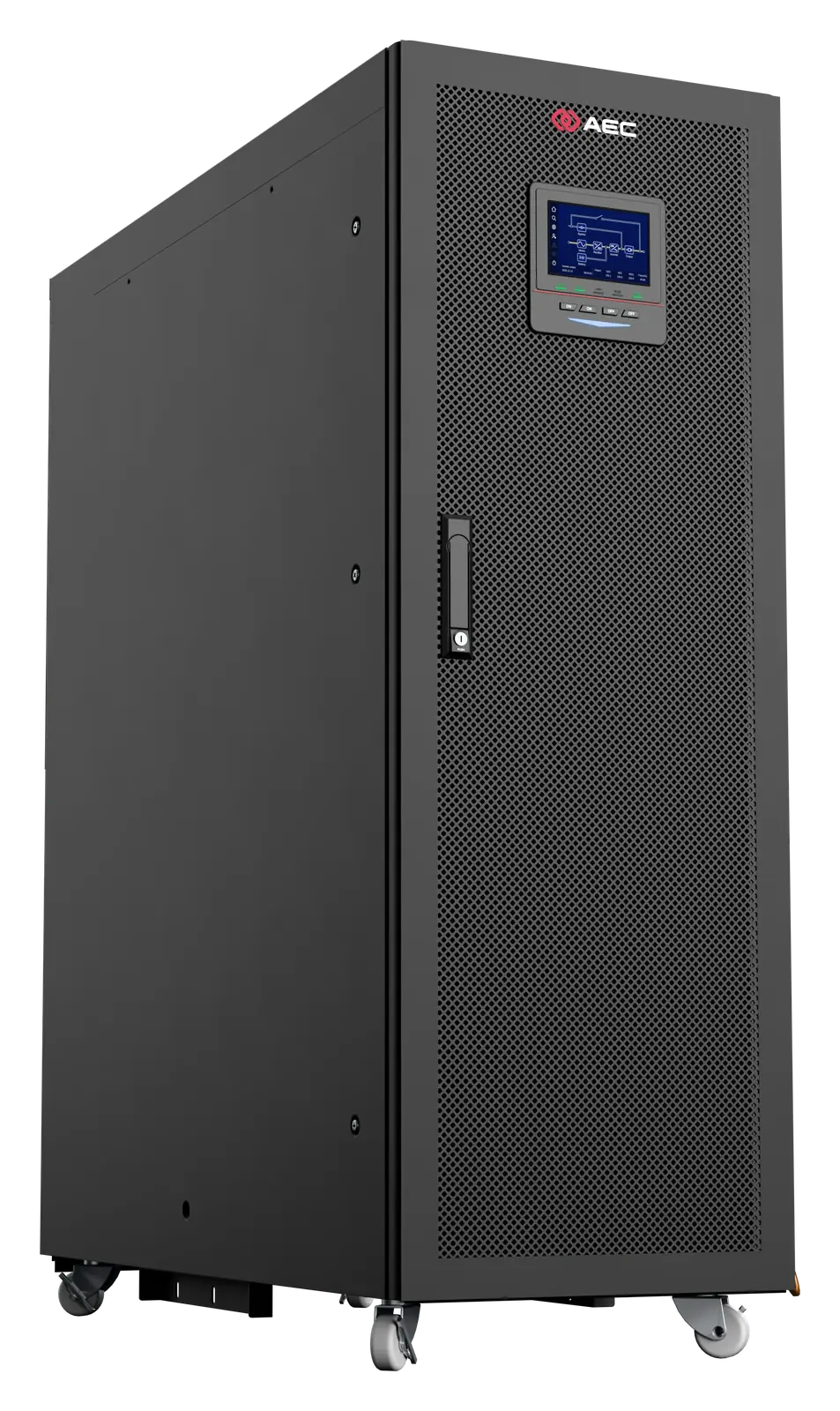
IST7 60–200
Three-phase online UPS, double conversion, 60–200 kVA
Details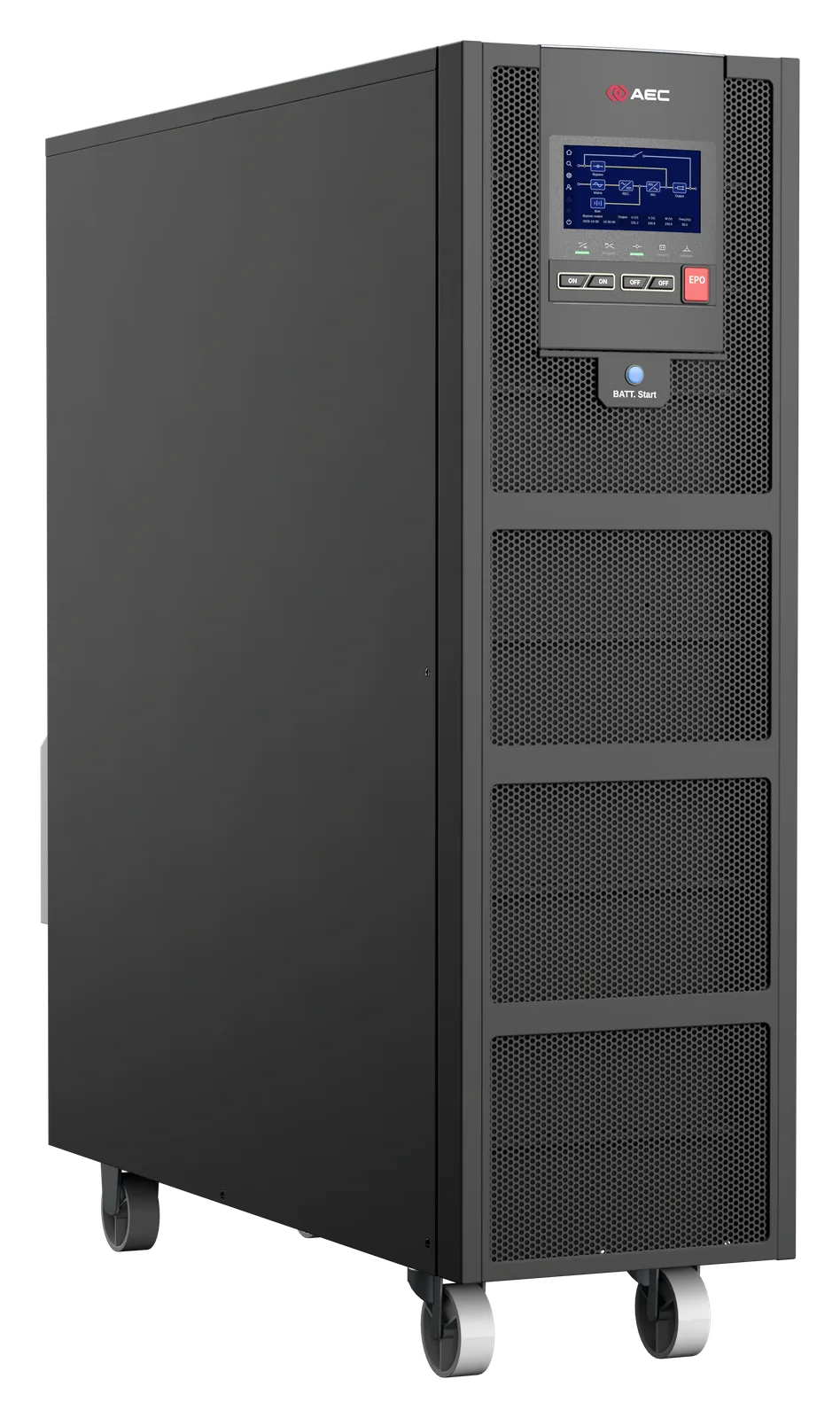
IST7 10–40
Online UPS, double conversion, 10–40 kVA
Details
IST6-120
Modular online UPS, double conversion, 30–120 kVA
Details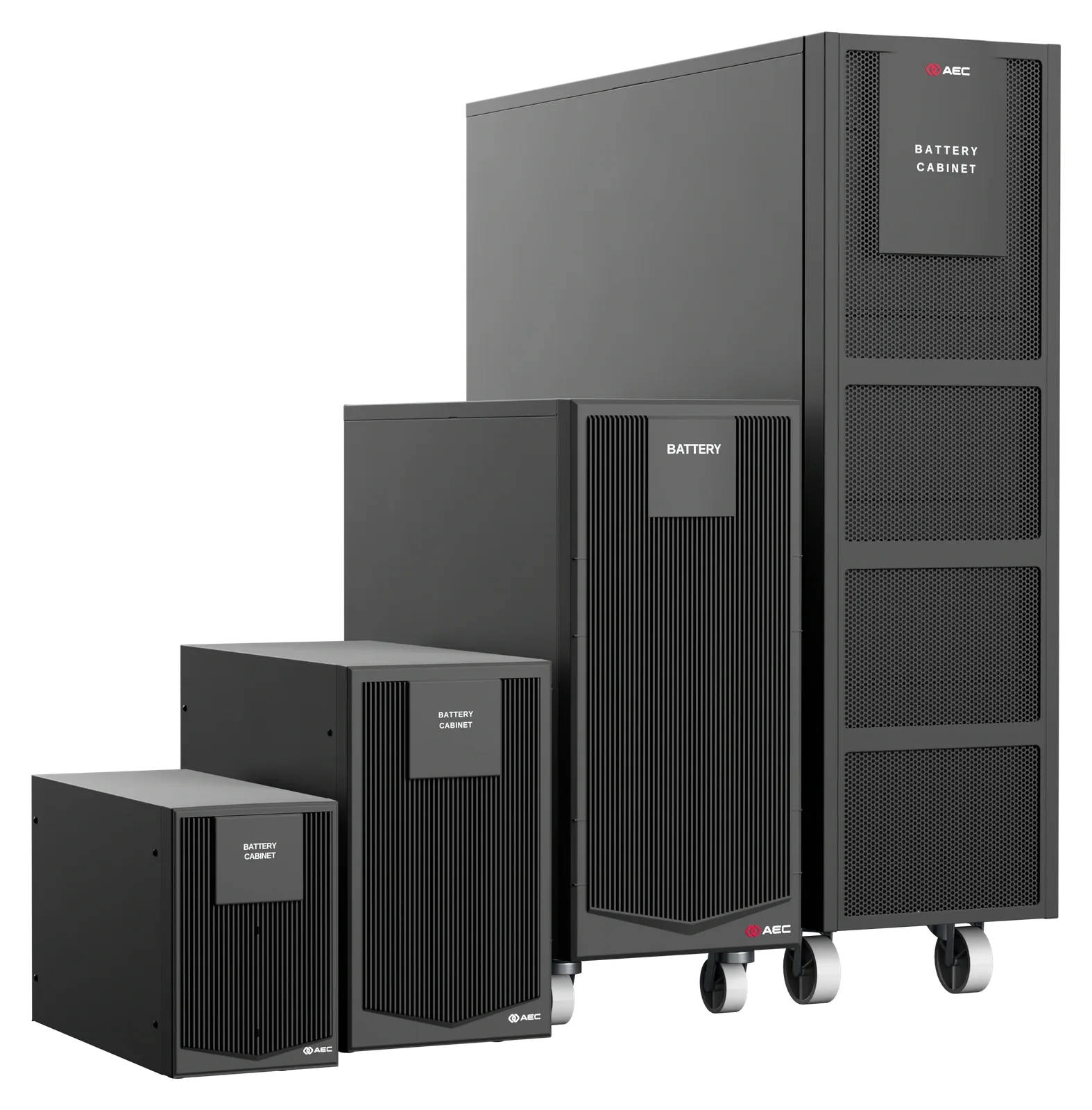
Battery cabinets
Battery cabinets and VRLA batteries for AEC UPS
DetailsBlog
Keep reading
Talk to an AEC engineer
Tell us the load, the supply and the backup time you need: we answer with the model and the batteries that fit.