



















Blog
Guides to uninterruptible power
How to choose, size and look after a UPS, explained by AEC's engineers: the UPS types and when online double conversion is needed, working out power and backup time, single or three-phase, lead-acid or lithium batteries, N+1 redundancy, heat and maintenance, with worked examples and the AEC ranges for EMEA.
Guides
UPS basics

What is a UPS and what does it do?
UPS means uninterruptible power supply: what a UPS is, how it works, the three types, what it is used for and how to read its rating.Read
Online UPS vs line-interactive vs offline: UPS types
The three UPS types compared: offline, line-interactive and online double conversion, with transfer time, VFI/VI/VFD classes and ECO mode.Read
How to choose a UPS: type, runtime, phases and service
How to choose a UPS once its size is known: online or line-interactive, runtime and shutdown, single- or three-phase, rack or tower, and service.Read
UPS vs generator: how they differ and work together
A UPS gives instant power, a generator long runtime after a start delay. How to combine them, size the generator and avoid common mistakes.Read
UPS glossary: 87 UPS terms and acronyms explained
UPS glossary: what UPS stands for and the terms engineers use, from VFI, PF and THDi to VRLA, SNMP and EPO, each linked to a deeper guide.Read
UPS datasheet explained: every line, with examples
How to read a UPS datasheet: UPS specifications explained section by section, from input and battery to efficiency, using a real AEC datasheet.ReadGuides
Sizing and backup time
UPS sizing: how to work out the power you need
How to size a UPS: list the loads, convert watts to VA, keep 20% headroom in both VA and W, then pick the battery. Two worked examples and a checklist.Read
kVA vs kW: power factor and UPS sizing explained
kVA is apparent power, kW is real power: kW = kVA × power factor. The conversions, the power factor of each AEC range and a 3 kW example.Read
UPS backup time: how to estimate and extend runtime
UPS runtime depends on the load in watts, battery energy and discharge rate: the estimate formula, why the maker's tables matter and how to extend it.ReadUPS heat output: BTU, cooling and room temperature
UPS heat output equals its losses: load × (1/efficiency − 1), then × 3.412 for BTU/h. Worked example, battery room temperature, clearances and checklist.Read
UPS efficiency and ECO mode: losses and energy savings
UPS efficiency explained: how losses change with load, the P × (1/η − 1) formula with a worked example, ECO mode trade-offs and how to read datasheets.ReadUPS installation clearances: what to check on site
Clearances, operating gangways, door widths, floor load, cable entry and airflow for every AEC EMEA UPS and battery cabinet, before the delivery.ReadGuides
Batteries

UPS batteries: VRLA vs lithium and how to choose
UPS batteries compared: VRLA AGM lead-acid vs LiFePO4 lithium on life, cycles, space and heat, plus how to read 12 V 9 Ah and a buyer's checklist.Read
UPS maintenance: batteries, checks and schedule
UPS maintenance guide: visual checks, alarm logs, battery tests, a monthly to yearly schedule, the maintenance bypass and when to replace UPS batteries.ReadBattery room ventilation to EN IEC 62485-2 for VRLA
The EN IEC 62485-2 air flow for a VRLA battery, term by term, worked out for every AEC BB4–BB8 cabinet, with the size of the openings.ReadL6 lithium battery sizing: modules, cabinets, room
How AEC sizes an L6 lithium battery for an IST7 or IST6 UPS: power and energy counts, modules and cabinets for 10 to 30 minutes, floor and clearances.ReadGuides
Three-phase and high power
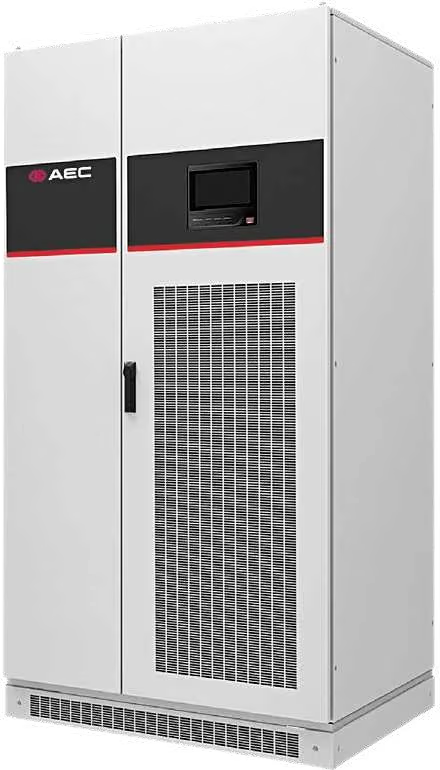
Three-phase UPS: configurations, sizing and installation
A three-phase UPS protects 400 V loads from about 10 kVA up. 3/3 against 3/1, phase balancing, sizing from measured currents, and installation.ReadSingle- or three-phase UPS: which does your site need?
Single-phase or three-phase UPS? Where the line falls in kVA and amps, what the supply and the loads decide, a 12 kW worked example and a checklist.Read
Modular UPS: how to grow power module by module
A modular UPS builds power from hot-swappable modules in one cabinet: how it grows with the load, against a conventional UPS, with IST6 examples.ReadUPS redundancy: N+1 or 2N, and how much a site needs
UPS redundancy explained: what N, N+1, N+X and 2N mean, parallel vs modular UPS, a worked 90 kW example, a comparison table and a checklist.ReadIsolation transformer UPS: when you need one
Isolation transformer UPS explained: galvanic isolation, the new neutral, when you need one, and transformer based vs transformerless UPS, with an example.ReadGuides
By application
UPS for data centres: how to choose and plan
A data centre UPS should be online double conversion, sized on measured IT load plus growth. Worked example, rack and modular options, N+1/2N, batteries.ReadIndustrial UPS: protecting PLCs, motors and processes
How to choose an industrial UPS: online double conversion, inrush and motor loads, harsh sites, 3/1 or 3/3, isolation, bypass and Modbus. With a checklist.Read
UPS for hospitals and healthcare facilities
A UPS for hospitals keeps medical and IT loads running with no break until the generator starts. Medical locations, redundancy and sizing.Read
UPS for CCTV and video surveillance systems
A UPS for CCTV keeps cameras, NVR and PoE switches recording through power cuts. How to choose the technology, size it and plan the runtime.ReadUPS for home: protect devices, router and data
A UPS for home keeps router, PC, NAS and alarm running in a power cut. How to size it, which type to pick and what a 3 kW whole-home UPS involves.ReadUPS for blackouts and storms: what to know
A UPS keeps equipment running through a blackout and filters storm sags and surges. What to check, how long it lasts and which AEC ranges fit.ReadGuides
Central power supplies (CPSS)

CPSS to EN 50171: what it asks and how to size one
A CPSS is a central battery system that powers emergency lighting and safety loads. What EN 50171 covers, how to size a CPSS and a worked example.ReadUPS vs CPSS: which one does a building need?
A UPS keeps equipment running; a CPSS keeps safety systems such as emergency lighting on. How they differ and when a building needs both.ReadTalk to an AEC engineer
Tell us the load, the supply and the backup time you need: we answer with the model and the batteries that fit.