



















Single-phase UPS · 230 V
IST8 Single-phase lithium UPS 1–3 kVA, rack 2U
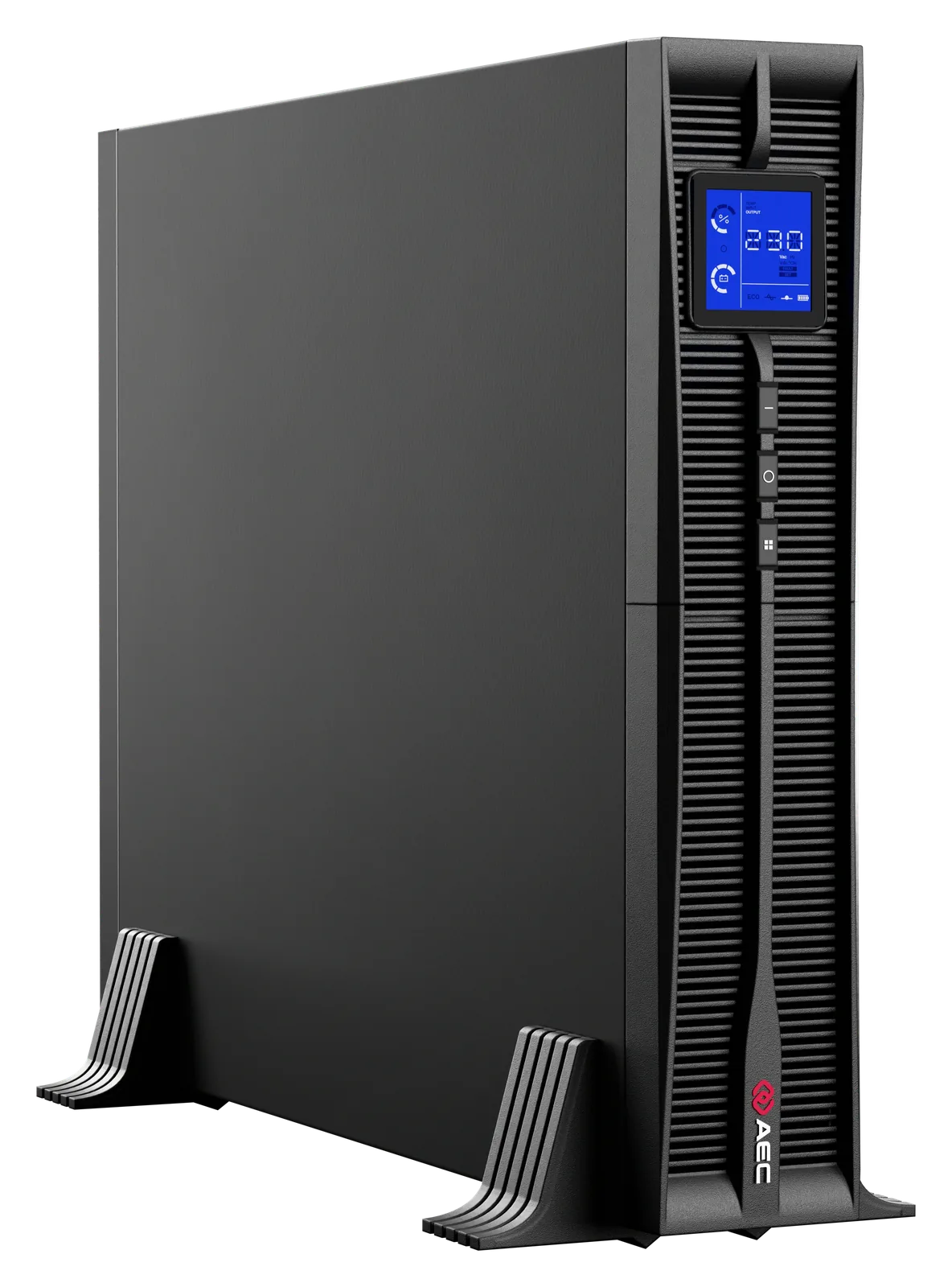
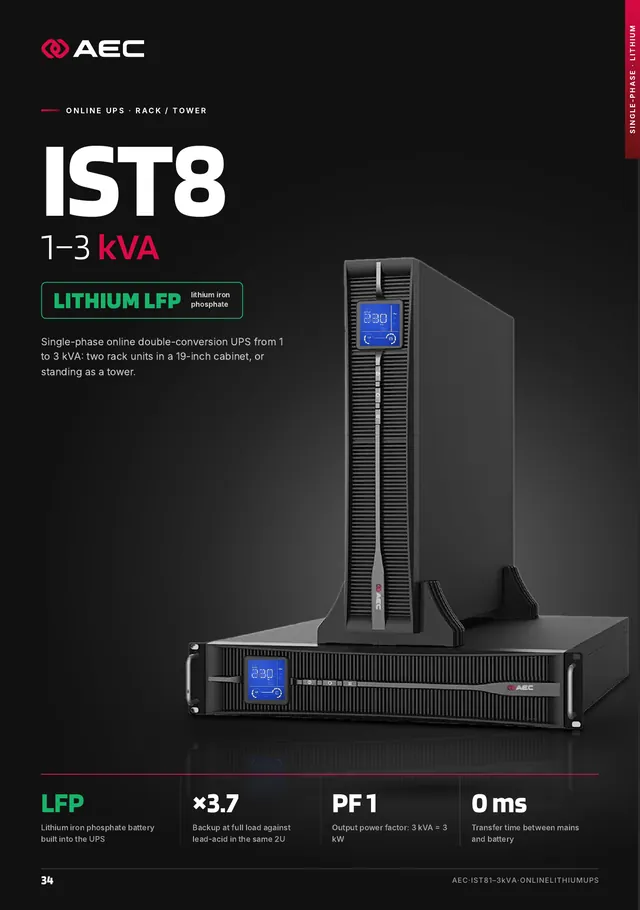
The AEC IST8 is a single-phase online UPS of 1, 2 and 3 kVA with a lithium iron phosphate (LFP) battery built in, 2U high, for a 19-inch rack or as a tower. Output power factor 1 (3 kVA = 3 kW), 0 ms transfer, AC/AC efficiency up to 93%.
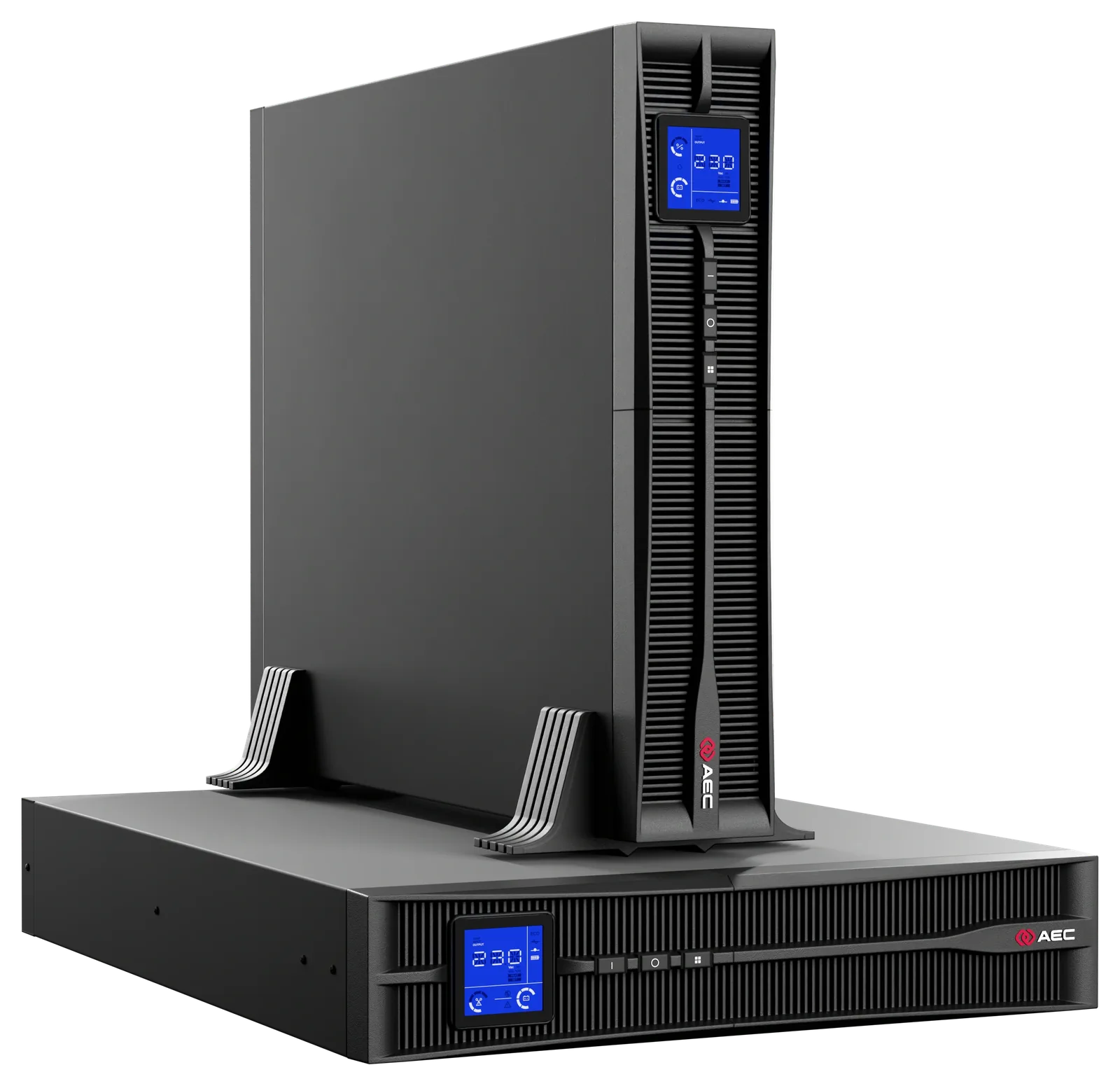
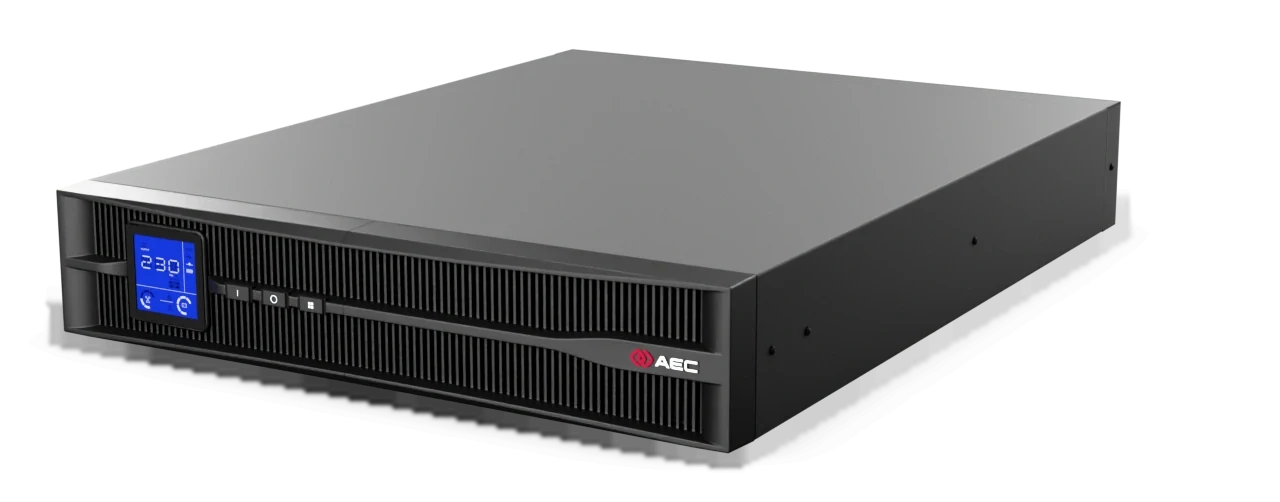 Drag to turn
In 3D
Look around the IST8
Drag it round, swipe on a phone or use the arrow keys. X-ray makes the enclosure see-through, so you can see what sits behind the panels.
Pick a size: the turn and the full 3D view follow it. Rendered from AEC's 3D models; the full 3D view zooms in, opens the unit and names every part.
Efficiency
How efficient is the AEC IST8 at your load?
AC/AC efficiency of each operating mode against the load: AEC's measured curves where they exist, elsewhere the typical curve derived from the datasheet figure by AEC's method. The losses and their cost follow the curve at the load you choose: drag along the chart or move the slider.
Filled points: measured by AEC (AC/AC technical datasheet). Hollow points: a typical curve, the shape of the most similar measured curve (same technology and size) moved to the range's datasheet efficiency: η(load) = reference curve + (datasheet figure − its highest point), AEC's method. Dashed lines: one figure without a load (ECO, W-ECO). Between points the efficiency is read on a straight line; beyond them, the nearest end. Losses = P × (1/η − 1). ECO mode is set from the panel; the catalogue gives no efficiency figure for it.
- Load
- —
- Lost as heat
- —
- Energy lost in a year, 24/7
- —
- Its cost in a year at € per kWh
- —
- The catalogue's examples use €0.20 per kWh.
Where each figure comes from
| Mode | Efficiency | Kind | Models | Source |
|---|---|---|---|---|
| Online, double conversion | 30%: 86.81% · 50%: 89.37% · 75%: 90.73% · 100%: 91.5% | Typical curve, derived from the datasheet efficiency of 91.5% (AEC method) | IST8-1 | AEC technical datasheet IST3-J 1–3 kVA: AC/AC efficiency |
| Online, double conversion | 30%: 88.3% · 50%: 90.17% · 75%: 91.1% · 100%: 91.5% | Typical curve, derived from the datasheet efficiency of 91.5% (AEC method) | IST8-2 | AEC technical datasheet IST3-J 1–3 kVA: AC/AC efficiency |
| Online, double conversion | 30%: 90.54% · 50%: 91.55% · 75%: 93% · 100%: 92.8% | Typical curve, derived from the datasheet efficiency of 93% (AEC method) | IST8-3 | AEC technical datasheet IST3-J 1–3 kVA: AC/AC efficiency |
EMEA 2026 catalogue figures: Online, double conversion up to 91.5% · Online, double conversion up to 93%.
Backup time
IST8 backup time, model by model
The same battery option on every model of the range, at the load you choose: minutes from AEC's data. Tap a model for its curve and all its codes.
Loading AEC's data…
Source: AEC EMEA product data: ordering codes, cabinets, blocks and strings, and the times AEC publishes from 50 to 100% load. Below 50%, AEC's calculator (W per cell = load ÷ 96% ÷ cells, read on a straight line between the columns of the battery maker's constant-power table at 1.70 V/cell), scaled to meet the published 50% figure. Lithium: published times only. New batteries, 25 °C. AEC checks every sizing. The catalogue prints 11 minutes without the load it is measured at; AEC's own data (EU portal) gives 12 minutes at full load for all three ratings, and the minutes from 50 to 100 % load shown here.
Table: every model at full and at half load
| Model | kW | Full load (min) | Half load (min) |
|---|---|---|---|
| IST8-1 | 1 | 12 | 42 |
| IST8-2 | 2 | 12 | 42 |
| IST8-3 | 3 | 12 | 42 |
From each model's smallest to its largest battery configuration, new batteries, 25 °C; AEC data (below 50% calculated with AEC's method).
The display
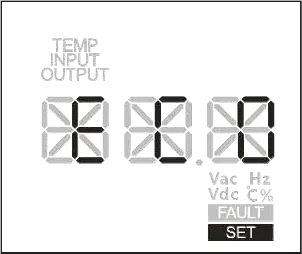
The IST8 1–3 kVA display
The real display, drawn by AEC's own simulator: pick a UPS state (normal, battery, bypass) or a main page.
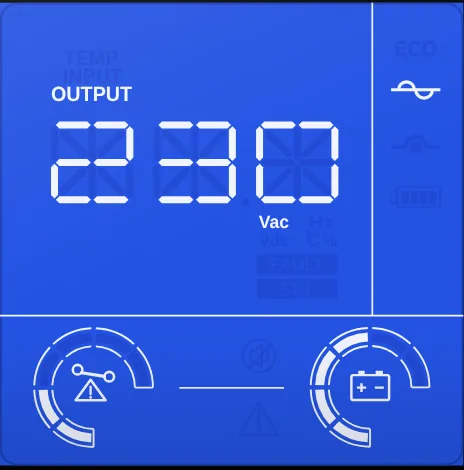
IST8 1–3 kVA · the real display
Output voltage
What is what
Inside the IST8, part by part.
Each number on the picture is named in the list.
Rear · 1 kVA
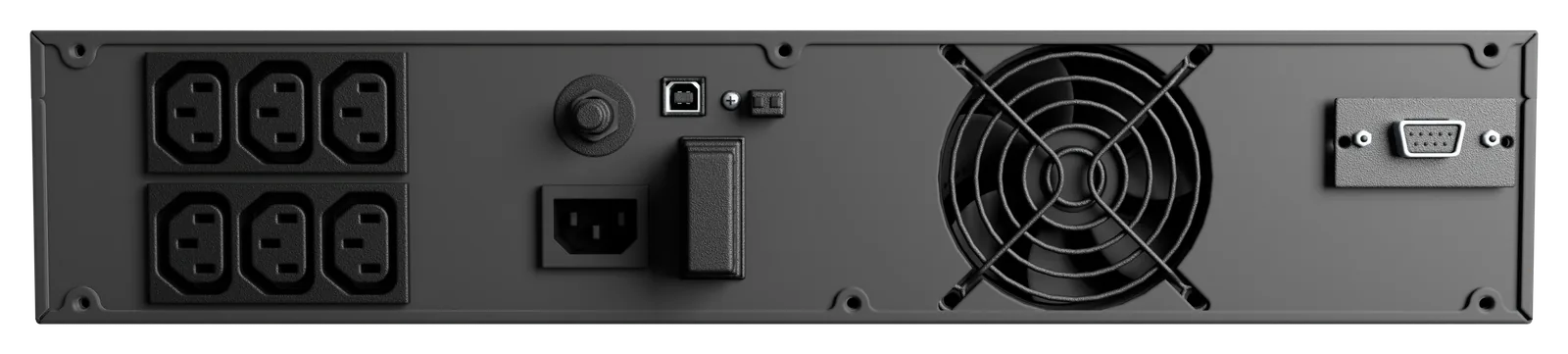 12345678
- IEC C13 output sockets6 × IEC C13 for the loads.
- Over-current protectorOn the rear panel.
- IEC C14 inputMains input socket.
- USB portFor the power management software: monitoring and remote ON / OFF.
- EPO connectorConnecting its two ports closes the UPS output. To recover: disconnect them, switch the UPS off and restart it.
- Battery connectorShipped disconnected for transport: plug it into the battery port after installation.
- Cooling fanOne on 1 kVA, two on 2–3 kVA.
- Intelligent slotDB9 port (RS232 + dry contact) as shipped; replaceable with the optional SNMP card or RS485 + dry-contact card.
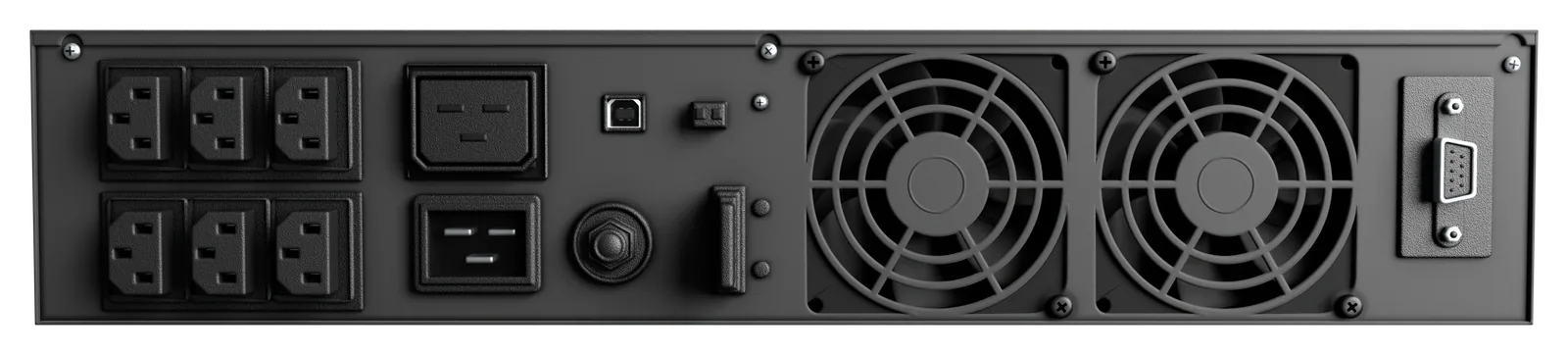
Rear · 2–3 kVA
 12345678
- IEC C13 output sockets6 × IEC C13 for the loads.
- IEC C19 output and C20 inputOne C19 output socket for a larger load and the C20 mains input socket.
- Over-current protectorOn the rear panel.
- USB portFor the power management software: monitoring and remote ON / OFF.
- EPO connectorConnecting its two ports closes the UPS output. To recover: disconnect them, switch the UPS off and restart it.
- Battery connectorShipped disconnected for transport: plug it into the battery port after installation.
- Cooling fansTwo on 2–3 kVA.
- Intelligent slotDB9 port (RS232 + dry contact) as shipped; replaceable with the optional SNMP card or RS485 + dry-contact card.
Overview
Key facts
- Power range
- 1–3 kVA
- Input / output
- 1/1 · 208 / 220 / 230 / 240 V
- Efficiency
- 91.5% · 93%
- Battery
- lithium iron phosphate (LFP), built in
- Display
- LCD, rack (RCK) or tower (TWR) reading
- Communication
- USB
- Network card
- SNMP card (optional)
- Warranty
- 3 years on the UPS, 5 years on the lithium batteries
- Dimensions W × D × H
- 438 × 423 × 86 (2U) · 438 × 570 × 87 (2U) mm
Applications:Servers & data centresTelecom systemsFinance & stockNetworksRailwayPostal services
Pictures
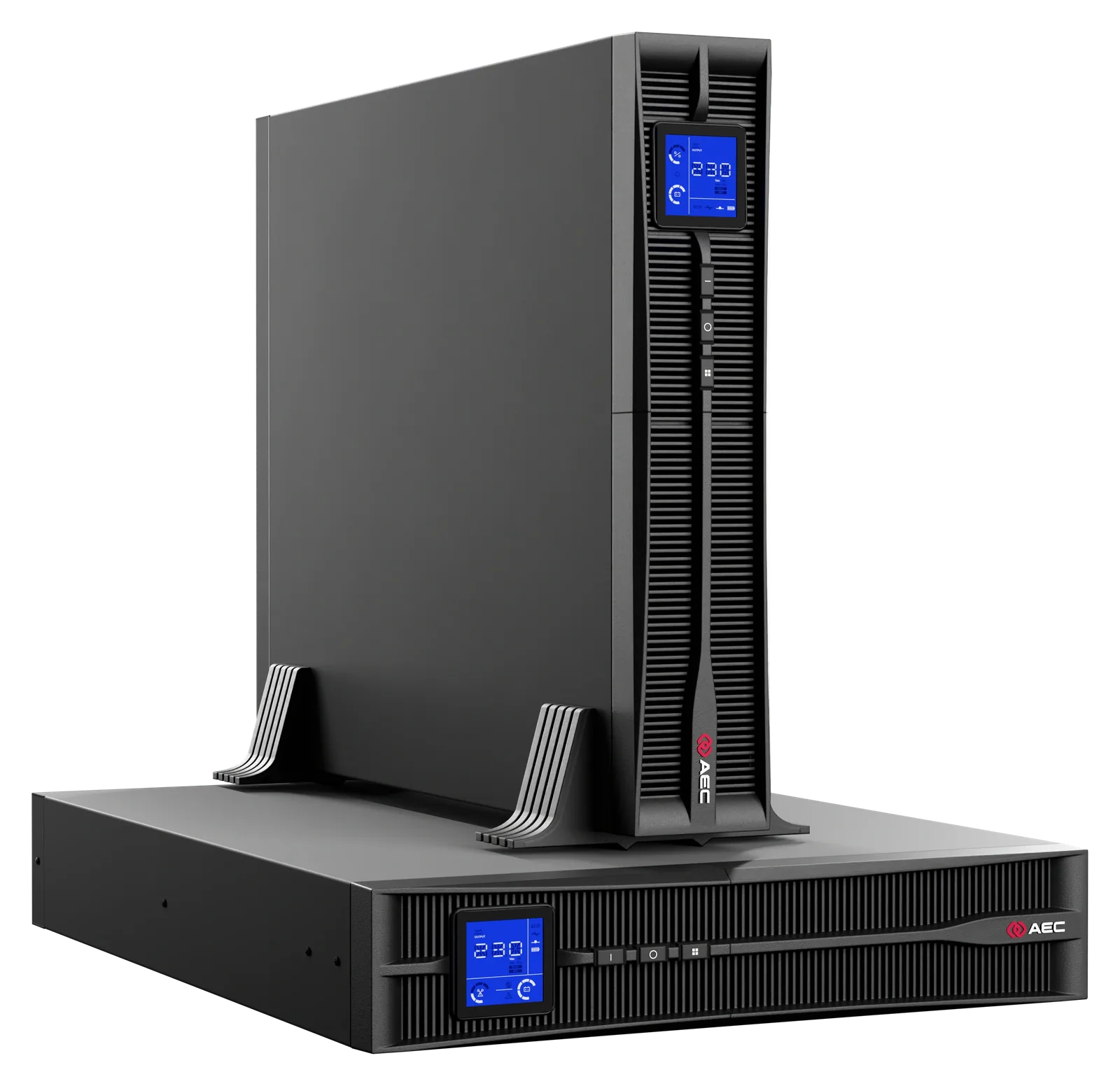
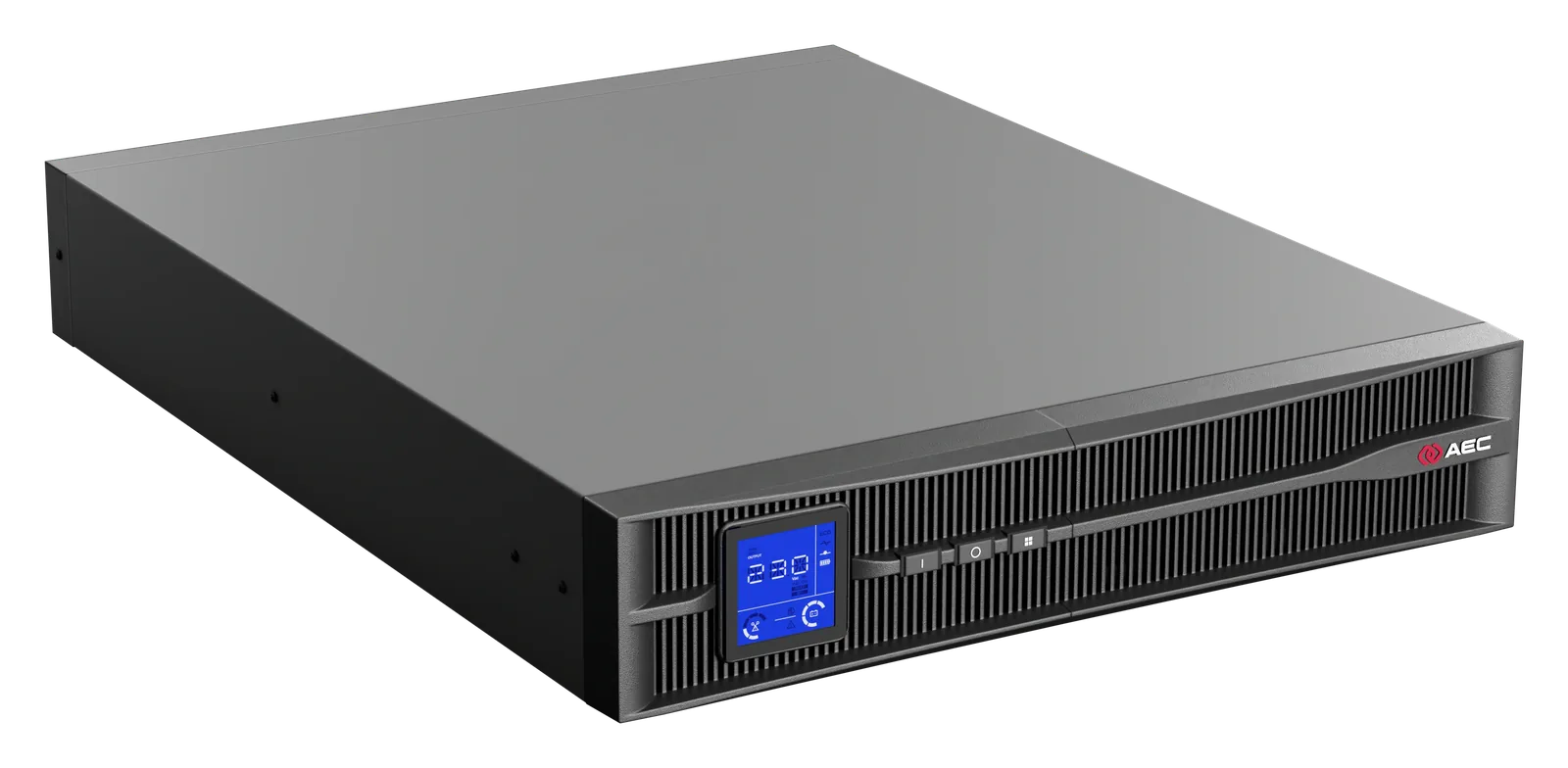
The IST8 in pictures
The photos and drawings of the EMEA 2026 catalogue: product views, displays, modules and connections. Tap a picture to enlarge it.
Models
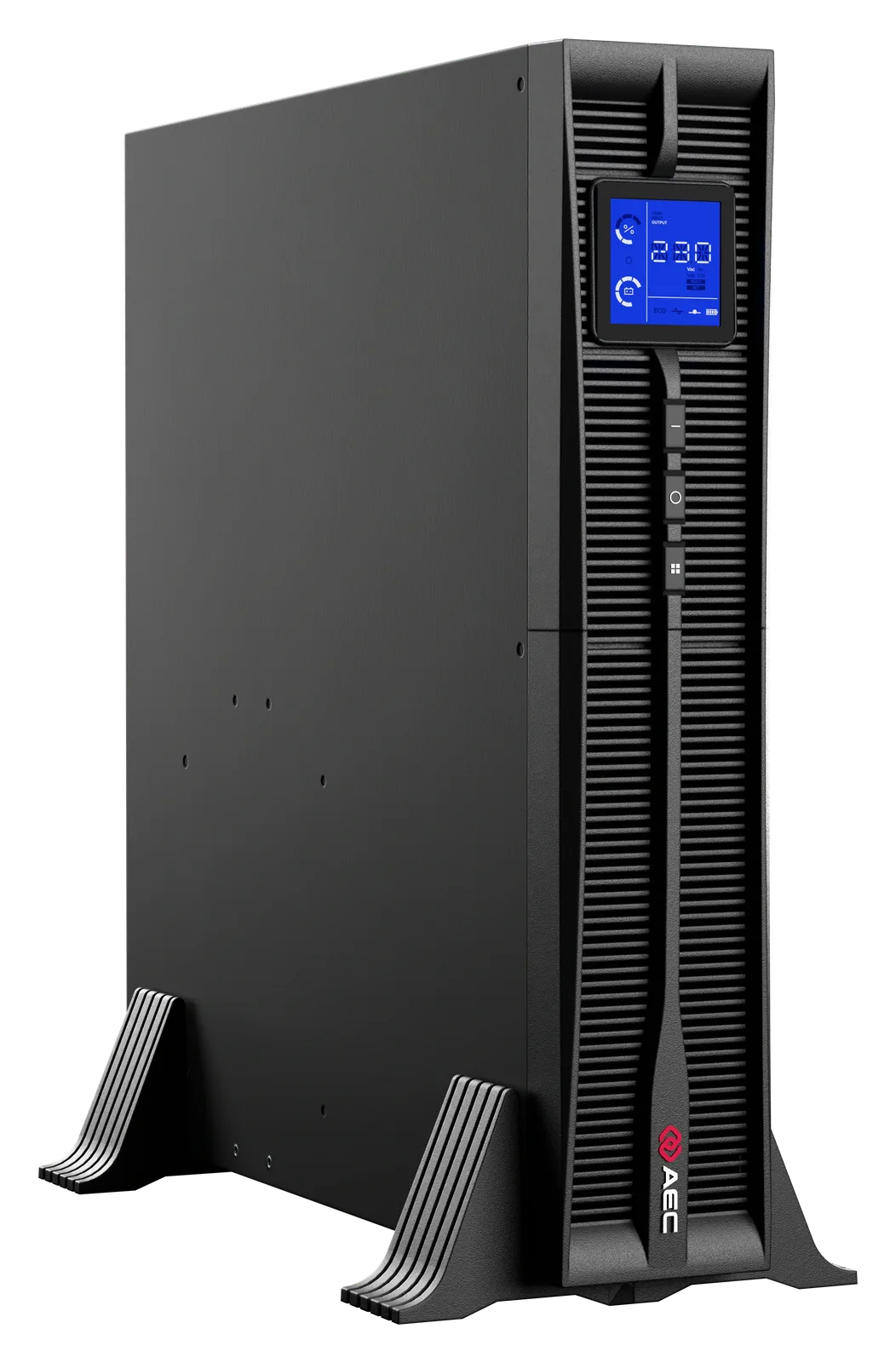
Which IST8 fits your load?
Every rating has its own page: that model's technical data, ordering codes, batteries and the questions people ask.
Datasheet
Datasheet IST8.
Every model side by side: keep only what differs, take it as CSV or print it.
| Model | IST8-1 | IST8-2 | IST8-3 |
|---|---|---|---|
| Rating | |||
| Power (VA / W) | 1000 / 1000 | 2000 / 2000 | 3000 / 3000 |
| Input | |||
| Voltage range | 120–295 V AC | ||
| Frequency | 50 / 60 Hz ± 10%, auto-sensing | ||
| Power factor · THDi | ≥ 0.99 · < 5% | ||
| Input socket | IEC C14 | IEC C20 | IEC C20 |
| Output | |||
| Voltage | 208 / 220 / 230 / 240 V ± 1%, settable from the panel | ||
| Frequency (battery mode) | 50 / 60 Hz ± 0.1 Hz | ||
| Power factor · voltage distortion | 1 · THDv < 3% | ||
| Transfer time | 0 ms | ||
| AC/AC efficiency | 91.5% | 91.5% | 93% |
| Overload | 101–115% 1 min · 116–133% 1 s · > 134% 200 ms | ||
| Output sockets | 6 × IEC C13 | 6 × IEC C13 + 1 × IEC C19 | 6 × IEC C13 + 1 × IEC C19 |
| Battery | |||
| Type | lithium iron phosphate (LFP), built in | ||
| Backup time · max. charging current | 11 min · 4 A | ||
| General | |||
| Operating modes | online (INV) · ECO, set from the panel | ||
| Display | LCD, rack (RCK) or tower (TWR) reading | ||
| Communication | USB · intelligent slot (DB9, RS232 + dry contact as shown; optional SNMP card or RS485 + dry-contact card) · EPO | ||
| Protections | output over-voltage, battery under-voltage, input over-voltage, overload, short circuit, over-temperature | ||
| Noise | < 55 dB | ||
| Environment | 0–60 °C (best 0–40 °C; long periods at 40–60 °C may reduce the output power) · 0–95% RH non-condensing | ||
| Dimensions W × D × H (mm) | 438 × 423 × 86 (2U) | 438 × 570 × 87 (2U) | 438 × 570 × 87 (2U) |
| Weight (kg) | 8.9 | 13.6 | 16.1 |
230 V models. Specifications are subject to change without notice.
Full technical details10 sections of the EMEA 2026 catalogue: functions, panel, connections, diagrams and ordering codes
Why IST8
ONLINE DOUBLE CONVERSION
High frequency, active PFC
A ±360 V DC bus feeds a half-bridge inverter; when the mains fails, a DC/DC stage boosts the battery onto the bus with no break.
- 0 ms transfer between mains and battery
- Input power factor ≥ 0.99, THDi < 5%
- Output voltage distortion < 3%
- Noise < 55 dB
THE RANGE
Three ratings, always 2U
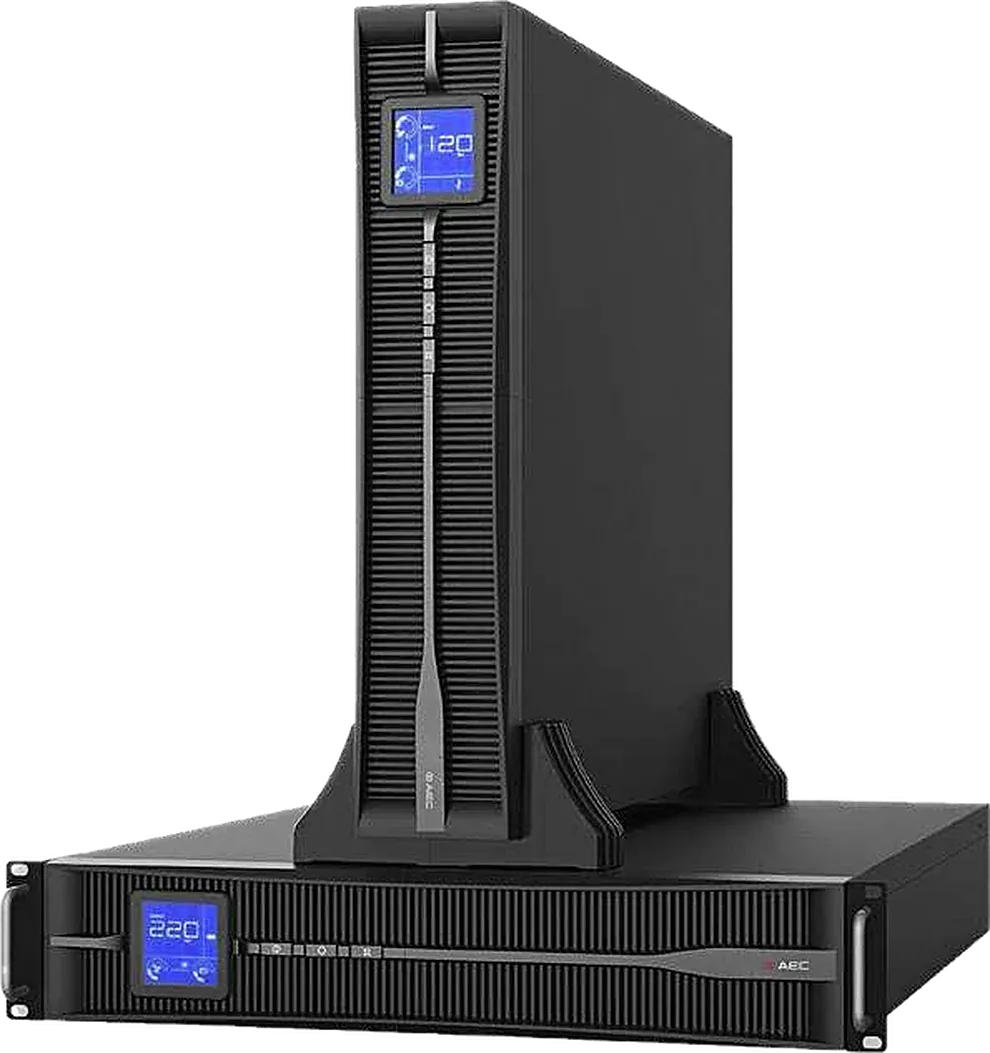
The same 19-inch, 2U chassis from 1 to 3 kVA, with the lithium-ion battery inside. Mounted in a rack or standing as a tower.
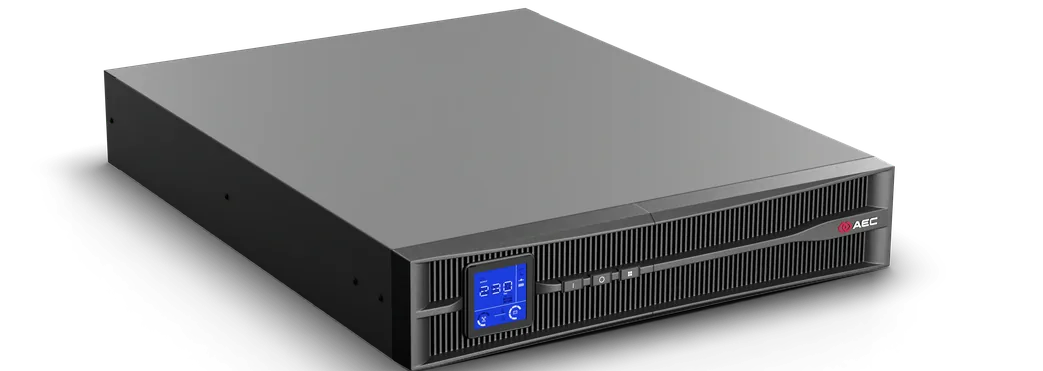
- 1 kVA: 1000 VA / 1000 W, 438 × 423 × 86 mm, 2U, 8.9 kg, AC/AC efficiency 91.5%, 6 × IEC C13 outlets, IEC C14 inlet
- 2 kVA: 2000 VA / 2000 W, 438 × 570 × 87 mm, 2U, 13.6 kg, AC/AC efficiency 91.5%, 6 × IEC C13 + 1 × IEC C19 outlets, IEC C20 inlet
- 3 kVA: 3000 VA / 3000 W, 438 × 570 × 87 mm, 2U, 16.1 kg, AC/AC efficiency 93%, 6 × IEC C13 + 1 × IEC C19 outlets, IEC C20 inlet
- Rack mounting: fix the two angle irons to the UPS with four M4 × 8 screws, push the UPS into the rack and fasten it with screws; default LCD reading RCK (rack).
- Tower mounting: stand the UPS upright, battery side up; join the two supports and fix them to the UPS with two M4 × 10 screws; set the LCD reading to TWR from the panel.
- 2U height for all ratings; 19" rack mounting, chassis width 438 mm
- 11 min backup time with the internal battery; max. charging current 4 A
FRONT PANEL
One LCD, three buttons
Status, measurements and settings on the front of the UPS. Values are scrolled with SELECT and confirmed with ON.

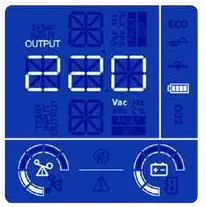
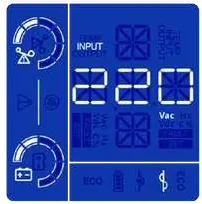
- LCD: working status, measurements and settings.
- ON: hold 1 s to switch on. In mains mode hold 3 s for a battery test. In battery mode hold 3 s to silence the buzzer, again 3 s to cancel. In the setting page, hold 1 s to confirm.
- OFF: hold 1 s to switch the UPS off.
- SELECT: press to scroll output and input voltage and frequency, battery voltage, inner temperature, load and faults. Hold 5 s to open the setting page.
- The LCD shows input and output voltage and frequency, load, temperature, fault code, parameters or working mode, with status icons for mains mode, bypass mode, battery mode, ECO mode, silence (buzzer silenced) and failure (with fault code on the display).
- Settings from the panel: operating mode ECO · INV; rack (default) or tower reading RCK · TWR; output voltage 208 · 220 · 230 · 240 V.
- The setting page closes after 20 s without confirmation.
REAR PANEL
Plug in, connect, protect
IEC inlet and outlets, battery connector and communication on the back of the 2U chassis.

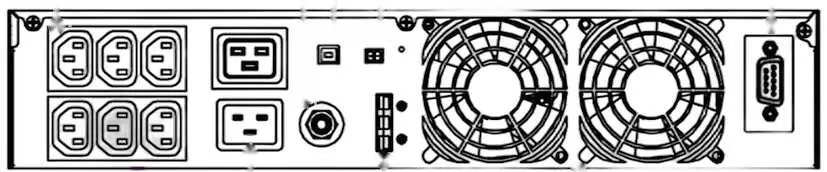
- Output sockets: 1 kVA 6 × IEC C13; 2–3 kVA 6 × IEC C13 + 1 × IEC C19.
- Input socket: IEC C14 (1 kVA) or C20 (2–3 kVA).
- Over-current protector on the rear panel.
- USB port for the power management software: monitoring and remote ON / OFF.
- EPO connector: connecting its two ports closes the UPS output. To recover, disconnect the two ports, switch the UPS off and restart it.
- Battery connector: shipped disconnected for transport; after installation, take it from the package and plug it into the battery port on the rear panel.
- Cooling fans: one on 1 kVA, two on 2–3 kVA.
- Intelligent slot: DB9 port (RS232 + dry contact) as shipped; replaced with an optional card in three steps: remove the standard slot, fit and fix the optional card, connect the communication cable.
HOW IT WORKS
Online double conversion in two rack units
Mains → PFC AC/DC → DC/AC inverter → transfer switch → load, with a charger and a DC/DC stage linking the battery to the DC bus.
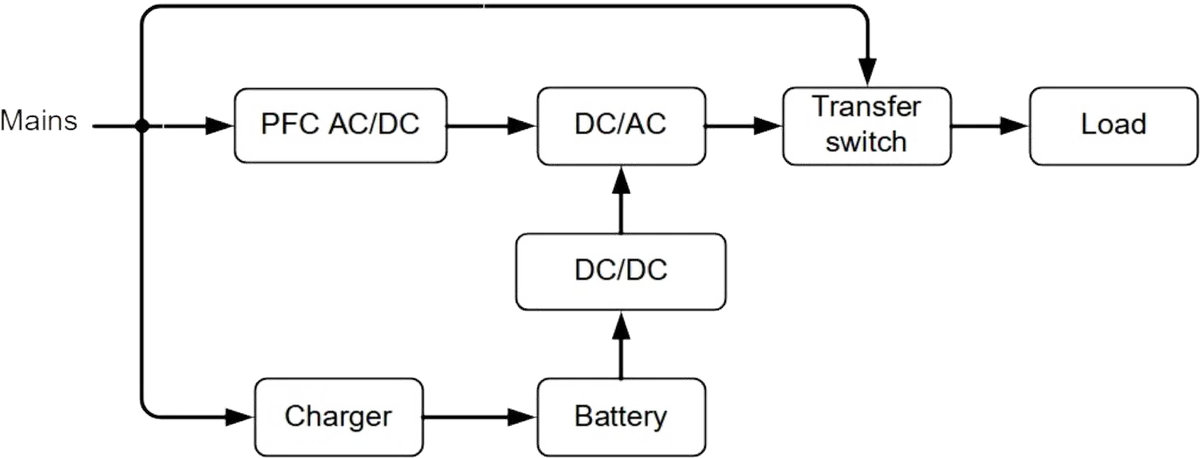
- Mains mode: PFC and inverter feed the load; the battery is charged.
- Battery mode: with the mains abnormal, the DC/DC boosts the battery onto the DC bus.
- Bypass mode: load fed from the mains through the transfer switch, e.g. after a load inrush; it returns automatically.
- ECO mode: selected from the setting page (ECO / INV).
- Output overload: 101–115% for 1 min, 116–133% for 1 s, > 134% for 200 ms.
- DC bus ±360 V from the mains through the PFC; ±380 V boosted from the battery.
- Input voltage range 120–295 V; 50 / 60 Hz auto-sensing, ± 10%.
| Fault code | Meaning |
|---|---|
| EPO | Emergency protection: bypass and inverter output closed |
| BUS | DC bus voltage fault: inverter output closed |
| TMP | Over-temperature: inverter output closed; check fans and air vents |
| OUT | Output fault: short circuit or load too large |
| MIF | More than 5 inverter faults within 5 minutes: UPS stays on bypass |
| BAT | Battery fault: voltage too low or too high |
| FAN | Fan fault alarm before protection |
CONNECTIVITY AND INSTALLATION
RS485 and dry-contact card
Outputs normally closed by default; jumpers CN1–CN3: NC = jumper 1–2, NO = jumper 2–3. Input signal below 60 V DC or 42 V AC RMS, below 1.25 A.
| Pin | Signal |
|---|---|
| 1 · 2 | Mains abnormal: COM · NC/NO |
| 3 · 4 | Battery under-voltage: COM · NC/NO |
| 5 · 6 | UPS failure: COM · NC/NO |
| 7 · 8 | RS485-A · RS485-B |
INSTALLATION
Installation, battery care and protections
Site conditions, battery maintenance and the protections and alarms built into the UPS.
- Flat surface, no vibration, gradient not more than 5°.
- Clearance of at least 300–500 mm around the UPS and 500 mm above it.
- Recommended 20–25 °C and about 50% RH; 0–95% RH non-condensing.
- Neutral-to-ground voltage below 5 V.
- Input breaker 1.5–2 times the max. input current, without leakage protection.
- Charge for 10 hours before first use; the UPS can be used meanwhile.
- Discharge and recharge every 4–6 months (every 2 months in hot areas).
- When not used for a long time, discharge and recharge every 3 months (charge for at least 10 hours).
- Protections: output over-voltage, battery under-voltage, input over-voltage, triple over-current protection; overload, short-circuit and over-temperature protection.
- Alarms: battery low voltage, mains abnormal, UPS fault, output overload.
- Do not connect unbalanced, half-wave rectified or inductive loads such as air conditioners, motors, drills or fluorescent lamps.
SERVICE
AEC service
service@aecups.com · +39 393 080 5211 · www.aecups.com
- 24/7 AEC technical assistance by phone and WhatsApp
- < 30 min WhatsApp reply to technical and commercial questions
- warranty 3 years on the UPS and 5 years on the lithium batteries; L6 lithium cabinets 5 years, extendable with a maintenance contract
- 21+ countries with spare parts across the Allis Electric group
Ordering codes IST8
| Code | Description |
|---|---|
IST8-1 | Online UPS 1 kVA, rack / tower, built-in lithium-ion battery |
IST8-2 | Online UPS 2 kVA, rack / tower, built-in lithium-ion battery |
IST8-3 | Online UPS 3 kVA, rack / tower, built-in lithium-ion battery |
SNMP | Internal SNMP card |
Diagrams
The IST8, in diagrams
The path of the power, the ratings, the footprints and the losses, drawn from the figures of the EMEA 2026 catalogue.
How the power flows
Pick an operating mode: the path the power takes to the load lights up.
Normal. Double conversion: the rectifier feeds the DC bus, the inverter rebuilds a clean voltage and the load always runs on the inverter. The battery stays on charge. Efficiency up to 93% (AC/AC, 3 kVA).
Battery. The mains fails: the battery feeds the DC bus and the inverter carries on without a break. The load does not notice. Transfer: 0 ms mains ↔ battery.
Bypass. Overload or internal fault: the static switch moves the load to the bypass line, fed by the mains.
ECO. The load runs on the bypass and the inverter stands ready: if the mains leaves the set window, the load goes back to the inverter. Higher efficiency, less protection.
The ratings
Every model in the range, in proportion to its power.
Phase configurations
Input / output: three-phase (3) or single-phase (1).
Documents
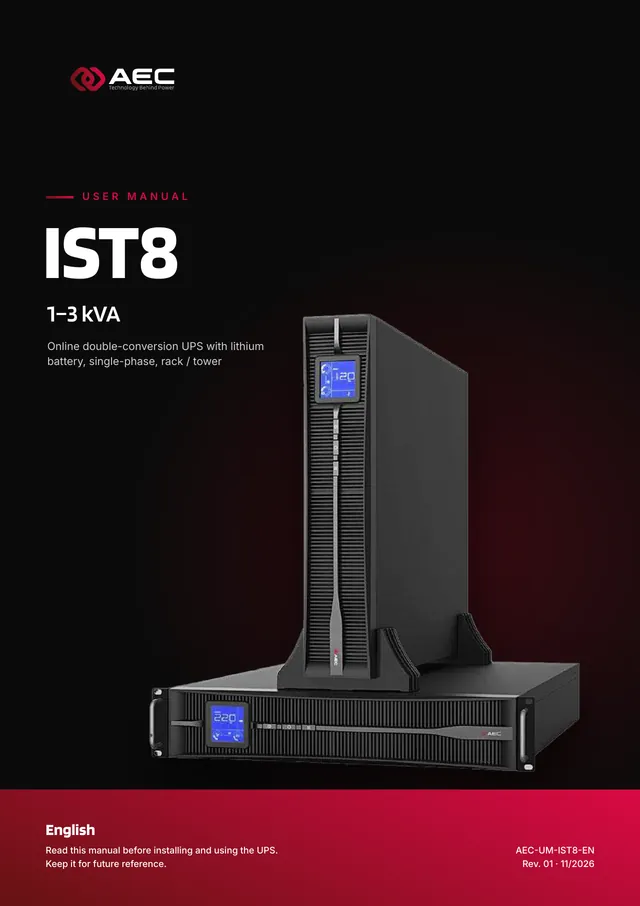
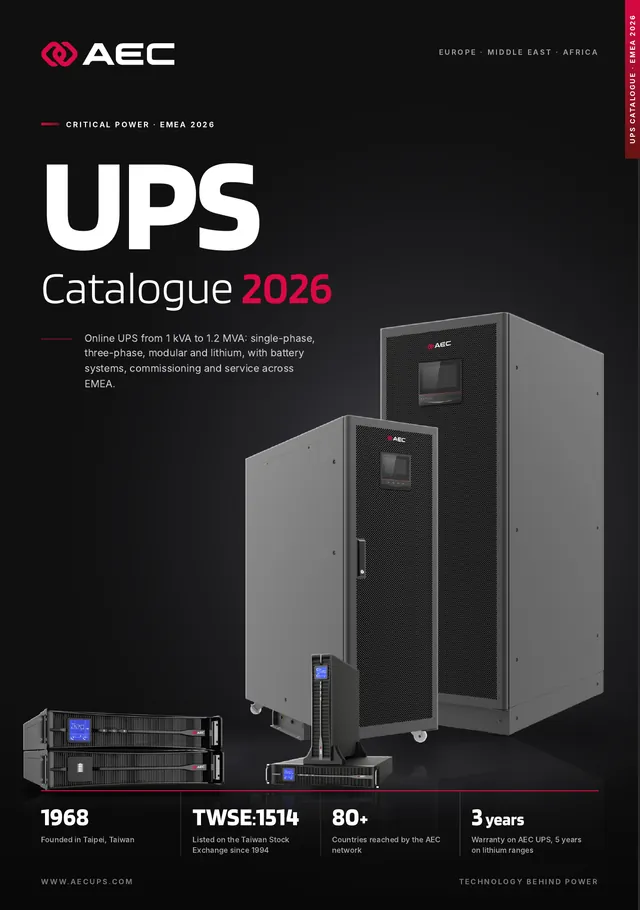
IST8 documents.
IST8 catalogue pages and manuals in English, as PDF.
Questions
Questions people ask
What battery does the IST8 use?
A lithium-ion battery built into the 2U chassis, with no separate battery box. It offers up to 8 years of service life and up to 1000 charge / discharge cycles.
What backup time does the IST8 give?
The internal battery gives 11 minutes of backup time, with a maximum charging current of 4 A. Down to 120 V of mains the battery does not discharge, so it stays at 100% for real outages.
Which IST8 model do I need for my load?
The output power factor is 1, so each kVA is a usable kW: the IST8-1 delivers 1000 W, the IST8-2 2000 W and the IST8-3 3000 W. Unbalanced, half-wave rectified or inductive loads such as air conditioners, motors, drills or fluorescent lamps must not be connected.
What are the IST8 dimensions and weights?
All ratings are 2U high and 438 mm wide for a 19-inch rack: the 1 kVA measures 438 × 423 × 86 mm (8.9 kg), the 2 and 3 kVA 438 × 570 × 87 mm (13.6 and 16.1 kg). The same unit mounts in a rack with two angle irons or stands as a tower on two supports.
Which voltages, inlets and outlets does the IST8 have?
The input accepts 120–295 V AC at 50 / 60 Hz, and the output is 208, 220 or 230 V ± 1%, set from the panel. The 1 kVA has an IEC C14 inlet and 6 × IEC C13 outlets; the 2–3 kVA have an IEC C20 inlet and 6 × C13 + 1 × C19 outlets.
What installation conditions does the IST8 need?
Leave at least 300–500 mm around the UPS and 500 mm above it, on a flat surface with no vibration and a gradient of not more than 5°. It operates from 0 to 60 °C (best 0–40 °C, output derated from 40 to 60 °C), with an input breaker of 1.5–2 times the maximum input current and no leakage protection.
Can the IST8 be monitored over SNMP?
Yes: USB with power management software is standard, and the intelligent slot (DB9, RS232 + dry contact as shipped) takes an optional SNMP card for remote monitoring and ON / OFF over the network. An RS485 and dry-contact card is also available, and an EPO connector is standard.
In the same family:IST3IST3-JSingle-phase UPS
Guides
Guides on the IST8
Talk to an AEC engineer
Tell us the load, the supply and the backup time you need for the AEC IST8 1–3 kVA: we answer with the model and the batteries that fit. AEC International sells through distributors in about 80 countries and an agency in every Italian region: ask AEC which one serves your area.