



















Single-phase UPS · 230 V
IST3 Single-phase online UPS 1–10 kVA, tower, 230 V
The AEC IST3 is a single-phase online double-conversion tower UPS for 230 V supplies: five ratings of 1, 2, 3, 6 and 10 kVA, with output power factor 1 (kVA = kW), 0 ms transfer and AC/AC efficiency up to 95.5%. Internal batteries or, for longer backup, external battery cabinets.
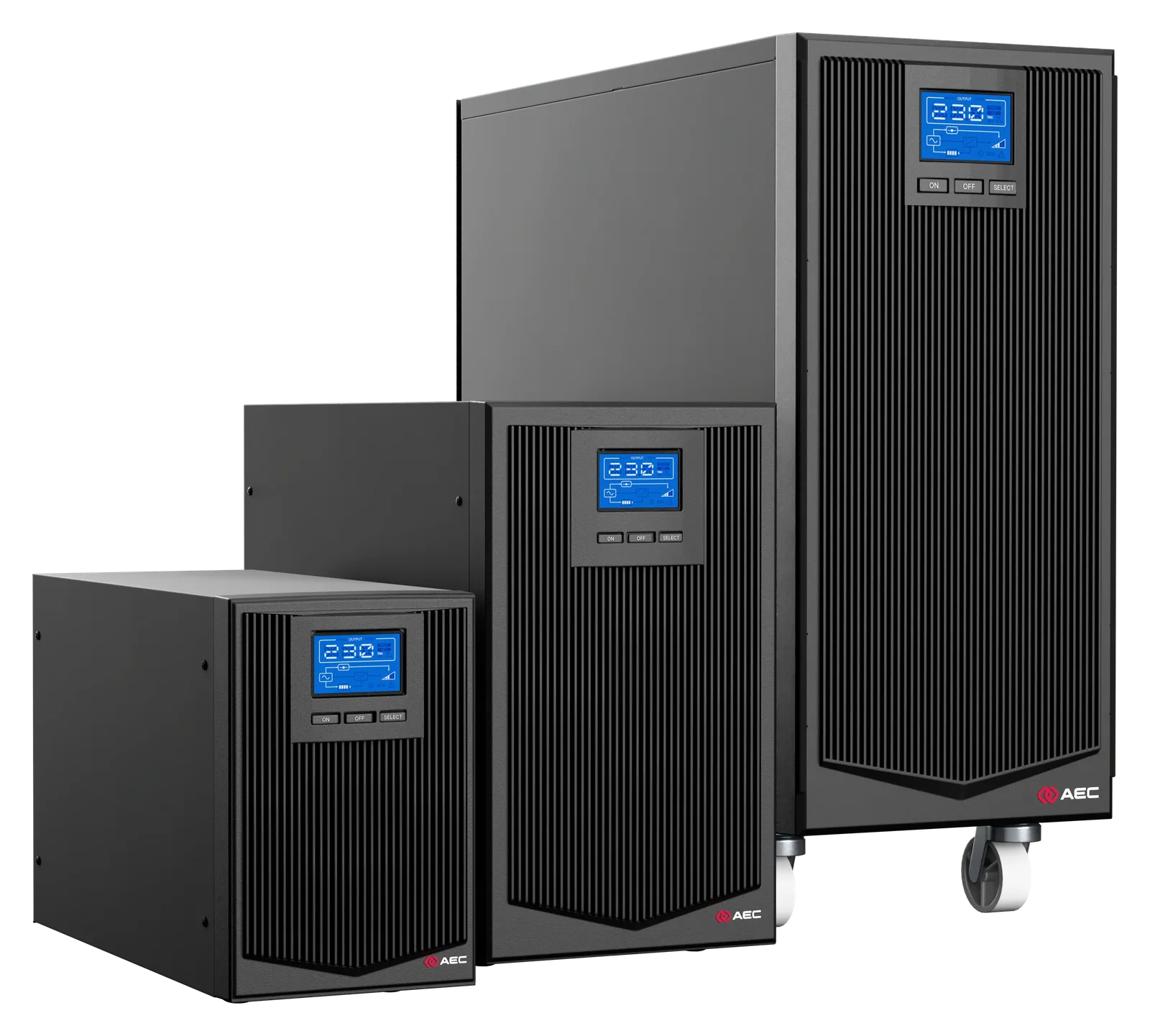
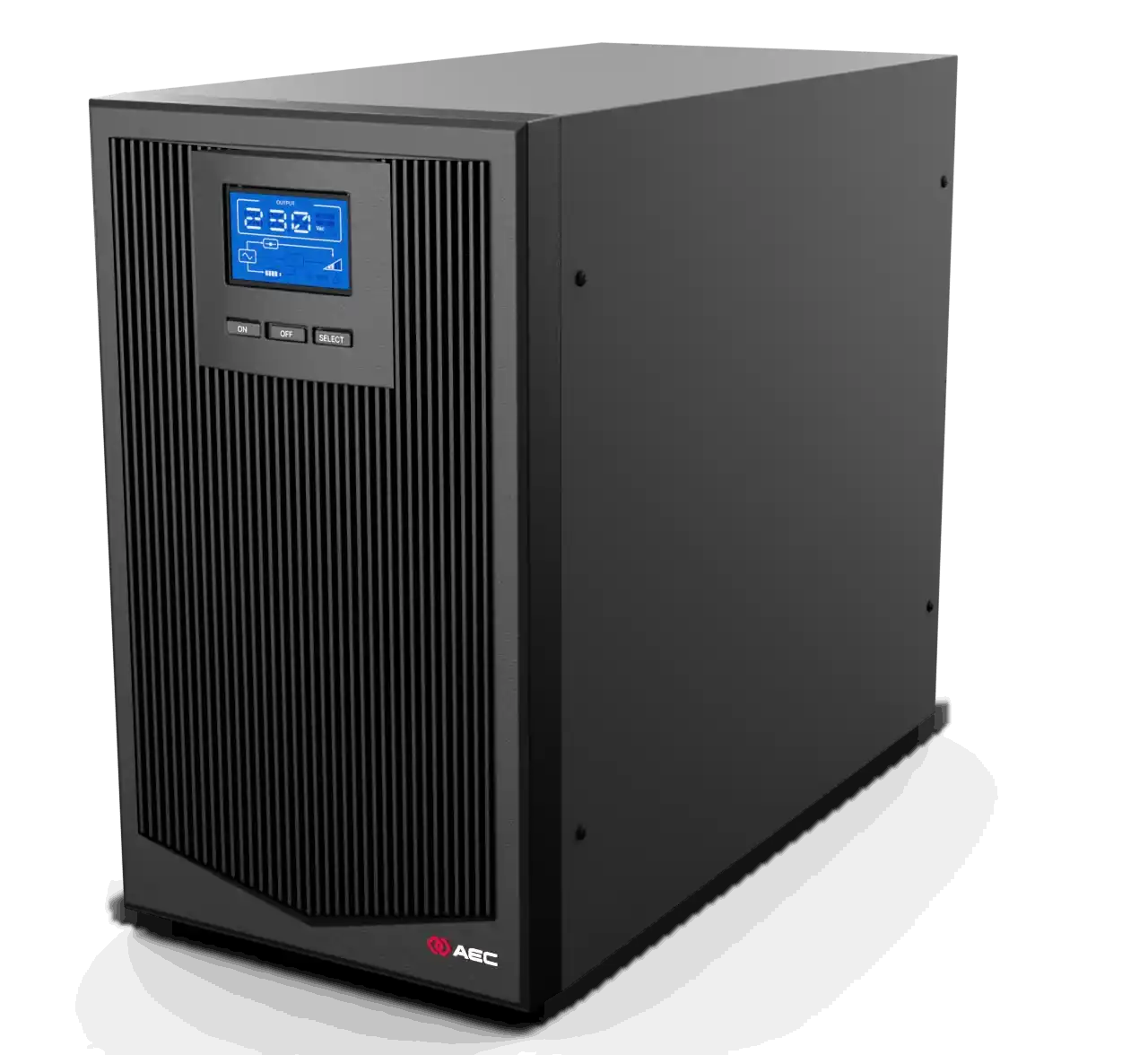 Drag to turn
In 3D
Look around the IST3
Drag it round, swipe on a phone or use the arrow keys. X-ray makes the enclosure see-through, so you can see what sits behind the panels.
Pick a size: the turn and the full 3D view follow it. Rendered from AEC's 3D models; the full 3D view zooms in, opens the unit and names every part.
Efficiency
How efficient is the AEC IST3 at your load?
AC/AC efficiency of each operating mode against the load: AEC's measured curves where they exist, elsewhere the typical curve derived from the datasheet figure by AEC's method. The losses and their cost follow the curve at the load you choose: drag along the chart or move the slider.
Filled points: measured by AEC (AC/AC technical datasheet). Hollow points: a typical curve, the shape of the most similar measured curve (same technology and size) moved to the range's datasheet efficiency: η(load) = reference curve + (datasheet figure − its highest point), AEC's method. Dashed lines: one figure without a load (ECO, W-ECO). Between points the efficiency is read on a straight line; beyond them, the nearest end. Losses = P × (1/η − 1). The IST3 pages of the EMEA 2026 catalogue give no efficiency figure. The 1, 2 and 3 kVA curves are the ones AEC measured on the IST3-J of the same rating (AEC technical datasheet IST3-J 1–3 kVA), which AEC states has the same electronics; the 6 and 10 kVA curve has the same shape, moved to their 95.5% figure.
- Load
- —
- Lost as heat
- —
- Energy lost in a year, 24/7
- —
- Its cost in a year at € per kWh
- —
- The catalogue's examples use €0.20 per kWh.
Where each figure comes from
| Mode | Efficiency | Kind | Models | Source |
|---|---|---|---|---|
| Online, double conversion | 30%: 86.14% · 50%: 88.7% · 75%: 90.06% · 100%: 90.83% | Measured (AEC datasheet) | IST3-1 | AEC technical datasheet IST3-J 1–3 kVA: AC/AC efficiency |
| ECO | 98.3% | Datasheet figure, load not stated | all | AEC technical datasheet IST3-J 1–3 kVA: AC/AC efficiency |
| Online, double conversion | 30%: 89.36% · 50%: 91.23% · 75%: 92.16% · 100%: 92.56% | Measured (AEC datasheet) | IST3-2 | AEC technical datasheet IST3-J 1–3 kVA: AC/AC efficiency |
| Online, double conversion | 30%: 90.84% · 50%: 91.85% · 75%: 93.3% · 100%: 93.1% | Measured (AEC datasheet) | IST3-3 | AEC technical datasheet IST3-J 1–3 kVA: AC/AC efficiency |
| Online, double conversion | 30%: 93.04% · 50%: 94.05% · 75%: 95.5% · 100%: 95.3% | Typical curve, derived from the datasheet efficiency of 95.5% (AEC method) | IST3-6 · IST3-10 | AEC technical datasheet IST3-J 1–3 kVA: AC/AC efficiency |
The display
The IST3 1–10 kVA display
The real display, drawn by AEC's own simulator: pick a UPS state (normal, battery, bypass) or a main page.
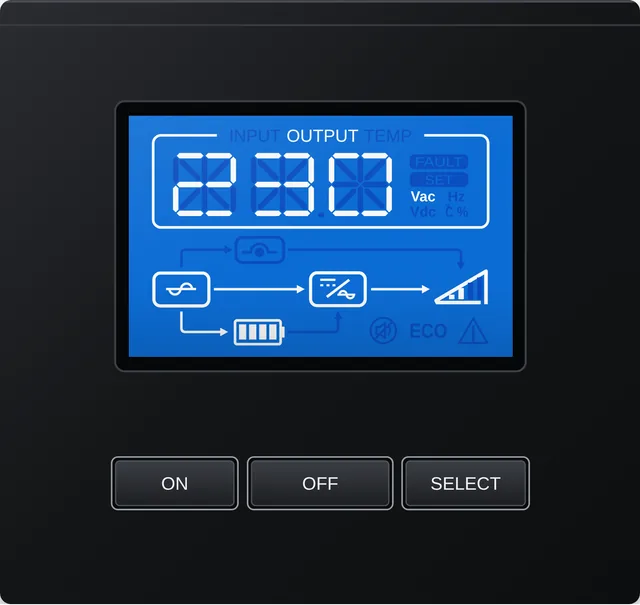
IST3 1–10 kVA · the real display
Output voltage
What is what
Inside the IST3, part by part.
Each number on the picture is named in the list.
Rear · 1 kVA
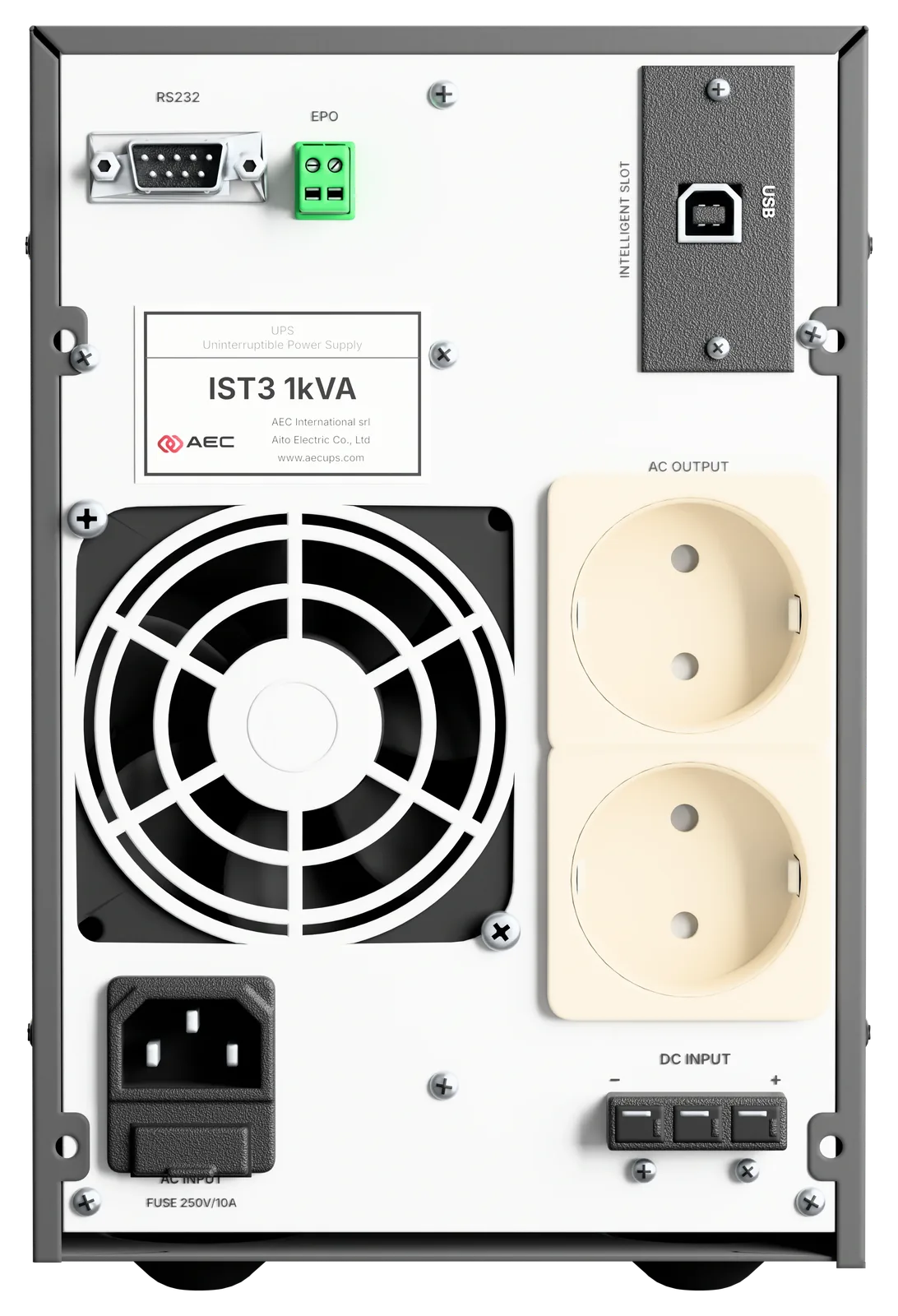
- RS232 portFor the UPS power management software: status and electrical data on the computer, remote ON / OFF.
- EPO inputOpening the EPO contact shuts down inverter and bypass output; keep it short-circuited (2-pin terminal supplied) for the UPS to run.
- USB and intelligent slotUSB as standard. The slot takes an optional SNMP card or an RS485 and dry-contact card (3 dry contacts), fitted from the rear.
- Schuko outputsTwo Schuko output sockets for the loads; generally not more than 5 A per socket.
- Cooling fanLeave 300–500 mm free at the rear and sides for the air flow.
- Mains input with fusePlug-in mains input socket, protected by a fuse.
- External battery connectorDC input for an external battery: standard on long backup models, optional on standard models.
Rear · 2–3 kVA
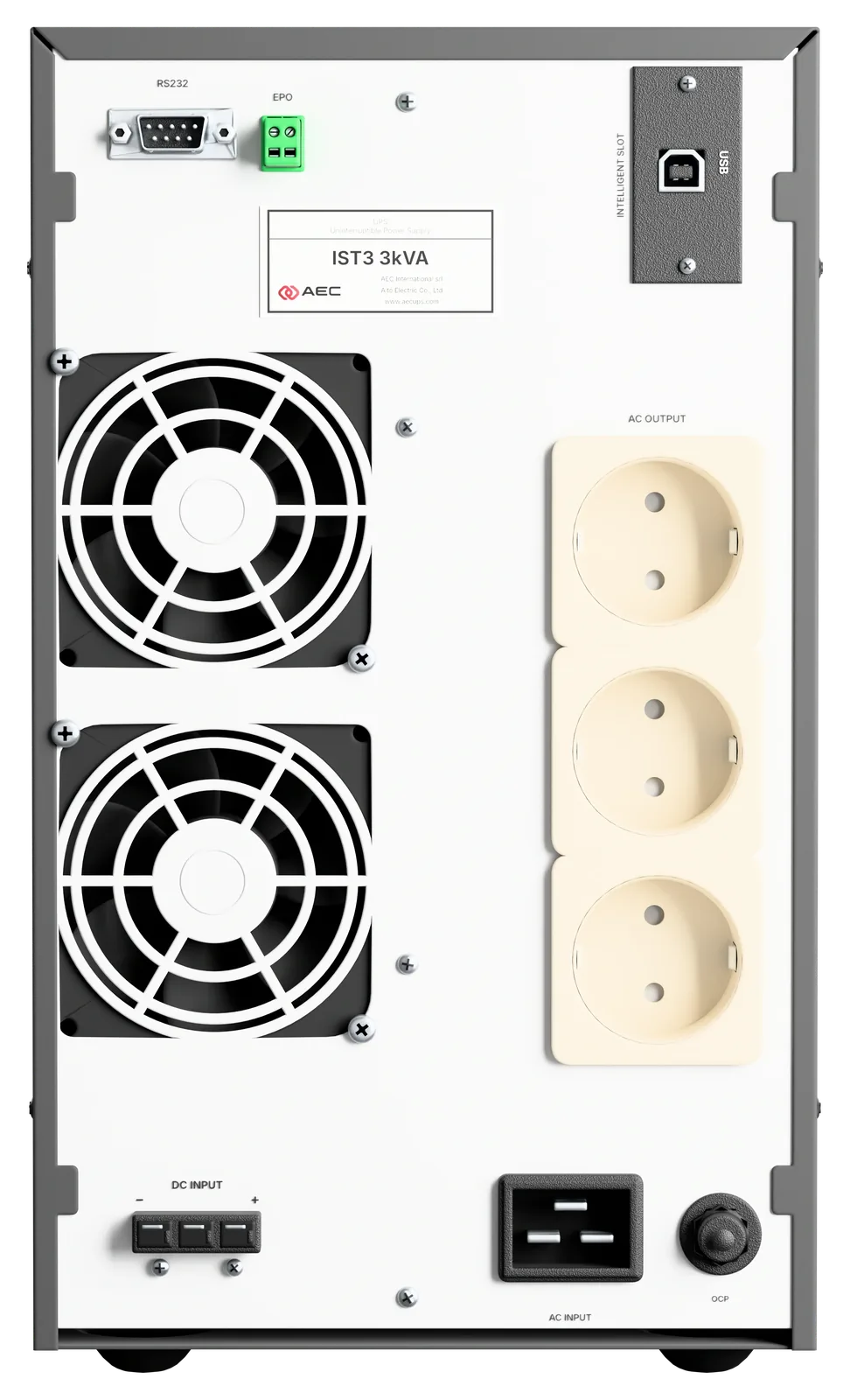
- RS232 portFor the UPS power management software: status and electrical data on the computer, remote ON / OFF.
- EPO inputOpening the EPO contact shuts down inverter and bypass output; keep it short-circuited (2-pin terminal supplied) for the UPS to run.
- USB and intelligent slotUSB as standard. The slot takes an optional SNMP card or an RS485 and dry-contact card (3 dry contacts), fitted from the rear.
- Schuko outputsThree Schuko output sockets for the loads; generally not more than 5 A per socket.
- Cooling fansLeave 300–500 mm free at the rear and sides for the air flow.
- External battery connectorDC input for an external battery: standard on long backup models, optional on standard models.
- Mains input socketPlug-in mains input: the UPS connects to a wall socket.
- Over-current protectorProtects the mains input of the 2–3 kVA models.
Rear · 6–10 kVA standard

- RS232 portFor the UPS power management software: status and electrical data on the computer, remote ON / OFF.
- EPO inputOpening the EPO contact shuts down inverter and bypass output; keep it short-circuited (2-pin terminal supplied) for the UPS to run.
- USB and intelligent slotUSB as standard. The slot takes an optional SNMP card or an RS485 and dry-contact card (3 dry contacts), fitted from the rear.
- Maintenance bypass switchUnder its cover. To service the UPS or change the battery without stopping the load: switch the UPS off so it moves to bypass, remove the cover, turn the switch to bypass, then open the mains and bypass breakers.
- Battery, bypass and mains breakersThe three breakers of the UPS, left to right as marked: battery, bypass, mains.
- Terminal barInput, output and battery on screw terminals.
- Ground terminalGround cable with the same section as the AC cables.
- Ventilation grilleLeave 300–500 mm free at the rear and sides for the air flow.
Rear · 6–10 kVA long backup
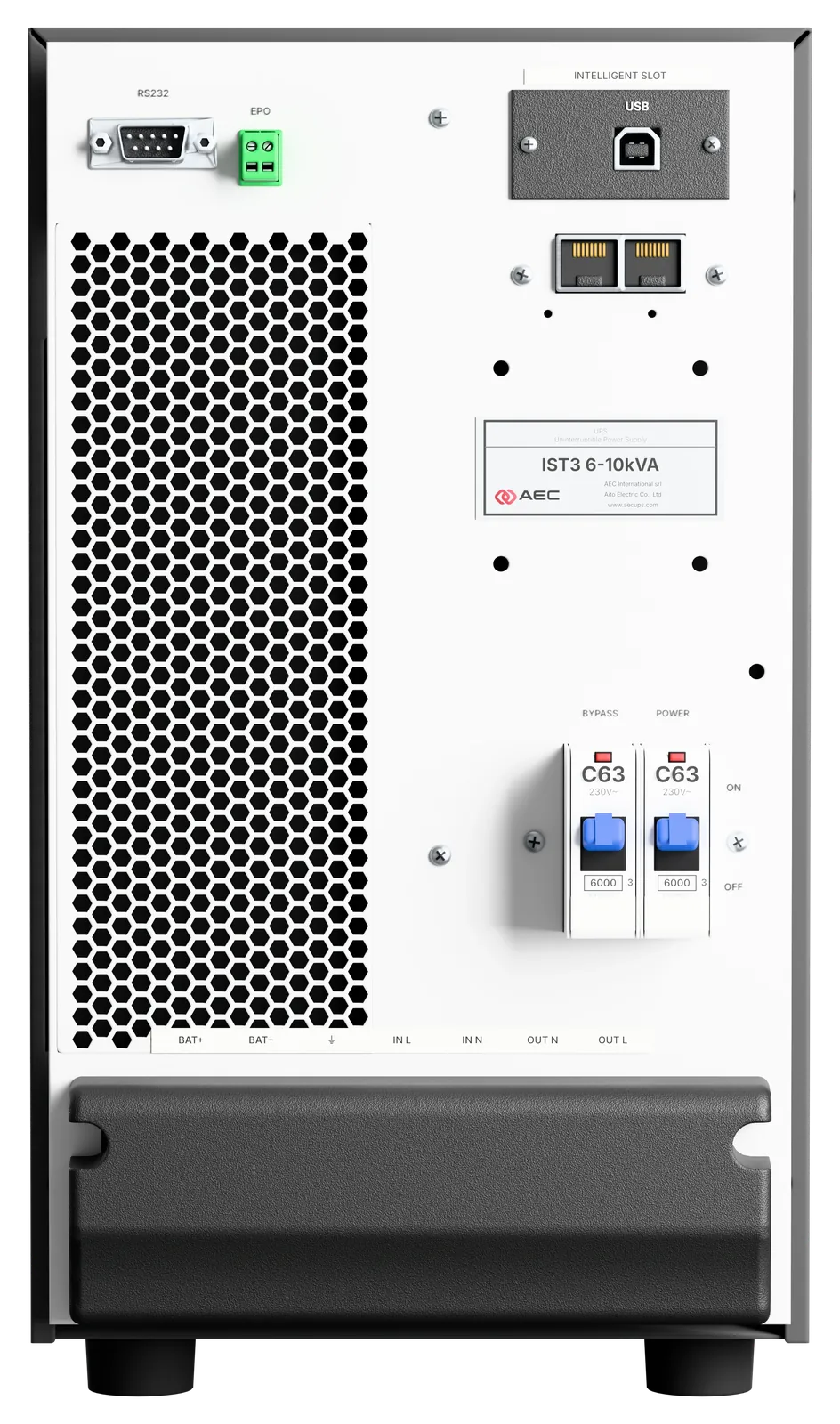
- RS232 portFor the UPS power management software: status and electrical data on the computer, remote ON / OFF.
- EPO inputOpening the EPO contact shuts down inverter and bypass output; keep it short-circuited (2-pin terminal supplied) for the UPS to run.
- USB and intelligent slotUSB as standard. The slot takes an optional SNMP card or an RS485 and dry-contact card (3 dry contacts), fitted from the rear.
- Mains and bypass breakersThe two breakers of the long backup model, marked POWER (mains) and BYPASS.
- Terminal barInput, output and battery on screw terminals; the battery goes to external battery cabinets.
- Ventilation grilleLeave 300–500 mm free at the rear and sides for the air flow.
Overview
Key facts
- Power range
- 1–10 kVA
- Input / output
- 1/1 · 208 / 220 / 230 / 240 V
- Efficiency
- 95.5% online double conversion · 98.3% ECO
- Battery
- 24 V · 48 V · 72 V · 192 V (16–20 × 12 V settable)
- Communication
- RS232 and USB standard · SNMP card or RS485 and dry-contact card optional · EPO
- Network card
- SNMP card (optional)
- Warranty
- 3 years
- Dimensions W × D × H
- 145 × 357 × 226 to 230 × 524 × 553 mm
Applications:Servers & data centresTelecom systemsFinance & stockNetworksRailwayPostal services
Pictures
The IST3 in pictures
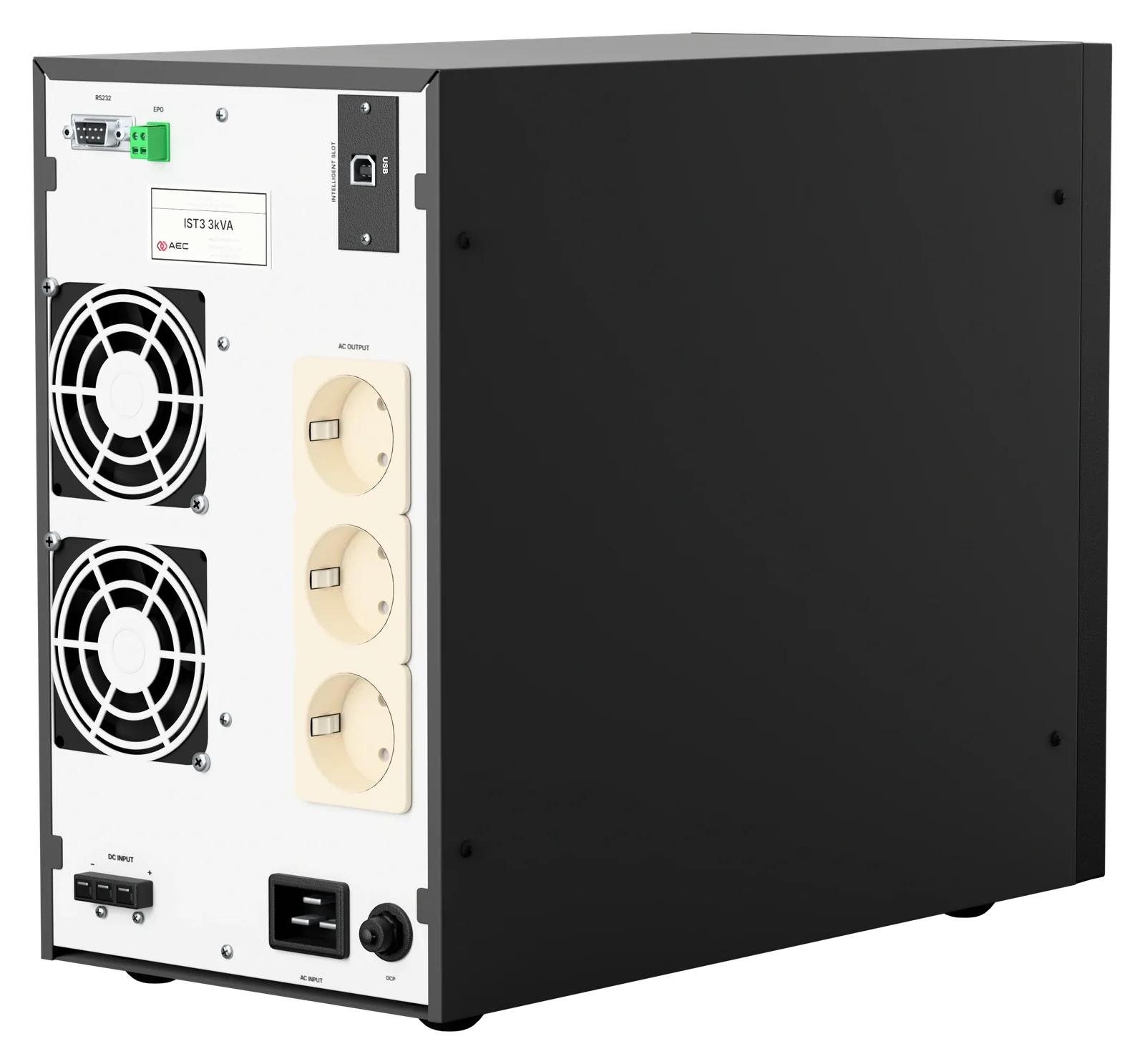
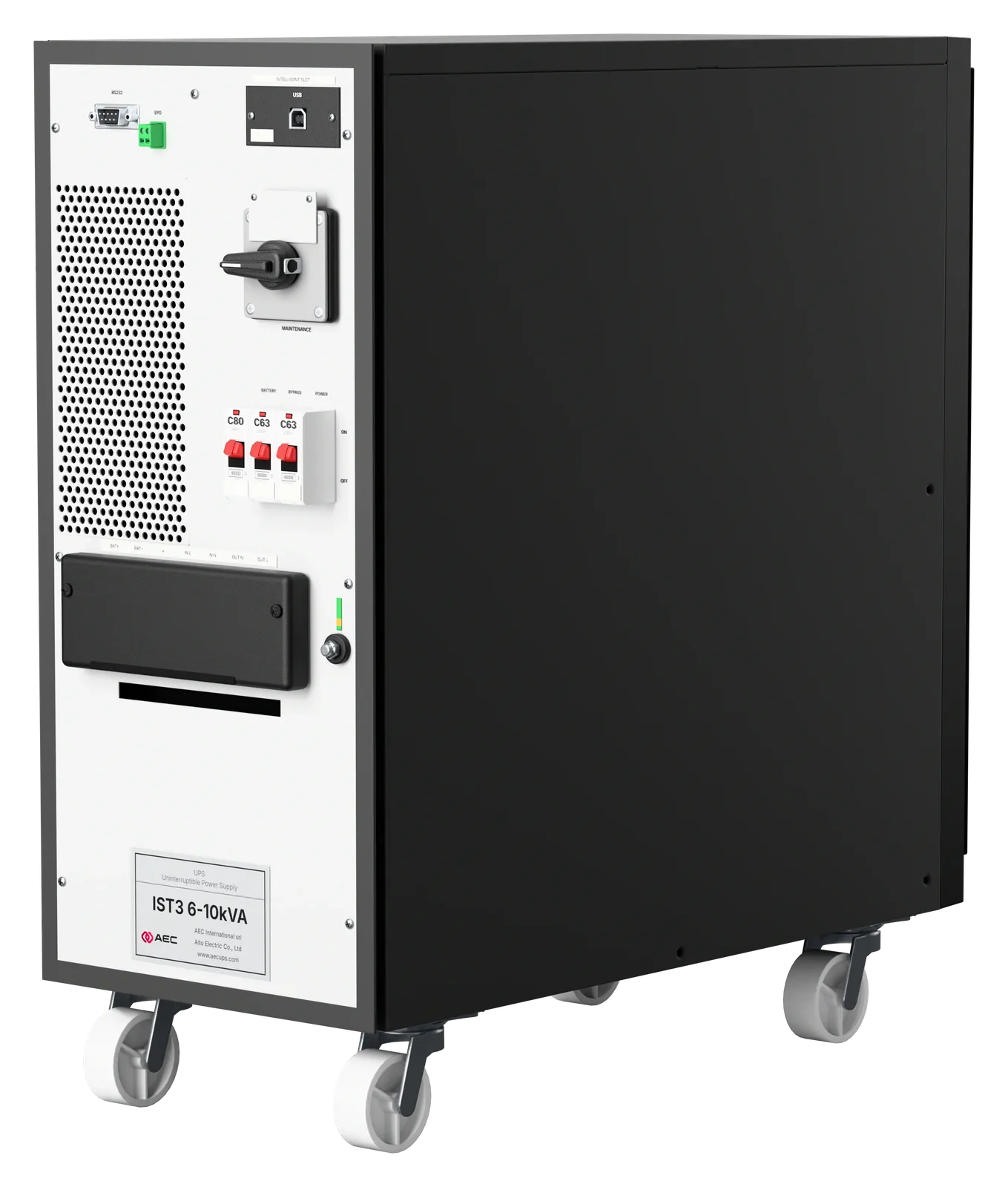
The photos and drawings of the EMEA 2026 catalogue: product views, displays, modules and connections. Tap a picture to enlarge it.
Models
Which IST3 fits your load?
Every rating has its own page: that model's technical data, ordering codes, batteries and the questions people ask.
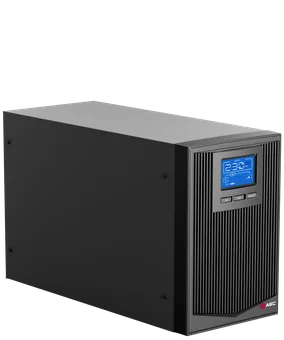
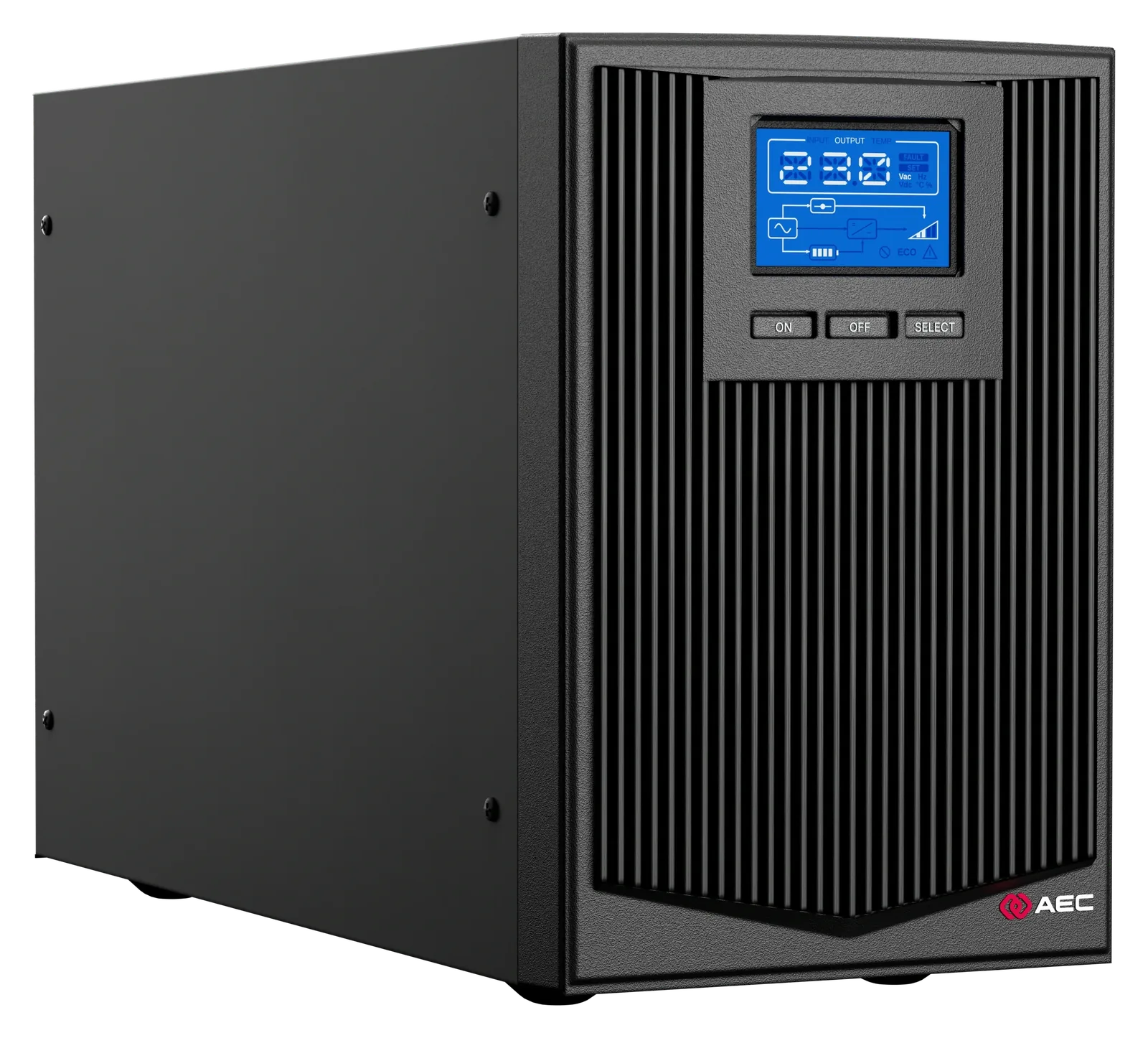 IST3-11 kVAThe IST3-1 is a 1 kVA / 1000 W single-phase online double-conversion tower UPS with two internal 12 V 9 Ah batteries.145 × 357 × 226 mmSize8.5 / 4.6 kgWeightSee the model
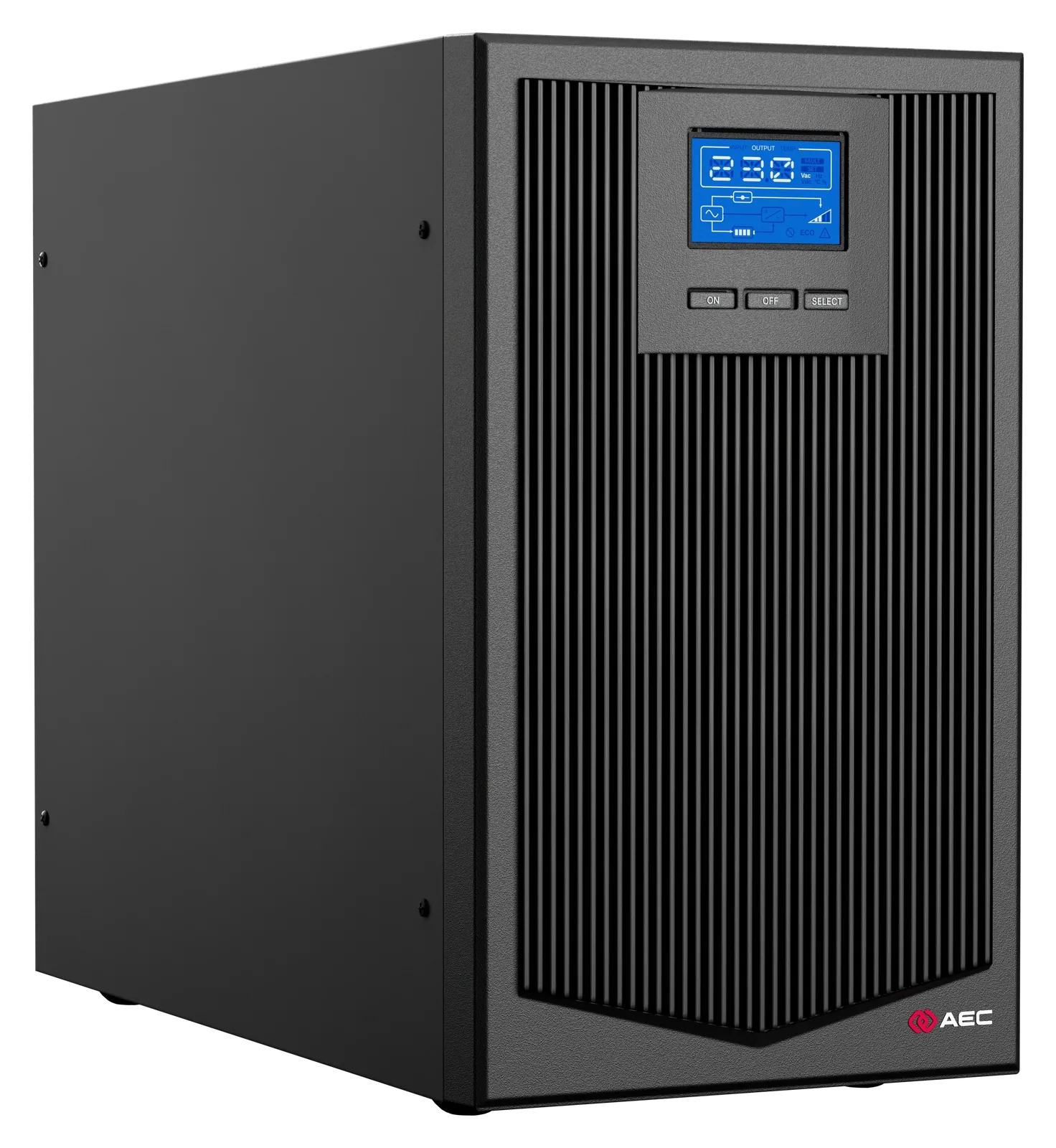 IST3-22 kVAThe IST3-2 is a 2 kVA / 2000 W single-phase online double-conversion tower UPS with four internal 12 V 9 Ah batteries.190 × 397 × 330 mmSize17.6 / 9.0 kgWeightSee the model IST3-33 kVAThe IST3-3 is a 3 kVA / 3000 W single-phase online double-conversion tower UPS with six internal 12 V 9 Ah batteries.190 × 397 × 330 mmSize22.5 / 9.2 kgWeightSee the model
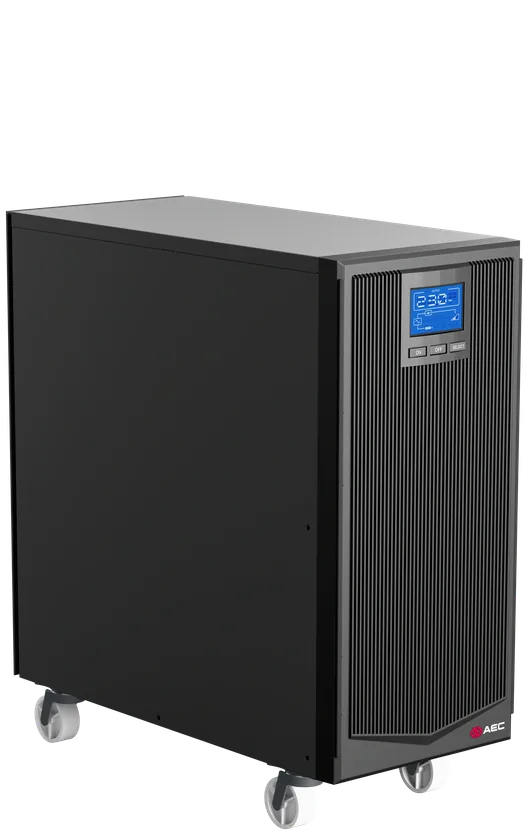
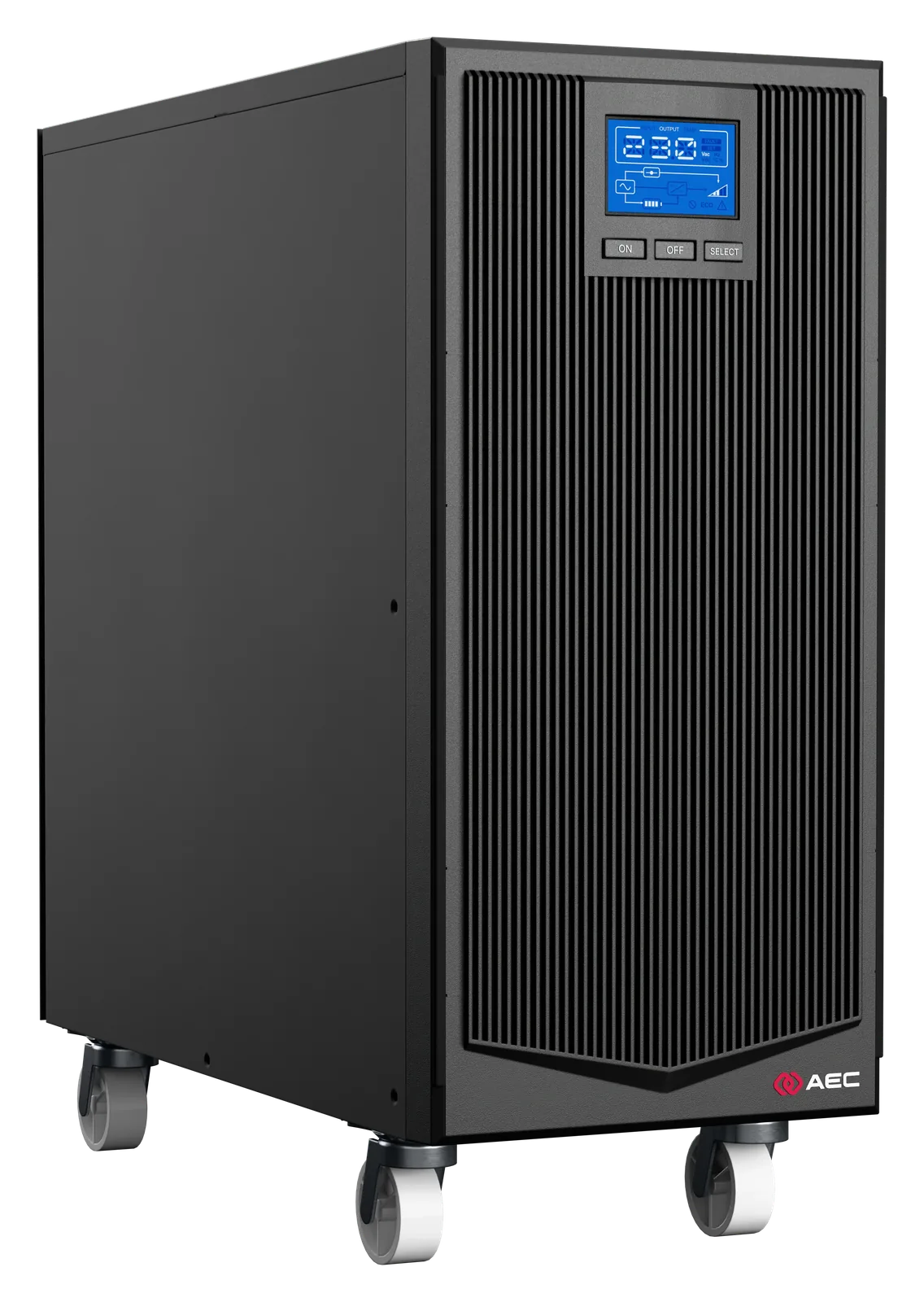 IST3-66 kVAThe IST3-6 is a 6 kVA / 6 kW single-phase online double-conversion tower UPS on wheels, with 16 internal 12 V 9 Ah batteries and its own maintenance bypass.230 × 524 × 553 mmSize54.5 / 11.0 kgWeightSee the model IST3-1010 kVAThe IST3-10 is a 10 kVA / 10 kW single-phase online double-conversion tower UPS, the largest IST3, with 16 internal 12 V 9 Ah batteries.230 × 524 × 553 mmSize56.2 / 12.5 kgWeightSee the model
Datasheet
Datasheet IST3.
Every model side by side: keep only what differs, take it as CSV or print it.
| Model | 1 kVA | 2 kVA | 3 kVA | 6 kVA | 10 kVA |
|---|---|---|---|---|---|
| Rating | |||||
| Power (VA / W) | 1000 / 1000 | 2000 / 2000 | 3000 / 3000 | 6000 / 6000 | 10000 / 10000 |
| Input | |||||
| Voltage range | 176–295 V full load · 154–176 V load < 75% · 120–154 V load < 50% | 176–275 V full load · 80–176 V linear derating | |||
| Frequency · connection | 50 / 60 Hz ± 10%, self-adapting · single phase, L + N + PE | ||||
| Output | |||||
| Voltage | 220 V ± 2% (default) · 208 / 220 / 230 / 240 V settable from the panel | ||||
| Frequency · waveform | 50 / 60 Hz ± 0.2% in battery mode · sine wave | ||||
| Voltage distortion | THD < 3% (linear load) | THD < 1% linear · < 4% non-linear | |||
| Power factor · transfer time | 1.0 (kVA = kW) · 0 ms mains to battery | ||||
| Overload | 100–130% 1 min · 130–150% 1 s · > 150% 200 ms | 105–130% 10 min (1 min above 30 °C) · 130–150% 30 s · > 150% 500 ms | |||
| Battery | |||||
| Voltage, standard model | 24 V | 48 V | 72 V | 192 V (16–20 × 12 V settable) | 192 V (16–20 × 12 V settable) |
| Voltage, long backup model | 36 V | 72 V | 96 V | 192 V | 192 V |
| Backup time, standard model | 3 min at full load | 5–20 min full / half load | 1–15 min full / half load | ||
| Charge recovery | standard model < 10 h · long backup: depends on the battery pack | ||||
| General | |||||
| Communication | RS232 and USB standard · SNMP card or RS485 and dry-contact card optional · EPO | ||||
| Protections | battery undervoltage, overload, short circuit, over-temperature, input overvoltage | ||||
| Noise | < 50 dB | < 50 dB | < 55 dB | < 55 dB | < 55 dB |
| Environment | −5 … 40 °C · 0–95% RH non-condensing · ≤ 1000 m without derating | ||||
| Dimensions W × D × H, standard | 145 × 357 × 226 | 190 × 397 × 330 | 230 × 524 × 553 mm | ||
| Dimensions W × D × H, long backup | 145 × 357 × 226 | 190 × 397 × 330 | 190 × 429 × 337 mm | ||
| Weight standard / long backup (kg) | 8.5 / 4.6 | 17.6 / 9.0 | 22.5 / 9.2 | 54.5 / 11.0 | 56.2 / 12.5 |
Specifications are subject to change without notice.
Full technical details11 sections of the EMEA 2026 catalogue: functions, panel, connections, diagrams and ordering codes
Why IST3
THE RANGE
Standard and long backup models
Every rating comes as a standard model with internal batteries or as a long backup model for external battery cabinets.

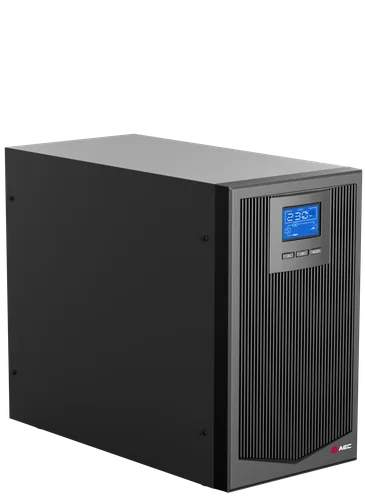

- Standard model heights: 226 mm (1 kVA, IST3-1), 330 mm (2 · 3 kVA, IST3-2 · IST3-3), 553 mm (6 · 10 kVA, IST3-6 · IST3-10).
- Backup at full load for 1–3 kVA; 6 and 10 kVA at full / half load.
- Long backup 6–10 kVA: 190 × 429 × 337 mm; 1–3 kVA long backup same size as the standard model.
- 6–10 kVA: 16 to 20 batteries of 12 V settable, 192 V by default.
- Battery voltage (12 V blocks), standard / long backup: 1 kVA 24 / 36 V · 2 kVA 48 / 72 V · 3 kVA 72 / 96 V · 6 kVA 192 / 192 V · 10 kVA 192 / 192 V.
- Weight, standard / long backup: 1 kVA 8.5 / 4.6 kg · 2 kVA 17.6 / 9.0 kg · 3 kVA 22.5 / 9.2 kg · 6 kVA 54.5 / 11.0 kg · 10 kVA 56.2 / 12.5 kg.
HOW IT WORKS
The load runs on the inverter
High-frequency online double conversion: in mains mode the inverter rebuilds a steady sine wave from the DC bus, and the battery takes over with no break.
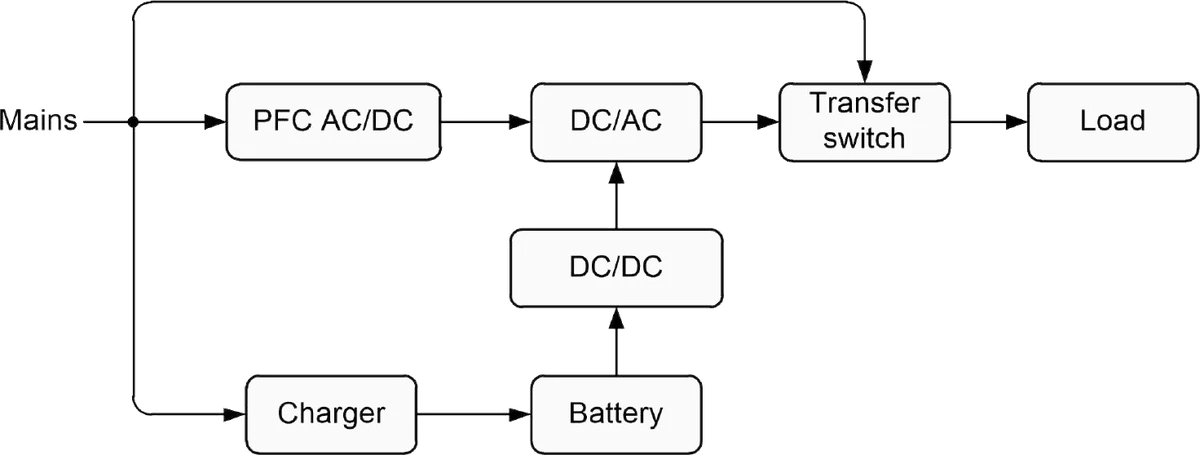
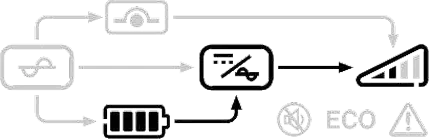
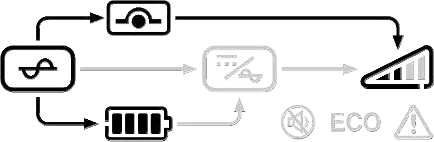
- Step 1 · PFC rectifier: with the mains normal, the active PFC turns the input into a steady ±360 V DC bus, with a high input power factor.
- Step 2 · Inverter: a half-bridge DC/AC inverter rebuilds a steady sine wave for the load, while the battery is charged.
- Step 3 · DC/DC boost: with the mains abnormal, a push-pull or boost DC/DC raises the battery voltage to the ±360 V bus: no break at the output.
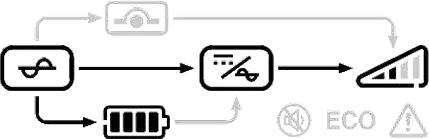
- Mains mode: mains normal, the inverter supplies the load and the battery is charged.
- Battery mode: mains abnormal, the battery is boosted to the DC bus and the inverter keeps running.
- Bypass mode: the load is supplied through the bypass while the battery is charged.
- ECO mode: selected on the panel (SELECT 5 s, confirm with ON); the LCD shows ECO.
- 0 ms transfer time · ±360 V DC bus · 50 / 60 Hz input, self-adapting, ±10% · ±0.2% output frequency in battery mode.
BATTERY-FRIENDLY
Mains for longer, battery when it counts
A wide input window runs from the mains through brownouts, so the battery is saved for real outages and stays charged.
- 1–3 kVA: 176–295 V at full load, 154–176 V with load below 75%, 120–154 V with load below 50%.
- 6–10 kVA: 176–275 V at full load, 80–176 V with linear derating.
- Input frequency 50 / 60 Hz ± 10%, self-adapting.
- Discharge time limit, 1–3 kVA (battery capacity has priority): no time limit with load below 75%; maximum discharge time 5.5 min at 75% load falling to 4.3 min at 90%, then 3.3 min at 90% falling to 3.0 min at 100%.
- Standard models: 75–90% load T = 18000 / (load % − 20) / 60; 90–100% load T = 18000 / load % / 60 (T in minutes).
- Backup time, standard models with internal batteries: 1, 2 and 3 kVA 3 min at full load; 6 kVA 5–20 min and 10 kVA 1–15 min at full / half load.
- Long backup models: backup time set by the external battery cabinet.
- Battery care: charge 10 hours before first use; discharge and recharge every 4–6 months (every 2 months in hot areas); in storage, recharge > 10 hours every 3 months; typical battery life 3–5 years, depending on temperature and use.
- < 10 h charge recovery (standard model) · 3 s battery test from the ON button.
1 · 2 · 3 KVA
Plug in, switch on
Input and output on sockets: connect the UPS to the wall socket and the loads to the Schuko outputs. The long backup model adds the external battery cable.
- 1 kVA rear panel: EPO connector · USB and intelligent slot (SNMP or RS485 / dry contact) · RS232 port · rating label · 2 × Schuko output · cooling fan · mains input socket with fuse · external battery connector.
- 2 · 3 kVA rear panel: RS232 port · EPO connector · USB and intelligent slot · rating label · 3 × Schuko output · cooling fans · external battery connector · overcurrent protector · mains input socket.
- The external battery connector is standard on long backup models and optional on standard models.
- Load current per output socket: generally not more than 5 A.
6 · 10 KVA
Terminal bar and maintenance bypass
Input, output and battery on a terminal bar. The standard model, on wheels, has its own maintenance bypass switch; the long backup model is compact and connects to external battery cabinets.
- Standard model: internal batteries, maintenance bypass, on wheels; 230 × 524 × 553 mm.
- Standard model rear: USB and intelligent slot · RS232 port · EPO connector · ventilation grille · maintenance bypass switch · mains, bypass and battery breakers · input, output and battery terminals · ground · rating label · wheels.
- Long backup model: external battery; 190 × 429 × 337 mm, 11.0 / 12.5 kg.
- Long backup model rear: USB and intelligent slot · RS232 port · EPO connector · rating label · ventilation grille · mains and bypass breakers · input, output and battery terminals.
- Maintenance bypass (standard 6–10 kVA): to service the UPS or replace the battery without stopping the load, switch the UPS off so it transfers to bypass, remove the maintenance bypass cover, turn the maintenance bypass switch to bypass, then switch off the mains and bypass breakers.
- The load is then fed through the maintenance bypass; the input, output and filter-board terminals stay live.
PANEL AND DISPLAY
The whole UPS on one screen
Three buttons and an LCD show the energy path, battery and load level, fault codes and settings, with no software needed.
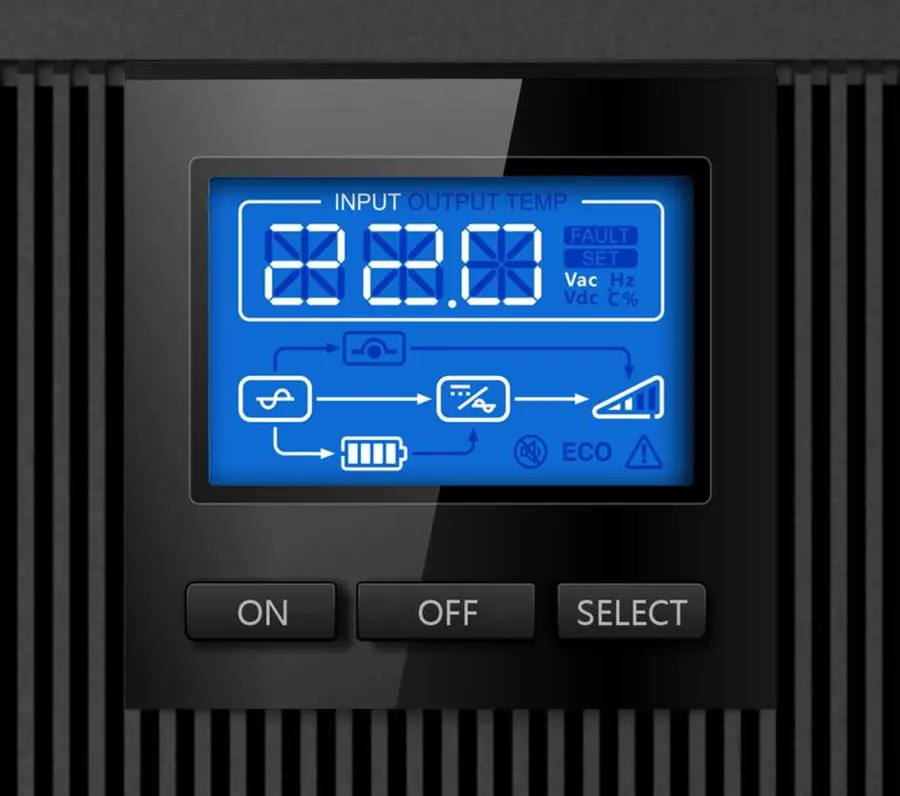
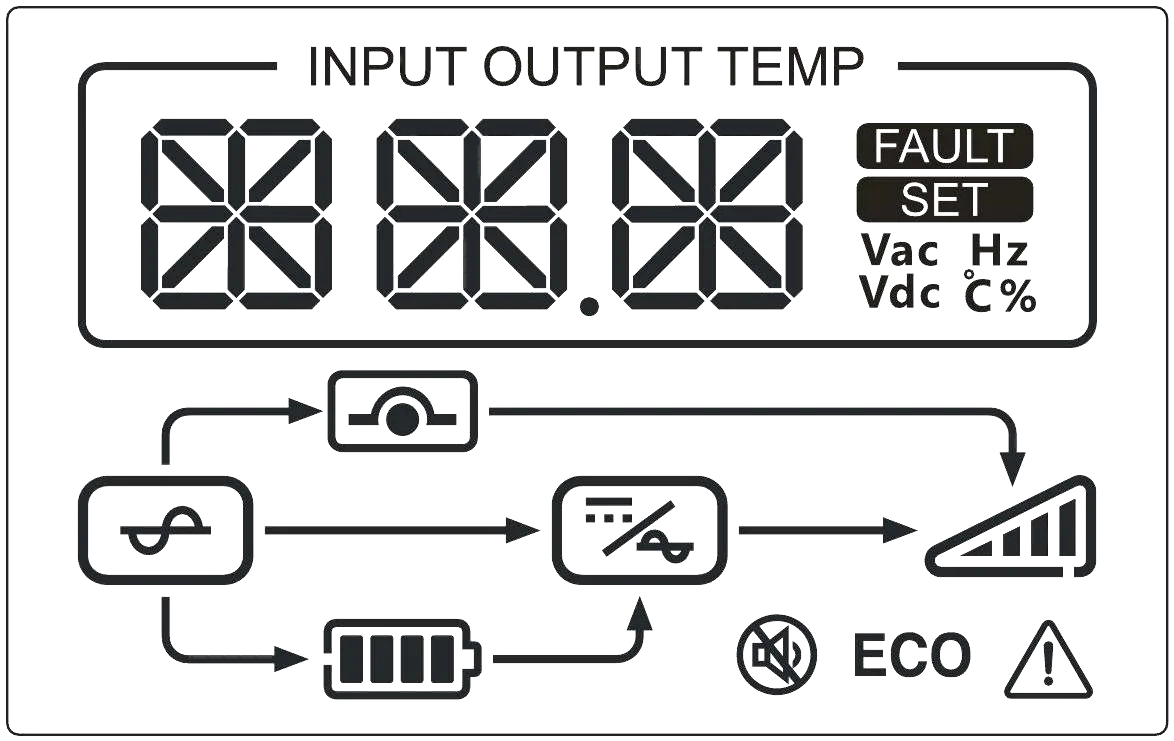
- Display area: input / output voltage and frequency, load, temperature, fault code, parameters, mode.
- Icons: mains (on: mains input normal) · bypass (on: UPS in bypass mode) · inverter (on: inverter working) · ECO (on: UPS in ECO mode) · silence (on: buzzer silenced) · alarm (on: UPS failure).
- Battery, 4 bars: running = charging · all on = full · all flashing = overvoltage · frame flashing = nearly empty. Load, 4 bars: load level; all flashing = load too large.
- ON: hold 1 s to switch on · in mains mode hold 3 s for a battery test · in battery mode hold 3 s to silence · hold 1 s to confirm a setting.
- OFF: hold 1 s to switch off. SELECT: press to scroll voltages, frequencies, battery, temperature, load and faults · hold 5 s for the setting page.
- Fault codes: EPO (long beep) emergency stop, bypass and inverter output closed · BUS (long beep) DC bus voltage fault, inverter output closed · TMP (long beep) over-temperature, check fans and air vents · FAN (every 0.2 s) fan alarm (0.2 s beep), then protection (long beep).
- OUT (long beep) output short circuit or load too large · BAT (long beep) battery voltage too low or too high · CHG (every 0.2 s) charger over-temperature or short circuit · BYP (every 2 s) bypass voltage or frequency abnormal.
- Settings: hold SELECT 5 s, scroll with SELECT, confirm by holding ON 1 s; without confirmation the page closes after 20 s. Settable: ECO or INV mode; output 208 / 220 / 230 / 240 V.
OVERLOAD AND PROTECTION
Overloads and protections
The inverter carries overloads for a set time before transferring, and the UPS protects battery, output, input, temperature, fans and charger.
- Overload 1–3 kVA: 100–130% 1 min, 130–150% 1 s, > 150% 200 ms.
- Overload 6–10 kVA: 105–130% 10 min (1 min above 30 °C), 130–150% 30 s, > 150% 500 ms.
- Protections: battery undervoltage and overvoltage · output overload and short circuit · input overvoltage · over-temperature · fan blocked or damaged · charger over-temperature and short circuit · EPO emergency power off.
- Alarms: battery low, mains abnormal, UPS failure, overload.
- Triple overcurrent protection: output overvoltage, battery undervoltage, input overvoltage and triple overcurrent protection solve the typical weak points of high-frequency UPS: poor adaptability to the grid and weak resistance to surges.
- Output power factor 1: kVA = kW.
- Output THD < 3% (1–3 kVA, linear load), < 1% (6–10 kVA, linear load).
- Do not connect unbalanced, half-wave rectified or inductive loads such as air conditioners, motors, drills or fluorescent lamps.
CONNECTIVITY
Always in touch with your UPS
RS232 and USB on every model; the intelligent slot takes an SNMP card or an RS485 and dry-contact card; the EPO input stops the UPS from a remote switch.
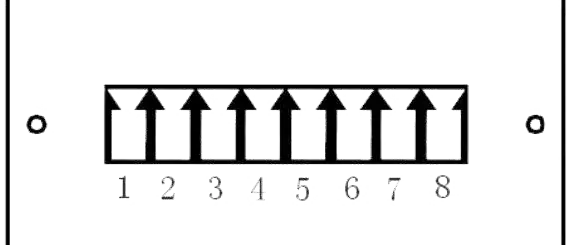
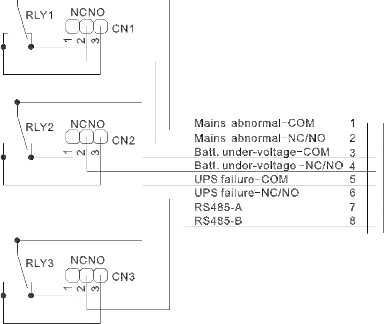
- RS232 and USB (standard): with the UPS power management software, status and electrical data on the computer, remote ON / OFF, SNMP adaptor support.
- Intelligent slot (optional): replace the standard slot with an SNMP card or an RS485 and dry-contact card; installed in three steps from the rear.
- EPO connector (standard): opening the EPO contact shuts down inverter and bypass output. Keep it short-circuited (2-pin terminal supplied) for the UPS to run.
- Dry-contact outputs normally closed by default; jumpers CN1–CN3 select NC (pins 1–2, default) or NO (pins 2–3). Input signal below 60 V DC or 42 V AC RMS, below 1.25 A.
| Pin | Signal |
|---|---|
| 1 · 2 | Mains abnormal: COM · NC/NO |
| 3 · 4 | Battery undervoltage: COM · NC/NO |
| 5 · 6 | UPS failure: COM · NC/NO |
| 7 · 8 | RS485-A · RS485-B |
INSTALLATION
Wall socket or terminal bar
1–3 kVA plug into a wall socket; 6–10 kVA connect on a terminal bar. Leave room for the air flow and size the input breaker for the model.
- Indoor, flat floor without vibration, tilt below 5°.
- At least 300–500 mm free at the rear and at the sides for ventilation.
- Input breaker 1.5–2 times the maximum input current, without leakage protection.
- Ground cable with the same section as the AC cable.
- −5 … 40 °C operating, 20–25 °C recommended · 0–95% RH non-condensing · ≤ 1000 m (above: reduce the rated power) · noise < 50–55 dB.
- Cables for about 5 m at 220 V; longer cables need larger sections. Battery cable for long backup models.
- 1–3 kVA, plug and play: input on a socket (1 kVA with fuse, 2–3 kVA with overcurrent protector), loads on the Schuko outputs; long backup models add the external battery connector.
- 6–10 kVA, terminal bar: input, output and battery on terminals; the standard model, on wheels, includes a maintenance bypass switch.
- Accessories: external rack maintenance bypass MBYP-3K (max. 3 kVA) or MBYP-6K (max. 10 kVA) for service without stopping the load.
- First start: 10 h first charge before use · hold ON 1 s to start · hold SELECT 5 s to set.
| Model | AC input max. (A) | AC breaker (A) | DC input max. (A, long backup) | DC breaker (A) | AC cable (mm²) | Battery cable (mm²) |
|---|---|---|---|---|---|---|
| 1 kVA | 6 | 10 | 37 | 50 | 1.5 | 6 |
| 2 kVA | 12 | 20 | 37 | 50 | 2.5 | 6 |
| 3 kVA | 18 | 32 | 42 | 50 | 4 | 6 |
| 6 kVA | 36 | 50 | 39 | 50 | 6 | 6 |
| 10 kVA | 60 | 100 | 65 | 100 | 10 | 10 |
Ordering codes IST3
| Code | Description |
|---|---|
IST3-1-2X9 · IST3-2-4X9 · IST3-3-6X9 | Standard models with internal 12 V 9 Ah batteries (2, 4, 6) |
IST3-6-16X9 · IST3-10-16X9 | 6 / 10 kVA with 16 internal 12 V 9 Ah batteries |
IST3-1-L · IST3-2-L · IST3-3-L | Long backup, external batteries only (36 / 72 / 96 V) |
IST3-6-L · IST3-10-L | Long backup 6 / 10 kVA, external batteries only |
IST3-[kVA]-[n]X9 | UPS with battery cabinet BB1, BB2 or BB3, n × 12 V 9 Ah in total |
DRYCNT-IST3/9 · SNMP | Dry-contact relay board · internal SNMP board |
MBYP-3K · MBYP-6K | External manual maintenance bypass, rack, max. 3 kVA · max. 10 kVA |
Diagrams
The IST3, in diagrams
The path of the power, the ratings, the footprints and the losses, drawn from the figures of the EMEA 2026 catalogue.
How the power flows
Pick an operating mode: the path the power takes to the load lights up.
Normal. Double conversion: the rectifier feeds the DC bus, the inverter rebuilds a clean voltage and the load always runs on the inverter. The battery stays on charge.
Battery. The mains fails: the battery feeds the DC bus and the inverter carries on without a break. The load does not notice. Transfer: 0 ms mains → battery.
Bypass. Overload or internal fault: the static switch moves the load to the bypass line, fed by the mains.
ECO. The load runs on the bypass and the inverter stands ready: if the mains leaves the set window, the load goes back to the inverter. Higher efficiency, less protection.
Maintenance. The maintenance bypass feeds the load straight from the mains, so the UPS can be isolated for service without switching the load off. built in on the 6–10 kVA standard models; on the others through the external MBYP-3K / MBYP-6K.
The ratings
Every model in the range, in proportion to its power.
Phase configurations
Input / output: three-phase (3) or single-phase (1).
Documents
IST3 documents.
IST3 catalogue pages and manuals in English, as PDF.
Questions
Questions people ask
What backup time does the IST3 give with its internal batteries?
With the internal 12 V 9 Ah batteries, the 1, 2 and 3 kVA standard models give 3 minutes at full load. The 6 kVA gives 5 minutes at full load and 20 minutes at half load, the 10 kVA 1 and 15 minutes. For longer backup, the long backup models connect to external battery cabinets, which set the backup time.
What is the difference between a standard and a long backup IST3?
Standard models have internal 12 V 9 Ah batteries (2, 4, 6 or 16 depending on the rating); long backup models (-L) have no internal batteries and run on external cabinets at 36, 72, 96 or 192 V. The 1–3 kVA long backup models are the same size as the standard ones, while the 6–10 kVA long backup unit measures 190 × 429 × 337 mm and weighs 11.0 / 12.5 kg.
Which IST3 rating do I need for my load?
Compare your load in watts with the rated power: 1000 W (1 kVA), 2000 W (2 kVA), 3000 W (3 kVA), 6000 W (6 kVA) and 10,000 W (10 kVA), at output power factor 1. Do not connect unbalanced, half-wave rectified or inductive loads such as air conditioners, motors, drills or fluorescent lamps.
Which input and output voltages does the IST3 accept?
The output is 220 V by default and can be set to 208, 220, 230 or 240 V from the front panel, with no software. On 1–3 kVA the UPS works from the mains, without the battery, from 176 to 295 V at full load and down to 120 V with load below 50%; on 6–10 kVA full load runs from 176 to 275 V, with linear derating down to 80 V.
How long do the IST3 batteries last and how should they be looked after?
Typical battery life is 3–5 years, depending on temperature and use. Charge for 10 hours before first use, then discharge and recharge every 4–6 months (every 2 months in hot areas); in storage, recharge for more than 10 hours every 3 months.
What are the IST3 dimensions and installation clearances?
Standard models measure 145 × 357 × 226 mm (1 kVA, 8.5 kg), 190 × 397 × 330 mm (2–3 kVA, 17.6 / 22.5 kg) and 230 × 524 × 553 mm (6–10 kVA, 54.5 / 56.2 kg, on wheels with a maintenance bypass switch). Leave at least 300–500 mm free at the rear and sides, on a flat floor tilted less than 5°, at −5 … 40 °C and up to 1000 m without derating.
Can the IST3 be monitored over the network with SNMP?
Yes: RS232 and USB are standard on every model, and the intelligent slot takes an optional SNMP card or an RS485 and dry-contact card with three contacts (mains abnormal, battery under-voltage, UPS failure). An EPO input is also standard.
In the same family:IST3-JIST8Single-phase UPS
Guides
Guides on the IST3
Talk to an AEC engineer
Tell us the load, the supply and the backup time you need for the AEC IST3 1–10 kVA: we answer with the model and the batteries that fit. AEC International sells through distributors in about 80 countries and an agency in every Italian region: ask AEC which one serves your area.