



















Three-phase UPS · 400 V
All-in-One Lithium UPS in one cabinet, 20 kVA
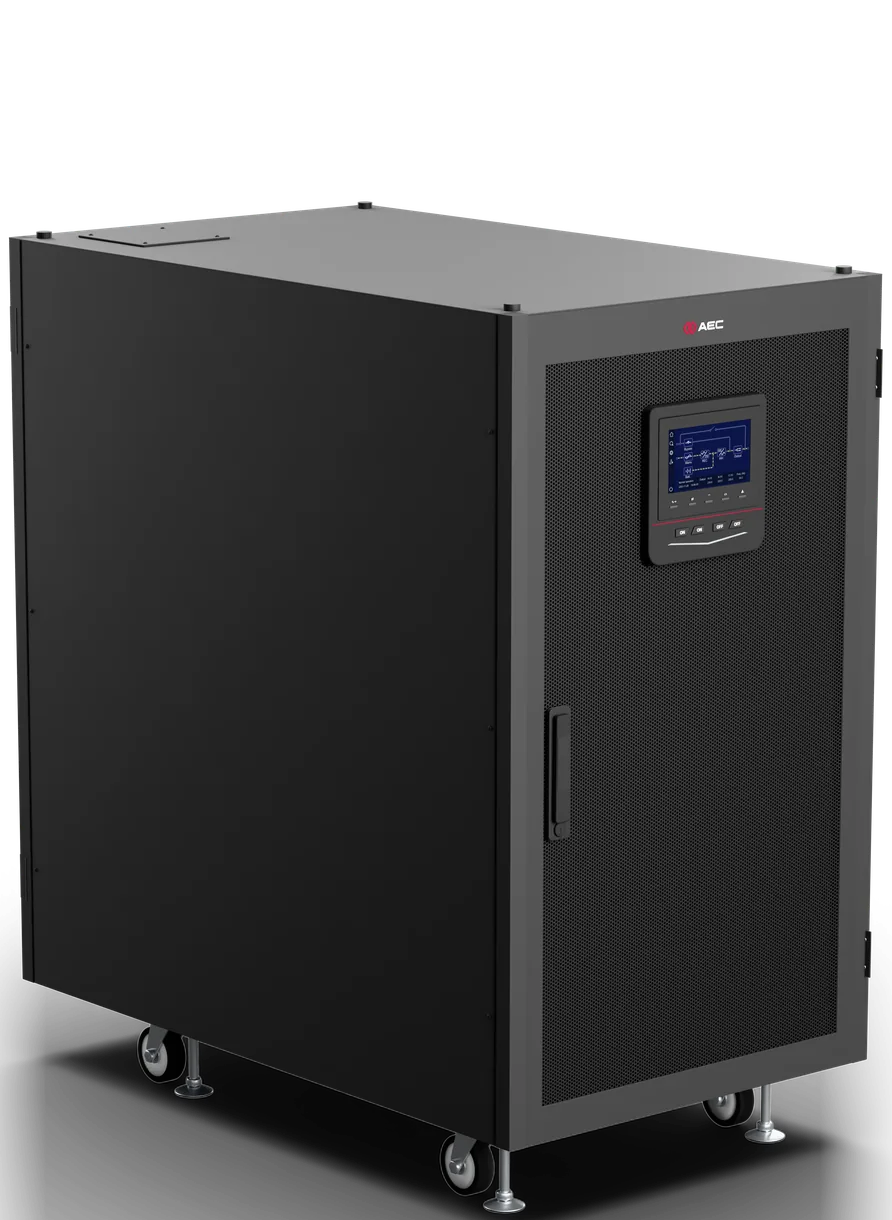
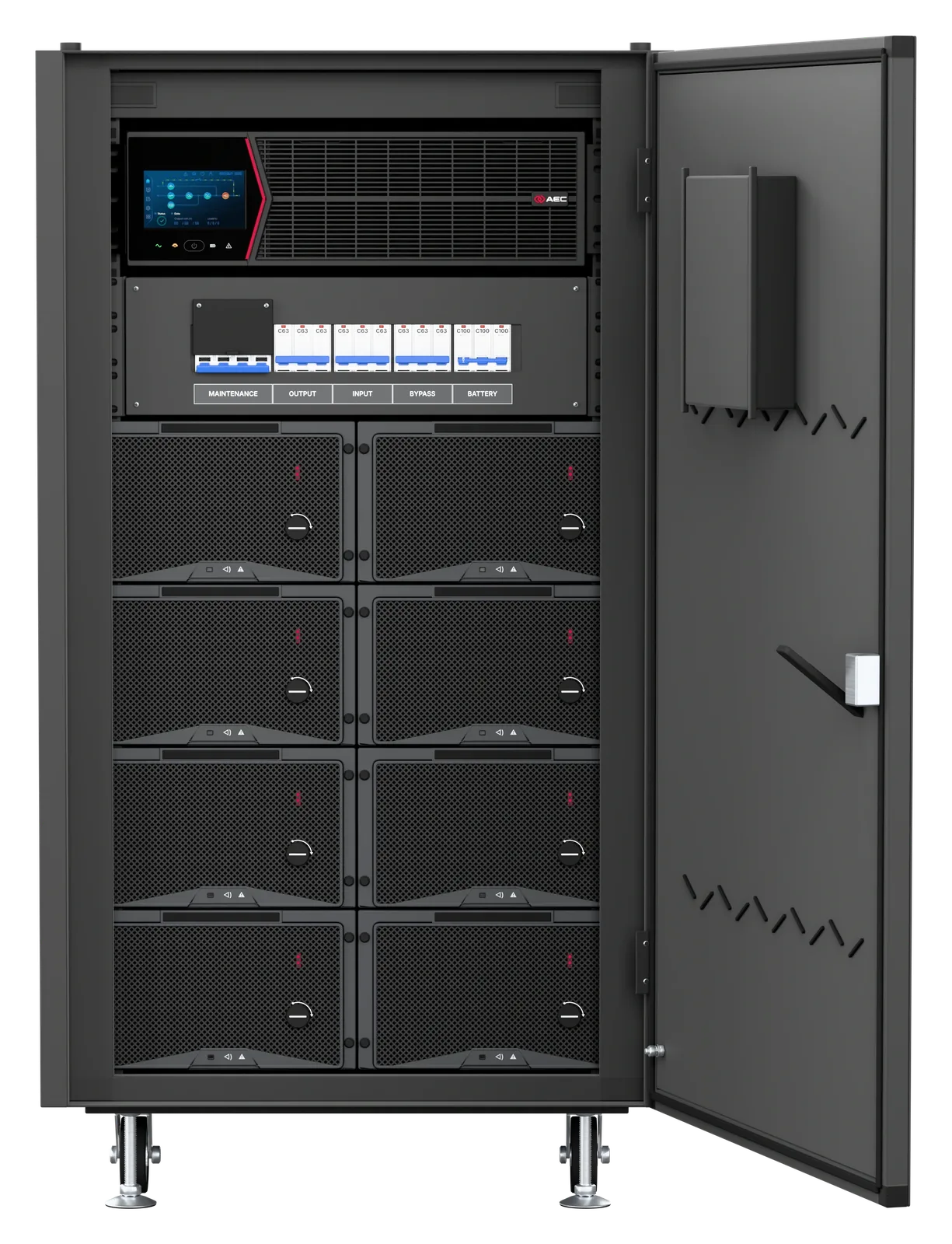
The AEC All-in-One puts an IST9 20 kVA online double-conversion UPS, its distribution switches with maintenance bypass and 2 to 8 hot-swappable 50 Ah LFP lithium modules, or four of 100 Ah, in one cabinet on castors. Three-phase, 3/3 or 3/1; cells rated for 5,000 cycles at 50% depth of discharge, 15 to 60 minutes at 20 kW and up to 200 minutes at 6 kW.
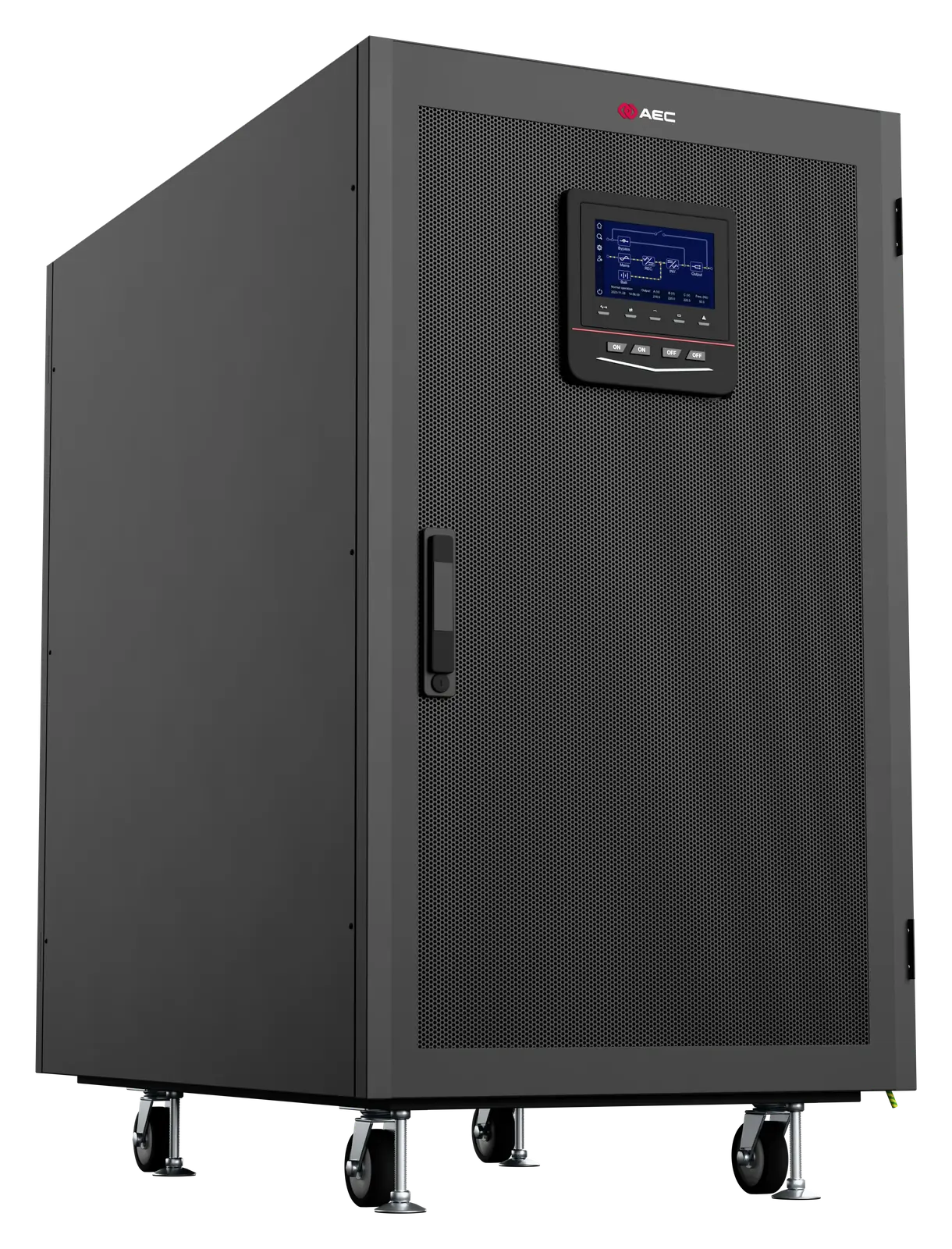
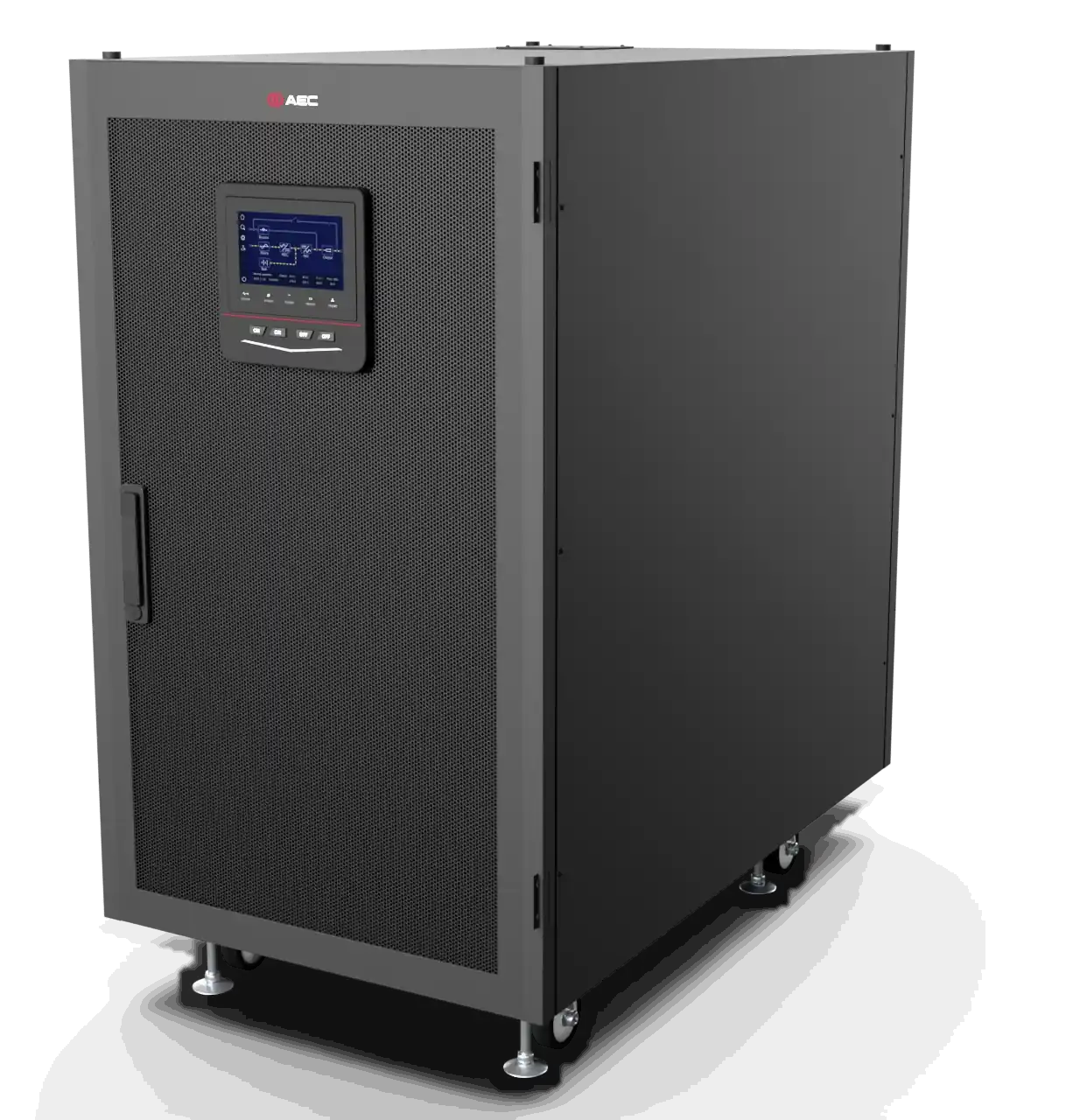 Drag to turn
In 3D
Look around the All-in-One
Drag it round, swipe on a phone or use the arrow keys. X-ray makes the enclosure see-through, so you can see what sits behind the panels.
Rendered from AEC's 3D model of the All-in-One 20 kVA. The full 3D view zooms in, opens the unit and names every part.
Hands on
Open the All-in-One 20 kVA yourself.
Click the unit: the door opens, then a module comes out. Drag to move it by hand. The 3D shows every part.

Efficiency
How efficient is the AEC All-in-One at your load?
AC/AC efficiency of each operating mode against the load: AEC's measured curves where they exist, elsewhere the typical curve derived from the datasheet figure by AEC's method. The losses and their cost follow the curve at the load you choose: drag along the chart or move the slider.
Filled points: measured by AEC (AC/AC technical datasheet). Hollow points: a typical curve, the shape of the most similar measured curve (same technology and size) moved to the range's datasheet efficiency: η(load) = reference curve + (datasheet figure − its highest point), AEC's method. Dashed lines: one figure without a load (ECO, W-ECO). Between points the efficiency is read on a straight line; beyond them, the nearest end. Losses = P × (1/η − 1).
- Load
- —
- Lost as heat
- —
- Energy lost in a year, 24/7
- —
- Its cost in a year at € per kWh
- —
- The catalogue's examples use €0.20 per kWh.
Where each figure comes from
| Mode | Efficiency | Kind | Models | Source |
|---|---|---|---|---|
| Online, double conversion | 25%: 95.4% · 50%: 96% · 75%: 95.7% · 100%: 95.4% | Typical curve, derived from the datasheet efficiency of 96% (AEC method) | All-in-One 20 kVA | AEC datasheet: AC/AC efficiency of the IST6-PM100 100 kW power module (the curve's shape) |
| ECO | 99% | Datasheet figure, load not stated | All-in-One 20 kVA |
EMEA 2026 catalogue figures: Online, double conversion up to 96% · ECO up to 99%.
Backup time
Every load, every number of modules.
All-in-One backup minutes from the EMEA 2026 catalogue: load down the side, lithium modules across. Touch a cell.
With 4 × 50 Ah modules and a 20 kW load: 30 minutes of backup.
| Load | 2 | 3 | 4 | 5 | 6 | 7 | 8 |
|---|---|---|---|---|---|---|---|
| 6 kW | |||||||
| 10 kW | |||||||
| 12 kW | |||||||
| 14 kW | |||||||
| 16 kW | |||||||
| 18 kW | |||||||
| 20 kW |
| Load | 4 |
|---|---|
| 6 kW | |
| 10 kW | |
| 20 kW |
Catalogue reference values, to be confirmed by actual measurement; AEC sizes every system. –: configuration not possible (at least two 50 Ah modules; the 100 Ah version always has four). All-in-One 20 kVA, IST9 three-phase: the load never exceeds 20 kW.
The display
The All-in-One display
The real display, drawn by AEC's own simulator: pick a UPS state (normal, battery, bypass) or a main page, or touch the screen as on the UPS.
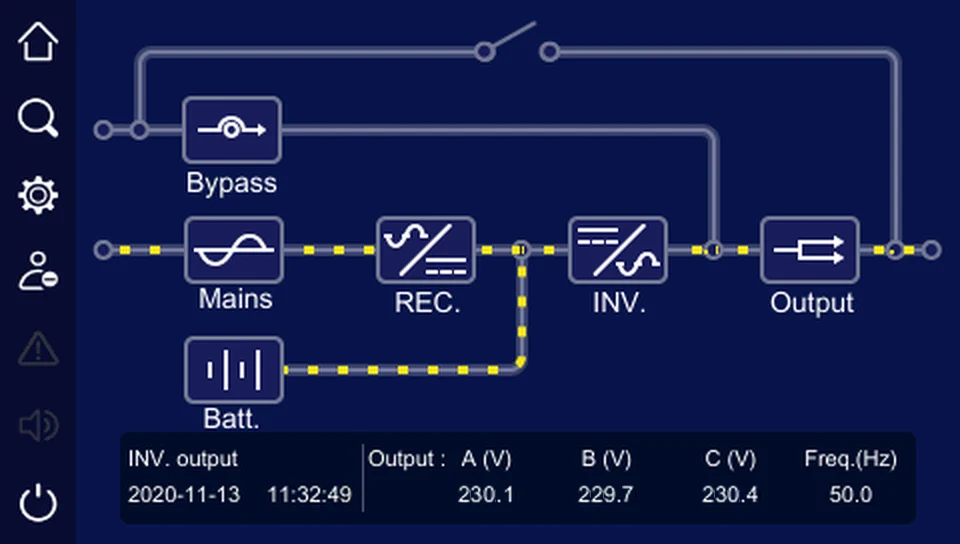
All-in-One · the real display
Normal
Normal: the rectifier and the inverter carry the load at 230 V per phase, 50 Hz, and charge the lithium modules.
What is what
Inside the All-in-One, part by part.
Each number on the picture is named in the list.
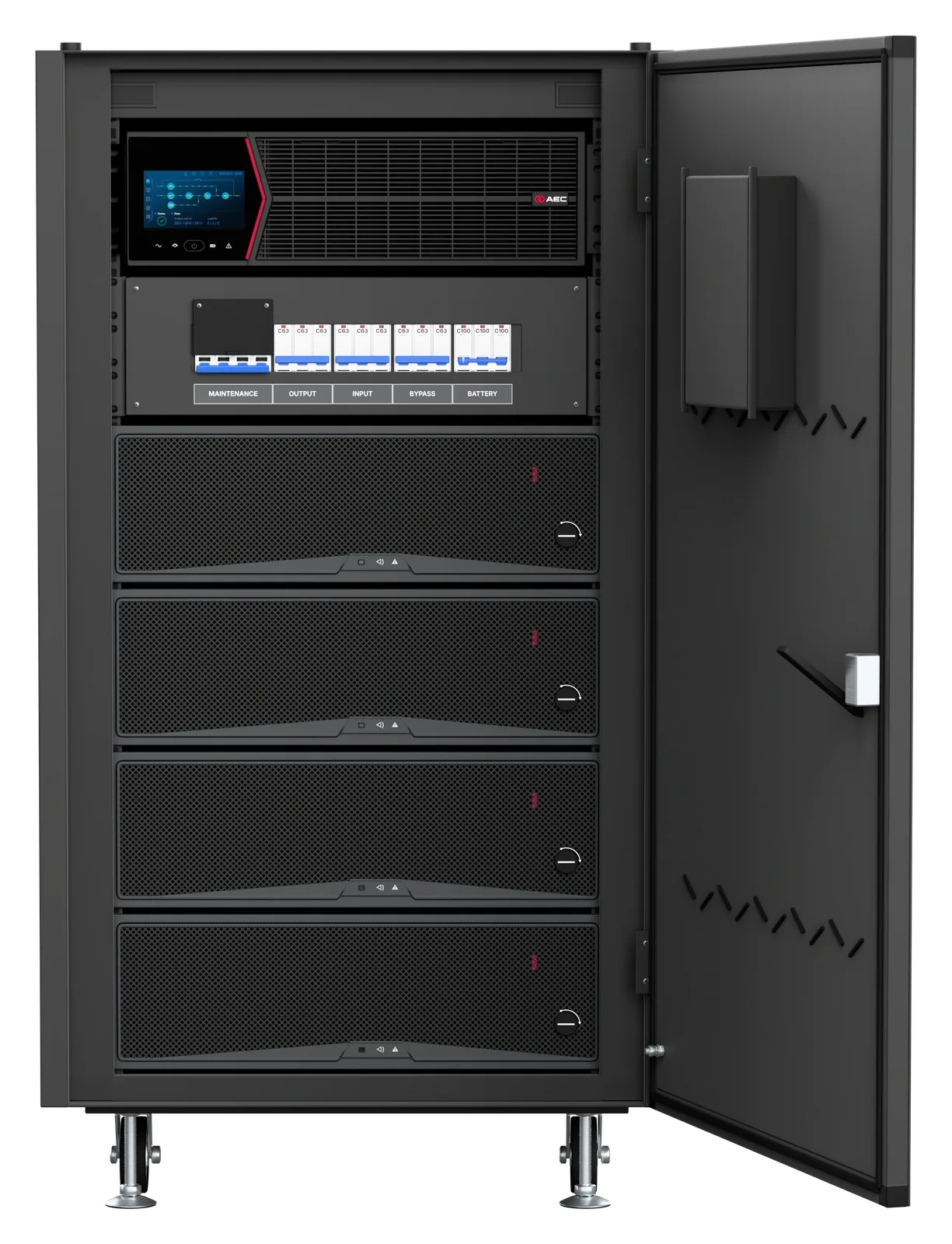
Front, door open

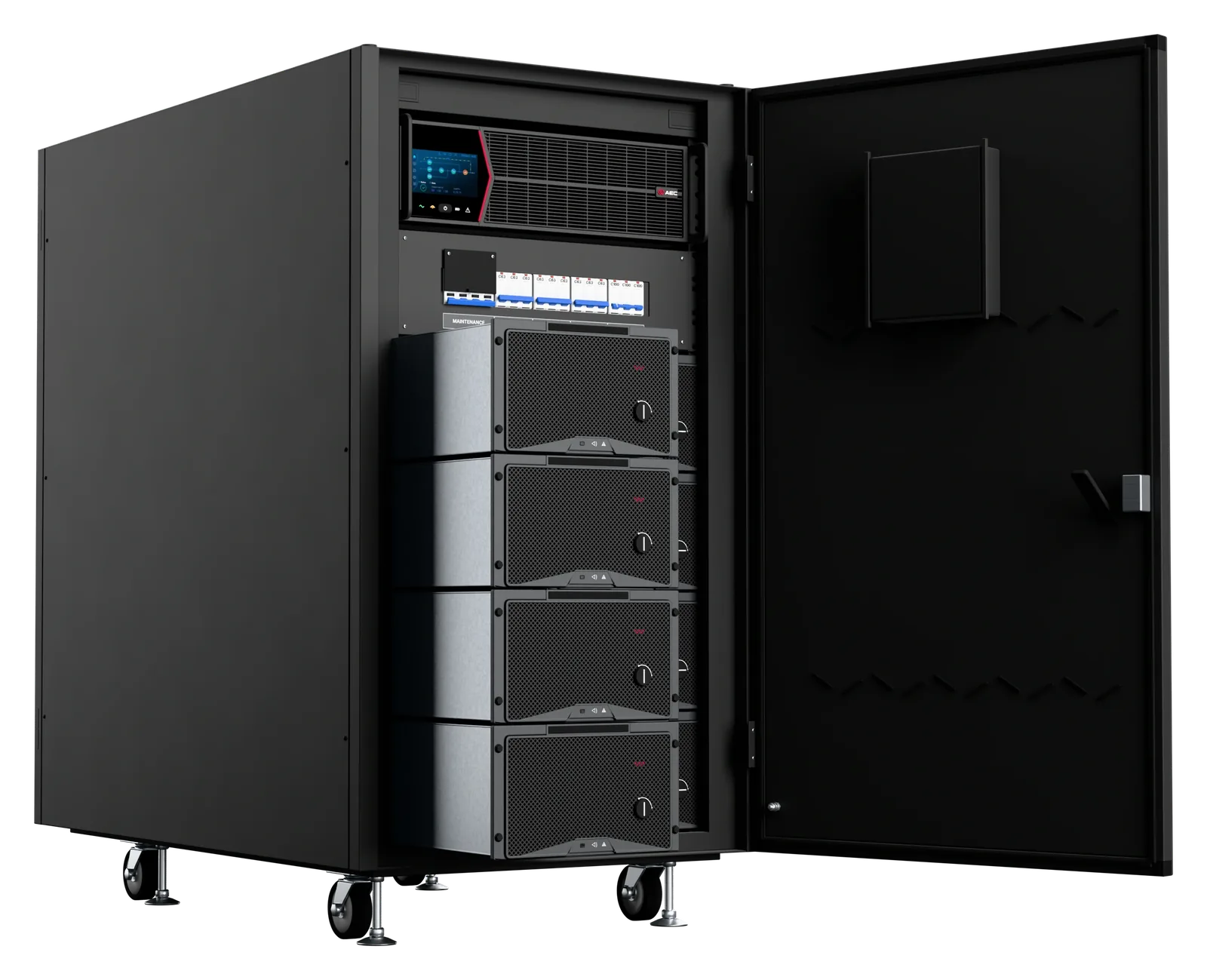
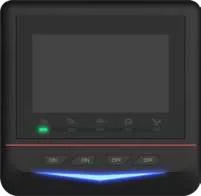
- The IST9's own display, with the UPS status and measurementsThe touch screen on the door also shows the battery, down to the cell.
- IST9 3U rack UPS, online double conversion96% efficient, 99% in ECO, output power factor 1 (kVA = kW).
- Distribution switchesInput, output, bypass and battery on one panel, with the maintenance bypass, its cover watched by a door switch.
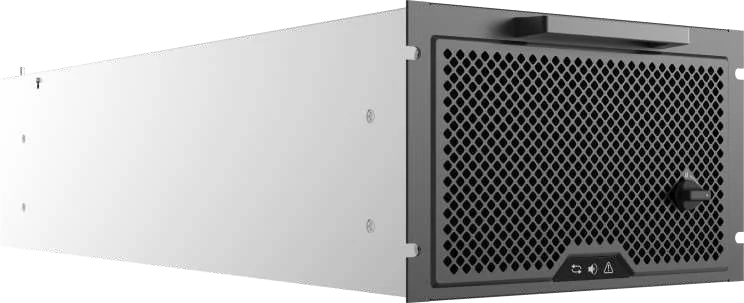
- Lithium modulesLithium iron phosphate modules, hot-swappable, each with its BMU, DC/DC converter, switch and indicators.
Distribution switches of the All-in-One three-phase cabinet
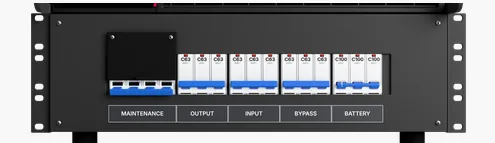 12345
- Maintenance bypassThree-phase systems. Remove its cover (a cover switch moves the UPS to bypass), close it, then open input, output and battery: the load runs on the maintenance bypass.
- Output breakerTo the load.
- Input breakerThe UPS mains supply.
- Bypass breakerThe static bypass supply.
- Battery breakerBetween the lithium modules and the UPS.
Overview
Key facts
- Power range
- 20 kVA
- Input / output
- 3/3 · 3/1 · 220 / 230 / 240 V L-N, 380 / 400 / 415 V L-L (IST9 20 kVA, 3/3 · 3/1)
- Efficiency
- up to 96% · 99% in ECO mode
- Communication
- RS232 · EPO · RS485 · options: SNMP, RS485 + dry contact
- Network card
- SNMP card (optional)
- Warranty
- 3 years on the UPS, 5 years on the lithium batteries
- Dimensions W × D × H
- 600 × 1000 × 1110 · 1000 mm
Applications:IT roomsOffices & financeCommunicationTransportSecurity systemsEducation & public
Pictures
The All-in-One in pictures
The photos and drawings of the EMEA 2026 catalogue: product views, displays, modules and connections. Tap a picture to enlarge it.
Models
Which All-in-One fits your load?
Every rating has its own page: that model's technical data, ordering codes, batteries and the questions people ask.
Datasheet
Datasheet All-in-One.
Every model side by side: keep only what differs, take it as CSV or print it.
| Model | 20 kVA |
|---|---|
| Model | |
| AEC codes | AIO-20K-2X50 … AIO-20K-8X50 · AIO-20K-4X100 |
| UPS inside | IST9 20 kVA, rack 3U |
| Rated power (kVA / kW) | 20 / 20 |
| Input / output | 3/3 · 3/1 |
| Technology | online double conversion · IGBT rectifier with PFC · DSP control · battery from isolated DC/DC lithium modules |
| Input | |
| Voltage range | phase 176–280 V full load · 80–176 V with linear derating |
| Frequency | 40–70 Hz |
| Power factor · THDi | ≥ 0.99 · ≤ 3% resistive, ≤ 5% non-linear full load |
| Output | |
| Voltage | 220 / 230 / 240 V L-N · 380 / 400 / 415 V L-L · fine adjustment ± 5 V |
| Frequency on battery | 50 or 60 ± 0.1 Hz |
| Voltage distortion | ≤ 2% resistive full load |
| Power factor | 1.0 (kVA = kW) |
| Transfer time | < 1 ms synchronised · < 10 ms not synchronised |
| Overload | ≤ 105% continuous · 105–110% 60 min · 110–130% 10 min · 130–155% 1 min · > 155% 200 ms |
| Efficiency (AC/AC) | up to 96% · 99% in ECO mode |
| Modes | online · ECO · battery · bypass · generator · frequency converter · impact load · test load |
| Battery system | |
| Lithium modules | 2 to 8 × 50 Ah (5.76–23.0 kWh) or 4 × 100 Ah (23.0 kWh) |
| Backup time | 15–60 min at 20 kW (50 Ah) · 60 min at 20 kW, 200 min at 6 kW (4 × 100 Ah) |
| Charge current, max. | 10 A (UPS charger); per module set from the number of modules |
| General | |
| Communication | RS232 · EPO · RS485 · options: SNMP, RS485 + dry contact |
| System display | 4.3" touch screen, tilted, on the door, with 3-colour LED status bar · LCD of the UPS · USB for records and upgrades |
| Noise | < 65 dB at full load |
| Working temperature · humidity | UPS −5 … 40 °C · battery 0–40 °C (15–30 °C recommended) · humidity 5–95%, non-condensing |
| Altitude · protection degree | ≤ 2000 m (above: derating to IEC 62040-3) · IP20 |
| Earthing systems | TN-S · TN-C · TN-C-S |
| Cabinet size W × D × H (mm), on castors | 600 × 1000 × 1110 · 1000 mm high without castors |
| Cabinet weight with distribution, without UPS and modules (kg) | 138 ± 5 (50 Ah) · 134 ± 5 (100 Ah) |
| System weight (kg) | 232 (2 × 50 Ah) to 460 (8 × 50 Ah) · 352 (4 × 100 Ah) |
| UPS size W × D × H (mm) | 438 × 535 × 130 (3U) |
| UPS weight (kg) | 18.4 |
UPS data from the IST9 user manual; system data from the AEC All-in-One 20 kVA user manual and the EMEA 2026 catalogue. Specifications are subject to change without notice.
Full technical details20 sections of the EMEA 2026 catalogue: functions, panel, connections, diagrams and ordering codes
Why All-in-One
OLD AND NEW TOGETHER
Grow the battery over the years
Modules added at different times work in the same system: each DC/DC converter balances its own module.
- Phase I · modules in service: SOH 88%
- Phase II · modules in service: SOH 91%
- Phase III · new modules: SOH 95%
- SOH: state of health of the battery modules.
LITHIUM VS LEAD-ACID
All-in-One compared with UPS + VRLA
AEC comparison, indicative values; VRLA cycle life from 12 V 9 Ah battery data at 25 °C.
| Item | All-in-One | UPS + VRLA |
|---|---|---|
| Units to install | 1 cabinet | UPS + battery cabinet |
| Installation | 1 person, 30–60 min | 2 people, 2–4 h |
| Battery life | 10+ years · 5,000 cycles at 50% DoD | 3–5 years · about 500 cycles at 50% DoD |
| Battery service | one module at a time, load supplied | whole string, often with downtime |
| Monitoring | every cell, module and system | string voltage only |
THE RANGE
One system, eight codes
The IST9 20 kVA inside, input / output 3/3 or 3/1. Seven codes with 2 to 8 lithium modules of 50 Ah, and one with four 100 Ah modules for long backup.

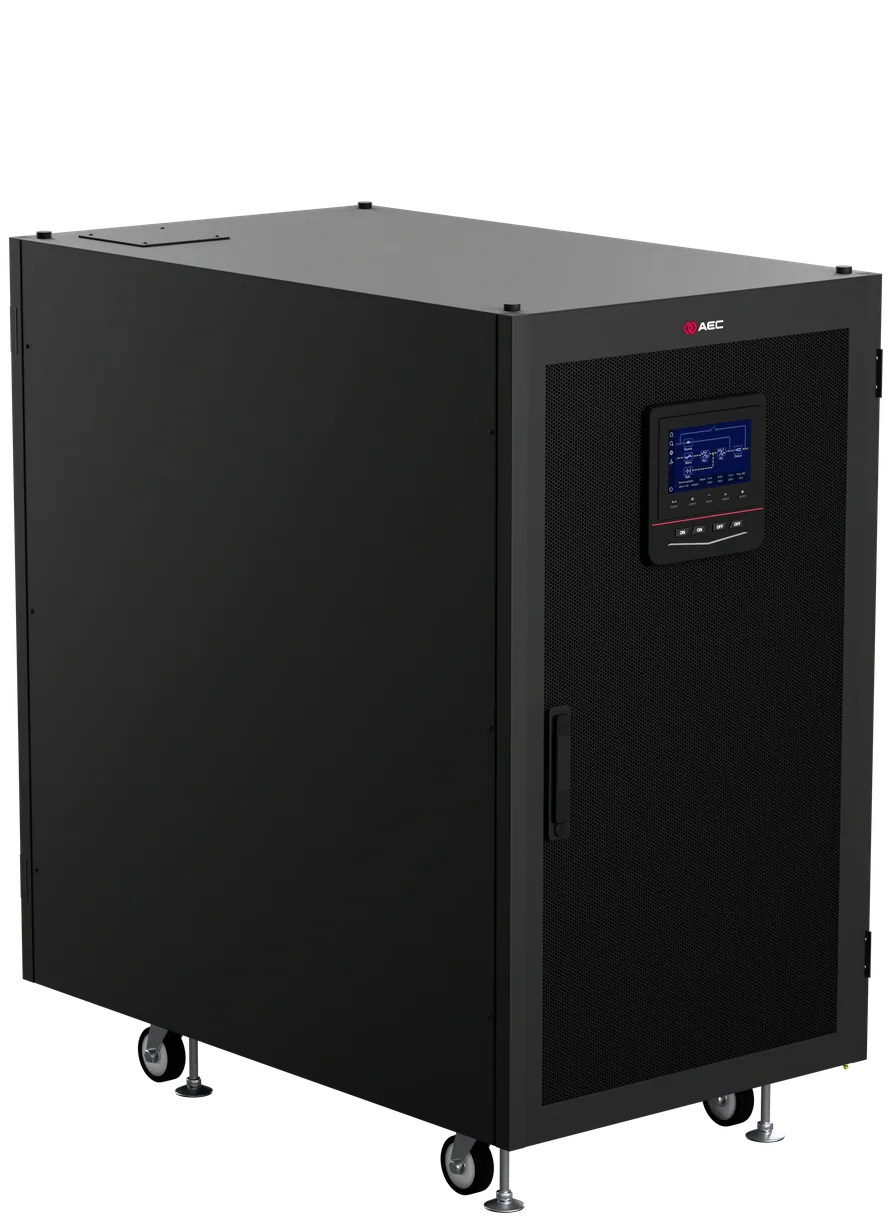
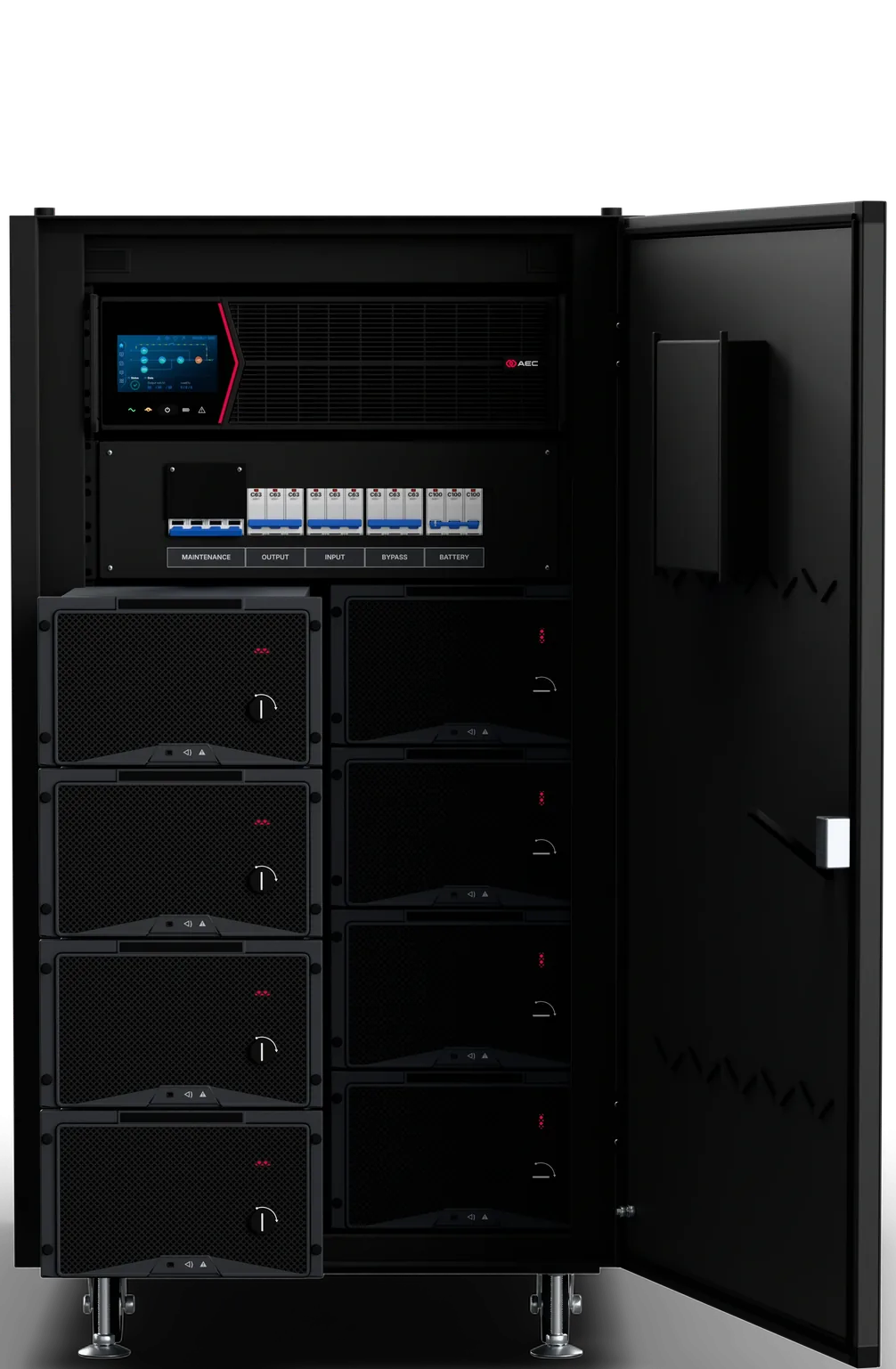
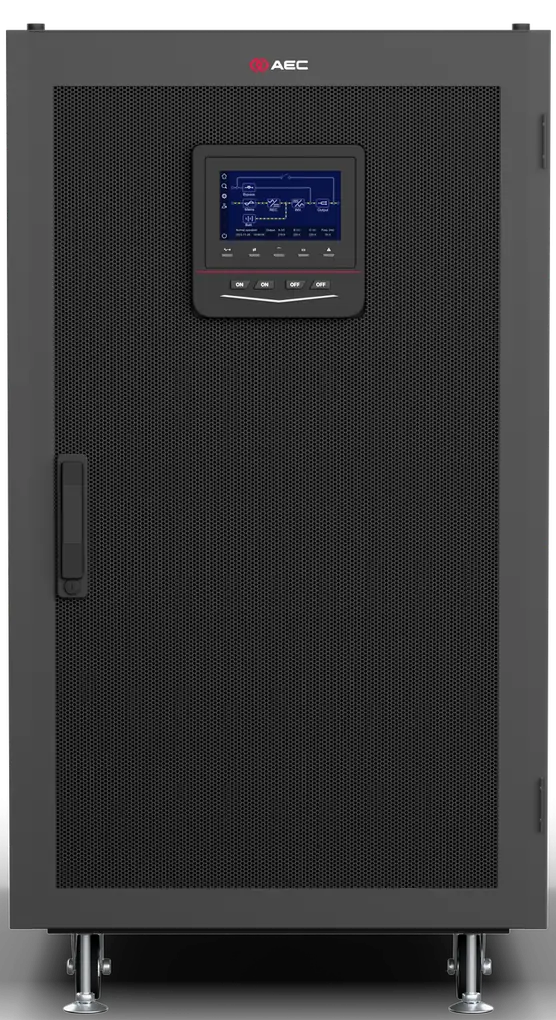
- From the top: tilted touch screen on the door; IST9 20 kVA rack UPS (3U); distribution switches (input, output, bypass, battery and maintenance bypass); lithium modules.
- Footprint 600 × 1000 mm (W × D); height 1110 mm on castors, 1000 mm without castors.
- 2 to 8 × 50 Ah: modules 223 mm wide, two per row; short and medium backup times.
- 4 × 100 Ah: modules 440 mm wide, one per row; long backup times.
- The number of modules depends on the load and the backup time required (see the backup tables). Configuration by AEC.
INSIDE THE CABINET
Everything wired at the factory
The UPS and the distribution switches sit at the top, the lithium modules underneath, all wired at the factory.
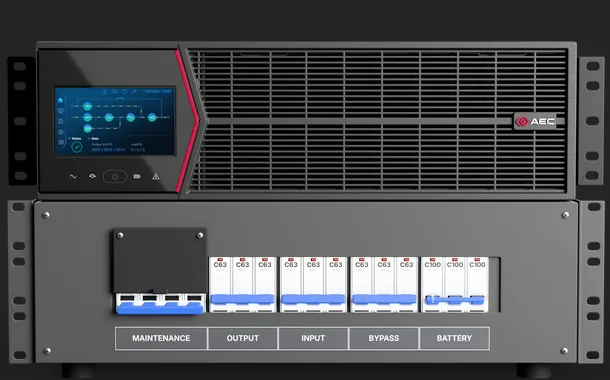
- Rack UPS: IST9 20 kVA (3U), online double conversion, with its own display.
- Distribution switches: input, output, bypass and battery breakers and the maintenance bypass on one front panel; the bypass cover is monitored by a door switch.
- Lithium modules: below the UPS, behind the door, 2 to 8 × 50 Ah or 4 × 100 Ah; hot-swappable, each with its own switch, indicators, battery management unit and DC/DC converter.
- System touch screen on the door: UPS and battery status down to the cell, records, settings and upgrades, with a 3-colour LED status bar.
- Control electronics: two system power boards feed the control electronics; a communication box for the optional SNMP card and RS485 port; one adapter board per module for DC power and measurement; a system adapter for EPO input and communication between UPS, modules and touch screen.
LITHIUM MODULES
Hot-swappable modules, managed one by one
Lithium iron phosphate modules of 50 or 100 Ah slide into the cabinet like drawers. Each one has its own battery management unit, DC/DC converter, switch and indicators.
- Module size 223 × 665 × 152 mm (50 Ah), 440 × 665 × 132 mm (100 Ah); kW = DC/DC rated output per module.
- Module rated output voltage 240 / ±240 / 480 V.
- Parts: front handle, indicators, in-place switch, fans, connector, rear handle, isolated DC/DC module, LFP cells, sealing plate.
- DC/DC isolation: the battery is electrically isolated from the mains.
- Zero voltage at the port: no risk of short-circuit shock when handling.
- Fire protection in the module, also under extreme battery failure.
- Automatic exit: a faulty module leaves the system, the others keep working.
- Less leakage risk from the battery cells; preventive alarm before a failure.
- Insulation monitored online, with early warning of an insulation fault.
- LFP: lithium iron phosphate cells, 3.2 V.
- Cell discharge rate 4C (50 Ah modules) or 1C (100 Ah modules).
- 5,000 cell cycles at 50% depth of discharge.
- SOC accuracy ≥ 95%.
- Battery working range 0–40 °C, 15–30 °C recommended.
| Module | V | kWh | kW | kg | per system |
|---|---|---|---|---|---|
| 50 Ah | 57.6 | 2.88 | 10 | > 38 | 2–8 |
| 100 Ah | 57.6 | 5.76 | 5 | > 50 | 4 |
LITHIUM MODULES
Three indicators
Run (green), alarm (yellow) and fault (red) on every module. Flashing: once per second; (3 s): once every 3 seconds.
Pick a state: the module's lights come on as the catalogue's table gives them.
| Status | Run (green) | Alarm (yellow) | Fault (red) |
|---|---|---|---|
| Charge | on | ||
| Discharge | flashing | ||
| Sleep | on | on | |
| Off | on | ||
| Module alarm | on | ||
| Communication fault | flashing (3 s) | ||
| Module protection | on | ||
| Battery fault | flashing |
ORDERING CODES
Eight codes, one 20 kVA system
Every code: IST9 20 kVA, input / output 3/3 or 3/1. Weight: UPS 18.4 kg + cabinet with distribution 138 ± 5 kg (134 ± 5 kg for 100 Ah) + modules of more than 38 kg (50 Ah) or 50 kg (100 Ah) each. Backup times: reference values, to be confirmed by actual measurement; AEC sizes every system.
| AEC code | Lithium modules | kWh | min at 20 kW | min at 10 kW | min at 6 kW | Weight (kg) |
|---|---|---|---|---|---|---|
| AIO-20K-2X50 | 2 × 50 Ah | 5.76 | 15 | 30 | 50 | 232 |
| AIO-20K-3X50 | 3 × 50 Ah | 8.64 | 22 | 45 | 75 | 270 |
| AIO-20K-4X50 | 4 × 50 Ah | 11.5 | 30 | 60 | 100 | 308 |
| AIO-20K-5X50 | 5 × 50 Ah | 14.4 | 37 | 75 | 125 | 346 |
| AIO-20K-6X50 | 6 × 50 Ah | 17.3 | 45 | 90 | 150 | 384 |
| AIO-20K-7X50 | 7 × 50 Ah | 20.2 | 52 | 105 | 175 | 422 |
| AIO-20K-8X50 | 8 × 50 Ah | 23.0 | 60 | 120 | 200 | 460 |
| AIO-20K-4X100 | 4 × 100 Ah | 23.0 | 60 | 120 | 200 | 352 |
BACKUP TIME
50 Ah modules · minutes
Backup grows one module at a time: 2 to 8 modules of 50 Ah, 2.88 kWh each. Load in kW; backup in minutes. 6 kW: catalogue reference values at 25 °C; 10 to 20 kW (50 to 100% load): AEC's product data. To be confirmed by actual measurement; AEC sizes every system. –: configuration not possible (at least two modules).
| Load · modules | 1 | 2 | 3 | 4 | 5 | 6 | 7 | 8 |
|---|---|---|---|---|---|---|---|---|
| 6 kW | – | 50 | 75 | 100 | 125 | 150 | 175 | 200 |
| 10 kW | – | 30 | 45 | 60 | 75 | 90 | 105 | 120 |
| 12 kW | – | 25 | 37 | 50 | 62 | 75 | 87 | 100 |
| 14 kW | – | 21 | 32 | 43 | 53 | 64 | 75 | 86 |
| 16 kW | – | 19 | 28 | 38 | 47 | 56 | 65 | 75 |
| 18 kW | – | 17 | 25 | 33 | 41 | 50 | 58 | 67 |
| 20 kW | – | 15 | 22 | 30 | 37 | 45 | 52 | 60 |
BACKUP TIME
100 Ah modules · minutes
Long backup with four 100 Ah modules, 23.0 kWh in all (AIO-20K-4X100); the 100 Ah version always has four. Catalogue reference values at 25 °C, to be confirmed by actual measurement. –: configuration not possible.
| Load · modules | 1 | 2 | 3 | 4 |
|---|---|---|---|---|
| 6 kW | – | – | – | 200 |
| 10 kW | – | – | – | 120 |
| 20 kW | – | – | – | 60 |
BATTERY MANAGEMENT
Two-layer battery management
A battery management unit in every module (CAN) and the system BMS in the touch screen watch the battery at cell, module and system level, and talk to the UPS over RS485.
- Equalisation: intelligent current and voltage equalisation between modules for longer backup time and better use of every module.
- Old + new: new modules work together with modules already in service, so capacity can grow over the years.
- SOC: adaptive charge control; intelligent charge and discharge management avoids over-charge and over-discharge.
- Test: each module is tested separately, without cutting the power supply.
- Records: fault recording and early warning for fast, accurate fault location.
- Expansion: plug and play, modules are added or replaced in minutes with the load supplied.
THE UPS INSIDE
Online double conversion, three-phase
The All-in-One 20 kVA is built around the AEC rack UPS IST9 20 kVA, three-phase, online double conversion. Full details are in the IST9 section of this catalogue.
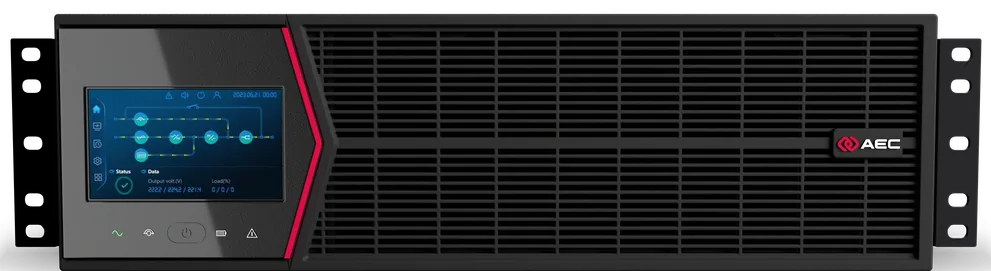
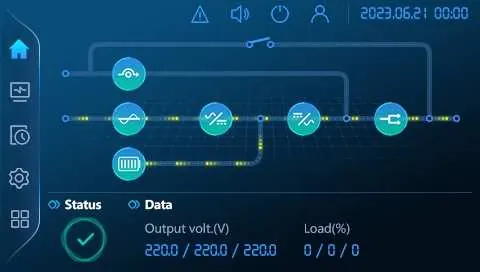
- Input / output 3/3 or 3/1 in the All-in-One.
- Efficiency 96% in double conversion, 99% in ECO mode; output power factor 1 (kVA = kW).
- Normal mode: rectifier and inverter supply the load; the lithium modules are charged.
- Battery mode: with the mains abnormal, the modules supply the inverter with no break at the output.
- Bypass mode: load on the static bypass when the UPS is off (if enabled) or on a fault.
- Maintenance bypass, through the distribution switches: the load stays supplied during service.
- Input: phase voltage 176–280 V at full load, 80–176 V with linear derating; 40–70 Hz; power factor ≥ 0.99; THDi ≤ 3% at resistive full load, ≤ 5% non-linear.
- Output: 220 / 230 / 240 V L-N, 380 / 400 / 415 V L-L; THDv ≤ 2%; output power factor 1.0 (kVA = kW).
- Inverter overload: ≤ 105% continuous · 105–110% 60 min · 110–130% 10 min · 130–155% 1 min · > 155% 200 ms.
- Battery cold start: the UPS starts from the lithium modules without mains.
- Operating modes: generator mode, frequency converter, impact load mode and test load.
- Output voltage adjustable by ± 5 V.
- 20 kVA UPS rating; 3U, 438 mm rack chassis; 5 modes: normal, battery, bypass, ECO, maintenance; UPS working temperature −5…40 °C.
SYSTEM TOUCH SCREEN
From the cabinet down to the cell
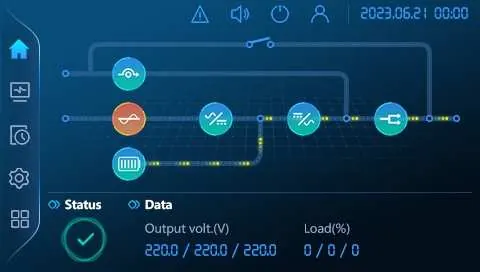
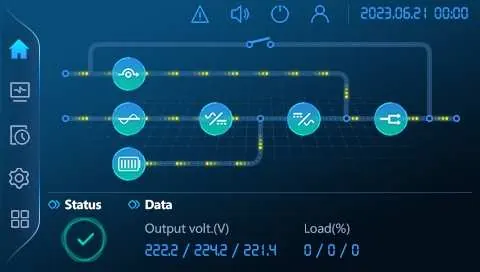
The tilted touch screen on the door shows the whole system: UPS energy flow, battery system, every module and every cell. A 3-colour LED bar shows the state from across the room.
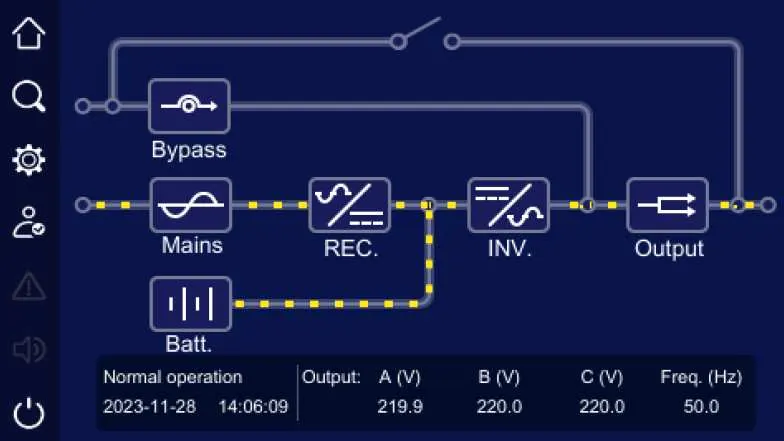
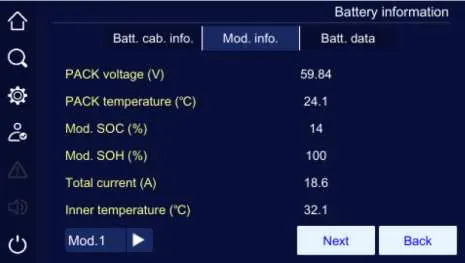
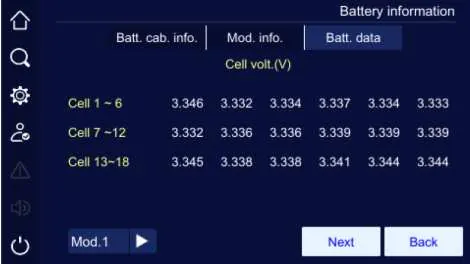
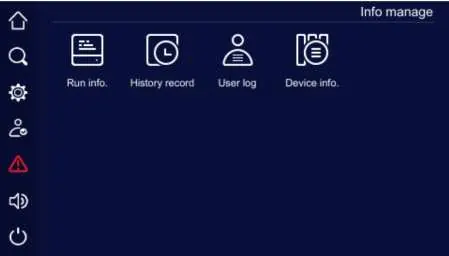
- Status bar: blue = normal, yellow = bypass, red = fault.
- Battery system, module and cell data; current fault, history and user log.
- Records downloaded to a USB stick; touch-screen and battery-system firmware upgraded from USB.
- Password levels protect the settings.
- Home page: live energy flow from mains, bypass and battery to the output, with run status, output voltage per phase and frequency.
- Battery information: voltage, current, status, system SOC and SOH, remaining time.
- Module data: pack voltage and temperature, SOC, SOH, current, inner temperature.
- Cell voltages: every cell of every module, page by page.
- Info manage: run information, history record, user log and device information.
- Run information: status of mains, bypass, inverter, output, battery, fans and EPO.
- History record: all abnormal events with date and time.
- Device manage: battery manage and test, communication, HMI, passwords, records, upgrade.
- Record manage: history and user log exported to USB.
SERVICE
Serviced without switching off the load
Maintenance bypass, live module replacement and USB upgrades keep the load supplied during service.
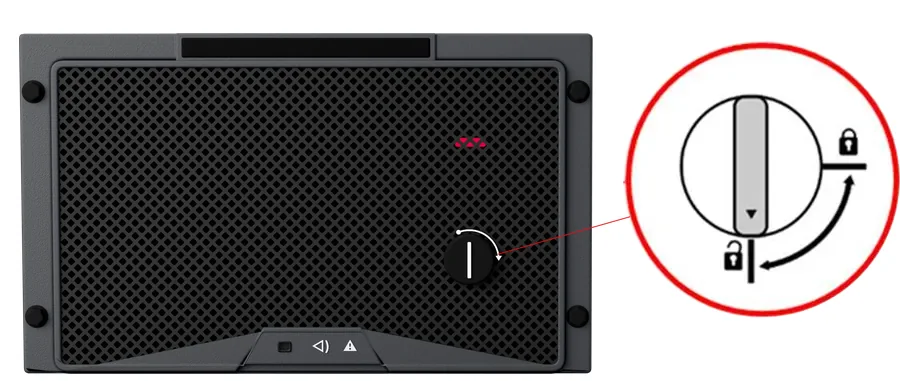
- Distribution switches: maintenance, output, input, bypass and battery. Module switch: unlock to isolate a module.
- To maintenance bypass without a break, step 1 · Inverter off: press ON/OFF on the touch screen; the UPS transfers to bypass.
- Step 2 · Cover off: remove the maintenance bypass cover. If step 1 was skipped, the cover switch stops the inverter and transfers to bypass.
- Step 3 · Maintenance bypass on: close the maintenance bypass switch; the load is fed by both bypasses.
- Step 4 · Isolate: open UPS input, bypass, output and battery breakers and set every module switch to unlock; the load runs on the maintenance bypass.
- Back to normal: close input, bypass, output and battery breakers and lock the modules; when the touch screen shows the bypass voltage, open the maintenance bypass and refit its cover; switch the inverter on from the touch screen (start-up about 30 s).
- Start without mains: lock any one battery module; it powers the system and the touch screen starts automatically.
- AEC service: 24/7 technical assistance by phone and WhatsApp; < 30 min WhatsApp reply to technical and commercial questions; warranty 3 years on the UPS and 5 years on the lithium modules, extendable with a maintenance contract; spare parts in 21+ countries across the Allis Electric group.
- service@aecups.com · +39 393 080 5211 · www.aecups.com
PLANNING
One cabinet to connect · IST9 20 kVA max. steady-state current (A)
Only mains, bypass and output are wired on site; the lithium modules are already connected to the UPS inside the cabinet.
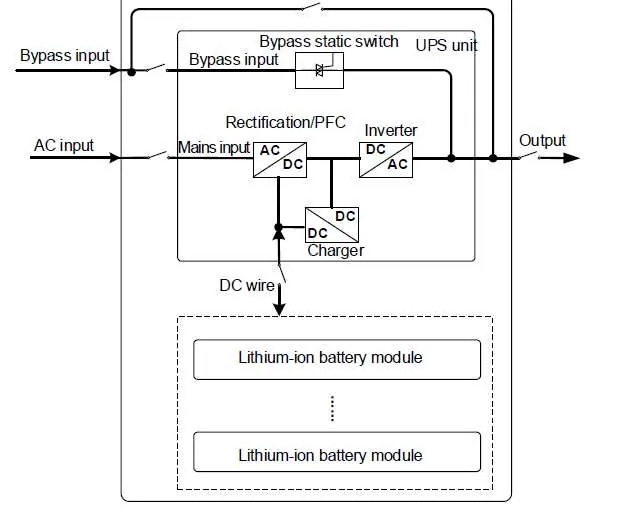
- Site: cabinet 600 × 1000 × 1110 mm on castors (1000 mm high without); 800 mm free in front and behind, 500 mm above.
- Floor: 232 kg (2 × 50 Ah) to 460 kg (8 × 50 Ah) on 0.6 m²; 352 kg with 4 × 100 Ah.
- Commissioning: date, time, language, module quantity and lithium charge current (up to 10 A) set on the touch screen by AEC.
- Choose the number of modules from the backup tables; AEC sizes and configures the system.
| kVA | Mode | AC in | Bypass | AC out |
|---|---|---|---|---|
| 20 | 3/3 | 35 | — | 30 |
| 20 | 3/1 | 35 | 91 | 91 |
PLANNING
IST9 20 kVA · recommended breakers (A)
From the IST9 user manual. Breaker 1.5–2 × max. input current, without leakage protection.
| kVA | Mode | AC in | Bypass | AC out |
|---|---|---|---|---|
| 20 | 3/3 | 63 × 3P | 50 × 3P | 50 × 3P |
| 20 | 3/1 | 63 × 3P | 125 × 1P | 125 × 1P |
CHOOSING THE MODULES
50 Ah or 100 Ah?
Same cabinet, same UPS: the module decides the backup. Catalogue reference values; AEC sizes every system.
| Item | 50 Ah | 100 Ah |
|---|---|---|
| Modules | 2 to 8, two per row | 4, one per row |
| Module width | 223 mm | 440 mm |
| Cells | 4C | 1C |
| Energy per module | 2.88 kWh | 5.76 kWh |
| Energy in all | 5.76–23.0 kWh | 23.0 kWh |
| Backup at 20 kW | 15–60 min | 60 min |
| System weight | 232–460 kg | 352 kg |
| Best for | short and medium backup | long backup, low and medium loads |
TECHNICAL DATA · BATTERY AND CABINET
Lithium modules
Lithium module data from the EMEA 2026 catalogue.
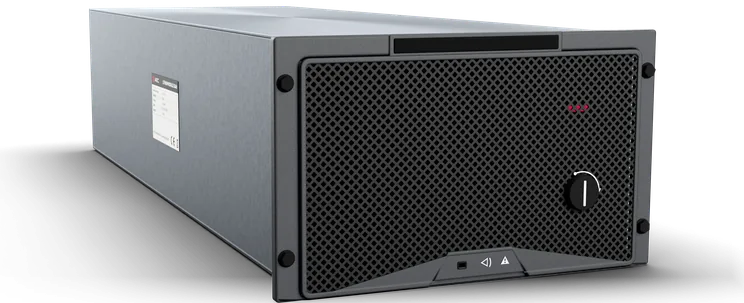
| Lithium module | 50 Ah | 100 Ah |
|---|---|---|
| Cells | LFP 3.2 V 50 Ah, 18 in series | LFP 3.2 V 100 Ah, 18 in series |
| Cell discharge / charge rate | 4C / 1C | 1C / 0.5C |
| Rated voltage (V) | 57.6 | 57.6 |
| Energy (kWh) | 2.88 | 5.76 |
| DC/DC rated output power (kW) | 10 | 5 |
| Rated output voltage (V) | 240 / ±240 / 480 | 240 / ±240 / 480 |
| Size W × D × H (mm) | 223 × 665 × 152 | 440 × 665 × 132 |
| Weight (kg) | > 38 | > 50 |
| Modules per system | 2 to 8 | 4 |
| Energy per system | 5.76–23.0 kWh | 23.0 kWh |
| Cycle life | 5,000 cell cycles at 50% DoD | 5,000 cell cycles at 50% DoD |
| SOC accuracy | ≥ 95% | ≥ 95% |
| Storage | 25–50% SOC, recharge every 3 months | 25–50% SOC, recharge every 3 months |
TECHNICAL DATA · BATTERY AND CABINET
Cabinet and system
Cabinet and system data from the AEC All-in-One 20 kVA user manual and the EMEA 2026 catalogue. Specifications are subject to change without notice.
- 20 kVA: one system, eight codes
- 2–8 × 50 Ah or 4 × 100 Ah modules
- 200 min at 6 kW with 8 × 50 Ah or 4 × 100 Ah
- 0.6 m² floor space of the cabinet
| Cabinet and system | All-in-One 20 kVA |
|---|---|
| Cabinet W × D × H (mm) | 600 × 1000 × 1110 on castors · 600 × 1000 × 1000 without castors |
| Cabinet weight | with distribution, without UPS and modules: 138 ± 5 kg (50 Ah) · 134 ± 5 kg (100 Ah) |
| System weight | UPS 18.4 + cabinet + modules: 232 kg (2 × 50 Ah) to 460 kg (8 × 50 Ah) · 352 kg (4 × 100 Ah) |
| Clearances | 800 mm in front and behind · 500 mm above |
| Breakers | input, output, bypass, battery · maintenance bypass |
| Displays | UPS display · tilted system touch screen with 3-colour LED status bar |
| Battery management | two layers: BMU in every module (CAN) · system BMS in the touch screen (RS485 to the UPS) |
| System communication | RS485 · USB on the touch screen (records, upgrades) · options: SNMP card, dry-contact card |
| Alarms | low battery, abnormal AC input, UPS failure, overload and more |
| Protections | low battery, overload, short circuit, over-temperature and more |
| Black start | any one locked module powers the system and the touch screen |
| Working temperature | UPS −5 … 40 °C · battery 0–40 °C, 15–30 °C recommended |
| Relative humidity | 5–95%, non-condensing |
| Warranty | lithium modules: 5 years |
Ordering codes All-in-One
| Code | Description |
|---|---|
AIO-20K-2X50 | IST9 20 kVA (3/3 · 3/1), distribution switches with maintenance bypass, 2 × 50 Ah lithium modules (5.76 kWh) |
AIO-20K-3X50 | IST9 20 kVA (3/3 · 3/1), distribution switches with maintenance bypass, 3 × 50 Ah lithium modules (8.64 kWh) |
AIO-20K-4X50 | IST9 20 kVA (3/3 · 3/1), distribution switches with maintenance bypass, 4 × 50 Ah lithium modules (11.5 kWh) |
AIO-20K-5X50 | IST9 20 kVA (3/3 · 3/1), distribution switches with maintenance bypass, 5 × 50 Ah lithium modules (14.4 kWh) |
AIO-20K-6X50 | IST9 20 kVA (3/3 · 3/1), distribution switches with maintenance bypass, 6 × 50 Ah lithium modules (17.3 kWh) |
AIO-20K-7X50 | IST9 20 kVA (3/3 · 3/1), distribution switches with maintenance bypass, 7 × 50 Ah lithium modules (20.2 kWh) |
AIO-20K-8X50 | IST9 20 kVA (3/3 · 3/1), distribution switches with maintenance bypass, 8 × 50 Ah lithium modules (23.0 kWh) |
AIO-20K-4X100 | IST9 20 kVA (3/3 · 3/1), distribution switches with maintenance bypass, 4 × 100 Ah lithium modules (23.0 kWh), one per row |
| Options | SNMP card · dry-contact card · extra 50 Ah modules, up to 8 per cabinet |
Diagrams
The All-in-One, in diagrams
The path of the power, the ratings, the footprints and the losses, drawn from the figures of the EMEA 2026 catalogue.
How the power flows
Pick an operating mode: the path the power takes to the load lights up.
Normal. Double conversion: the rectifier feeds the DC bus, the inverter rebuilds a clean voltage and the load always runs on the inverter. The battery stays on charge. Efficiency up to 96% (IST9 20 kVA inside).
Battery. The mains fails: the battery feeds the DC bus and the inverter carries on without a break. The load does not notice. Transfer: no break at the output mains → battery; inverter ↔ bypass < 1 ms synchronised.
Bypass. Overload or internal fault: the static switch moves the load to the bypass line, fed by the mains.
ECO. The load runs on the bypass and the inverter stands ready: if the mains leaves the set window, the load goes back to the inverter. Higher efficiency, less protection. Efficiency up to 99%.
Maintenance. The maintenance bypass feeds the load straight from the mains, so the UPS can be isolated for service without switching the load off. Through the cabinet's distribution switches.
Frequency converter. Output at 50 or 60 Hz whatever the input: the load always runs on the inverter and the bypass is not used. IST9 operating modes.
Losses per 100 kW of load
Worked out as P × (1/η − 1) at the stated maximum efficiency, with the load steady all year. IST9 20 kVA inside.
Phase configurations
Input / output: three-phase (3) or single-phase (1). 3/3 or 3/1; no 1/1 on the All-in-One.
Footprints to scale
Front view of the cabinets, all at the same scale, beside a 2 m rule. W × D × H, mm.
- Cabinet on castors, 20 kVA 600 × 1,000 × 1,110 mm · 138 ± 5 kg with distribution, without UPS and modules (134 ± 5 kg, 100 Ah version); 232–460 kg complete
Documents
All-in-One documents.
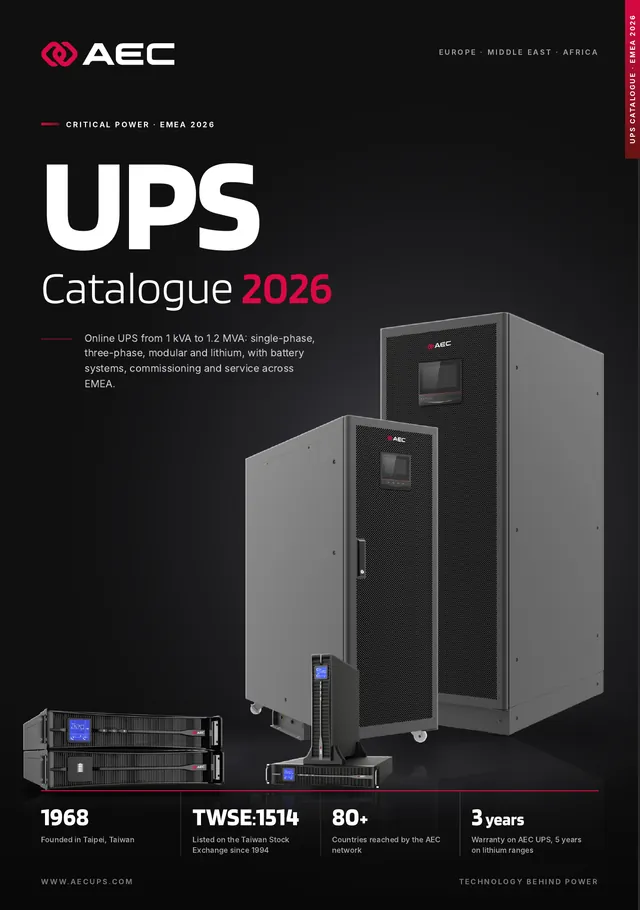
All-in-One catalogue pages and manuals in English, as PDF.
Questions
Questions people ask
What is inside the All-in-One cabinet?
An IST9 20 kVA online double-conversion rack UPS (three-phase, 3/3 or 3/1), the distribution switches with maintenance bypass and 2 to 8 hot-swappable 50 Ah lithium modules, or four of 100 Ah, factory-built into one 600 × 1000 × 1110 mm cabinet on castors. One touch screen on the door shows UPS and battery down to the cell.
What backup time can the All-in-One reach?
Up to 200 minutes at 6 kW with 8 × 50 Ah or 4 × 100 Ah modules. At the full 20 kW the tables give 15 to 60 minutes with 2 to 8 × 50 Ah modules and 60 minutes with 4 × 100 Ah. These are reference values to be confirmed by actual measurement, and AEC sizes every system.
Which lithium modules should I choose?
The 50 Ah modules (2.88 kWh each, 2 to 8 per cabinet, 10 kW each) are for short and medium backup times; the 100 Ah version (5.76 kWh each, always 4 per cabinet, 5 kW each) is for long backup. Both are lithium iron phosphate and hot-swappable, and a faulty module leaves the system on its own while the others keep supplying the load.
Which All-in-One fits my load?
There is one: the All-in-One 20 kVA, with the IST9 20 kVA inside, three-phase input, 3/3 or 3/1, for loads up to 20 kW. Two 50 Ah modules already carry the full 20 kW; more modules, or the 100 Ah version, give longer backup. For a single-phase supply or above 20 kVA, AEC proposes another range.
How long do the lithium modules last compared with lead-acid?
The LFP cells are rated for 5,000 cycles at 50% depth of discharge and 10+ years, against about 500 cycles and 3–5 years for VRLA in AEC's indicative comparison. Each module has its own DC/DC converter, so new modules can be added later and work together with the older ones.
How long does installation take?
AEC indicates 1 person and 30–60 minutes for the All-in-One, against 2 people and 2–4 hours for a UPS with a separate VRLA cabinet. Only mains, bypass and output are wired on site; the cabinet measures 600 × 1000 × 1110 mm on castors and weighs 232 to 460 kg complete (352 kg with 4 × 100 Ah).
How is the All-in-One monitored?
RS485 links UPS, battery BMS and touch screen as standard, and the touch screen exports records and takes firmware upgrades from USB. An SNMP card and a dry-contact card are optional.
In the same family:IST9IST7 10–40IST7 60–200IST7-TThree-phase UPS
Guides
Guides on the All-in-One
Talk to an AEC engineer
Tell us the load, the supply and the backup time you need for the AEC All-in-One 20 kVA: we answer with the model and the batteries that fit. AEC International sells through distributors in about 80 countries and an agency in every Italian region: ask AEC which one serves your area.