



















20 July 2022 · updated 20 October 2026 · 9 min
UPS maintenance: batteries, checks and schedule
UPS maintenance means checking the whole system on a schedule: the batteries, the UPS electronics, the cooling, the alarm logs and the switches that let you work safely. Most of the work is inspection and measurement, done monthly, quarterly and yearly, with a full battery capacity test or battery replacement every few years.
Done well, it turns sudden failures into planned replacements.
In brief
- The battery is the part most exposed to wear, but fans, capacitors, connections and firmware need attention too.
- A typical plan has monthly visual checks, quarterly UPS checks, block voltages every 6 months and a yearly service visit. Always follow the manufacturer's manual.
- Temperature is the biggest factor in battery life: for VRLA batteries, life halves about every 8 °C above 25 °C.
- A maintenance bypass keeps the load supplied while the UPS is isolated for service.
- Battery strings carry dangerous DC voltages: work inside the UPS or cabinet is for qualified staff only.
Why UPS maintenance matters
A UPS (uninterruptible power supply) spends most of its life waiting. Its battery is idle, its bypass is rarely used, and problems stay hidden until the mains fails. A battery that has aged unnoticed may pass months of normal operation and then fail within seconds of a blackout.
Battery failures fall into two broad groups. A failure in the first discharge cycles usually points to a manufacturing defect. Most later failures are driven by operating conditions on top of normal ageing: high temperature, wrong charging, deep or frequent discharges, long storage without recharging, or simply no maintenance.
The UPS itself also wears: fans run day and night, capacitors age with heat, dust blocks air paths and connections loosen.
What a UPS maintenance visit checks
Visual and environmental checks
Start with what you can see. Look for swollen or cracked battery cases, leaks, corrosion on terminals and discoloured cables. Check that air inlets and outlets are clear. Note the room temperature: 20–25 °C is the target for best battery life.
Logs and alarms
The event log tells you what happened between visits: transfers to battery, overloads, overtemperature, fan alarms and faults. Read it, clear what is resolved and investigate what repeats.
Thermal checks
Heat shows problems early. A thermal camera or a contact thermometer can reveal a loose terminal, an overloaded cable or a battery block warmer than its neighbours. Compare readings with the previous visit.
Fans, capacitors and filters
Fans and electrolytic capacitors are wear parts. Their life depends on running hours and temperature, so manufacturers set replacement intervals and many UPS track their operating time. Air filters, where fitted, need cleaning or replacement so that the UPS does not overheat.
Firmware and settings
Firmware is the software inside the UPS. The technician checks the installed version against the manufacturer's current release and updates it when the release notes recommend it. They also check that battery and alarm settings still match the installation.
UPS battery maintenance: tests and measurements
Valve-regulated lead-acid (VRLA) batteries are sealed and need no topping up, but they still need measuring. Three checks matter most.
- Block voltages on float: float is the steady charging voltage that keeps a battery full. Measuring every block shows which ones are drifting away from the rest.
- Battery test from the UPS: a short, controlled discharge that confirms the string can carry the load.
- Capacity test: a full controlled discharge that measures how much of the rated capacity is left. It is the most reliable check and is usually done every few years or when results look doubtful.
Lithium batteries work differently. A battery management system (BMS) watches cell voltages and temperatures all the time, so many checks are automatic. The UPS, its fans and its connections still need the same care. Our guide to VRLA vs lithium UPS batteries compares the two in detail.
Worked example: reading block voltages
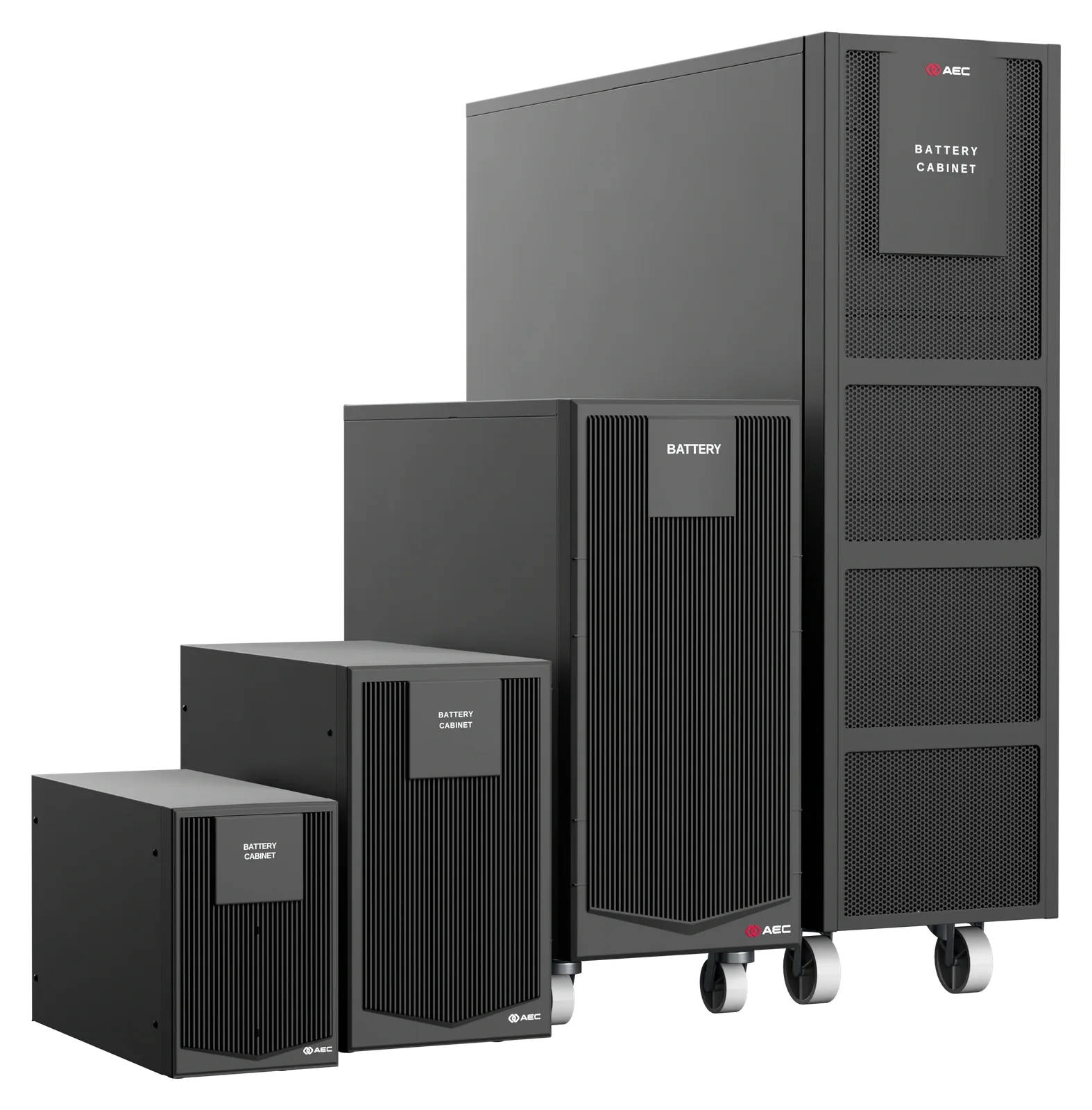
A UPS has a string of 36 × 12 V VRLA blocks. The AEC battery cabinet manual gives a float voltage of 13.5–13.7 V per battery and says to check any battery more than 0.3 V from the average.
- Measure each block on float and add the readings. The total is 489.6 V.
- Average per block: 489.6 V ÷ 36 = 13.60 V. This is inside the 13.5–13.7 V float range, so the charger is set correctly.
- Block 17 reads 13.24 V. Difference: 13.60 − 13.24 = 0.36 V. This is more than 0.3 V, so the block is flagged.
- Block 5 reads 13.82 V. Difference: 13.82 − 13.60 = 0.22 V. This is within the limit, but worth noting for the next visit.
- Action: check the terminals of block 17, measure again, and plan a capacity test. If several blocks drift, plan replacement of the whole string.
Temperature changes the picture. At 25 °C, a 12-year design life battery gives 100% of that life; at 35 °C it gives about 43%, around 5 years. A warm room can halve the replacement interval.
UPS maintenance checklist and preventive schedule
The table shows a typical preventive schedule. Intervals vary with the UPS, the battery type and the site, so always follow the manufacturer's manual. Critical or warm sites usually need shorter intervals.
| Interval | UPS | Batteries | Who |
|---|---|---|---|
| Monthly | Display, alarms and event log; air paths clear | Visual check of cases, leaks, corrosion, ventilation and room temperature | Site staff |
| Quarterly | Preventive check of operating mode, loads, fans and dust | Charger voltage and current; battery test from the UPS if supported | Site staff or technician |
| Every 6 months | Terminal contacts where the manual asks for it | Voltage of every block on float; flag any block more than 0.3 V from the average | Technician |
| Yearly | Full service visit: thermal check, fans and capacitors, firmware, settings, maintenance bypass operation | Terminal torque with the battery disconnected; dust cleaned | Qualified technician |
| Every 3–5 years | Wear parts replaced as the manufacturer specifies | Capacity test or replacement | Qualified technician |
A practical monthly checklist for site staff:
- the UPS shows normal mode, with no active alarm;
- the event log shows no new faults or repeated transfers;
- air inlets, outlets and filters are clear;
- room temperature is close to 20–25 °C;
- battery cases show no swelling, leaks or corrosion;
- remote alarms still reach the right people.
If the UPS works with a generator, test the two together as well. Our guide to UPS and generator explains what to check.
The external maintenance bypass switch
A maintenance bypass is a manual switch that feeds the load directly from the mains while the UPS is isolated. It lets technicians service, repair or replace the UPS without switching the load off. It is different from the static bypass, which the UPS uses automatically on overload or fault.
An external maintenance bypass is mounted between the UPS and the critical load, with a switch that selects UPS or bypass. Because it sits outside the UPS, the whole UPS can be removed from the circuit. It must be compatible with the UPS and installed by qualified personnel.
The order of operations matters. The UPS is first transferred to its internal bypass, then the maintenance bypass is closed, then the UPS input, output and battery breakers are opened. Returning to normal reverses the steps. Follow the sequence in the UPS manual exactly: a wrong step can drop the load.
On maintenance bypass the load has no protection from mains disturbances, so plan the work at a quiet time.
UPS battery replacement: when and how
Replace batteries when tests show they can no longer give the required backup time, or when they approach the end of their life in service. Signs include a failed battery test, blocks that keep drifting from the average, swollen cases and backup times shorter than at commissioning.
Design life is not service life. Design life is measured in float service at 25 °C; real life is shorter in warm rooms or with frequent discharges. In service, VRLA batteries are often replaced after 3–5 years, depending on type, temperature and use.
Good practice for replacement:
- Replace the whole string, so old and new blocks do not work together.
- Use the same model, capacity and batch across the string.
- Use the maintenance bypass, where fitted, so the load stays supplied.
- Record the installation date and the first set of block voltages.
- Return old lead-acid batteries for collection and recycling.
Spare batteries also age on the shelf. Recharge stored VRLA batteries every 6 months, or sooner if the open-circuit voltage falls below 12.6 V.
The battery replacement tool gives the 12 V blocks of each AEC UPS and how many, or the OZ Power block of the same size as the one on your label.
Safety: DC voltages and qualified staff
A UPS battery string is dangerous even when the UPS is off. A 36-block string has a nominal voltage of 432 V DC, and a single OZ Power 100 Ah block has a short-circuit current of 2,150 A. Direct current does not pass through zero, so an arc is harder to extinguish than on AC.
- Only qualified, authorised staff open the UPS or the battery cabinet.
- Open the battery disconnect and keep it open for any work inside.
- Use insulated tools; remove rings and watches; wear suitable protective equipment.
- Measure before you touch: capacitors inside the UPS can stay charged after shutdown.
- Keep the battery room ventilated, as the manual and IEC 62485-2 require.
Site staff can safely do the visual checks, read the display and run tests from the front panel. Everything behind the covers is technician work.
Common mistakes
- Only checking batteries: fans, capacitors and loose connections also cause failures.
- Ignoring room temperature: a battery room at 35 °C roughly halves battery life compared with 25 °C.
- Replacing single blocks in an old string: the new block works against aged ones and the string stays weak.
- Mixing models or batches: blocks age unevenly and the string becomes unbalanced.
- Never reading the event log: repeated alarms are early warnings.
- Using the maintenance bypass in the wrong order: this can interrupt the load.
Maintaining AEC UPS and batteries
AEC UPS include tools that make maintenance easier between visits:
- The IST7 60–200 kVA runs a standard (10 min) or deep battery test from the screen and keeps a history of 10,000 events. Optional fan and bus capacitor service-life alarms (default 10 years, settable) can be enabled, and firmware is updated from a USB stick.
- The IST9 shows reminders for capacitors, fans, batteries and filter, and its optional distribution module includes a maintenance bypass breaker.
- The IST3 runs a battery test when you hold the ON button for 3 s in mains mode; the MBYP-3K and MBYP-6K rack bypasses serve UPS up to 3 and 10 kVA.
- The SNMP card sends alarms over the network, so the service team knows at once.
The OZ Power AGM batteries come in two series: 9 and 24 Ah general purpose blocks with a 6–8 year design life. The 40 to 200 Ah long-life blocks have a 12-year design life. Both figures are for float service at 25 °C. Self-discharge is below 3% per month at 25 °C, and the batteries are 99% recyclable at end of life (OZ Power catalogue). AEC battery cabinets come with wiring diagrams and the monthly, six-monthly, yearly and 3–5 year battery checks used in the table above. The L6 lithium system has a BMS in every module, every cabinet and the whole system.
AEC offers maintenance programmes and contracts written for each site, with battery checks and replacement and generator tests, on top of the AEC warranty: 3 years on every UPS, 5 on the lithium ranges. Support includes 24/7 technical assistance by phone and WhatsApp, with on-site intervention when needed. Spare parts are in stock in 21+ countries across the Allis Electric group. Ask us about a maintenance plan for your site.
Questions
Questions people ask
How often should a UPS be serviced?
Typical practice is a monthly visual check by site staff, quarterly checks of the UPS and a full service visit by a qualified technician at least once a year. Critical or warm sites usually need shorter intervals. Always follow the manufacturer's manual for your UPS.
How often should UPS batteries be checked?
Check VRLA batteries visually every month and measure the voltage of every block on float about every 6 months. A capacity test or replacement is typical every 3–5 years. Remote monitoring adds continuous checks between visits.
How long do UPS batteries last?
6 to 12 years at 25 °C, by block size: OZ Power 9 and 24 Ah blocks have a 6–8 year design life and 40–200 Ah blocks 12 years, in float service. Life halves about every 8 °C above 25 °C, so warm rooms shorten it a lot.
Can I replace only one faulty battery block?
No, it is usually better to replace the whole string, so that blocks of different age do not work together. Use the same model, capacity and batch across the string. A technician can advise based on the measurements.
What does an external maintenance bypass switch do?
It feeds the load directly from the mains while the UPS is isolated, so the UPS can be serviced, repaired or replaced without switching the load off. It is mounted between the UPS and the load. It must be compatible with the UPS and operated in the order the manual gives.
Can I do UPS maintenance myself?
Only the checks from outside: site staff can do visual checks, read the display and event log and run battery tests from the front panel. Work inside the UPS or battery cabinet involves dangerous DC voltages and is for qualified, authorised technicians only.


Blog
Keep reading
Talk to an AEC engineer
Tell us the load, the supply and the backup time you need: we answer with the model and the batteries that fit.