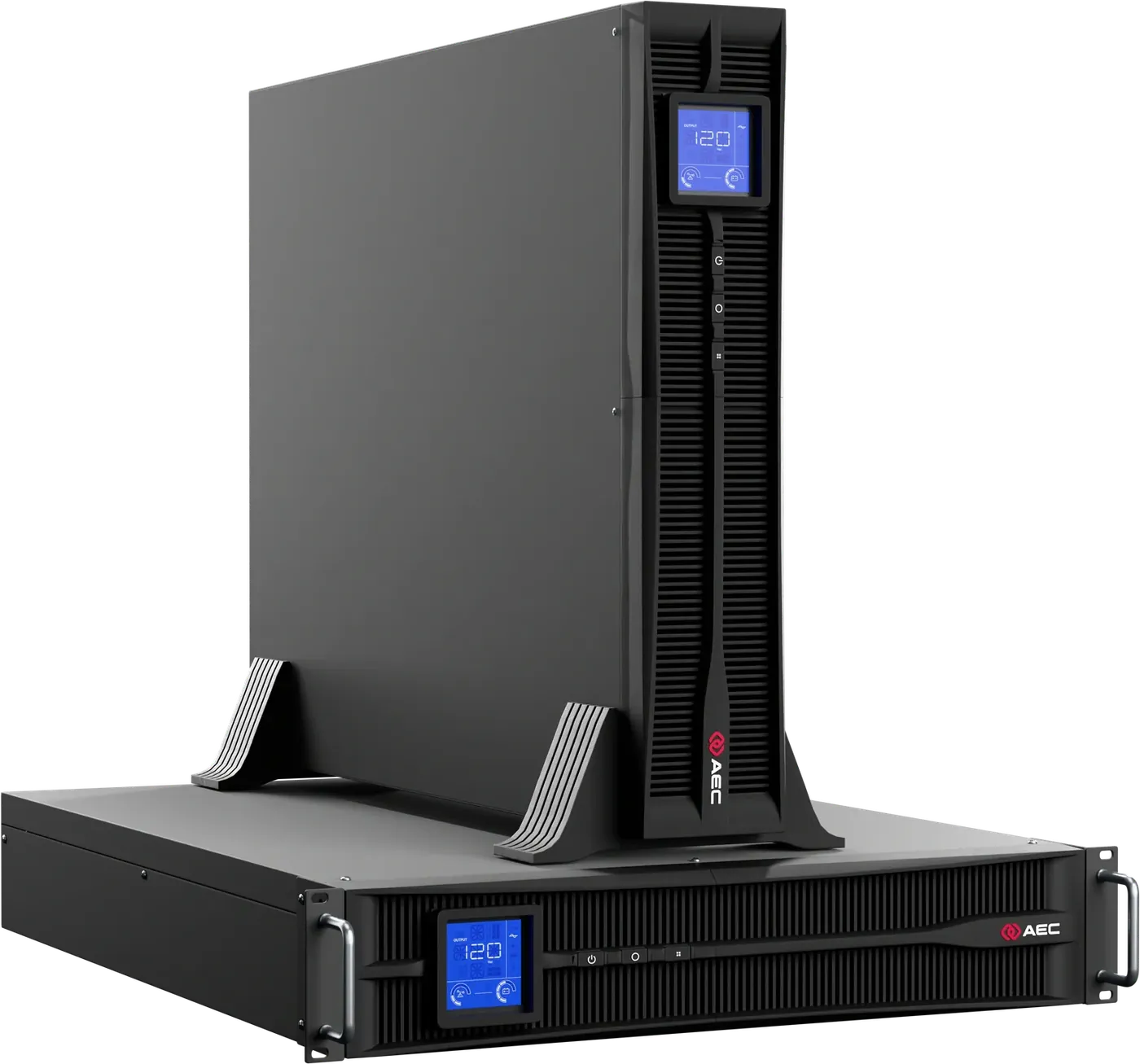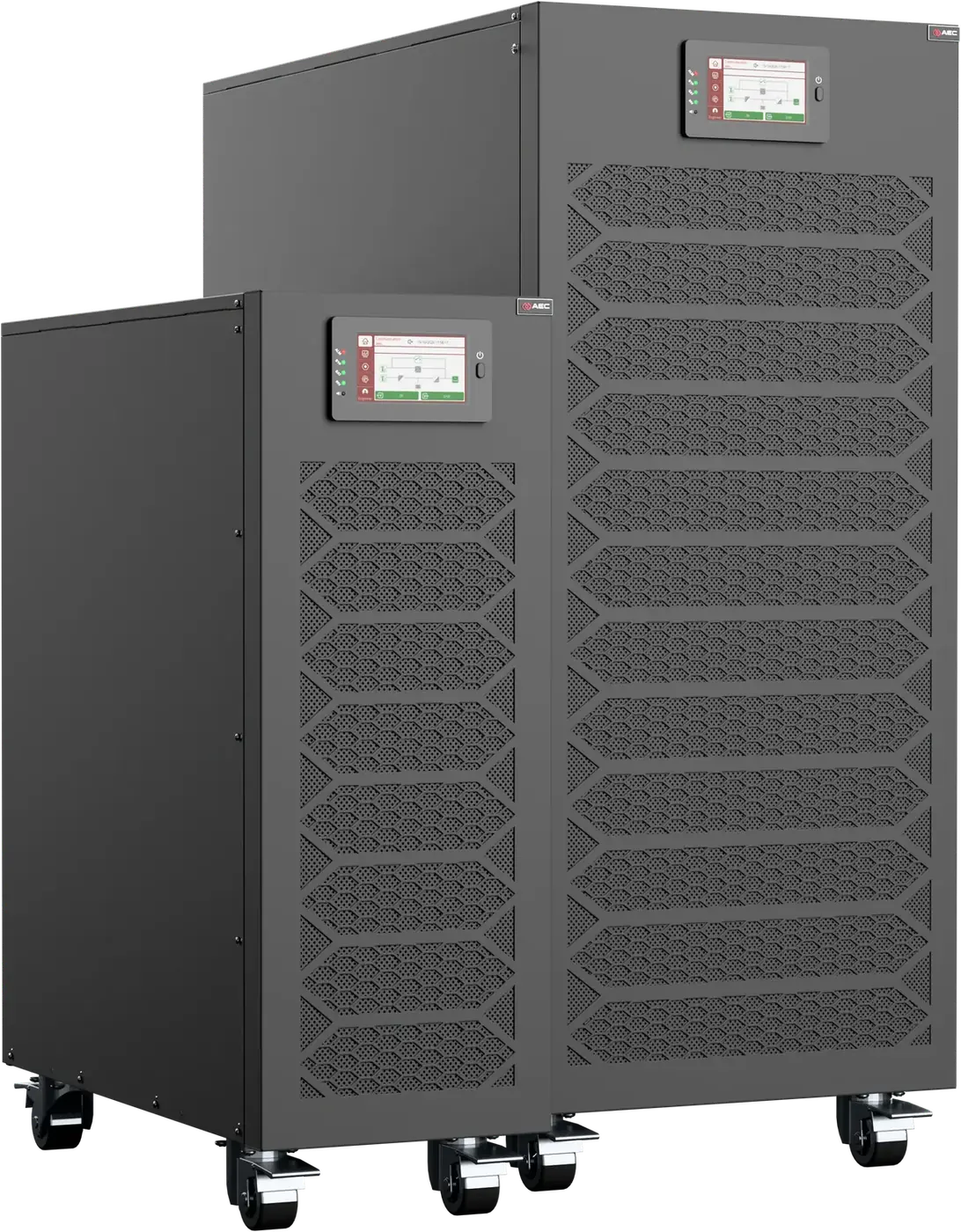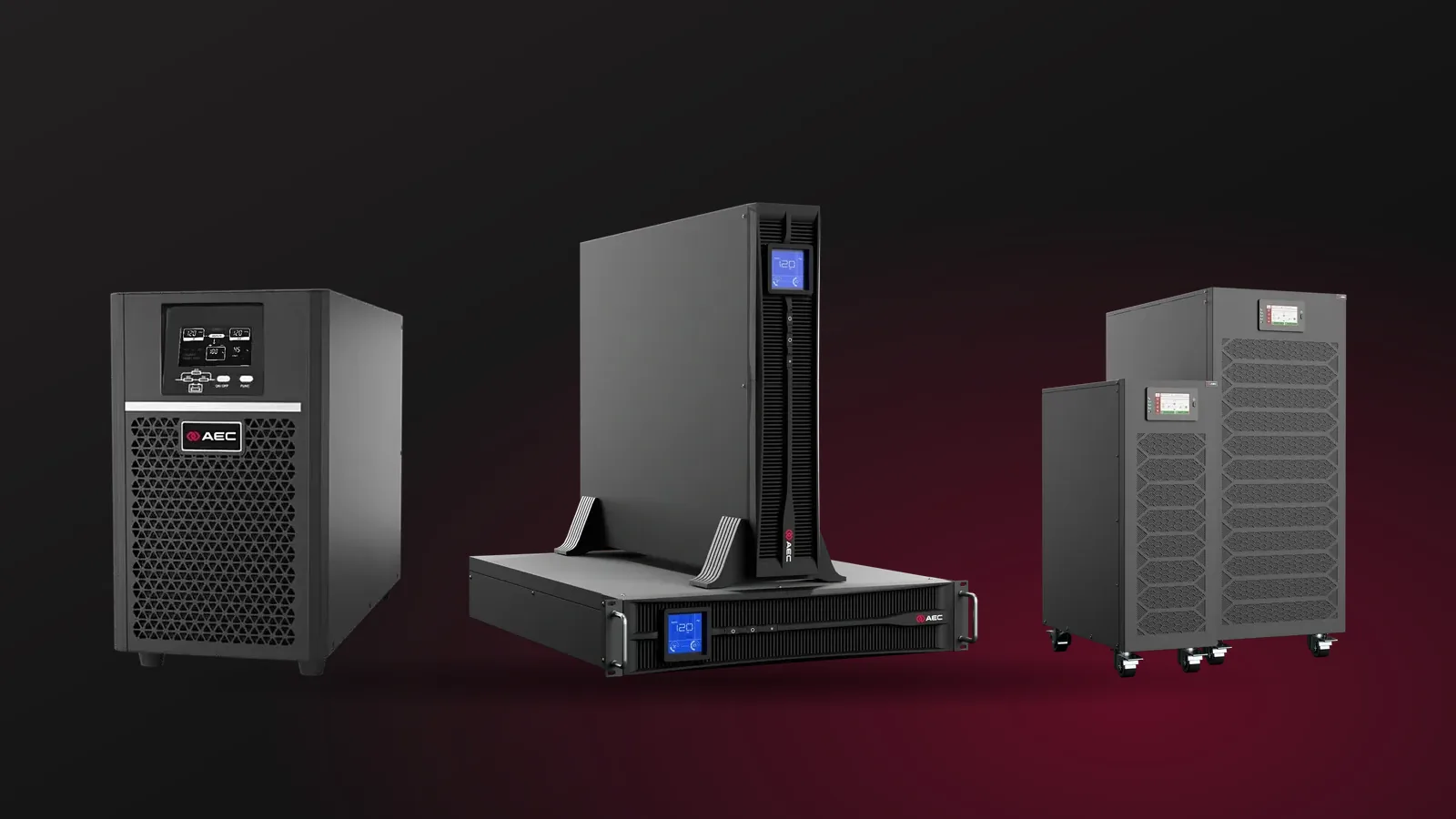
What should go on the UPS?
- Yes: router, firewall and switches; the server or NAS; point-of-sale terminals; the phone system; the video recorder of the security cameras; access control.
- No: laser printers, space heaters and coffee makers. Their inrush and heating loads would eat the battery for nothing.
How big a UPS does a small office need?
Add up what goes on it. An example rack in a 20-person office, with figures of the kind a metered PDU shows (measure your own):
| Equipment | Draw |
|---|---|
| Internet modem and router | 30 W |
| Firewall | 40 W |
| 24-port PoE switch, feeding the desk phones and Wi-Fi access points | 400 W |
| Small server | 350 W |
| Network storage (NAS) | 120 W |
| Video recorder for the cameras | 80 W |
| Phone system controller | 60 W |
| Total | 1,080 W |
Kept at 80 % of the UPS rating, 1,080 W needs 1,350 W. The LUM1500RT-2U-LI is 1,500 VA / 1,350 W, so the load sits exactly at 80 %, and its catalog table gives 17 minutes there: enough for the server and the NAS to shut down in order. For the phones to stay up through a longer outage, the LUM2200RT-2U-LI (1,980 W) runs at 55 % and gives between 42 and 46 minutes, the table's figures at 60 % and 50 %. The VRLA FER1500RT-4X9 (1,500 W) runs at 72 % and gives about 9 minutes on its internal batteries.
Which 120 V UPS for one rack or a few desks?
| Series | Power | Battery | Receptacles |
|---|---|---|---|
| LUMINA 2U rack | 1 to 3 kVA, power factor 0.9 | Internal LiFePO4, 12 to 15 years | 8× NEMA 5-15R (1 kVA) to 4× 5-20R + 1× L5-30R (3 kVA) |
| FERRUS tower | 1 to 3 kVA, power factor 1 | VRLA, up to 4 external packs | 8× NEMA 5-15R (1 kVA) to 6× 5-20R + 1× L5-30R (3 kVA) |
| FERRUS RT rack/tower | 1 to 3 kVA, power factor 1 | VRLA, up to 4 external packs | 8× NEMA 5-15R (1 kVA) to 6× 5-20R + 1× L5-30R (3 kVA) |
Which plug, and which circuit?
A 120 V UPS plugs into a receptacle, and its plug decides the circuit the electrician must provide before it arrives:
- LUM1500RT-2U-LI: a cord with a NEMA 5-15P plug, the ordinary office receptacle.
- LUM2000RT-2U-LI and LUM2200RT-2U-LI: a NEMA 5-20P plug, which needs a 20 A circuit and a 5-20R receptacle (the one with a T-shaped slot).
- FERRUS 3 kVA, tower and rack: an attached cord with a NEMA L5-30P twist-lock plug, on a 30 A circuit with an L5-30R receptacle. A 3 kVA UPS at full output delivers 25 A at 120 V, more than a 20 A circuit can carry.
A dedicated circuit is good practice for any UPS, so a heater or a copier on the same breaker cannot trip it.
Which UPS protects a whole 120/240 V panel?
Many small commercial buildings have a 120/240 V split-phase service. FERRUS SP (6 to 20 kVA, tower, with an isolation transformer) and FERRUS SP RT (6 to 10 kVA, rack, with external battery cabinets) protect a whole sub-panel.
FERRUS SP is hardwired to its output terminal block and has a manual maintenance bypass built in, so the sub-panel stays powered while the UPS is serviced. An example: a dental or accounting office puts 7 kW of workstations, network and phones on one sub-panel. A FERSP10000-16X9 carries it at 70 % and its 16 internal batteries give 5 minutes; with a BB4US cabinet of 32 blocks beside it, the catalog table gives 18.7 minutes, and with 64 blocks 35.2. At 240 V, 10 kVA is 41.7 A on each leg at full output.
Lithium or VRLA?
VRLA costs less to buy; lithium lasts longer, weighs less and needs fewer replacements. LUMINA's LiFePO4 battery is rated for 12 to 15 years and 3,000 cycles, and carries a five-year warranty with the UPS. The FERRUS family carries three years on the UPS and two on its VRLA batteries, whose life shortens quickly in a warm closet. More in how long UPS batteries last.
Where should the UPS go?
In the rack, at the bottom, or on the floor of a ventilated closet, never in a closed cabinet under a desk. A UPS gives off its losses as heat: the LUM1500RT-2U-LI at 1,080 W and its catalog efficiency of 92.5 % loses about 88 W, about 300 BTU/h, on top of the heat of the equipment it feeds. In a small closet with the door shut, that heat shortens battery life. See UPS heat output.
How does the UPS shut equipment down by itself?
With a network card the UPS tells servers to save their work and shut down before the battery runs out, and emails the alarm. See UPS monitoring and size the load with the sizing tool.
Every LUMINA and FERRUS has RS232, USB and an emergency power off (EPO) input as standard. A USB cable is enough for one server. For several, fit the network card (SNMP-L on LUMINA, SNMP-M on the FERRUS family), and set the order: the server and the NAS shut down first, a few minutes into the outage, while the switch, the router and the phones stay on until the battery is low. A dry-contact relay card sends "on battery", "battery low" and "fault" to an alarm panel.
What mistakes do small offices make?
- Buying by the VA on the box instead of the watts the UPS delivers.
- Ordering a 3 kVA unit for an office that has only 15 A receptacles.
- Plugging a power strip with its own surge protection into the UPS output, or the UPS into an extension cord.
- Never testing the battery, and finding out at the next outage that it ended its life two summers ago.
- No shutdown software: the UPS runs flat and the server drops anyway, only later.