



















2 October 2026 · updated 17 November 2026 · 7 min
How to choose a UPS: type, runtime, phases and service
To choose a UPS, start from the real load in watts, keep it within about 80% of the UPS rating, and pick online double conversion for servers and sensitive equipment. Then decide how much runtime you need, how the UPS will tell your systems to shut down, and whether the site needs a single-phase or a three-phase unit.
Those decisions settle which UPS to choose far better than a brand name or a VA figure on its own.
In brief
- Size first: the load in watts within about 80% of the UPS watt rating; the arithmetic is in the sizing guide.
- Technology: online double conversion for servers, medical and industrial loads; line-interactive only for simple equipment.
- Runtime: 5–10 minutes is usually enough for a controlled shutdown; longer needs external or lithium batteries.
- Phase and service: single-phase for small loads, three-phase for larger sites, and a service plan for the batteries.
Step 1: size it in watts, with a margin
The size comes first, and it is arithmetic: add up the real load in watts, check it against the UPS rating in watts as well as in VA, and keep it within about 80% of that rating. Two UPS with the same VA figure can carry very different loads: several AEC online ranges have an output power factor of 1, so kVA and kW are the same (the IST8 delivers 3 kW from 3 kVA), while entry-level units often give only 0.6 to 0.7 W per VA. The method, the margin and two worked examples are in our UPS sizing guide; this guide covers the choices the size does not settle.
One choice does follow from the size. If you expect the load to grow a lot, a modular UPS that adds power modules later is often a better answer than a large unit bought on day one, which would run for years at 10% of its rating.
Step 2: which UPS to choose (off-line, line-interactive or online)?
Not every UPS works the same way, and the right choice depends on what you are protecting. The standard IEC 62040-3 sorts UPS into three classes.
| Technology | IEC 62040-3 class | Corrects voltage | Transfer to battery | Good for |
|---|---|---|---|---|
| Off-line (standby) | VFD | No | Short break | Very basic home use |
| Line-interactive | VI | Yes, with an AVR | Short break | Home, small office, simple loads |
| Online double conversion | VFI | Yes, fully regenerated | None (0 ms) | Servers, networks, medical, industry |
Off-line (standby)
The simplest design. It has no automatic voltage regulator (AVR), so it does not correct voltage fluctuations, and it needs a short transfer time to switch to battery. That may be too slow for a server or sensitive equipment. It can suit very basic home use but is not suitable for professional settings.
Line-interactive (VI)
One step up. The AVR corrects sags and surges without drawing on the battery, so the battery is used only when really needed. A sound compromise for homes, small offices and many simple loads.
Online double conversion (VFI)
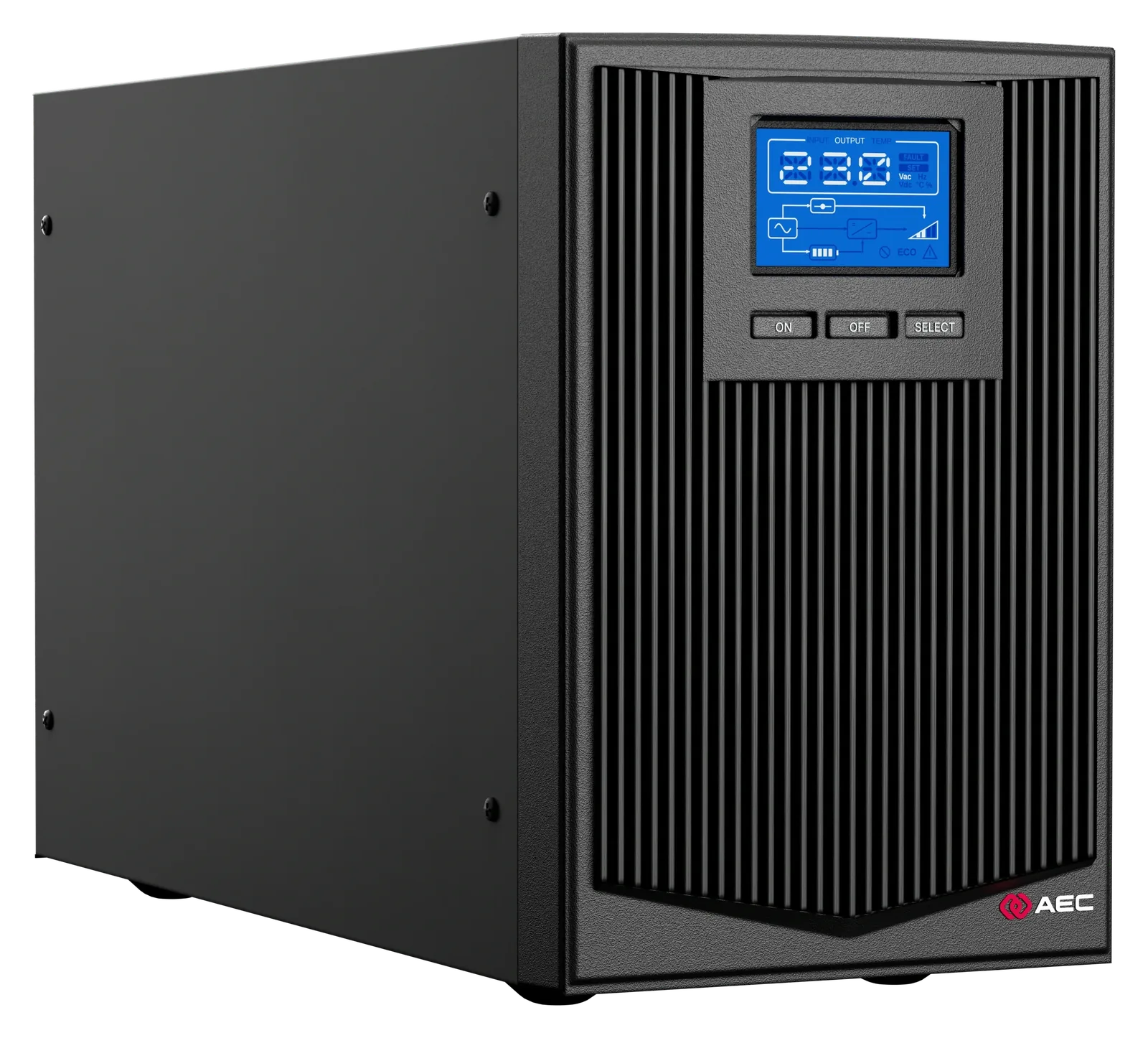
The load always runs from the inverter, so there is no transfer time when the mains fails and no micro-break. This is the technology for servers, critical workstations, medical equipment and data centres. Every AEC range in the EMEA catalogue is online double conversion, from the 1 kVA IST3 tower to the modular IST6 systems. The guide to UPS types compares them in depth.
Check the output waveform
Equipment with active power factor correction (PFC) power supplies, common in servers and high-end PCs, needs a pure sine wave. A stepped or simulated wave can cause malfunctions, overheating or sudden shutdown. Check the waveform on the data sheet before you buy; the IST3, for example, delivers a pure sine wave.
Step 3: how much runtime do you really need?
Runtime for a controlled shutdown
A UPS is rarely meant to run for hours. Its main job is to give you time to save data and shut systems down in an orderly way. For most IT uses, 5 to 10 minutes is enough. Buying far more without a clear reason means batteries you will not use, which still need space, cooling and replacement.
Runtime falls quickly as the load rises. For example, the standard 1–3 kVA IST3 models give 2 minutes at full load from their internal batteries (AEC data), and more at lower loads. Check your own case with the backup time calculator.
Monitoring and automatic shutdown
Automatic shutdown only works if the UPS can talk to the equipment. USB, RS232 or an SNMP network card, together with management software, let the UPS start the shutdown when the battery runs low, even when nobody is in the room. The IST3 has USB and RS232 as standard, with an optional SNMP card in its intelligent slot.
Longer runtime
A production line or a hospital ward may need far more than 10 minutes, or enough time for a generator to take over. Choose a UPS that accepts external batteries. The IST3 comes in a long backup version for external battery cabinets, and the IST7 takes internal and external batteries on the same model. For lithium, the All-in-One reaches up to 200 minutes at 6 kW with eight 50 Ah modules.
Step 4: single-phase or three-phase?
For smaller loads, roughly below 20 kVA, such as homes and small offices, a single-phase UPS is usually the simplest choice. Larger sites, such as factories, medium and large data centres and hospitals, move to three-phase, which spreads the load across three phases and handles demand a single-phase system could not.
| Need | AEC range | Power |
|---|---|---|
| Office, small server room, tower | IST3 | 1–10 kVA, single-phase |
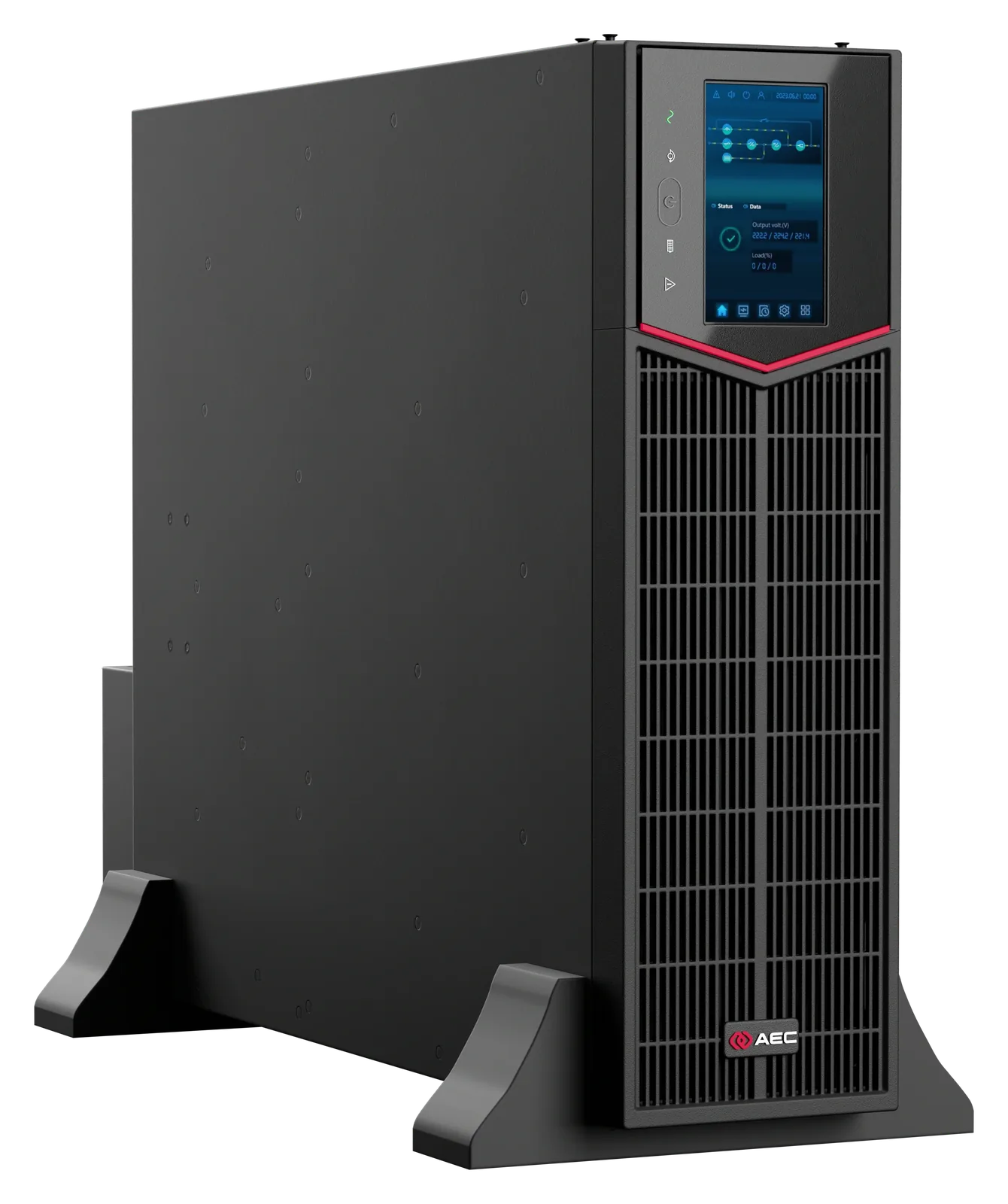
| 19-inch rack | IST3-J · IST8 (lithium) | 1–10 kVA · 1–3 kVA |
| Three-phase in a rack | IST9 | 10–40 kVA, 3U |
| Three-phase, floor-standing | IST7 10–40 · IST7 60–200 | 10–40 kVA · 60–200 kVA |
| Harsh grids, full isolation | IST7-T | 100–200 kVA, isolation transformer |
| Growing loads, redundancy | IST6 | 30–120 kVA, modular, N+1 slot |
Worked example: choosing a UPS for a small server room
A small business has one rack with two servers at 350 W each, a storage unit at 120 W, a network switch at 40 W and a firewall at 30 W. It wants 10 minutes to shut everything down.
- Size: 890 W, ÷ 0.8 = about 1,110 W at least. A 1 kVA IST3-J (PF 1, 1,000 W) is too small; the 2 kVA IST3-J and the 2 kVA IST8 both give 2,000 W, so the load sits at 45%.
- Technology: servers and storage take online double conversion; both candidates are online rack units.
- Battery: the IST3-J uses lead-acid blocks, the IST8 built-in lithium; in a closed rack that warms up, the battery choice is a service choice too.
- Check the runtime: the standard 1–3 kVA IST3-J gives 2 to 4 minutes at full load (AEC data), more at half load. If the calculator shows less than 10 minutes, add an external battery box in the same rack.
- Plan the shutdown: fit an SNMP card so the servers receive the shutdown signal over the network.
Result: a 2 kVA online rack UPS, sized at about half load, with battery and monitoring matched to a 10-minute shutdown.
Which UPS for home, office, server room or industry
No one UPS suits every site; the right one is the one that fits the load. As a guide:
- Home and home office: a small online unit such as a 1 kVA tower covers a PC, router and NAS. See UPS for home.
- Server rack: a 2U rack unit, with lead-acid (IST3-J) or built-in lithium (IST8) batteries.
- Server room or small data centre: a three-phase unit of 10–40 kVA, such as the IST9 in a rack or the IST7 on the floor.
- Industry: a transformer-based unit such as the IST7-T where the grid is difficult or full electrical isolation is needed.
- Growing data centres: a modular IST6, which adds power modules as the load grows and allows N+1 redundancy.
Common mistakes when choosing a UPS
- Choosing line-interactive for servers. The transfer break and, on some models, a stepped (simulated) waveform can trip sensitive power supplies.
- Buying runtime nobody needs. Extra batteries add weight, heat and maintenance.
- Skipping the communication link. Without USB, RS232 or SNMP, the UPS simply runs flat and the servers crash anyway.
- Forgetting the batteries. Lead-acid batteries typically last 3–5 years in service, less in a hot room.
Checklist before you buy, and why service matters
- List every critical load and add up its watts.
- Divide by 0.8 and compare with the UPS watt rating.
- Choose online double conversion for servers and sensitive equipment.
- Set the runtime: shutdown time, or time until the generator takes over.
- Choose single-phase or three-phase, and tower, rack or floor-standing.
- Plan monitoring and automatic shutdown.
- Plan battery checks and replacement.
Good components and well-kept batteries reduce the risk of failure at the moment the UPS is needed. Just as important is a service team that checks the batteries before a small problem turns into an outage. AEC offers 24/7 technical assistance by phone and WhatsApp, and maintenance contracts that include battery checks and replacement. To narrow the choice, try the UPS finder; the warranty, the spare parts and the service network behind an AEC unit are set out on why AEC.
Questions
Questions people ask
Is an online UPS always better than a line-interactive one?
Not for every load: online double conversion gives zero transfer time and constant output, so it is the right choice for servers and sensitive loads. A line-interactive unit can be enough for simple home or small office equipment.
How many minutes of backup should I plan for?
For most IT loads, 5 to 10 minutes is enough for a controlled shutdown. Plan for more only when the process cannot stop or a generator must take over, and choose a model that takes external batteries.
Which UPS should I choose for a server rack?
A 2U online rack UPS with a pure sine wave is the usual choice, sized at around half to three quarters of its watt rating. Add a network card so the servers shut down automatically when the battery runs low.
When do I need a three-phase UPS?
When the load is too large for a single-phase supply, roughly above 20 kVA, or when the site already distributes power on three phases. Factories, hospitals and medium to large data centres usually need three-phase.

Blog
Keep reading
Talk to an AEC engineer
Tell us the load, the supply and the backup time you need: we answer with the model and the batteries that fit.