



















20 October 2026 · updated 3 November 2026 · 10 min
Online UPS vs line-interactive vs offline: UPS types
There are three main types of UPS (uninterruptible power supply): offline or standby, line-interactive, and online double conversion. They differ in how the load is fed while the mains is present: an offline UPS passes the mains straight through, a line-interactive UPS also corrects the voltage, and an online UPS rebuilds the output from scratch at all times.
The result is a different level of protection, a different transfer time when the mains fails and a different classification under IEC 62040-3: VFD, VI or VFI.
In brief
- Offline (standby): load on the mains with only basic filtering, battery only during a failure, short break on transfer. IEC 62040-3 class VFD.
- Line-interactive: load on mains with automatic voltage regulation (AVR), short break on transfer. Class VI.
- Online double conversion: load always on the inverter, no transfer time when the mains fails, output independent of mains voltage and frequency. Class VFI.
- ECO mode on an online UPS raises efficiency by feeding the load through the bypass, but in that mode the load sees the mains again.
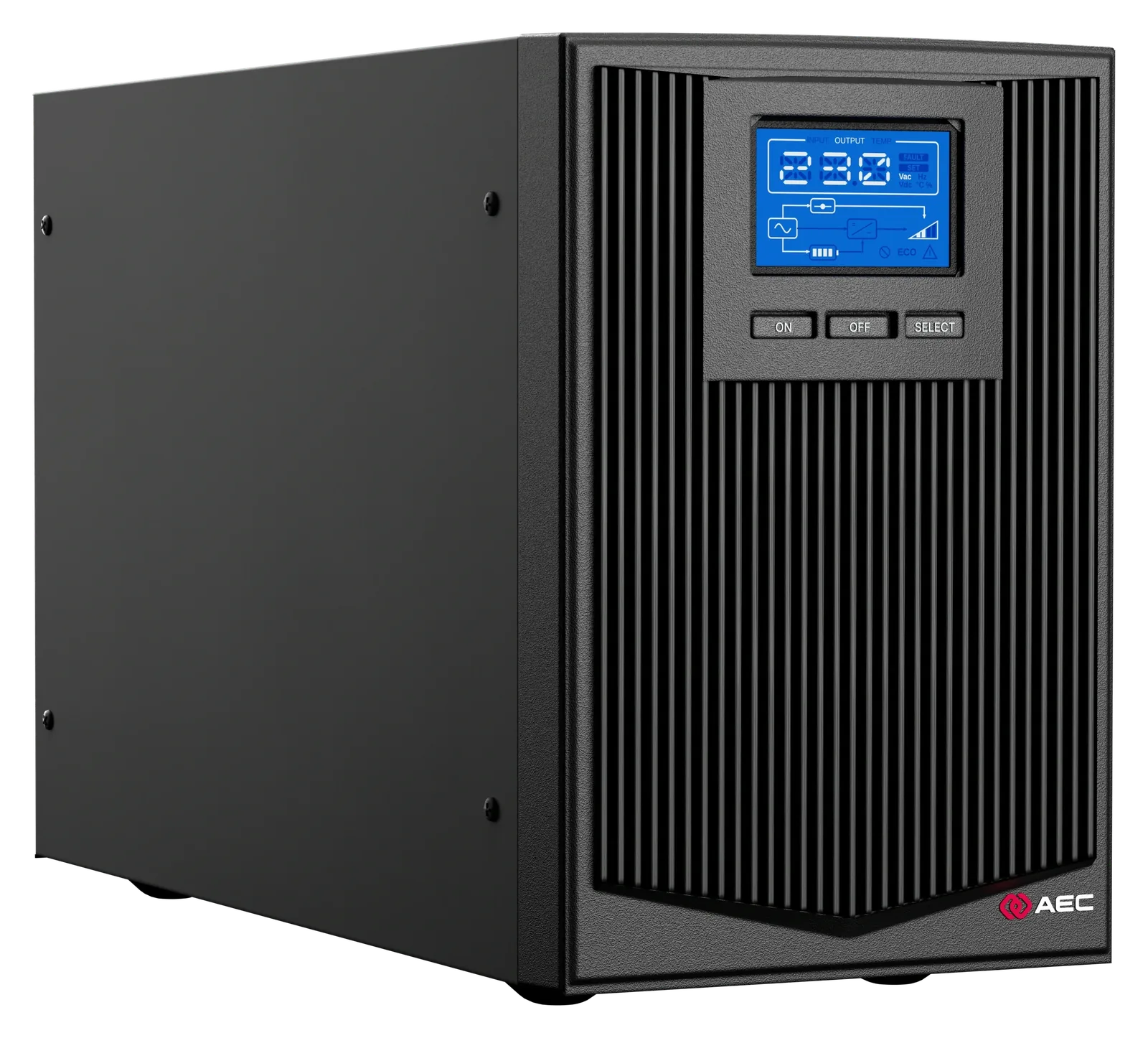
- Every AEC range in the EMEA catalogue is online double conversion.
A UPS keeps equipment running when the mains fails, using energy stored in a battery (our guide what is a UPS and how it works covers the basics). Every UPS has a battery and an inverter, the circuit that turns the battery's direct current (DC) into alternating current (AC). The topology decides when the inverter works and what happens to the mains before it reaches your equipment: whether there is a gap when the mains fails, how well sags and surges are handled, and how much energy the UPS itself uses.
Offline (standby) UPS: how it works
Normal mode. The load is connected to the mains through a transfer switch. The UPS filters spikes in a basic way and keeps the battery charged, but the voltage and frequency at the output are those of the mains.
On battery. When the mains fails or goes far out of range, the UPS starts its inverter and the switch moves the load to it.
On transfer. Detecting the fault and moving the switch takes time, typically a few milliseconds. During that gap the load is not supplied. Many power supplies ride through a short break, but not all do, especially at high load.
Waveform. Entry-level standby units often produce a stepped (simulated) sine wave on battery rather than a true sine wave. Some modern power supplies with active power factor correction (PFC) can react badly to a stepped wave.
Offline UPS are compact and simple. They suit a single home PC or a router, where a brief gap and an unregulated supply are acceptable.
Line-interactive UPS: how it works
Normal mode. The load is still fed from the mains, but through an automatic voltage regulator (AVR). The AVR is usually a transformer with several taps: when the voltage sags or rises, the UPS changes tap to bring the output back towards nominal, without using the battery.
On battery. When the mains fails, or goes beyond what the AVR can correct, the inverter takes over.
On transfer. As with the offline design, there is a short break of a few milliseconds while the UPS switches over. Frequency is not corrected in normal mode: if the mains frequency drifts, for example on a generator, the output drifts with it.
Waveform. Depending on the model, the output on battery may be a stepped wave or a sine wave. Check the data sheet.
Line-interactive units are a sound choice for homes, small offices and many network cabinets where the mains is reasonably stable. Because the AVR handles ordinary sags, the battery is used less often.
Online double conversion UPS: how it works
Normal mode. The incoming AC goes into a rectifier, which converts it to DC and feeds an internal DC bus. The inverter then converts that DC back into a new AC sine wave for the load. This is the "double conversion": AC to DC, then DC to AC. The battery is connected to the DC bus, directly or through a DC/DC converter, and is kept charged.
On battery. When the mains fails, the rectifier stops and the battery feeds the DC bus instead. The inverter keeps running exactly as before.
On transfer. Because the inverter never stops, there is no transfer time between mains and battery: 0 ms. The load does not notice the mains failure at all.
Waveform. The inverter produces a sine wave in every mode, with voltage and frequency held steady by the UPS rather than by the grid.
Online UPS also have a static bypass: an electronic switch that connects the load to the mains if the inverter is overloaded or develops a fault. Moving between inverter and bypass is very fast when the two are synchronised, and slower when they are not. The online double conversion design is the standard for servers, data centres, medical equipment and industrial control.
IEC 62040-3 classes: VFI, VI and VFD
IEC 62040-3 (EN 62040-3 in Europe) is the performance standard for UPS. It replaces marketing words with a classification code in three parts:
- Output dependency: how far the output depends on the input supply. This is the part people cite: VFI, VI or VFD.
- Output waveform: the shape of the output voltage, stated for normal operation and for battery operation.
- Dynamic performance: how much the output voltage moves when the operating mode changes or the load steps.
The three dependency classes are:
- VFI (Voltage and Frequency Independent): the output is independent of changes in supply voltage and frequency. This is the class of online double conversion UPS.
- VI (Voltage Independent): the output depends on the supply frequency, but the voltage is regulated. This is the class of line-interactive UPS.
- VFD (Voltage and Frequency Dependent): the output depends on both supply voltage and frequency. This is the class of offline (standby) UPS.
When you compare offers, ask for the full IEC 62040-3 classification, not just the word "online". The first part of the code tells you plainly what the load will see when the mains misbehaves.
Comparison table: offline vs line-interactive vs online UPS
| Feature | Offline (standby) | Line-interactive | Online double conversion |
|---|---|---|---|
| IEC 62040-3 class | VFD | VI | VFI |
| Load fed in normal mode by | Mains, basic filtering only | Mains, through AVR | Inverter |
| Voltage regulation in normal mode | No | Yes, in steps | Yes, continuous |
| Frequency regulation in normal mode | No | No | Yes |
| Transfer time mains to battery | A few milliseconds | A few milliseconds | 0 ms |
| Waveform on battery | Often stepped | Stepped or sine, by model | Sine |
| Own energy use | Lowest | Low | Higher in double conversion; lower in ECO mode |
| Typical power range | Small single-phase units | Small to medium single-phase units | From about 1 kVA up to large three-phase and modular systems |
| Typical use | Home PC, router | Home, small office, network cabinet | Servers, data centres, healthcare, industry |
ECO mode: efficiency against isolation
Double conversion has a cost: every conversion loses a little energy as heat. Many online UPS therefore offer an ECO mode (also called high-efficiency mode). While the mains is within a set window of voltage and frequency, the load is fed through the static bypass and the inverter waits in standby. If the mains leaves the window, the UPS moves the load back to the inverter.
The trade-off is simple. In ECO mode the load sees the mains again, with its sags, spikes and frequency drift inside the window, and there is a short transfer when the UPS returns to the inverter. In that mode the UPS behaves more like a VFD design than a VFI one. In exchange, the losses fall sharply.
Worked example: losses at 30 kW
Take an IST7 10-40 kVA UPS feeding a steady 30 kW load, 24 hours a day. Its data sheet gives system efficiency up to 96% in double conversion and up to 99% in ECO mode. UPS losses are P × (1/η − 1), where P is the load power and η the efficiency.
- Double conversion: 30 × (1/0.96 − 1) = 30 × 0.0417 ≈ 1.25 kW of losses.
- ECO mode: 30 × (1/0.99 − 1) = 30 × 0.0101 ≈ 0.30 kW of losses.
- Difference: 1.25 − 0.30 = 0.95 kW.
- Over a year: 0.95 kW × 8,760 h ≈ 8,300 kWh less energy turned into heat, before counting the cooling needed to remove it.
These are maximum efficiencies, so treat the result as indicative. Real efficiency depends on load level and battery charging.
A good rule: use ECO mode where the mains is stable and the load tolerates it, and keep double conversion for loads that must never see the grid, such as medical equipment, sensitive IT and installations fed by a generator.
Which UPS type for which load?
- Home and home office. A line-interactive unit is often enough for a PC, a router and a NAS. If you have a server, an expensive workstation or unstable mains, a small online UPS is the safer choice. See choosing a UPS for the home.
- IT, servers and network rooms. Online double conversion (VFI). Server power supplies expect a clean, uninterrupted sine wave, and network equipment does not like even short breaks.
- Data centres. Online double conversion, often modular and redundant, with ECO mode used only where the operator accepts the trade-off.
- Medical and healthcare. Online double conversion, with ECO mode normally left off. Diagnostic and life-support equipment should not see mains disturbances.
- Industry and process control. Online double conversion. PLCs, drives and instruments need stable voltage and frequency, especially where a generator feeds the site. Some ranges can also act as frequency converters, for example to run 60 Hz machines on a 50 Hz grid.
Checklist before you choose a UPS type
- List the loads and mark the ones that must never see a break or a mains disturbance.
- Check how stable your mains is, and whether a generator feeds the site.
- Ask for the IEC 62040-3 classification (VFI, VI or VFD) on the data sheet.
- Check the output waveform on battery: true sine wave or stepped.
- Check the transfer time mains to battery, and inverter to bypass.
- Decide whether ECO mode is acceptable for your loads, and in which window.
- Size the power and runtime with our guide on how to choose a UPS.
Common mistakes
- Trusting the product name. Names such as "online interactive" or "line-interactive online" mix two different topologies. A line-interactive UPS is not online, whatever the label says. Look for the IEC 62040-3 class: only VFI means double conversion.
- Ignoring the waveform. A stepped wave on battery can upset active-PFC power supplies. Check that the output is a sine wave.
- Leaving ECO mode on for critical loads. ECO saves energy, but in ECO mode the load sees the grid. Make it a conscious choice, not a default.
- Choosing the topology and forgetting the rest. An online UPS that is undersized, or has too little battery, still lets you down. Size the power with a margin and check the runtime with the backup time calculator.
AEC UPS ranges: all online double conversion
Every AEC range in the EMEA catalogue is online double conversion, with 0 ms transfer from mains to battery. Most also offer ECO mode, so you can choose between maximum isolation and minimum losses.
- Single-phase, 1-10 kVA: the IST3 online tower UPS (1, 2, 3, 6 and 10 kVA) and the IST3-J rack/tower UPS give a sine wave output and 0 ms transfer. Both let you set ECO or INV (online) mode from the front panel.
- Lithium single-phase, 1-3 kVA: the IST8 is online double conversion with a built-in lithium-ion battery, AC/AC efficiency up to 93% at 3 kVA, and ECO or INV mode selectable on the panel.
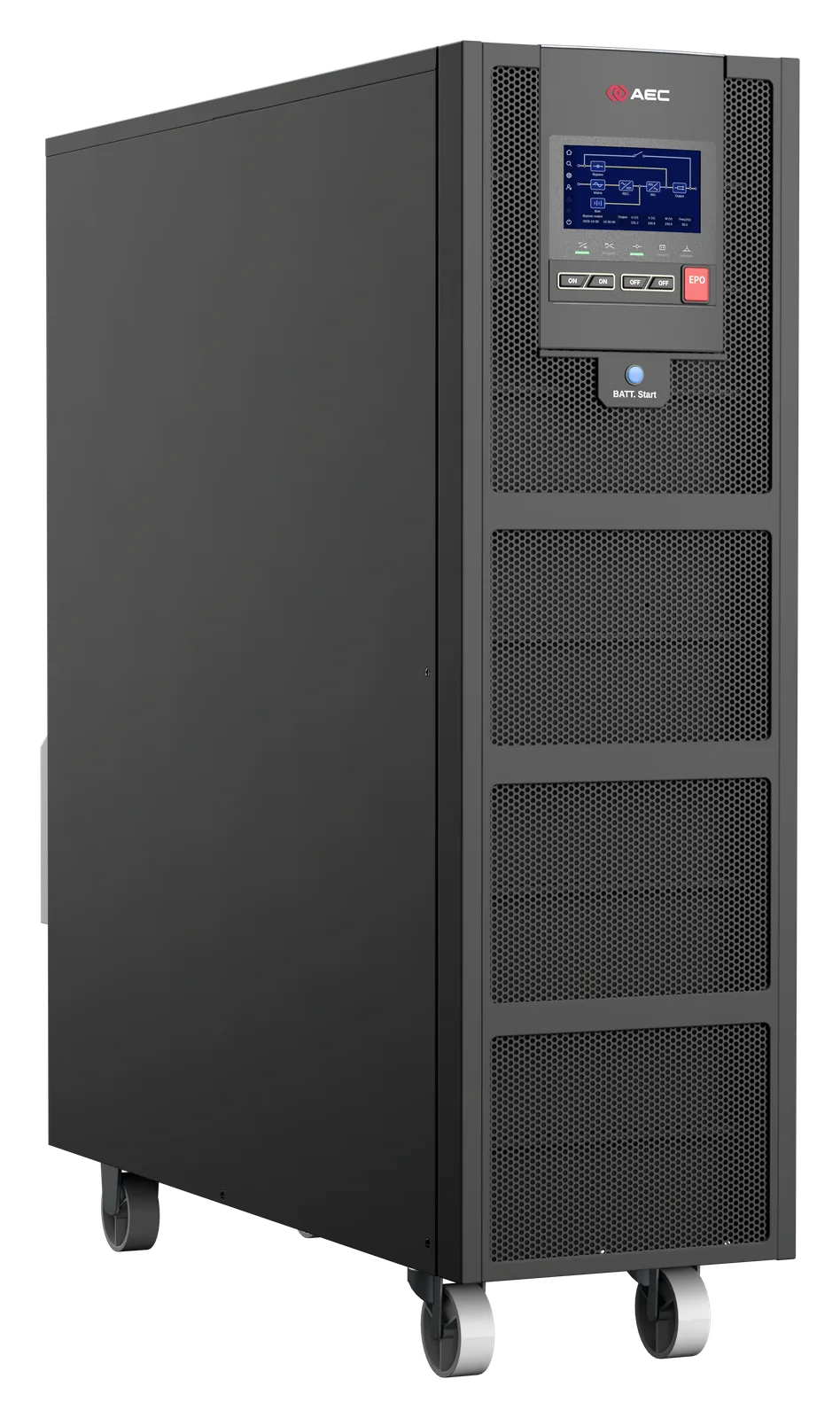
- Three-phase, 10-40 kVA: the IST7 10-40 kVA and the 3U IST9 reach up to 96% in double conversion and 99% in ECO mode on a single UPS. Transfer between inverter and bypass is under 1 ms when synchronised and under 10 ms when not.
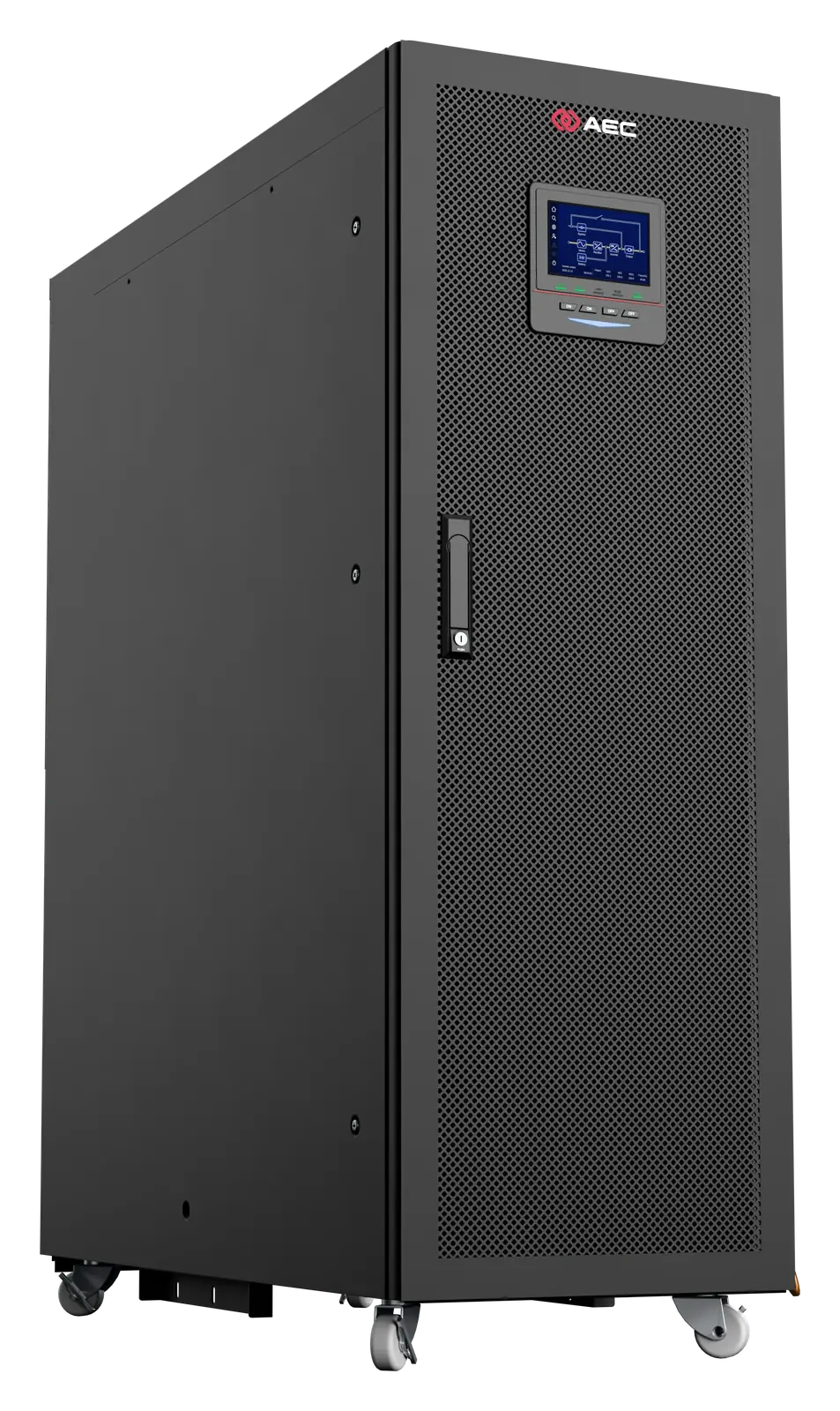
- Three-phase, 60-200 kVA: the IST7 60-200 kVA reaches up to 96.5% peak efficiency in double conversion and 99% in ECO mode, and returns the load to the inverter automatically when the bypass leaves tolerance. The IST7-T adds an isolation transformer, with 0 ms transfer from mains to battery.
- Modular: the IST6 30-120 kVA gives 97% in double conversion and up to 99% in ECO mode, with scheduled ECO. The larger IST6 400-1200 kVA reaches 98.1% with PLUS modules and 99.2% in ECO. See all modular UPS systems.
Not sure which mode suits your site? Tell us about your loads and your mains and we will help you choose.
Questions
Questions people ask
What is an online UPS?
An online UPS, or online uninterruptible power supply, feeds the load from its inverter at all times. The mains is first converted to DC and then rebuilt as a new sine wave, so the load never sees the grid directly. When the mains fails there is no transfer time, because the inverter keeps running from the battery.
What is the difference between an online UPS and a line-interactive UPS?
A line-interactive UPS feeds the load from the mains and corrects the voltage with an automatic voltage regulator, but does not correct the frequency. When the mains fails it switches to battery with a short break of a few milliseconds. An online UPS rebuilds voltage and frequency continuously and has 0 ms transfer from mains to battery.
What do VFI, VI and VFD mean?
They are the output dependency classes of IEC 62040-3. VFI means the output is independent of changes in supply voltage and frequency (online double conversion). VI means the voltage is regulated but the output depends on frequency (line-interactive), and VFD means the output depends on both (offline or standby).
Is ECO mode safe to use on an online UPS?
Only for loads that tolerate the raw mains, on a site where the mains is stable; AEC's normal mode is double conversion. In ECO mode the load is fed through the bypass, so it sees mains disturbances within the set window, and the UPS transfers to the inverter when the mains leaves that window. For medical, sensitive IT or generator-fed loads, double conversion is usually the better choice.
Which type of UPS power supply do I need for a server?
For servers and network equipment, choose an online double conversion UPS, class VFI, with a sine wave output. Server power supplies expect a clean, uninterrupted supply. Then size the power with a margin and check the runtime you need.
Is an 'online interactive' UPS the same as an online UPS?
No. Names like 'online interactive' are marketing labels and usually describe a line-interactive design. Check the IEC 62040-3 classification on the data sheet: only VFI indicates online double conversion.
Products
Products in this guide

Blog
Keep reading
Talk to an AEC engineer
Tell us the load, the supply and the backup time you need: we answer with the model and the batteries that fit.