



















25 June 2025 · updated 17 November 2026 · 7 min
Single- or three-phase UPS: which does your site need?
A single-phase UPS takes one 230 V phase and neutral and is the usual choice up to about 10–20 kVA: homes, offices, racks and small server rooms. A three-phase UPS uses three phases at 400 V and is the norm above that, for whole buildings, data centres and industrial sites.
Your choice depends on the supply you have, the supply your equipment needs and the total power to protect.
In brief
- Single-phase UPS systems cover small and medium loads; AEC's single-phase ranges run from 1 to 10 kVA.
- Above about 20 kVA, three-phase is the norm, because the same power flows at roughly a third of the current per conductor.
- A three-phase UPS can still feed single-phase loads, either in 3/1 mode or with the loads balanced across three phases in 3/3 mode.
- In 3/3 mode each phase carries about a third of the rating, so phase balance matters as much as the total.
- Single-phase units up to a few kVA often plug in; three-phase units are always hard-wired by an electrician.
What is a single-phase UPS?
A UPS (uninterruptible power supply) keeps equipment running when the mains fails and filters the mains while it is present. A single-phase uninterruptible power supply takes its input from one phase conductor and the neutral, and delivers one 230 V output. That is the same supply as an ordinary wall socket in most of Europe.
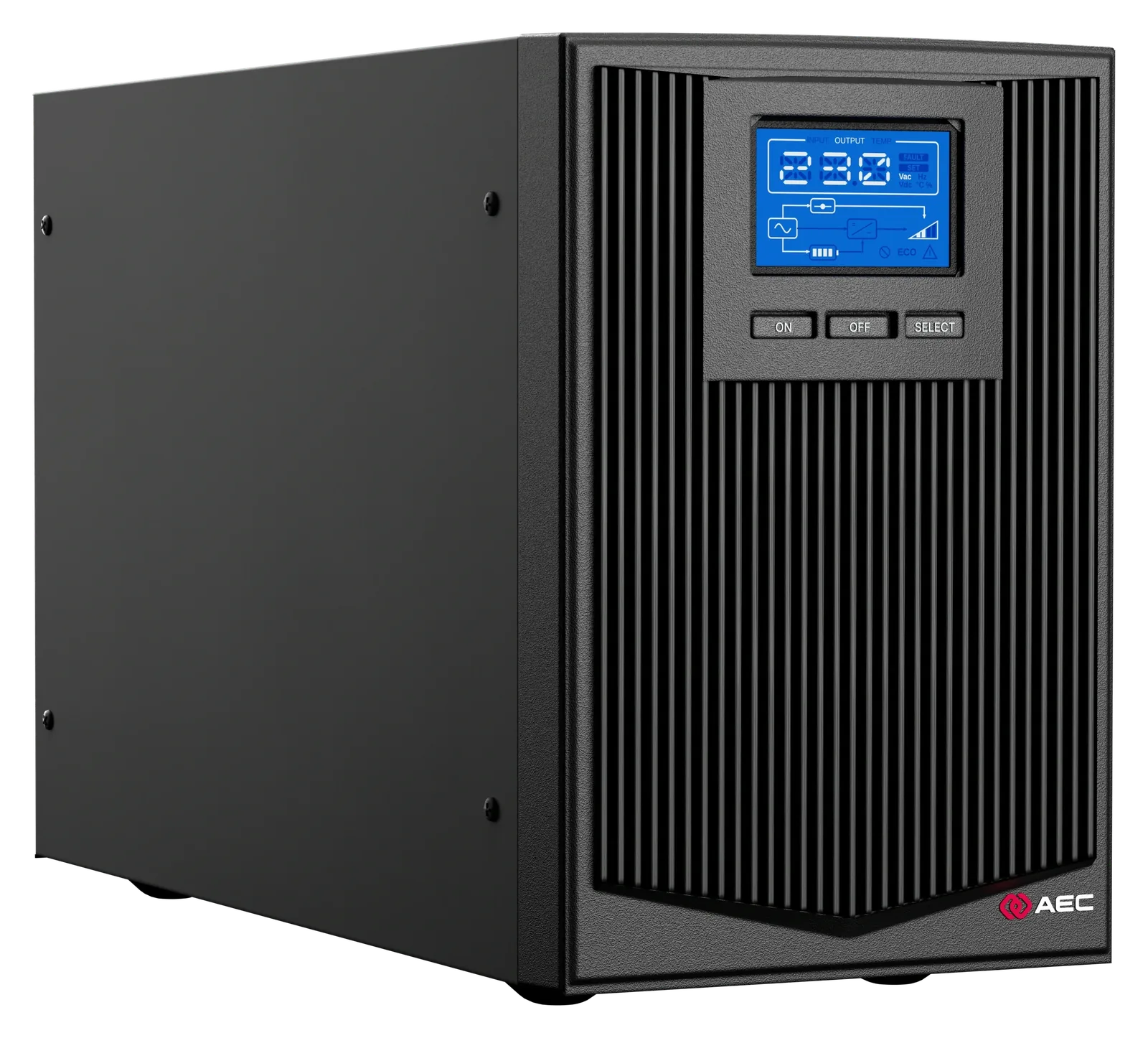
Single-phase UPS systems are compact. Small models often come with internal batteries and plug straight into a socket. The IST3, for example, is a single-phase online UPS from 1 to 10 kVA: the 1–3 kVA models plug into a wall socket, while the 6 and 10 kVA models connect on a terminal bar. Online, or double conversion, means the load always runs from the inverter, so there is no break when the mains fails.
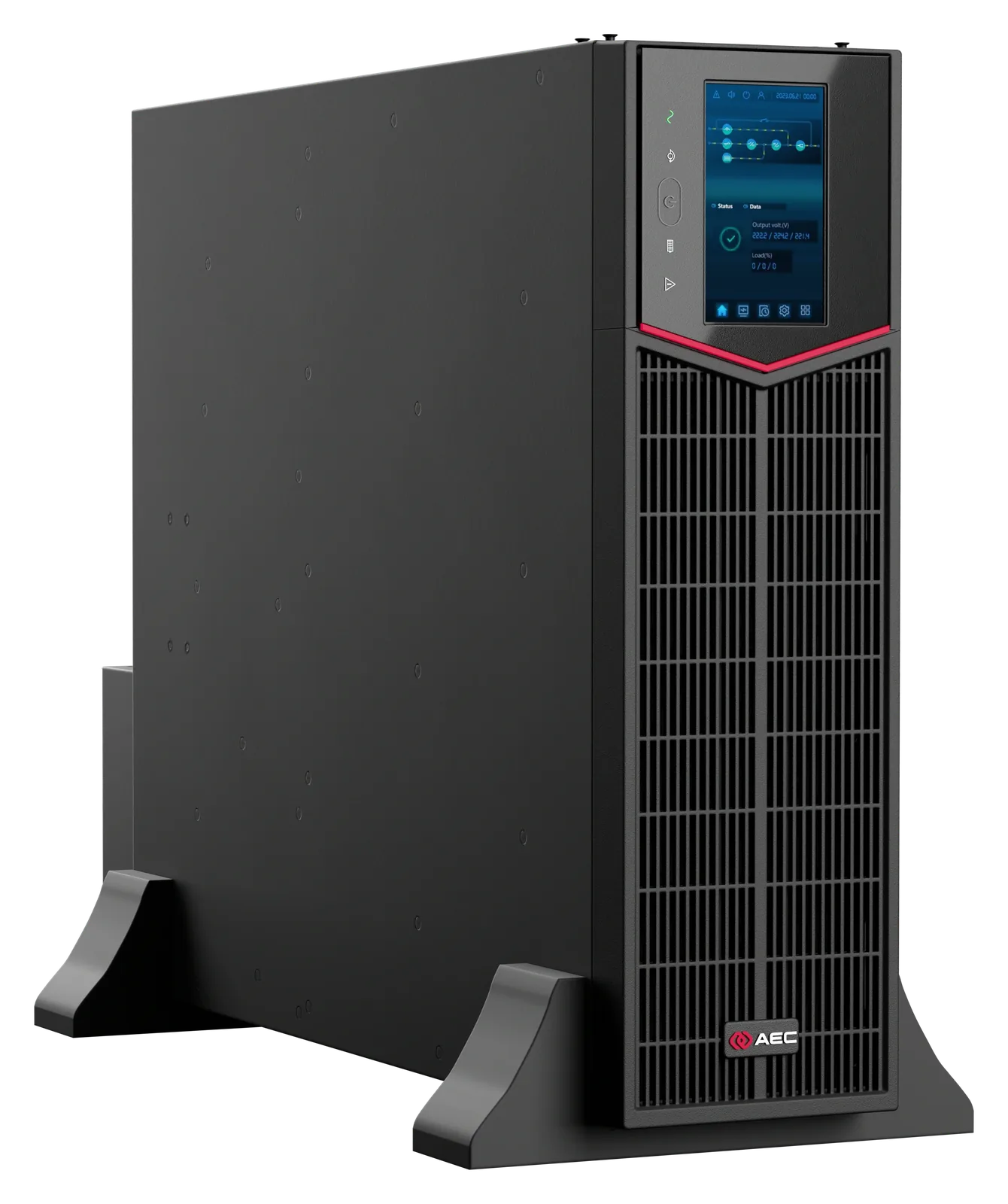
Single-phase UPS systems also come in rack formats. The IST3-J fits every rating from 1 to 10 kVA into a 2U, 19-inch chassis, with battery boxes mounted below it in the same rack. Runtime is a separate question from phases: it depends on the battery and the load, as our guide to UPS backup time explains.
What is a three-phase UPS?
A three-phase supply carries three alternating voltages, each 120° out of step with the others. Between any phase and neutral you measure 230 V; between two phases, 400 V. Because the three waves peak at different moments, power flows more evenly and the same cable size carries far more power.
A three-phase UPS is wired to all three phases. It protects a distribution board, a whole floor or a building from one central unit. It is always hard-wired, with breakers and cables sized for the site. For the full picture on three-phase design, parallel systems and large installations, see our guide to three-phase UPS.
Single vs three-phase UPS: the key differences
The table sums up the practical differences. The power figures are typical ranges, not hard limits: the right answer depends on the site.
| Aspect | Single-phase UPS | Three-phase UPS |
|---|---|---|
| Typical power | Up to about 10–20 kVA | From about 10–20 kVA to megawatts |
| Supply | One phase and neutral, 230 V | Three phases (with or without neutral), 400 V between phases |
| Output | One sine wave | Three sine waves 120° apart (3/3), or one (3/1) |
| Typical sites | Homes, offices, racks, small server rooms | Data centres, hospitals, factories, whole buildings |
| Installation | Often plug-in up to a few kVA | Hard-wired by an electrician |
| Protection plan | One UPS per device, rack or room | One central UPS for a building or several critical circuits |
| Main design check | Total load and input current | Total load and the load on each phase |
How much power: where single-phase stops
The real limit of a single-phase UPS is current. On a single phase, current is power divided by voltage (and power factor). On three phases, the same power is shared out, so each conductor carries much less. Power factor is the ratio of real power in watts (W) to apparent power in volt-amperes (VA); our guide to kVA and kW explains it in detail.
Worked example: a 12 kW load
Take an office floor with 12 kW of IT and network equipment, and assume a power factor of 1 to keep the sums simple.
- Single-phase current: I = P ÷ V = 12,000 W ÷ 230 V ≈ 52 A on one phase conductor and the neutral.
- Three-phase current: I = P ÷ (√3 × V) = 12,000 W ÷ (1.732 × 400 V) = 12,000 ÷ 693 ≈ 17 A on each phase.
- Result: the three-phase supply carries about a third of the current per conductor, so cables, breakers and the supply connection can be smaller.
You can see the same effect in AEC's own data. The IST3 data sheet gives a maximum input current of 60 A for the 10 kVA single-phase model. On the IST7 10–40 kVA, the 20 kVA model draws a maximum of 35.5 A per phase in 3/3 mode. Twice the power, with about 40% less current per conductor. This is why three-phase becomes the norm somewhere between 10 and 20 kVA.
3/3, 3/1 and 1/1: input and output configurations
UPS configurations are written as input/output phases:
- 1/1, single-phase in and out: the classic single-phase UPS.
- 3/3, three-phase in and out: for three-phase loads or a three-phase distribution board.
- 3/1, three-phase in, single-phase out: the UPS draws from all three phases and delivers one single-phase output, so you do not have to balance single-phase loads.
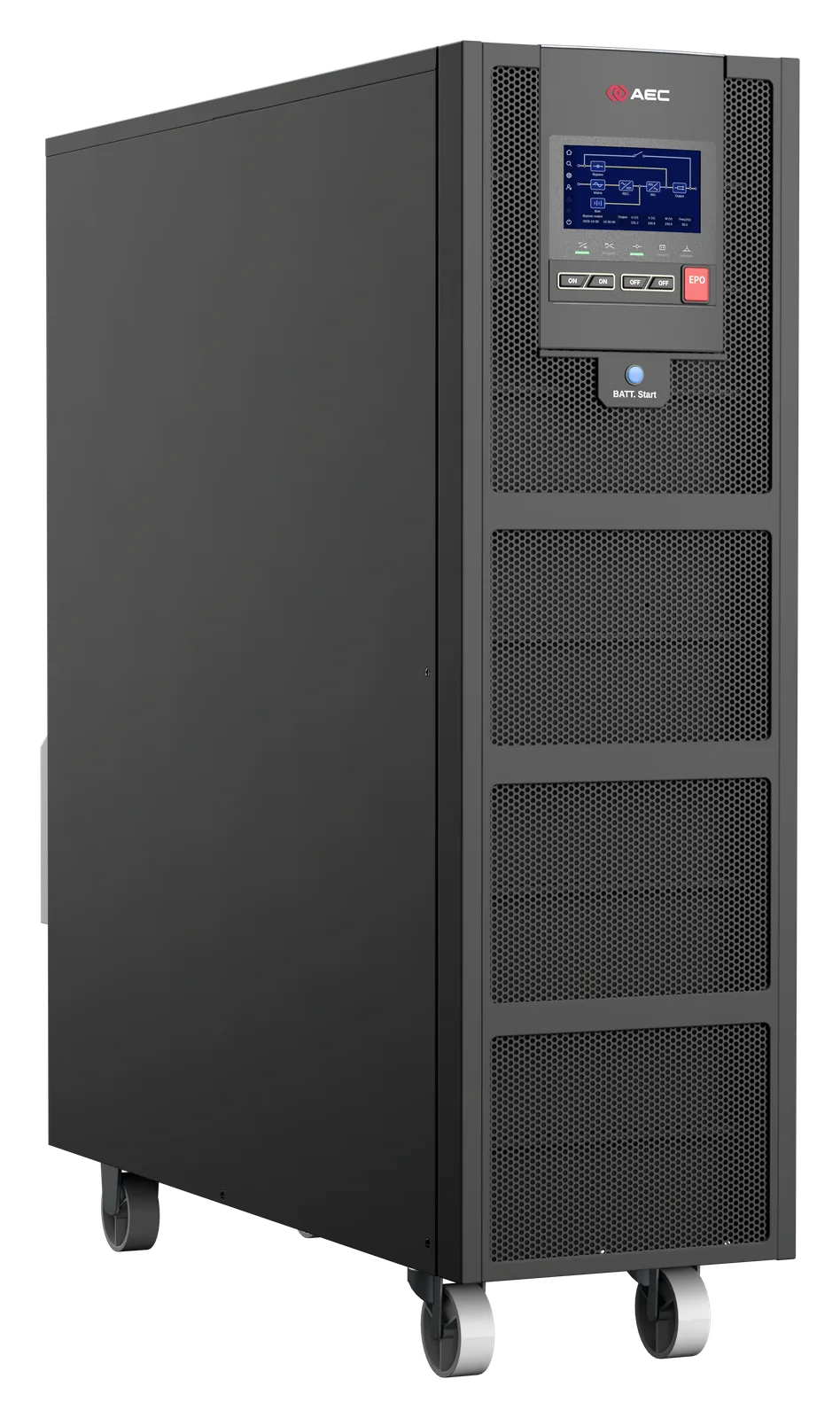
Some AEC models offer all three from the same unit. The IST7 10–40 kVA works 3/3 or 3/1 on every size and 1/1 on 10–20 kVA, set by wiring, connector jumpers and the touch screen. The IST9 does the same in a 19-inch, 3U rack chassis.
A 3/1 output has one consequence on the output side. The single-phase output carries up to three times the phase current, so neutral and output cables are larger. Their cross-sections follow the national wiring rules, such as BS 7671 in the UK or CEI 64-8 in Italy, and the UPS installation manual. On the IST7 20 kVA, the maximum output current is 30.3 A per phase in 3/3 mode and 90.9 A in 3/1 mode.
Choosing 3/1 avoids balancing the single-phase loads. Choosing 3/3 means spreading them so that no phase passes its third of the rating (on a 30 kVA UPS, about 10 kVA a phase), unless the UPS accepts full unbalance, as the IST7-T with its output isolation transformer does. Our guide to three-phase UPS covers the choice between 3/3 and 3/1, phase balancing and the neutral in detail.
Common mistakes
- Judging by the total only. In 3/3 mode one overloaded phase trips the UPS even when the total is well within the rating.
- Undersizing 3/1 output cabling. The single-phase output and neutral carry up to three times the phase current.
- Stretching single-phase too far. Large single-phase loads mean high currents, heavy cables and a strain on the supply connection.
- Connecting the wrong loads to a small UPS. The IST3 manual warns against inductive or half-wave rectified loads such as air conditioners, motors, drills and fluorescent lamps.
- Forgetting growth. A site that will move to three-phase within a few years may be better served by a UPS that works 1/1 now and 3/3 later.
Checklist: single-phase or three-phase?
- Check the incoming supply: single-phase only, or three-phase with neutral?
- List the loads and note which need a three-phase supply, such as motors or some medical and industrial equipment. Most IT equipment is single-phase.
- If one large single-phase load is too much for one phase of the mains, a 3/1 UPS draws it from all three phases; if a whole 400 V distribution board must be protected, the UPS is three-phase.
- Add up the total power and allow for growth; our UPS sizing guide shows the method.
- Below about 10 kVA of single-phase loads, choose a single-phase UPS.
- Between about 10 and 20 kVA, compare single-phase currents with a 3/1 or 3/3 option.
- Above about 20 kVA, choose three-phase, and decide between 3/3 with balanced loads or 3/1.
- Decide on redundancy and backup time before choosing the model.
Which AEC ranges?
- Single-phase, 1–10 kVA: IST3 tower and IST3-J 2U rack/tower, both online; IST8 with built-in lithium, 1–3 kVA, output power factor 1. See all single-phase UPS.
- Three-phase or single-phase output, 10–40 kVA: IST7 floor-standing and IST9 3U rack/tower, 3/3, 3/1 and, on 10–20 kVA, 1/1, both up to 96% efficiency in double conversion.
- UPS and lithium battery in one cabinet, 20 kVA: All-in-One, three-phase input, 3/3 or 3/1.
- Three-phase 400 V, 60–200 kVA: IST7 60–200 kVA, up to 8 units in parallel, up to 1.6 MW, with N+X redundancy. With isolation transformer, 100–200 kVA: IST7-T.
- Modular three-phase: IST6 30–120 kVA in 30 kVA steps, and larger IST6 cabinets up to 1.2 MW. See all three-phase UPS.
Not sure which side of the line you are on? Try the UPS finder, or send us your load list and we will suggest a configuration.
Questions
Questions people ask
What is a single-phase UPS used for?
A single-phase UPS protects equipment fed from one 230 V phase: PCs, servers, network racks, tills and small server rooms. AEC's single-phase ranges cover 1 to 10 kVA. Above about 20 kVA a three-phase UPS is usually the better choice.
Can a three-phase UPS supply single-phase loads?
Yes. Use a 3/1 configuration, which delivers one single-phase output, or a 3/3 UPS with the single-phase loads spread evenly across the three phases. In 3/1 mode the output and neutral cables must be sized for up to three times the phase current.
When should I move from single-phase to three-phase?
Usually somewhere between 10 and 20 kVA. Above that, single-phase currents get high and cables and breakers get large. Three-phase loads such as motors need a three-phase UPS whatever the size.
Is a three-phase UPS more efficient?
Not because of the phases: efficiency depends on the design. Check the data sheet: the IST7 10–40 kVA, for example, reaches up to 96% in double conversion.
Do I need an electrician to install a three-phase UPS?
Yes. A three-phase UPS is hard-wired, with cables and breakers sized for the site. Single-phase units up to a few kVA, such as the IST3 1–3 kVA, often simply plug into a socket.
Blog
Keep reading
Talk to an AEC engineer
Tell us the load, the supply and the backup time you need: we answer with the model and the batteries that fit.