



















18 November 2026 · 7 min
Battery room ventilation to EN IEC 62485-2 for VRLA
A VRLA battery needs fresh air in proportion to its cells and its capacity, and EN IEC 62485-2 gives the amount. An AEC BB8 cabinet with 64 × 12 V 100 Ah blocks needs 1.92 m³/h on float and 15.4 m³/h on boost charge, and with natural ventilation an inlet and an outlet of at least 430 cm² each.
The formula is Q = 0.05 × n × Igas × Crt × 10⁻³ m³/h; the rest of this guide shows where each figure comes from, cabinet by cabinet.
In brief
- The air flow grows with the number of cells (six per 12 V block) and the capacity in Ah; the UPS power does not enter the formula.
- VRLA blocks give off 1 mA of gas current per Ah on float and 8 mA per Ah on boost charge: size the openings for boost.
- With natural ventilation each opening, inlet and outlet, needs at least 28 × Q cm².
- The largest AEC battery cabinet, a BB8 with 64 × 100 Ah, needs 15.4 m³/h on boost; two BB8 in one room need 30.7 m³/h.
- This air is a safety requirement for hydrogen, separate from the cooling of the room.
Why does a sealed battery need ventilation?
A lead-acid cell gives off hydrogen and oxygen while it charges. A VRLA block recombines almost all of that gas inside: the OZ Power AGM blocks AEC fits in its cabinets are rated at 99% gas recombination. The small remainder escapes through the valve. The ventilation rule of EN IEC 62485-2 keeps that hydrogen well below a dangerous level by changing the air of the battery room or cabinet.
The gas comes from the charge current, not from the load. A battery on float in a quiet room gives off little; the same battery on boost charge after a long outage gives off eight times more. That is why the openings are sized for boost.
What does each term of the formula mean?
AEC's battery cabinet manuals and the battery cabinets page use the formula of EN IEC 62485-2 for lead-acid batteries:
Q = 0.05 × n × Igas × Crt × 10⁻³ m³/h
| Term | What it is | Value for an AEC cabinet |
|---|---|---|
| Q | Fresh air the battery needs | m³ per hour |
| 0.05 | Constant of the standard | 0.05 |
| n | Number of cells in the battery | 6 per 12 V block: 40 blocks = 240 cells |
| Igas | Gas-producing current, mA per Ah | VRLA: 1 on float, 8 on boost charge |
| Crt | Rated capacity of the blocks, Ah | 9 to 100 Ah (OZ Power 12 V) |
For natural ventilation the standard asks for an air inlet and an air outlet, each with a free area of at least A = 28 × Q cm². With Q in m³/h, A comes out in cm².
When a cabinet holds two strings in parallel, as the BB8 does, count every cell of both strings at the Ah of one block. Two strings of 32 blocks of 100 Ah are 384 cells at 100 Ah, not 192 cells at 200 Ah: the product n × Crt is the same either way, so the result does not change.
How much air does each AEC battery cabinet need?
The table applies the formula to the configurations AEC sells in the BB4 to BB8 cabinets, the longest string of each block size in AEC's code list. Q float is the air with the battery at rest, Q boost the air during a boost charge, and the last column the free area of each natural-ventilation opening.
| Cabinet | Blocks × Ah | Cells (n) | Q float | Q boost | Each opening |
|---|---|---|---|---|---|
| BB4 | 80 × 9 Ah | 480 | 0.22 m³/h | 1.73 m³/h | 48 cm² |
| BB5 | 40 × 24 Ah | 240 | 0.29 m³/h | 2.30 m³/h | 65 cm² |
| 38 × 40 Ah | 228 | 0.46 m³/h | 3.65 m³/h | 102 cm² | |
| 120 × 9 Ah | 720 | 0.32 m³/h | 2.59 m³/h | 73 cm² | |
| BB6 | 36 × 60 Ah | 216 | 0.65 m³/h | 5.18 m³/h | 145 cm² |
| BB7 | 36 × 80 Ah | 216 | 0.86 m³/h | 6.91 m³/h | 194 cm² |
| 36 × 100 Ah | 216 | 1.08 m³/h | 8.64 m³/h | 242 cm² | |
| BB8 | 64 × 80 Ah (2 strings) | 384 | 1.54 m³/h | 12.3 m³/h | 344 cm² |
| 64 × 100 Ah (2 strings) | 384 | 1.92 m³/h | 15.4 m³/h | 430 cm² |
The cabinet pages also describe BB5 and BB6 layouts of up to 40 blocks. A BB5 with 40 × 40 Ah (240 cells) needs 0.48 m³/h on float, 3.84 m³/h on boost and 108 cm² per opening; a BB6 with 40 × 60 Ah needs 0.72 m³/h, 5.76 m³/h and 161 cm².
The 120 small 9 Ah blocks of a BB5 need less air than 38 blocks of 40 Ah, because the formula follows the stored capacity, n × Crt, and not the number of blocks. The UPS power is not in the formula: a BB7 with 36 × 100 Ah needs the same air behind an IST7-60 as behind an IST7-160.
Worked example: an IST7-200 with two BB8 cabinets
The IST7 60–200 kVA range lists the IST7-200 with one or two BB8 cabinets. Take the larger battery, two BB8 with 64 × 12 V 100 Ah each, in one battery room:
- Cells: 128 blocks × 6 = 768 cells.
- Float: 0.05 × 768 × 1 × 100 × 10⁻³ = 3.84 m³/h.
- Boost: 0.05 × 768 × 8 × 100 × 10⁻³ = 30.7 m³/h.
- Natural ventilation: 28 × 30.7 = 860 cm² of free area for the inlet and the same for the outlet.
- Forced ventilation instead: a fan that moves at least 30.7 m³/h out of the room, with an air inlet that lets the same air in.
The free area is the open part of the grille, not its outside size: a louvre or a mesh closes part of it, so read the grille maker's free-area figure.
For comparison, an IST6 200 kVA cabinet moves 2,420 m³/h of cooling air through itself. The battery's 30.7 m³/h is small next to that, but it is a different air: it must leave the room and be replaced by fresh air, while an air conditioner only moves and cools the air already there.
Float or boost: which figure do you design for?
Design the openings or the fan for boost. AEC's cabinet pages size the natural-ventilation openings on Q boost. A battery goes to boost charge after a long outage, when it recharges at its highest current. The float figure tells you how little gas a healthy battery gives off on a normal day; it is not the design value.
The AEC maintenance plan checks the ventilation and the room temperature every month, with the cases, leaks and corrosion, and reads the voltage of every block every six months. Our guide to UPS battery maintenance covers the plan.
What about the battery cabinet itself?
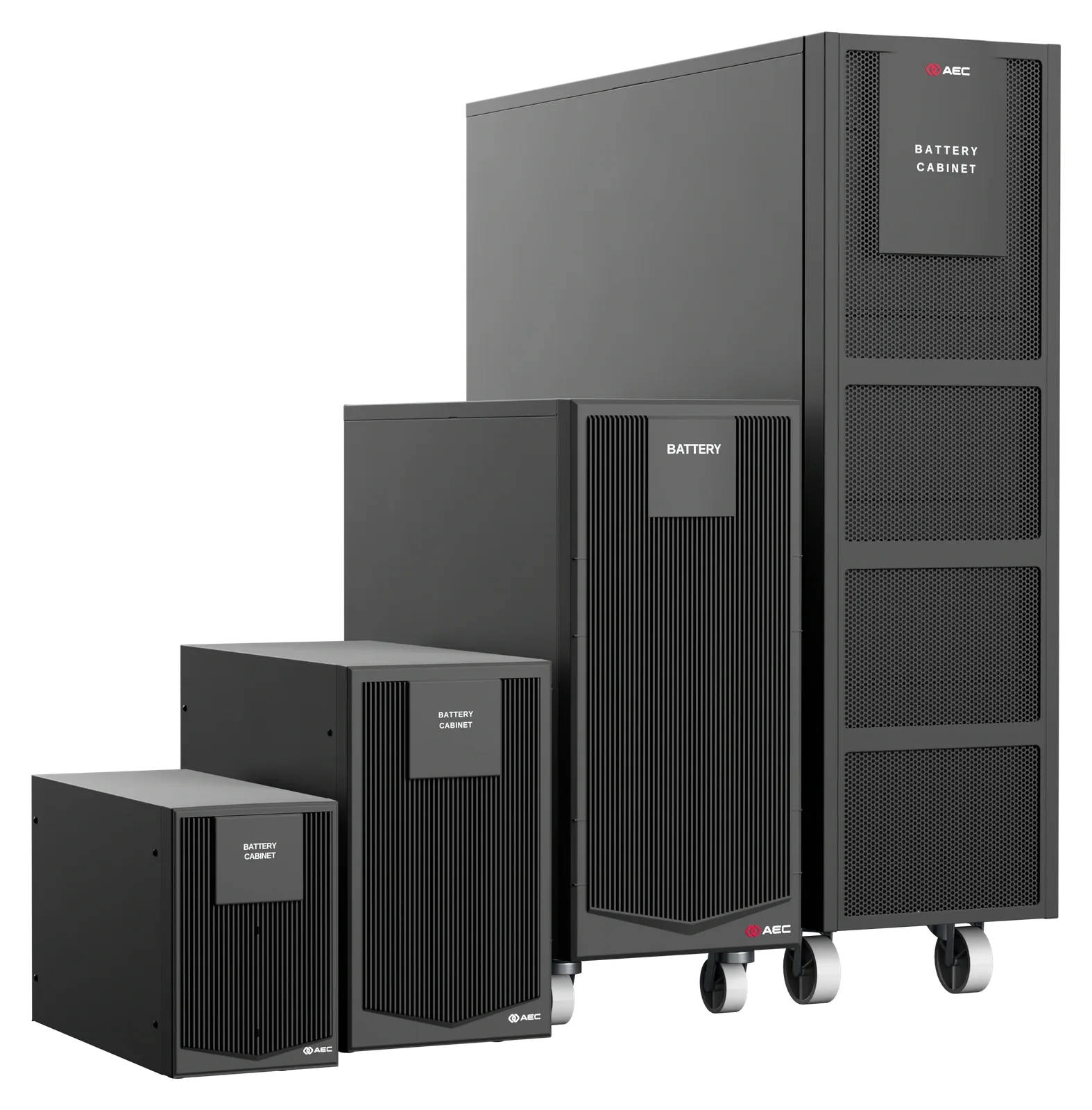
The BB5 to BB8 cabinets are IP20 as standard, and the BB5 has ventilation slots in its plinth. The cabinet manual asks for an indoor, dry and clean site, and never a sealed enclosure. IP21 to IP44 are available on request, and forced ventilation with automatic fans, IP68, at 12 or 24 V DC, is a cabinet option: ask AEC which one a closed cabinet needs.
The cabinet manual also asks for at least 600 mm free in front and 100 mm behind and at the sides. Those distances do not replace the room's own fresh-air openings.
What temperature should the battery room keep?
The BB5 to BB8 manuals allow 0 to 40 °C and give 20 to 25 °C for the best life, with life roughly halving for every 8 °C above 25 °C. A battery room at 33 °C therefore costs about half the service life of the blocks, whatever its air change.
Plan the two together: the fresh air for hydrogen, and cooling for the heat of the UPS and the room. Our guide to UPS heat output and cooling works out the second.
Does a lithium battery need the same air?
No. The formula above is for lead-acid batteries, which give off hydrogen on charge. The L6 lithium system follows its maker's figures: operation from 0 to 40 °C, best between 20 and 30 °C, front air inlet and rear or top air outlet, with a fan in each module. The VRLA vs lithium guide compares the two chemistries.
What must the installer check?
- The standard's current text. The formula and the Igas values are those of EN IEC 62485-2 as AEC applies them; check them, and the rules for where the openings go, against the edition in force.
- Local rules. National and local regulations, the fire authority and the building's own rules may ask for more.
- The battery data. OZ Power does not publish a float current per block, so the standard's values are used; a different battery brand may give its own.
- All the batteries in the room. Add every cabinet and string sharing the air: the cells add up.
- The path of the air. AEC's room fit tool puts the inlet and the outlet on opposite walls, the outlet high; check where they lead against the standard and local rules, and keep them free of storage.
The room fit tool works out this air flow and the openings for an AEC UPS and its cabinets, beside the clearances, the floor load and the cables, and shows the formula next to every result. For the backup time of a given battery, use the battery runtime calculator.
Questions
Questions people ask
How do you calculate battery room ventilation for a UPS?
With EN IEC 62485-2: Q = 0.05 × n × Igas × Crt × 10⁻³ m³/h. n is the number of cells (six per 12 V block), Igas is 1 mA/Ah on float or 8 mA/Ah on boost for VRLA, and Crt is the capacity in Ah. For 64 blocks of 12 V 100 Ah (384 cells) that is 1.92 m³/h on float and 15.4 m³/h on boost: design for boost charge.
How big must the ventilation openings of a battery room be?
For natural ventilation, an inlet and an outlet each with a free area of at least 28 × Q cm², with Q in m³/h. An AEC BB8 with 64 × 12 V 100 Ah blocks needs 15.4 m³/h on boost, so about 430 cm² per opening.
Do VRLA batteries need ventilation if they are sealed?
Yes. VRLA blocks recombine almost all their gas inside, 99% for the OZ Power AGM blocks, but a small amount of hydrogen still escapes on charge, and more on boost charge. EN IEC 62485-2 sets the fresh air needed.
Does the UPS power change the battery room ventilation?
No. The formula depends only on the number of cells and their capacity in Ah. A BB7 cabinet with 36 × 100 Ah blocks needs 8.64 m³/h on boost behind an IST7-60 or an IST7-160 alike.
Is air conditioning enough for a battery room?
Not by itself. Air conditioning cools the air already in the room; the hydrogen rule asks for fresh air in and out. Plan both: fresh air for the batteries and cooling for the heat.
Do lithium battery cabinets need the same ventilation as lead-acid?
No. The EN IEC 62485-2 hydrogen formula is for lead-acid batteries. The AEC L6 lithium cabinets follow their own data: 0 to 40 °C, best 20 to 30 °C, front air inlet and rear or top outlet.
Products
Products in this guide


Blog
Keep reading
Talk to an AEC engineer
Tell us the load, the supply and the backup time you need: we answer with the model and the batteries that fit.