



















20 October 2026 · 10 min
UPS backup time: how to estimate and extend runtime
UPS backup time, or runtime, is how long a UPS can keep its load running on battery after the mains fails. It depends mainly on the load in watts and the energy stored in the batteries, but it is not a simple division: the harder you discharge a battery, the less energy it gives.
Use a formula for a first estimate, then confirm the figure in the manufacturer's runtime tables.
In brief
- Runtime is set by the real load in watts (W), not by the VA rating of the UPS.
- A quick estimate: runtime (h) ≈ battery energy (Wh) × efficiency ÷ load (W).
- That estimate is optimistic for short, high-power discharges. Runtime tables built from constant-power battery data are the reliable reference.
- Battery age and temperature cut runtime over the years, so size with a reserve.
- To get more runtime, add battery cabinets or lithium modules, shed non-critical loads, or pair the UPS with a generator.
What determines UPS runtime?
Five things decide how long a UPS lasts on battery.
The load, in watts
The battery supplies real power, measured in watts. Volt-amperes (VA) describe apparent power, which includes current that does no useful work. A UPS rated 10 kVA that carries 4 kW will run as long as the batteries allow at 4 kW, whatever its VA rating. If you only know VA, our guide to kVA, kW and power factor explains the conversion.
The battery energy
A lead-acid UPS battery is usually a string of 12 V blocks. A block is one sealed battery with six cells inside. The nominal energy of the string is the number of blocks × 12 V × the capacity in ampere-hours (Ah). Thirty-two blocks of 100 Ah hold 32 × 12 × 100 = 38,400 Wh, or 38.4 kWh.
The inverter efficiency
On battery, the UPS converts direct current (DC) from the battery into alternating current (AC) for the load. Some energy is lost as heat in this step. The efficiency in battery mode is on the UPS data sheet; if you have no figure, an assumption of about 90–95% is common for online UPS.
Battery age and temperature
A new battery at around 25 °C gives its rated capacity. Below that temperature, the available capacity drops. Above it, the battery ages faster. For lead-acid, life roughly halves for every 8 °C above 25 °C. As a battery ages, its capacity falls, and a lead-acid battery is commonly considered at the end of its life when it drops to about 80% of its rated capacity.
The end-of-discharge voltage
The UPS stops discharging when the battery voltage falls to a set limit, called the end-of-discharge or end voltage. For lead-acid UPS batteries this is usually about 1.75 V per cell, or 10.5 V per 12 V block. A lower limit gives a little more runtime but stresses the battery more; the UPS manufacturer sets it.
Why runtime is not linear
You might expect half the load to give double the runtime. With lead-acid batteries, it usually gives more than double.
The reason is that a battery delivers fewer usable ampere-hours at high discharge rates. This is often called the Peukert effect, after the scientist who described it. Chemical reactions and internal resistance cannot keep up with a fast discharge, so the voltage reaches the end limit while energy is still left inside.
The OZ Power data sheets show it clearly. The 12 V 100 Ah block is rated at a 10-hour discharge. Discharged over 3 hours it gives 75 Ah; over 20 hours it gives 106 Ah (to 1.80 V per cell, 25 °C). In constant-power terms, at 1.75 V per cell the same block delivers 1,693 W for 15 minutes, which is about 423 Wh, but 120 W for 10 hours, which is 1,200 Wh. That is almost three times the energy from the same block.
The same table shows the effect on runtime. At 1,079 W per block the 100 Ah block lasts 30 minutes; at 631 W it lasts 60 minutes. A 42% lower load doubles the runtime.
Lithium iron phosphate (LFP) batteries are much less sensitive to discharge rate than lead-acid, though not immune. With any chemistry, use the published data rather than a straight line.
UPS battery backup calculation: the estimate formula
For a first sense of scale, use this formula:
Runtime (h) ≈ battery energy (Wh) × efficiency ÷ load (W), where battery energy = number of blocks × 12 V × Ah.
Worked example (an estimate, not a design figure)
A 15 kW load runs on one string of 32 blocks of 12 V 100 Ah. Assume 95% efficiency from DC to AC, new batteries and 25 °C.
- Battery energy: 32 × 12 V × 100 Ah = 38,400 Wh.
- Energy reaching the load: 38,400 × 0.95 = 36,480 Wh.
- Runtime: 36,480 Wh ÷ 15,000 W = 2.43 h, or about 146 minutes.
Now check it the way the catalogue does. Divide the load by the efficiency and the number of blocks to get the power each block must supply: 15,000 ÷ (0.95 × 32) = 493 W per block. In the OZ Power 100 Ah constant-power table at 1.75 V per cell, 631 W lasts 1 hour and 380 W lasts 2 hours. Interpolating along the curve (on logarithmic scales, not in a straight line), 493 W gives about 84 minutes. The formula promised 146.
The gap is the Peukert effect at work. The 100 Ah rating applies to a 10-hour discharge, and this example empties the string in under an hour and a half. Use the formula to rule options in or out, never as the design figure.
Why manufacturers' runtime tables are the reliable reference
Battery makers test their blocks at constant power, at several end voltages and temperatures, and publish the results. A UPS also draws constant power from its battery: as the voltage falls, the current rises to keep the output steady. That is why constant-power tables, in watts per block, are the right basis for UPS sizing.
The table below compares the simple formula with the times AEC's catalogue gives for the same case: 15 kW on 32 blocks, 95% efficiency assumed, one string, 25 °C, 1.75 V per cell, new batteries, times interpolated in the constant-power tables.
| Battery | Simple formula | Catalogue tables |
|---|---|---|
| 12 V 24 Ah | ≈ 35 min | ≈ 11 min |
| 12 V 40 Ah | ≈ 58 min | ≈ 24 min |
| 12 V 60 Ah | ≈ 88 min | ≈ 38 min |
| 12 V 80 Ah | ≈ 117 min | ≈ 62 min |
| 12 V 100 Ah | ≈ 146 min | ≈ 84 min |
| 12 V 200 Ah | ≈ 4.9 h | ≈ 3.8 h |
The shorter the runtime, the wider the gap. Even the tables describe new batteries at 25 °C, so the real system still needs a reserve for age and temperature. Our UPS backup time calculator applies the same method to your load for VRLA runtimes up to 60 minutes.
How to get more runtime
Add external battery cabinets
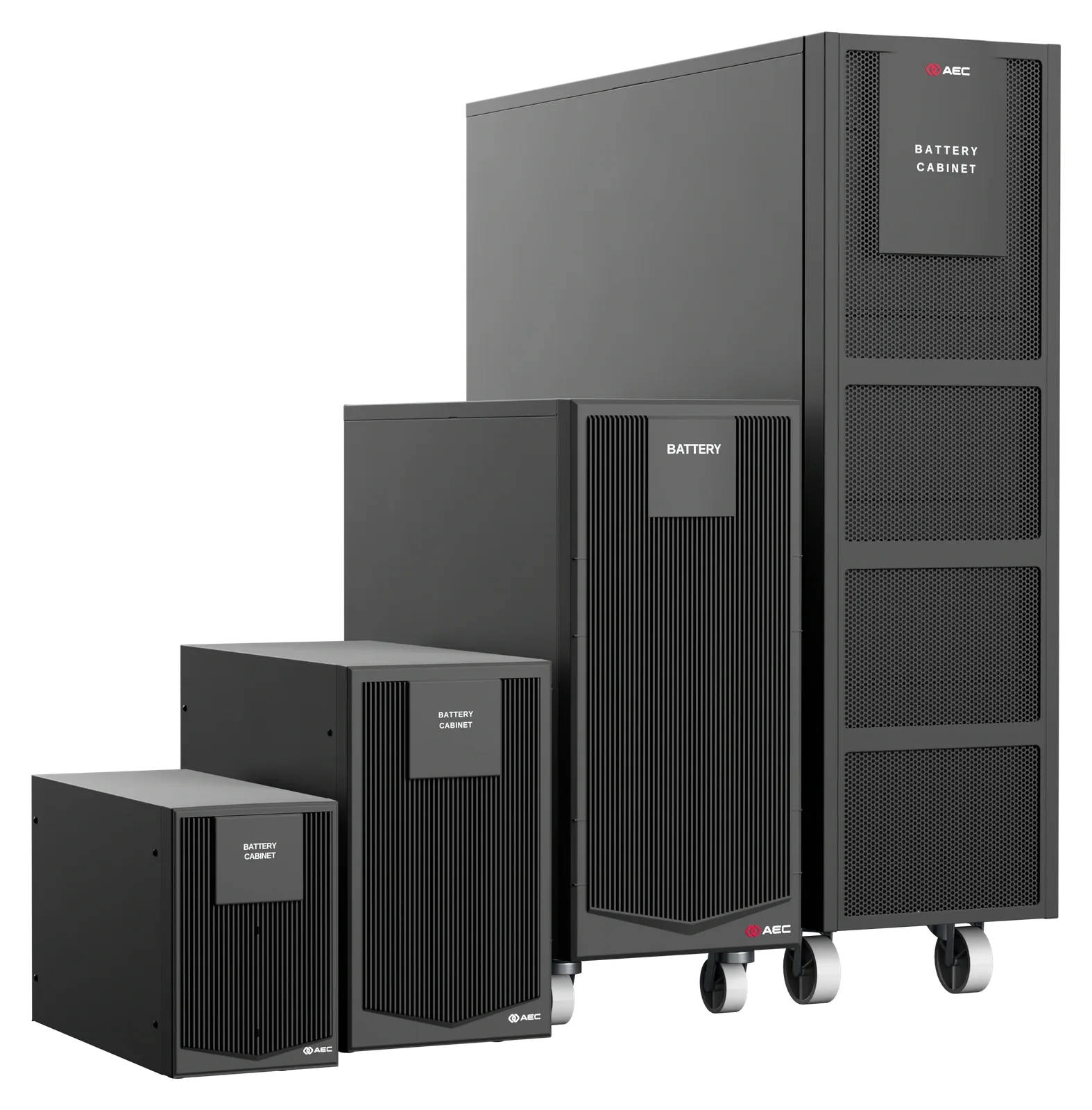
The most common route is more battery. A bigger UPS on its own does not add runtime; more stored energy does. A second identical string in parallel halves the power each block must supply, which, thanks to the non-linear curve, more than doubles the runtime of lead-acid. AEC's battery cabinets serve UPS up to 200 kW from one cabinet, and the BB8 holds two strings as standard.
Move to lithium
Lithium modules store more energy in less space and weight, and lose less capacity at high discharge rates. Modular lithium systems also let you add runtime one module at a time. Our guide to VRLA versus lithium UPS batteries covers the trade-offs.
Reduce the load on battery
Put non-critical loads, such as printers or comfort lighting, on outlets that switch off on battery, or leave them off the UPS. Every watt removed extends the runtime of the rest, by more than its share.
Use shutdown software
Shutdown software, connected through USB, a network card or dry contacts, closes servers and storage cleanly before the battery runs out. It does not add minutes, but it makes sure the minutes you have end in an orderly shutdown instead of a crash.
How much runtime do you need?
With a generator: minutes are enough
If a standby generator backs up the site, the UPS only has to bridge the gap until the generator starts, stabilises and takes the load. That usually happens within seconds to a minute or so. Long runtime is then wasted battery.
A sensible target is enough minutes to cover a failed first start and a manual intervention, often in the range of 5 to 15 minutes. Our guide to UPS and generator covers sizing the generator for a UPS load.
Typical targets by application
These ranges are common starting points, not rules; your risk assessment, regulations and the process you protect set the final figure.
- Office IT and small server rooms: about 5 to 15 minutes, enough to ride through short dips and shut down cleanly.
- Data centres with generators: often 5 to 15 minutes at full load, to bridge to the generator.
- Network, telecoms and CCTV without a generator: from 30 minutes to several hours, depending on how long the service must stay up.
- Emergency lighting and safety systems: set by the applicable rules, commonly 1 or 3 hours; these often fall under EN 50171 central power supply systems.
- Industrial processes: long enough to bring the process to a safe stop, which only the process owner can define.
How AEC's ranges and backup time tool apply
The backup time tool on this site reads the catalogue tables directly. You choose the load in kW and the battery type: the All-in-One, the L6 lithium system or OZ Power VRLA blocks.
All-in-One: minutes by number of modules
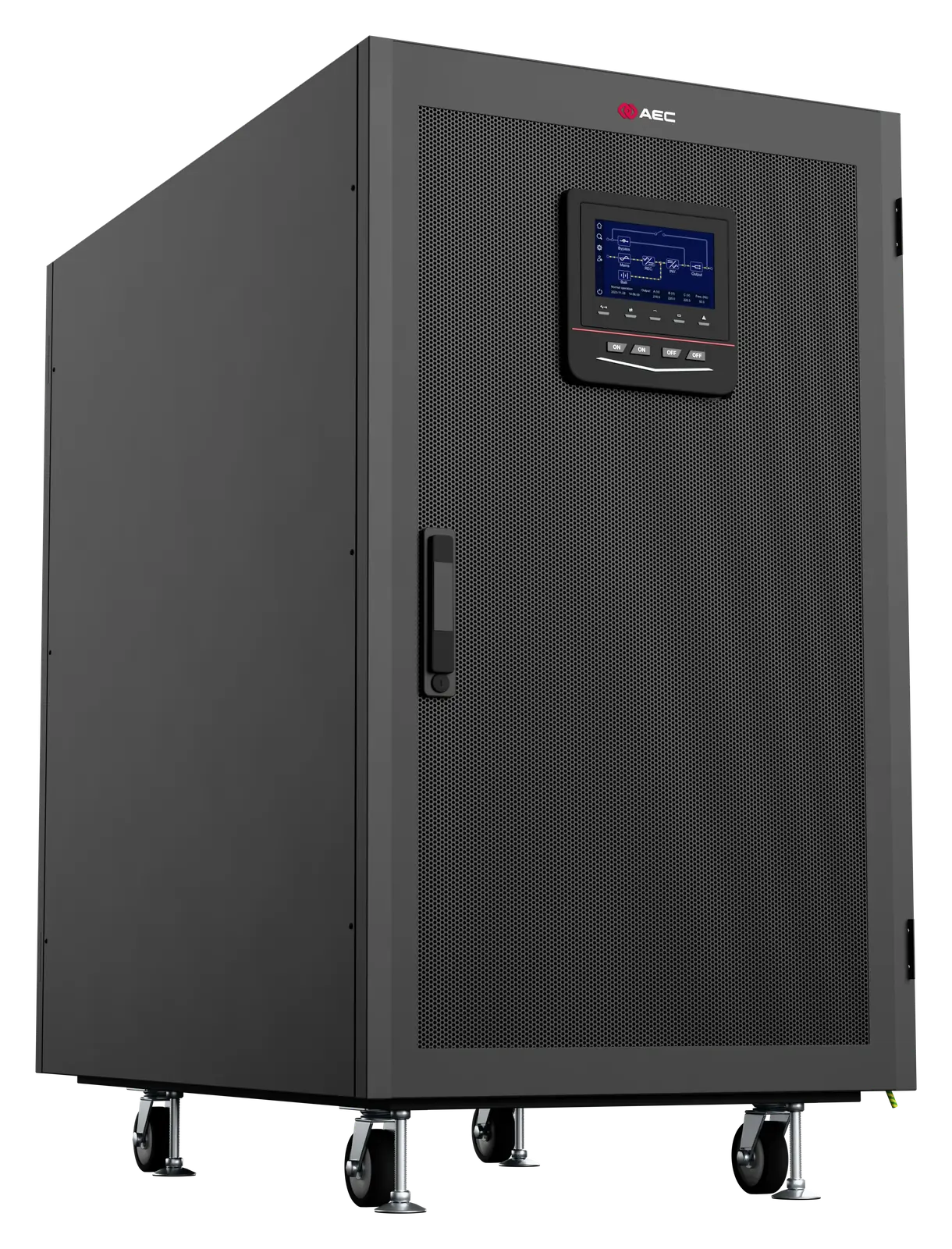
The All-in-One puts an IST9 20 kVA online UPS and hot-swappable lithium modules, 2 to 8 of 50 Ah or four of 100 Ah, in one cabinet. Its catalogue tables give minutes by number of modules. With 50 Ah modules, two give 50 minutes at 6 kW and eight give 200 minutes; at the full 20 kW, two give 15 minutes and eight 60 minutes. With four 100 Ah modules, 20 kW runs for 60 minutes and 6 kW for 200 minutes. These are reference values, to be confirmed by actual measurement; AEC sizes every system.
L6 lithium: cabinets and modules by backup time
The L6 lithium system offers three LFP modules for three profiles. The 40 Ah module (6C cells) and the 50 Ah module (4C) suit minutes at high power: a full cabinet of 20 modules gives 10 or 15 minutes at its 200 kW rated power. The 100 Ah module (1C) suits hours: 12 modules give 69 kWh and 1 hour at 60 kW. Here "C" is the discharge rate relative to capacity: 1C empties the cell in about an hour, 6C in about ten minutes. The tables come from AEC sizing data at initial capacity, and the catalogue advises a 10% reserve: actual backup = theoretical × 0.9.
OZ Power VRLA: watts per block
For OZ Power AGM batteries, from 9 to 200 Ah, the tool follows the method in the worked example. You pick 30, 32, 36 or 40 blocks per string and one or two strings. It works out the watts per block and reads the time from the constant-power tables, assuming 95% efficiency, 25 °C, 1.75 V per cell and new batteries. Above 60 minutes it asks you to contact our engineers. The 40–200 Ah models have a 12-year design life in float service at 25 °C; heat shortens it.
Checklist: estimating and specifying runtime
- Measure or list the real load in watts, including only what must stay on.
- Decide the runtime you need, and why: shutdown, generator bridge or full ride-through.
- Run a quick estimate with the formula to see the scale.
- Check the figure in the constant-power tables or the backup time tool.
- Add a reserve for battery ageing and the real room temperature.
- Choose the battery type and cabinet that fit the space, weight and life you expect.
- Plan shutdown software and alarms, so the runtime ends in an orderly way.
- Test runtime at commissioning and periodically, as part of battery maintenance.
Common mistakes
- Using VA instead of W. Runtime follows real power. Using the VA rating, or the UPS rating instead of the actual load, gives the wrong answer.
- Treating the formula as the result. For short, high-power discharges it can be wrong by half or more, as the table above shows.
- Scaling runtime in a straight line. Half the load does not mean exactly twice the runtime with lead-acid; usually it is more, and double the load gives less than half.
- Forgetting age and temperature. A system sized exactly for new batteries at 25 °C will fall short after a few years or in a hot room.
- Buying a bigger UPS for more runtime. Runtime comes from battery energy relative to the load. Size the UPS for power with our UPS sizing guide, then size the battery for time.
- Mixing old and new lead-acid blocks. Replace with the same model, capacity and batch across the whole string.
- Never testing. A runtime that has never been measured is a guess.
If your load or runtime falls outside the published tables, send us the loads and the backup time you need through our contact form, and AEC's engineers will size the battery.
Questions
Questions people ask
How long will a UPS last during a power cut?
From a few minutes to a few hours, set by the load in watts and the battery energy: the AEC All-in-One, for example, runs 15 to 60 minutes at its full 20 kW and up to 200 minutes at 6 kW, by its lithium modules. A small UPS at full load may last only a few minutes. Check the manufacturer's runtime table for your actual load.
How do I calculate UPS backup time?
For a first estimate, multiply the battery energy in Wh (blocks × 12 V × Ah) by the inverter efficiency and divide by the load in watts. The result is in hours and is optimistic for short, high-power discharges. Confirm it with constant-power runtime tables.
Why does halving the load more than double UPS runtime?
Batteries, and lead-acid in particular, deliver fewer usable ampere-hours at high discharge rates. This is often called the Peukert effect. A lighter load lets the battery give more of its stored energy before reaching the end voltage.
Does a bigger UPS give more backup time?
Not by itself. Runtime depends on battery energy relative to the load. To get more runtime, add battery cabinets, more lithium modules or a second string, rather than a larger UPS.
How much UPS runtime do I need with a generator?
About 5 to 15 minutes as a starting point: enough to bridge until the generator starts and takes the load, plus a margin for a failed start. Your own risk assessment sets the final figure.
Does UPS runtime fall as the batteries age?
Yes. Battery capacity falls with age, and faster at high temperature. Size the battery with a reserve so the runtime you need still holds near the end of the battery's life, and test it periodically.
Products
Products in this guide


Blog
Keep reading
Talk to an AEC engineer
Tell us the load, the supply and the backup time you need: we answer with the model and the batteries that fit.