



















30 August 2022 · updated 20 October 2026 · 8 min
UPS for hospitals and healthcare facilities
A UPS for hospitals keeps group 2 medical locations, such as operating theatres and intensive care, supplied with no break. IEC 60364-7-710 sets changeover classes for the safety supply: a few circuits, such as operating-table lights, within 0.5 s, many other safety services within 15 s. An online double-conversion UPS transfers in 0 ms and bridges the generator start.
The UPS is one layer of a wider medical power supply that also includes generators, safety supplies and redundant paths.
In brief
- Generators cover long outages but take seconds to start. The UPS covers the gap and filters the supply at all times.
- IEC 60364-7-710 groups medical locations into group 0, 1 and 2 and sets requirements for the safety supply. Group 2 locations need the most protection.
- Online double conversion is the usual choice for an uninterruptible power supply for medical equipment: no transfer time and an output independent of the mains.
- Critical areas use redundancy, such as N+1 modules or parallel units, so one fault does not drop the load.
- Emergency lighting is often fed by a central power supply system to EN 50171, which is a separate system from the UPS.
Why power continuity is critical in healthcare
A hospital is one of the most complex buildings to supply. It runs 24 hours a day, must meet high standards for safety and service, and has very low tolerance to power problems. A failure can affect:
- life-support equipment such as ventilators and heart-lung machines;
- electromedical equipment used during surgery;
- imaging and laboratory systems;
- heating, ventilation and air conditioning;
- telecommunications, nurse call and alarm systems;
- IT systems and electronic patient records.
Beyond the clinical risk, any interruption of service disrupts the whole facility. Healthcare organisations therefore plan their power around three goals:
- Business continuity: the ability to keep operating through incidents.
- High availability: critical services must be available at all times.
- Disaster recovery: resources and procedures to restore services and minimise data loss after an event.
Medical locations and the safety supply
The international rules for electrical installations in medical locations are in IEC 60364-7-710, adopted in Europe as HD 60364-7-710 and in national wiring rules. They classify each room by how a loss of supply would affect the patient:
- Group 0: no applied parts are used, so a supply failure does not put patients at risk. Examples include consulting rooms without electromedical equipment.
- Group 1: applied parts (the parts of equipment that touch the patient) are used externally or invasively, but a supply interruption does not threaten life.
- Group 2: applied parts are used for intracardiac procedures, vital treatments or surgery, where an interruption could endanger life. Operating theatres and intensive care are typical.
The standard requires a safety supply that takes over the essential services when the normal supply fails. It sets maximum changeover times by service: a few critical circuits, such as operating-table lights, must be restored in 0.5 s or less, and many other safety services within 15 s. In group 2 locations, the circuits that feed medical electrical equipment in the patient environment normally use a medical IT system. This is an isolating transformer with insulation monitoring, so that a first insulation fault raises an alarm instead of tripping the supply. The current edition of the standard and national rules set the details, and the design engineer applies them to each site.
In practice the hospital network is split into a normal (non-essential) part and an essential part. Loads that cannot accept any break, often called privileged loads, are fed through a UPS, because a generator alone cannot meet the shortest changeover times.
Where the UPS fits: generator, UPS and CPSS
A hospital usually combines three sources. Each does a different job, and none replaces the others:
| Source | What it does | Changeover | Typical loads |
|---|---|---|---|
| Standby generator | Long-duration backup for the essential network | Seconds, after start-up and stabilisation | Essential circuits, HVAC, lifts, general wards |
| Online UPS | Continuous conditioned supply; bridges the generator start | 0 ms | Theatre and ICU equipment on UPS circuits, monitoring, hospital IT and data centre |
| CPSS to EN 50171 | Central safety supply for emergency lighting and other safety equipment | As required by EN 50171 and the safety design | Emergency and escape lighting, safety signs |
A central power supply system (CPSS) looks like a UPS but is built and tested to EN 50171 for life-safety systems. Our guide to CPSS and EN 50171 explains the requirements, and UPS and generator covers how to make the two work together.
Why online double conversion for medical equipment
For privileged loads the key parameter is transfer time, and the usual design target is no break at all. In an online double-conversion UPS the load always runs from the inverter, so there is no switch-over when the mains fails. The output is also independent of mains disturbances and of the frequency swings of a generator. Under IEC 62040-3 this is the VFI class, and it is the usual choice for an uninterruptible power supply for medical equipment.
Two points need care. First, many UPS offer an ECO mode that feeds the load from the bypass to save energy; for medical loads, keep the UPS in online mode unless the design engineer decides otherwise. Second, a UPS is not itself medical electrical equipment. If it stands in the patient environment, or forms part of a medical electrical system, the rules for such systems apply, so agree its position and connection with the designer.
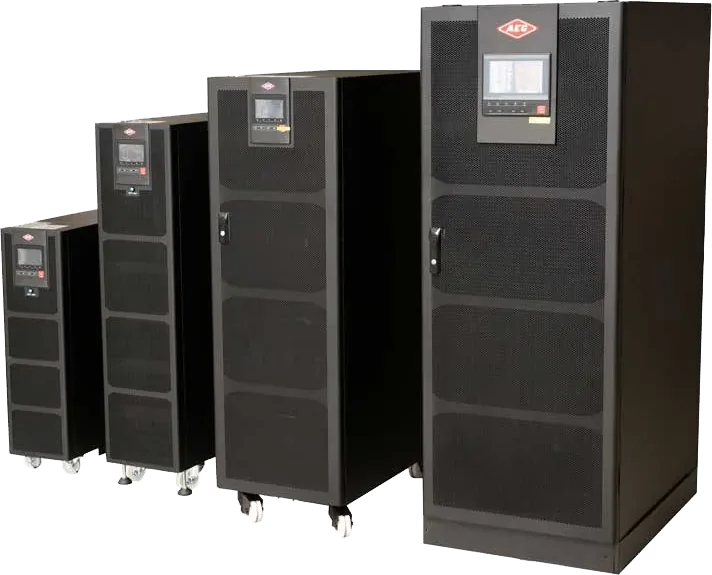
Every AEC UPS range in the EMEA catalogue is online double conversion with 0 ms transfer. Examples are the IST3 (1–10 kVA) for single rooms and equipment and the three-phase IST7 (60–200 kVA) for whole buildings.
Redundancy: N+1 and parallel systems
No single product protects a whole building. Protection is built in layers, with redundant systems for the most critical areas and clear procedures for testing and maintenance.
Redundancy means installing more UPS capacity than the load needs, so that one module or unit can fail, or be serviced, while the others carry the load. In an N+1 system, N is the number of modules or units needed for the load, and one more is added. Larger sites may use parallel units on one bus or a dual-bus design, where equipment with two power inputs is fed from two independent UPS systems. Our guide to UPS redundancy and N+1 compares these designs.
Worked example: an N+1 UPS for a critical department
A hospital wants to put a critical department on a modular UPS. The load figures below are an example; real figures come from the electrical design.
- List the UPS loads. Monitoring and IT: 25 kW. Ward equipment on UPS circuits: 30 kW. Theatre equipment on UPS circuits: 15 kW. Total: 25 + 30 + 15 = 70 kW.
- Add a margin. With 20% for growth: 70 × 1.2 = 84 kW.
- Choose the module size. The IST6 30–120 kVA uses 30 kVA power modules with an output power factor of 1, so each module gives 30 kW.
- Find N. 84 / 30 = 2.8, rounded up to 3 modules (90 kW).
- Add redundancy. N+1 = 4 modules. With all four running, each carries 84 / 4 = 21 kW, or 70%. If one fails, the other three carry 28 kW each, or about 93%, and the load stays on the inverter.
- Plan the runtime. The generator should take over in seconds, but plan for a failed first start, for example 10 minutes. Energy at the output: 84 kW × 10 / 60 h = 14 kWh. Using the 95% double-conversion efficiency as an approximation, the battery must deliver about 14 / 0.95 ≈ 14.7 kWh, before margins for ageing and temperature.
The IST6 30–120 kVA holds four power modules plus a fifth slot reserved for a redundant module, so this design still leaves room to grow. The battery string is then sized by AEC from the discharge tables.
AEC ranges for healthcare
| Need | AEC range | Why |
|---|---|---|
| Single rooms, IT and equipment | IST3, IST3-J | 1–10 kVA, 0 ms, pure sine wave |
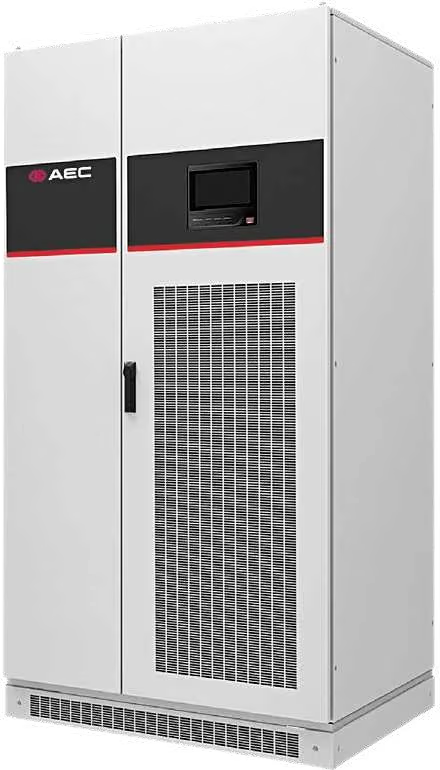
| Departments and plant rooms | IST7-T | 100–200 kVA with built-in output isolation transformer; medical care is among its listed applications |
| Whole buildings | IST7 60–200 kVA | Up to 8 units in parallel with N+X redundancy |
| Hospital data centre | IST6 30–120 kVA | Modular, hot-swap power modules, N+1 in one cabinet |
| Emergency lighting | CPSS 10–200 kVA | Static central power supply to EN 50171 |
The IST7-T gives complete electrical isolation between input and output, works with input voltage within ±25% and withstands 100% three-phase unbalanced load. Its isolation transformer is part of the UPS; it does not replace the medical IT system the standard requires in group 2 locations. Its RS232 / RS485 Modbus port and 8 output and 4 input configurable dry contacts connect it to the building management system. It also supports parallel, series hot standby and dual-bus systems. The AEC data sheets do not list a medical device certification for these ranges, so ask us which standards a model is declared to before you specify it. To discuss a project, contact our engineers.
The UPS finder gives the AEC ranges and the rating for the department's supply, load and battery; the hospital among the example designs shows one whole, with the UPS room to scale and its single-line diagram.
Checklist for choosing a hospital UPS
- Map the loads by medical location group and by the changeover time each one needs.
- Separate UPS loads from loads the generator alone can carry.
- Decide the redundancy level for each area: a single UPS, N+1 modules or parallel units.
- Plan the battery runtime against the generator start-up time, including a failed first start.
- Keep emergency lighting on a system designed to EN 50171.
- Check the communication interfaces for the building management system: dry contacts, Modbus or SNMP.
- Check the room: ventilation, temperature and access for service.
- Agree a maintenance plan with regular battery tests and recorded results.
Common mistakes
- Relying on the generator alone. A generator cannot meet a 0.5 s changeover, and a failed start leaves critical loads without supply.
- No redundancy in group 2 areas. A single UPS is a single point of failure for the most critical rooms.
- Running medical loads in ECO mode. It saves energy but brings back a transfer on mains failure.
- Treating the UPS as a CPSS. Emergency lighting systems have their own standard, EN 50171.
- Confusing isolation transformers. A UPS output transformer is not a medical IT system with insulation monitoring.
- Neglected batteries. Without tests, a worn battery is found only during an outage. See our battery maintenance guide.
Questions
Questions people ask
Why do hospitals need a UPS if they have generators?
A generator takes seconds to start and reach stable output. A UPS supplies critical loads without any break during that time and filters disturbances at all times. It also covers the case where the generator fails to start at the first attempt.
What transfer time is acceptable for medical loads?
For privileged loads the usual target is no break at all. That is why online double-conversion UPS, where the load always runs from the inverter, are used. IEC 60364-7-710 also sets maximum changeover times for the safety supply, down to 0.5 s or less for a few critical circuits.
What is a medical UPS?
The term usually means a UPS used to protect medical and hospital loads, normally an online double-conversion unit. A UPS is not itself medical electrical equipment, so its position and connection near patients must follow the installation rules. Check which standards a specific model is declared to.
What are group 0, 1 and 2 medical locations?
They are classes in IEC 60364-7-710. Group 0 uses no applied parts, group 1 uses applied parts where an interruption does not threaten life, and group 2 covers areas such as operating theatres and intensive care, where an interruption could endanger life.
Is a CPSS the same as a hospital UPS?
No. A central power supply system to EN 50171 feeds emergency lighting and other safety equipment, with requirements set by that standard. A UPS keeps medical and IT loads running. Many hospitals need both.
Can a UPS report its status to the building management system?
Yes. Ranges such as the IST7-T have RS232 / RS485 Modbus and configurable dry contacts as standard, and an SNMP card is available as an option.

Blog
Keep reading
Talk to an AEC engineer
Tell us the load, the supply and the backup time you need: we answer with the model and the batteries that fit.