



















20 October 2026 · 9 min
Industrial UPS: protecting PLCs, motors and processes
An industrial UPS keeps PLCs, process control systems and critical machines running through power cuts, dips and surges. For industrial applications, choose an online double-conversion UPS that tolerates a wide input voltage range, handles inductive and inrush loads, and works in dust and heat. Then add the battery runtime, maintenance bypass and monitoring that your process needs.
In brief
- Protect the control layer first: PLCs, SCADA, drives control, instrumentation and safety systems.
- Use online double conversion (VFI class under IEC 62040-3), so in normal operation the load is isolated from mains disturbances.
- Check how the UPS handles motor and transformer inrush: overload limits, impact load mode, or an output isolation transformer.
- For dusty or hot sites, look at IP rating, filters, dedusting functions and operating temperature.
- Link the UPS to the plant with dry contacts and Modbus, and fit a maintenance bypass for service without shutdown.
What makes a UPS industrial
A UPS (uninterruptible power supply) stores energy in batteries and feeds the load when the mains fails or goes out of tolerance. An office UPS protects a few computers. An industrial UPS protects a process, where a one-second interruption can stop a line, spoil a batch or leave a machine in an unsafe state.
That changes the priorities. Industrial grids often have voltage dips when large motors start, harmonics from drives, and long cable runs. The UPS room may be warm and dusty. Loads include transformers, solenoids and small motors, not just switch-mode power supplies.
For these reasons, most industrial UPS are online double-conversion units. The rectifier turns the incoming AC into DC, and the inverter rebuilds a clean AC output. IEC 62040-3 calls this class VFI (voltage and frequency independent). Our guide to UPS types compares it with line-interactive and offline designs.
Which industrial loads need a UPS
Not everything in a factory should run on the UPS. Large motors and heaters would need a very big UPS and battery, and they can usually stop safely. The aim is to keep control, data and safety alive, so the process can ride through or shut down in an orderly way.
| Load | On the UPS? | Why |
|---|---|---|
| PLCs, I/O racks, HMIs | Yes | A reset loses the machine state and can stop the whole line. |
| SCADA servers, network switches | Yes | Keeps visibility and alarms during the event. |
| Instrumentation and analysers | Yes | Many need a long warm-up or recalibration after a cut. |
| Drive and contactor control circuits | Usually | Lets the control system stop motors in sequence. |
| Small motors, pumps and fans | Sometimes | Only if the process needs them, and with inrush checked. |
| Large motors, ovens, compressors | Rarely | Better served by a generator alone; they can usually stop for the seconds it takes to start. |
If the site has a generator, the UPS bridges the seconds before it starts and filters its output. Our guide to UPS and generator systems explains how to size the pair.
Motors, transformers and inrush current
Inrush current is the short surge a load draws when it is switched on. A transformer draws a magnetising surge. A motor started direct-on-line typically draws several times its rated current, often 5 to 8 times, until it reaches speed. A UPS that sees this surge must either supply it, or pass it to the bypass.
Worked example: a pump on an IST7T-100
A control and process panel draws 65 kW at 400 V three-phase, power factor 1. The plan is to add a pump motor that draws 11 kW from the supply (power factor 0.85), started direct-on-line, on the same UPS.
- Size for the steady load with 20% headroom: 65 kW ÷ 0.8 = 81.3 kW. The IST7T-100 is rated 100 kVA / 90 kW, so it fits.
- Steady current: I = P ÷ (√3 × V × PF) = 65,000 ÷ (1.732 × 400 × 1) = 93.8 A per phase.
- UPS rated current: 100,000 ÷ (1.732 × 400) = 144.3 A per phase.
- Motor running current: 11,000 ÷ (1.732 × 400 × 0.85) = 18.7 A. Starting at about 6 times: about 112 A.
- Peak during start: 93.8 + 112 = 206 A, which is 206 ÷ 144.3 = 143% of rating.
- The IST7-T inverter accepts 131-155% for 1 minute. A start of a few seconds fits, but with little margin.
Adding the two currents directly is a conservative simplification, because the starting current has a low power factor. The safer choice here is a soft starter or a variable-speed drive on the pump, which cuts the starting current. If you need more margin, choose the next rating up. Treat the result as a first check and confirm it with AEC, who can look at the actual motor data.
How AEC ranges handle inrush
- The IST7-T has an output isolation transformer matched to the inverter. AEC states that it removes the inrush effect that an external high-power transformer produces at start-up, and improves short-circuit and inductive-load capability.
- The IST9 and IST7 10-40 kVA have an impact load mode, enabled on the screen before an inrush load such as a transformer is started.
- The IST7 60-200 kVA static bypass handles inrush and fault-clearing currents up to 300% for 100 ms, and in a parallel system the units start one after another to limit inrush on the source.
Harsh environments: dust, heat and IP rating
Factories are hard on electronics. Conductive dust settles on boards, fibres block filters, and summer temperatures in a plant room can be high. Plan the UPS location as carefully as the UPS itself.
The IP rating (ingress protection, defined in IEC 60529) describes how well an enclosure keeps out solids and water. IP20 means protection against fingers and objects larger than 12.5 mm, with no protection against water. Most UPS, including AEC's three-phase ranges, are IP20 and are meant for a clean, dry indoor room. The IST7-T reaches IP21 with an optional top cover, which protects against vertically dripping water. IST7 battery cabinets are IP20, with IP21 to IP44 on request.
Where a clean room is not possible, put the UPS in a ventilated electrical room or a suitable enclosure, and plan regular filter cleaning. Several AEC ranges help with timed self-dedusting: the fans run at full speed for short cycles to clear the air path. On the IST7 60-200 kVA this runs every 360 hours by default.
All the AEC three-phase ranges in this guide operate from −5 to 40 °C, at 0-95% relative humidity, non-condensing. Batteries prefer about 20-25 °C. Our guide to UPS heat output and cooling shows how to plan the room.
Isolation transformer and frequency converter
An isolation transformer separates the output circuit electrically from the input. Industrial sites use it to create a new neutral and earthing point, to handle heavily unbalanced or non-linear loads, and to keep disturbances from crossing between circuits. The IST7-T has one built into every model from 100 to 200 kVA. It delivers full kVA at 100% non-linear load and accepts 100% three-phase unbalanced load. See our guide to the isolation transformer UPS for when you need one.
A frequency converter mode supplies loads at a fixed frequency different from the mains. Imported machinery, test benches and marine equipment may need 60 Hz on a 50 Hz grid, or the other way round. The IST7 10-40 kVA, IST7 60-200 kVA and IST9 offer a 50 ↔ 60 Hz frequency converter mode. In this mode the bypass is not used, because the mains is at the wrong frequency, so redundancy matters more.
3/1 or 3/3, runtime and maintenance bypass
3/1 versus 3/3
The notation gives input and output phases. A 3/3 UPS takes three phases and delivers three phases. A 3/1 UPS takes three phases and delivers a single-phase output. Choose 3/3 for three-phase loads such as motors and three-phase drives. Choose 3/1 when the protected loads are all single-phase, such as PLC power supplies and control panels: it removes the need to balance them across phases.
The IST7 10-40 kVA and the IST9 work in 3/3 or 3/1 mode on every size, and also 1/1 on 10-20 kVA. The mode is set on site. Read more in our guide to three-phase UPS.
Long runtime
Industrial sites often need more runtime than a server room: to finish a batch, to wait for a generator, or to shut down safely. Runtime depends on the battery, not the UPS rating. All the ranges in this guide take external battery cabinets. The IST7 60-200 kVA has a generator mode that limits charging power so the generator is not overloaded; on the IST9, generator mode disables battery charging. Use the backup time calculator for a first estimate.
Maintenance bypass
A maintenance bypass is a manual switch path that feeds the load directly from the mains while the UPS is switched off for service. In a plant that runs around the clock, it lets you service the UPS without stopping production. The IST7 10-40 kVA, IST7 60-200 kVA, IST7-T and IST6 120 include one. For the IST3 single-phase range, AEC offers an external maintenance bypass.
Monitoring with dry contacts and Modbus
An industrial UPS should report to the plant control system, not just beep in a corner. Two methods are common.
- Dry contacts are potential-free relay contacts that open or close on a UPS state, such as mains failure, battery low or bypass. They wire directly into a PLC input. Inputs can also take signals from the plant, such as a generator running.
- Modbus RTU is a serial protocol, usually over RS485, that PLCs and SCADA systems read natively. It gives values such as load, battery voltage and remaining runtime, not just alarms.
The IST7-T has RS232 / RS485 Modbus RTU and 8 output and 4 input dry contacts as standard, all configurable. Its EMS mode lets a supervisory computer set mode, power and current over Modbus. The IST7 60-200 kVA has Modbus RTU, RS232 and RS485 plus 4 inputs and 3 outputs. The IST7 10-40 kVA has 5 outputs, 1 input and EPO (emergency power off). An SNMP card adds network monitoring on all of them.
Common mistakes
- Putting everything on the UPS. Large motors and heaters make the UPS and battery much bigger and often do not need protection.
- Ignoring inrush. A transformer or motor started on the inverter can trip it to bypass, or overload it during an outage when there is no bypass.
- Choosing a line-interactive UPS for a poor grid. It passes more disturbances through. Industrial loads usually need double conversion.
- Installing the UPS on the shop floor. IP20 equipment needs a clean, dry room; dust and moisture shorten its life.
- No maintenance bypass. Without one, every service visit means a planned shutdown.
- Alarms nobody sees. If the dry contacts or Modbus link are not wired to the control system, a battery fault may go unnoticed until the next outage.
AEC UPS for industrial applications
| Range | Power | Configurations | Industrial features |
|---|---|---|---|
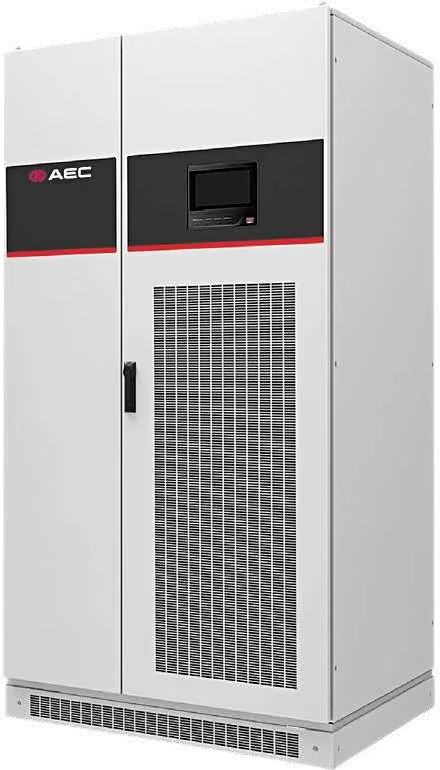
| IST7-T | 100–200 kVA | three-phase in and out | built-in output isolation transformer; input range ±25%; 8 + 4 dry contacts; Modbus RTU |
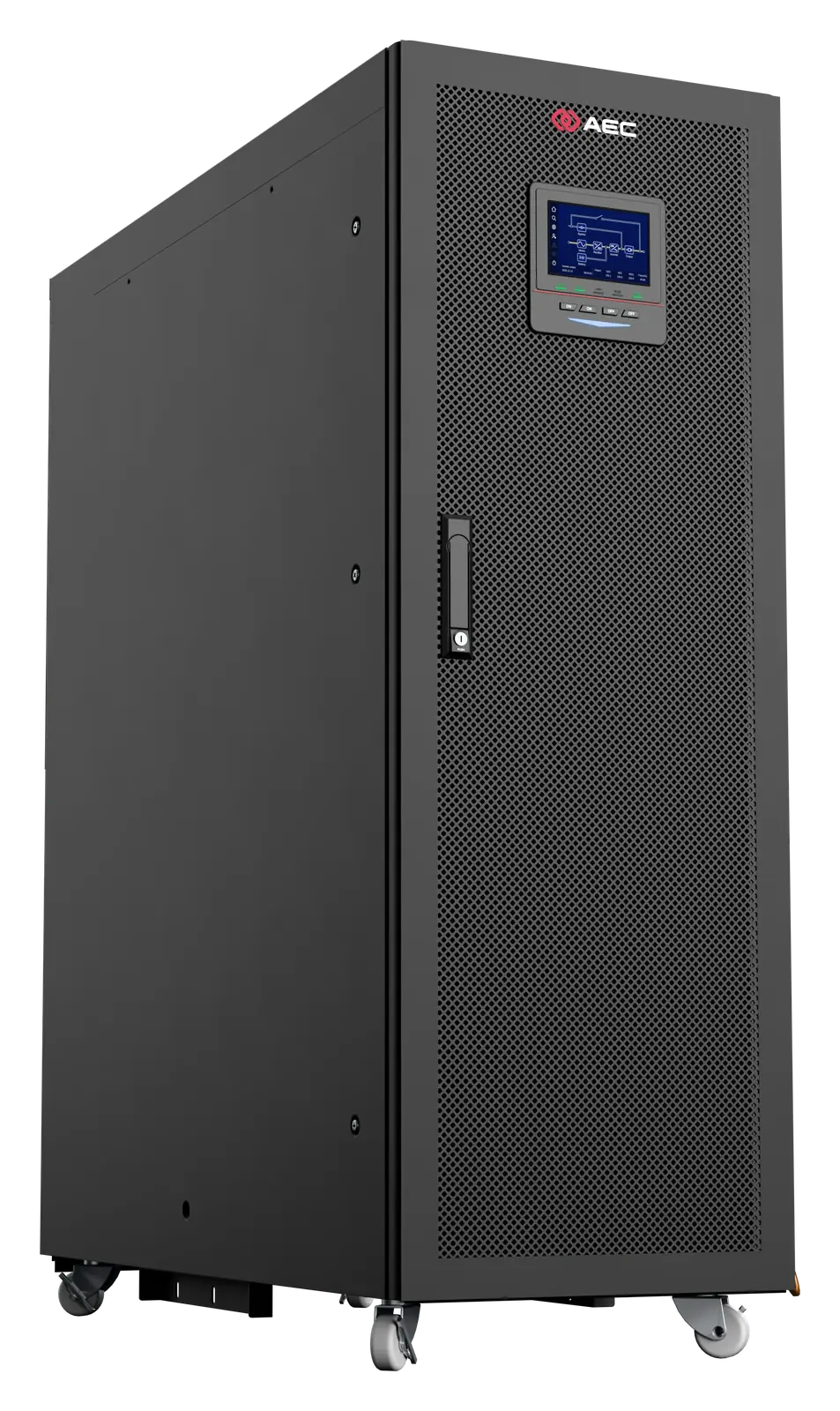
| IST7 60-200 kVA | 60-200 kVA | three-phase | frequency converter; generator mode; bypass handles 300% for 100 ms; self-dedusting |
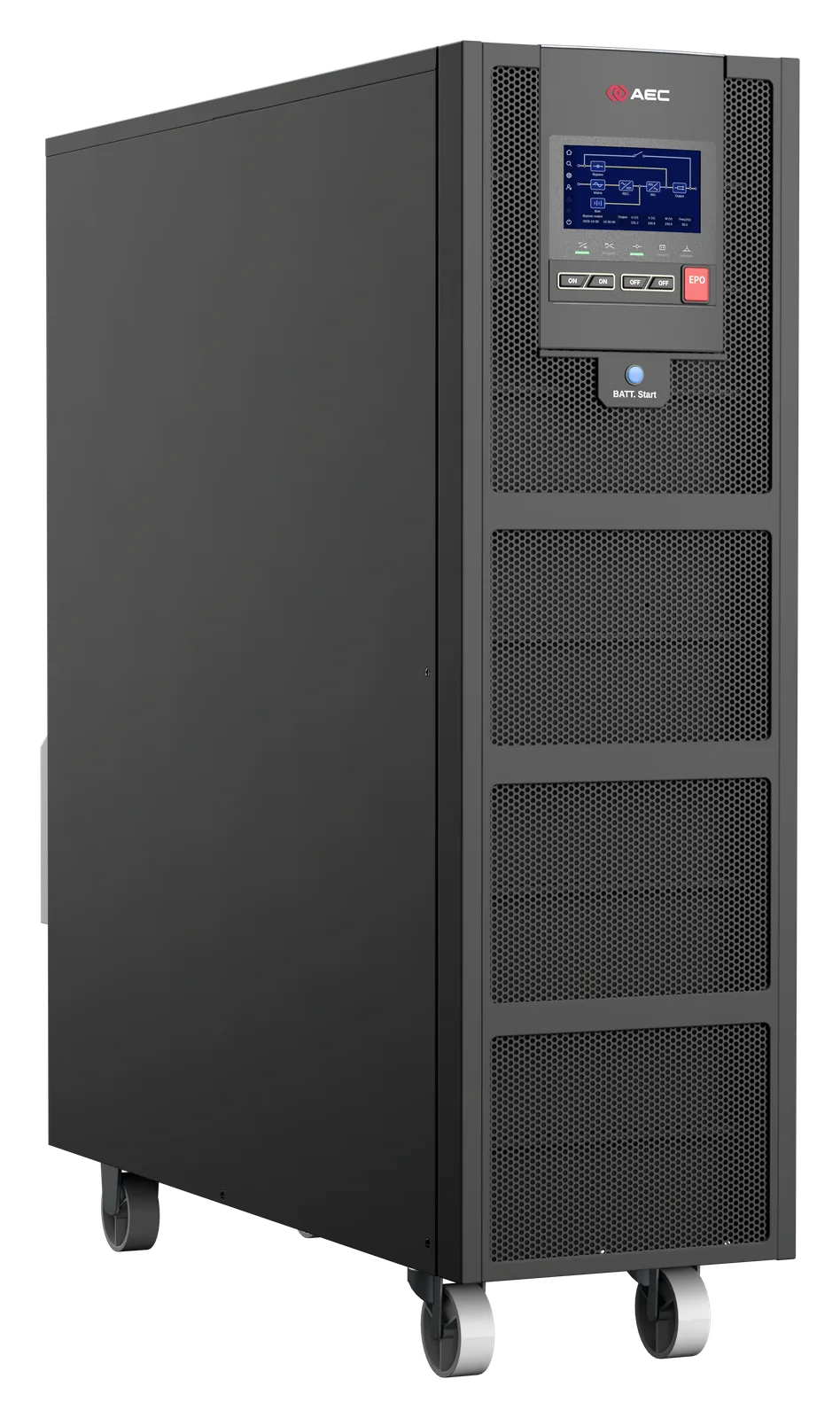
| IST7 10-40 kVA | 10-40 kVA | 3/3, 3/1, 1/1 (10-20 kVA) | frequency converter; impact load mode; built-in maintenance bypass |
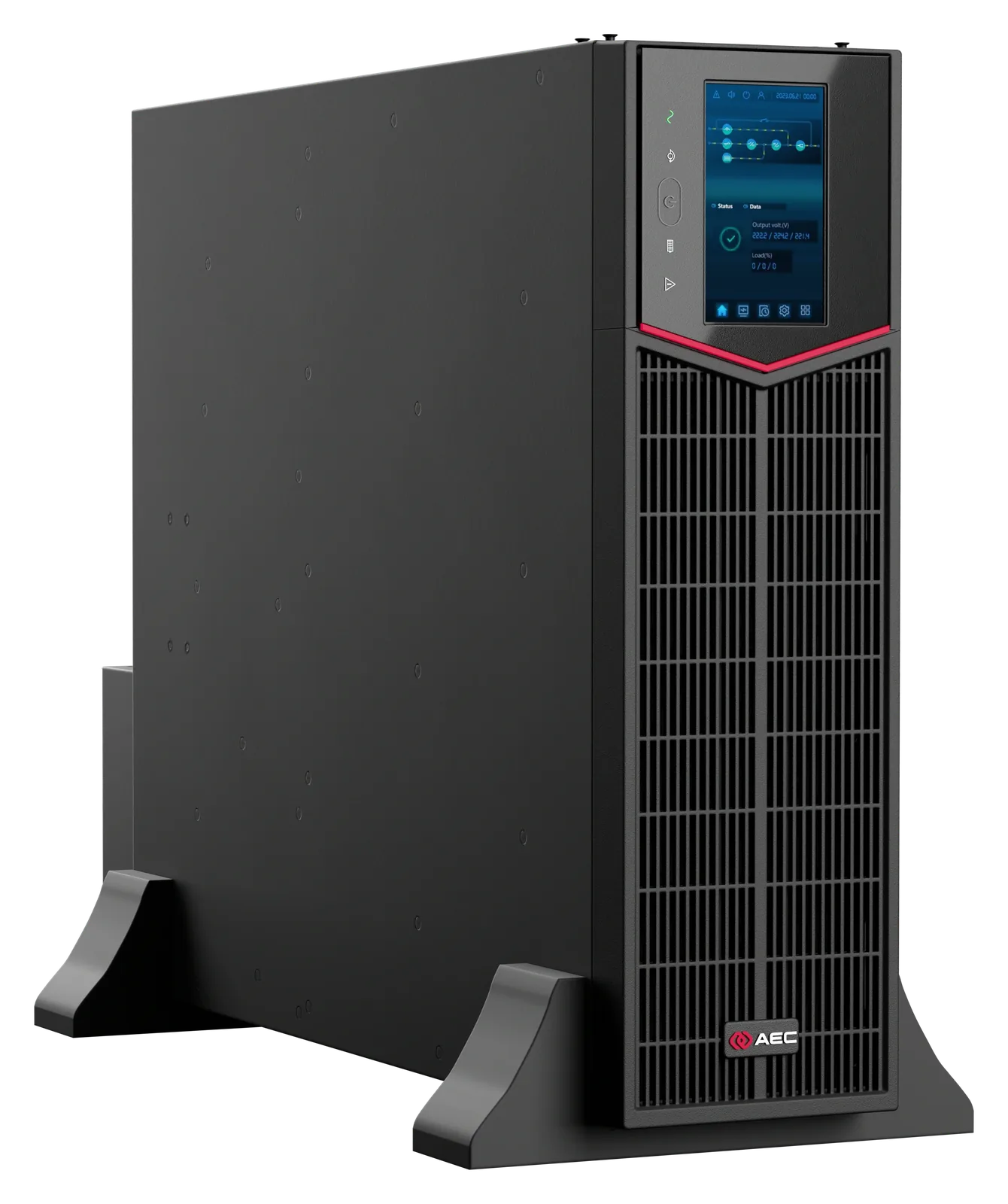
| IST9 | 10-40 kVA | 3/3, 3/1, 1/1 (10-20 kVA) | rack/tower; frequency converter; impact load mode; generator mode |
For a harsh grid or loads that need galvanic isolation, start with the IST7-T. For larger plant loads, look at the IST7 60-200 kVA. For machine-side panels and single-phase control loads from a three-phase supply, the IST7 10-40 kVA and IST9 offer 3/1 output.
Checklist before you ask AEC
- List the loads to protect, with kW, power factor and phase.
- Note motors and transformers, with rating and starting method.
- Choose 3/3 or 3/1 output.
- Set the runtime and say whether a generator is present.
- Describe the room: temperature, dust, humidity, altitude.
- State the frequency needed at the output, if not the mains frequency.
- List the signals the plant needs: dry contacts, Modbus, SNMP.
- Confirm the need for a maintenance bypass or isolation transformer.
Send the list to AEC's engineering team for sizing. You can also start with the UPS finder.
Questions
Questions people ask
What is an industrial UPS?
An industrial UPS is an uninterruptible power supply built for factories and process plants. It is usually an online double-conversion unit that tolerates poor grids, inductive and inrush loads, dust and heat. It protects PLCs, control systems and critical machines from power cuts and disturbances.
Which UPS type is best for industrial applications?
Online double conversion, classed VFI under IEC 62040-3, is the usual choice. In normal operation the load is fed by the inverter, so dips, surges and frequency changes on the mains do not reach it. Add an isolation transformer where the site needs galvanic separation.
Can a UPS run motors?
Yes, within limits. Check the starting current against the UPS overload rating, because direct-on-line motors often draw 5 to 8 times their rated current while starting. A soft starter or variable-speed drive makes this much easier.
Which suits manufacturing, a 3/1 or a 3/3 UPS?
Choose 3/3 if any protected load is three-phase, such as motors or drives. Choose 3/1 if all protected loads are single-phase, such as PLC supplies and control panels. Some AEC ranges, such as the IST7 10-40 kVA and IST9, can be set to either.
How does an industrial UPS connect to a PLC?
Through dry contacts wired to PLC inputs, or through Modbus RTU over RS485. Dry contacts signal states such as mains failure or battery low. Modbus also reads values such as load and remaining runtime.
What IP rating does an industrial UPS need?
Most UPS are IP20 and are designed for a clean, dry electrical room. If the plant is dusty or wet, install the UPS in a separate room or a suitable enclosure rather than on the shop floor. The AEC IST7-T reaches IP21 with an optional top cover.
Products
Products in this guide
Blog
Keep reading
Talk to an AEC engineer
Tell us the load, the supply and the backup time you need: we answer with the model and the batteries that fit.