



















IST6 200–500 · Modular UPS
IST6-300, 6 × 50 kVA Hot-swappable modular UPS, 400 V
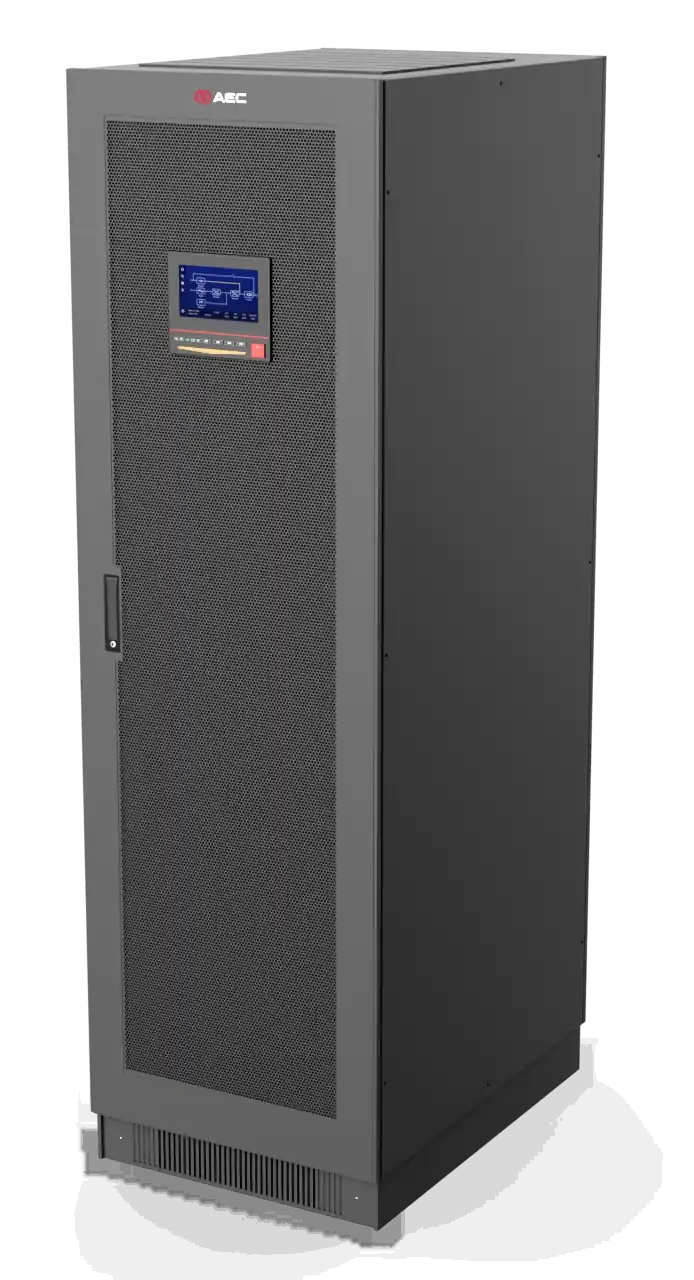
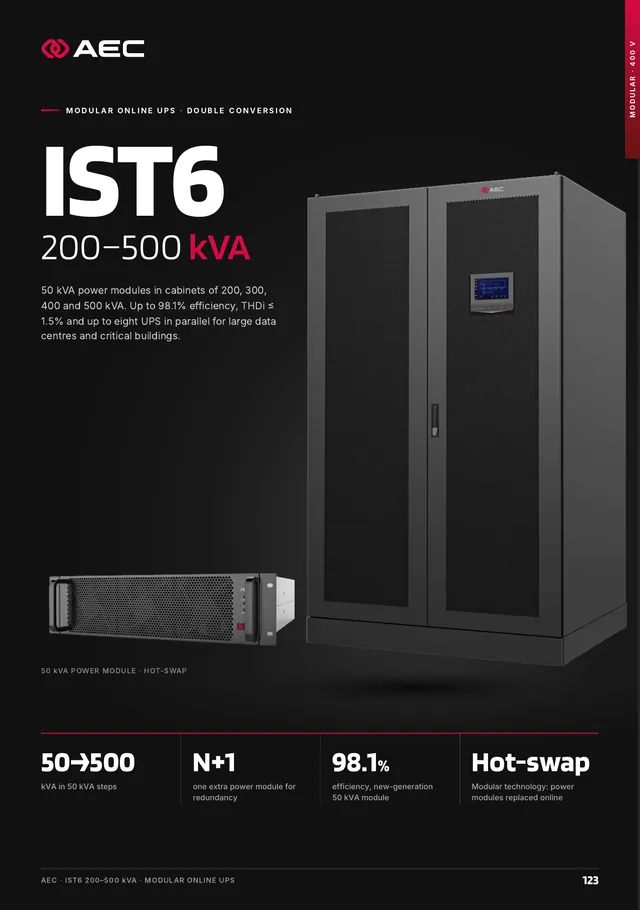
The IST6-300 is a single-column modular online UPS cabinet for up to six 50 kVA power modules: 300 kVA / 300 kW on the 200 kVA's 607 × 860 mm. For data centres and large buildings of 150 to 300 kW that want the most power per square metre of the 50 kVA platform.

Quick answers
IST6-300, 6 × 50 kVA: quick answers
- What it is
- The IST6-300 is a single-column modular online UPS cabinet for up to six 50 kVA power modules: 300 kVA / 300 kW on the 200 kVA's 607 × 860 mm.
- Who it is for
- For data centres and large buildings of 150 to 300 kW that want the most power per square metre of the 50 kVA platform.
- Supply and configuration
- 380 / 400 / 415 V
- Battery and backup
- ±240 V DC nominal (±180 … ±300 V), 30–50 × 12 V blocks, standard 40
- Size and weight
- 607 × 860 × 2000 mm · 236 kg without modules
- Ordering code
- IST6-300
IST6 200–500
What sets apart the IST6-300, 6 × 50 kVA
The IST6-300 adds two module slots to the 200 kVA in the same column, for 12 kg more (236 kg without modules): 300 kW on 0.52 m². The catalogue's operating-cost example is built on it: at 80% load (240 kW) and 98.1% efficiency the losses are about 4.65 kW, about 40,700 kWh a year, and each further point of efficiency saves about 2.5 kW at that load.
Fully loaded it draws 518 A at the mains (2 × (4 × 185) mm², 630 A 3P breaker), 455 A at bypass and output and 651 A from a 40-block battery, and needs 3630 m³/h of air. With five modules it runs 250 kVA N+1.
- Against the IST6-200, 4 × 50 kVA (one size down): Power modules · rating 6 × 50 kVA against 4 × 50 kVA; Bypass module 300 kVA · 3U against 200 kVA · 3U; Weight without power modules 236 kg against 224 kg.
- Against the IST6-400, 8 × 50 kVA (one size up): Power modules · rating 6 × 50 kVA against 8 × 50 kVA; Bypass module 300 kVA · 3U against 400 kVA · 3U; W × D × H 607 × 860 × 2000 mm against 1203 × 864 × 2000 mm; Weight without power modules 236 kg against 459 kg.
Planning data
IST6-300, 6 × 50 kVA: currents, breakers, cables, batteries
The rows and columns of the EMEA 2026 catalogue's and AEC manuals' tables that concern the IST6-300, 6 × 50 kVA.
Four cabinets, one 50 kVA module
| Cabinet | 300 kVA |
|---|---|
| Power modules (50 kVA) | 6 |
| Bypass module | 300 kVA · 3U |
| W × D × H (mm) | 607 × 860 × 2000 |
| Weight without power modules | 236 kg |
| Mains input current | 518 A |
| Cooling air flow (min.) | 3630 m³/h |
Site conditions and service
| Line | 300 kVA |
|---|---|
| Mains input | 518 A · 2×(4×185) |
| Bypass / output | 455 A · 2×(4×185) |
| Battery (40 blocks) | 651 A · 2×(3×185) |
| Mains breaker | 630 A 3P |
Installation
Installing the IST6-300, 6 × 50 kVA: space, heat, cables
Each figure with its source. Heat is the power lost at the peak efficiency stated.
| Item | Figure | Source |
|---|---|---|
| Clearances | front 800 mm, rear 500 mm, top 500 mm; left and right: not given | AEC user manual Table 3-1; EMEA 2026 catalogue p.157 |
| Cable entry | Bottom (standard); Top (built to order) | AEC user manual Table 3-1; EMEA 2026 catalogue p.157 |
| Cooling air | 3,630 m³/h | EMEA 2026 catalogue p.157 |
| Heat at full load | 5.81 kW at 300 kW load, 98.1 % efficiency | IST6 200–500 data (up to 98.1 %, AEC); output PF 1 (EMEA 2026 catalogue) |
| Operating temperature | 0 to 40 °C | IST6 200–500 AEC user manual |
| Switches and terminals | Mains, bypass, maintenance bypass and output switches inside the front door (single column 1,148–1,711 mm up; double column on the left, 462–1,658 mm). | IST6 200–500 user manual §3.5.1 p.43 (right-hand hinges, one door per column) |
| Door | One leaf, hinged on the right | IST6 200–500 user manual §3.5.1 p.43 (right-hand hinges, one door per column) |
| Module withdrawal | 650 mm in front of the cabinet to withdraw a module | EMEA 2026 catalogue p.143; AEC user manual A.2.1 |
| Units in parallel | Up to 8 units | AEC user manual A.1.2; EMEA 2026 catalogue p.139 |
Size and floor
How big it is
607 × 860 × 2000 mm · 236 kg without modules.
Efficiency
How efficient is the AEC IST6-300, 6 × 50 kVA at your load?
IST6-300, 6 × 50 kVA, 300 kW at its rating, online, double conversion (typical curve, AEC's method). Heat to remove on this curve: 25%: 1.92 kW (η 97.5%) · 50%: 2.91 kW (η 98.1%) · 75%: 5.06 kW (η 97.8%) · 100%: 7.69 kW (η 97.5%). At 50% load, 24/7, it loses about 25,450 kWh a year.
How the curve is drawn and where each figure comes from: the IST6 200–500 range page. ECO and W-ECO modes are listed without an efficiency figure.
- Load
- —
- Lost as heat
- —
- Energy lost in a year, 24/7
- —
- Its cost in a year at € per kWh
- —
- The catalogue's examples use €0.20 per kWh.
Where each figure comes from
| Mode | Efficiency | Kind | Models | Source |
|---|---|---|---|---|
| Online, double conversion | 25%: 97.5% · 50%: 98.1% · 75%: 97.8% · 100%: 97.5% | Typical curve, derived from the datasheet efficiency of 98.1% (AEC method) | all | AEC datasheet: AC/AC efficiency of the IST6-PM100 100 kW power module (the curve's shape) |
| ECO | 99.2% | Datasheet figure, load not stated | all | AEC datasheet: AC/AC efficiency of the IST6-PM100 100 kW power module (the curve's shape) |
EMEA 2026 catalogue figures: Online, double conversion up to 98.1%.
 Drag to turn
Technical data
Technical data IST6-300, 6 × 50 kVA
Only this model's values, from the EMEA 2026 catalogue table.
| Cabinet | |
|---|---|
| Power modules · rating | 6 × 50 kVA |
| Bypass module | 300 kVA · 3U |
| Input | |
| System · voltage | 3Ph+N+PE · 380 / 400 / 415 V; 138–485 V (full power 324–485 V, linear derating below) |
| Frequency · PF · THDi | 40–70 Hz · ≥ 0.99 · ≤ 1.5% at full load |
| Bypass | 304–438 V; synchronisation 50 ± 5 / 60 ± 6 Hz; settable window |
| Battery | |
| Lead-acid | ±240 V DC nominal (±180 … ±300 V), 30–50 × 12 V blocks, standard 40 |
| Lithium (with BMS card) | ±256 V DC nominal (±192 … ±294.4 V), 120–200 cells, standard 160 |
| Charging current | up to 30 A × number of modules · cold start · shared battery |
| Output | |
| System · voltage | 3Ph+N+PE (3Ph+PE optional) · 380 / 400 / 415 V ± 1% |
| Power factor · THDv | settable 0.8–1.0 (default 1.0) · ≤ 1% linear, ≤ 4% non-linear |
| Frequency · phase error | tracks the bypass; 50 / 60 ± 0.1 Hz with mains abnormal · ≤ 1° balanced, ≤ 3° unbalanced |
| Transfer | mains ↔ battery 0 ms · bypass ↔ inverter < 1 ms synchronised, < 15 ms |
| Inverter overload (PF 1) | ≤ 105% continuous · 105–110% 60 min · 110–125% 10 min · 125–150% 1 min · > 150% to bypass |
| Bypass overload | ≤ 130% continuous · 130–150% 5 min · 150–200% 1 min · 200–300% 100 ms |
| System | |
| Efficiency · modes | up to 98.1% · ECO, WECO, source share, redundancy sleep |
| Parallel | up to 8 UPS, current imbalance ≤ 5% · BSC dual bus and multi-bus (3 buses) |
| Communication | Modbus · RS232 · RS485 · 4 inputs / 3 outputs dry contact · options: SNMP, expansion, BMS |
| Environment | 0 … 40 °C · 0–95% RH · ≤ 2000 m (derating to 4000 m) · IP20 · < 70 dB · EMC C3 |
| W × D × H (mm) | 607 × 860 × 2000 |
| Weight without power modules | 236 kg |
| Item | IST6-300, 6 × 50 kVA |
|---|---|
| Power modules (50 kVA) | 6 |
| Bypass module | 300 kVA · 3U |
| W × D × H (mm) | 607 × 860 × 2000 |
| Weight without power modules | 236 kg |
| Mains input current | 518 A |
| Cooling air flow (min.) | 3630 m³/h |
Power module 500 × 650 × 130 mm, 39 kg. Data from the IST6 200–500 kVA user manual. Specifications are subject to change without notice.
More technical detailshow it works, ordering codes
Diagrams
How the power flows: AEC IST6-300, 6 × 50 kVA
Pick an operating mode: the path the power takes to the load lights up.
Normal. Double conversion: the rectifier feeds the DC bus, the inverter rebuilds a clean voltage and the load always runs on the inverter. The battery stays on charge. Efficiency up to 98.1% (double conversion, up to; ECO and WECO modes stated without a figure).
Battery. The mains fails: the battery feeds the DC bus and the inverter carries on without a break. The load does not notice. Transfer: mains ↔ battery 0 ms.
Bypass. Overload or internal fault: the static switch moves the load to the bypass line, fed by the mains.
ECO. The load runs on the bypass and the inverter stands ready: if the mains leaves the set window, the load goes back to the inverter. Higher efficiency, less protection.
Maintenance. The maintenance bypass feeds the load straight from the mains, so the UPS can be isolated for service without switching the load off.
Frequency converter. Output at 50 or 60 Hz whatever the input: the load always runs on the inverter and the bypass is not used.
Modules and redundancy
Move the slider: the modules the load needs light up, and the spare slot holds the N+1 redundancy. Each slot takes one 50 kVA module.
modules working · redundant · free slot
Ordering codes
Ordering codes IST6-300, 6 × 50 kVA
| Code | Description |
|---|---|
| IST6-300 | Modular cabinet, max. 6 × 50 kVA power modules, without modules |
| IST6-50-J | 50 kVA / 50 kW power module |
| PAR - IST6 | Parallel kit |
Questions
Questions about the IST6-300, 6 × 50 kVA
How much energy does an IST6-300 lose in a year?
At 80% load (240 kW), 8,760 hours, the losses at 98.1% efficiency are about 4.65 kW, about 40,700 kWh a year, cooling excluded. Each additional point of efficiency saves about 2.5 kW, about 22,100 kWh a year.
What clearances does the IST6-300 need?
At least 800 mm in front, 500 mm behind and 500 mm above, airflow front to rear, at 0–40 °C up to 2000 m. Handling by forklift from the short side, or two forklifts from the front.
How long does a 300 kVA UPS like the IST6-300, 6 × 50 kVA run?
3 to 104 minutes at full load (300 kW), and 8 to 207 minutes at half load, with the AEC battery options in the table: the battery chosen sets the figure. With 60 × 12 V 100 Ah · 2 × 30 (IST6-300-60X100): 3 minutes at 100% and 8 at 50%. For other loads and batteries use the backup-time tool.
How big is the AEC IST6-300, 6 × 50 kVA and how much does it weigh?
The AEC IST6-300, 6 × 50 kVA measures 607 × 860 × 2000 mm; weight: 236 kg without modules (size from AEC's CAD drawing, weight from the EMEA 2026 catalogue).
What is the ordering code of the AEC IST6-300, 6 × 50 kVA?
In the EMEA 2026 catalogue the AEC IST6-300, 6 × 50 kVA is listed as IST6-300; AEC gives the full code, batteries included, from the load and the backup time.
Talk to an AEC engineer
Tell us the load, the supply and the backup time you need for the AEC IST6-300, 6 × 50 kVA: we answer with the model and the batteries that fit. AEC International sells through distributors in about 80 countries and an agency in every Italian region: ask AEC which one serves your area.