



















18 November 2026 · 7 min
L6 lithium battery sizing: modules, cabinets, room
An L6 lithium battery is sized twice, for power and for energy, and the larger count wins. Each 40 or 50 Ah module delivers 10 kW and each 100 Ah module 5 kW, while the backup time sets the energy.
For an IST7-200 at 200 kW, 15 minutes take 22 modules of 50 Ah in two cabinets, and 10 minutes take 20 modules of 40 Ah in one.
In brief
- Choose the module by the backup time: 40 Ah for 10–20 minutes, 50 Ah for 15–30 minutes, 100 Ah for one to four hours.
- Power sets a floor: never fewer modules than carry the UPS rating, 10 kW per 40 or 50 Ah module, 5 kW per 100 Ah module.
- Energy sets the rest: AEC's table counts 95% battery and 95% inverter efficiency and adds a 10% reserve, with new modules.
- A cabinet takes 20 modules of 40 or 50 Ah, or 12 of 100 Ah; up to 15 cabinets work in parallel.
- A full 50 Ah cabinet weighs 985 kg on 600 × 850 mm, about 1,930 kg/m², and needs 800 mm in front and behind.
This guide works through the sizing. For the choice between lithium and lead-acid in general, read the VRLA vs lithium guide.
Which module for which backup time?
The three L6 modules share one cabinet footprint and differ in their cells. The 40 Ah module uses 6C cells for high power and short backup, the 50 Ah module 4C cells with more energy in the same drawer, the 100 Ah module 1C cells for hours.
| L6-40 | L6-50 | L6-100 | |
|---|---|---|---|
| Module energy | 2.05 kWh | 2.88 kWh | 5.76 kWh |
| Module output (DC/DC) | 10 kW | 10 kW | 5 kW |
| Modules per cabinet | 20 | 20 | 12 |
| Cabinet energy · rated power | 41 kWh · 200 kW | 58 kWh · 200 kW | 69 kWh · 60 kW |
| Full cabinet at rated power | 10 min | 14 min | 57 min |
| Typical backup | 10 / 20 min | 15 / 30 min | 1 / 2 / 4 h |
| Cabinet weight, full | 965 ± 20 kg | 985 ± 20 kg | 810 ± 24 kg |
The power column matters as much as the energy. A 100 Ah cabinet stores the most energy, 69 kWh, but delivers only 60 kW: twelve modules at 5 kW. It suits a small load held for hours, not a large load for minutes.
How does AEC turn kW and minutes into modules?
The L6 range page publishes AEC's sizing tables. Their basis is stated with them: new modules, 95% battery and inverter efficiency, a 10% reserve, and never fewer modules than carry the UPS rating. Worked through, that gives two counts:
- Energy count: load kW × minutes ÷ 60 = kWh to the load. Divide by the module's energy × 0.95 × 0.95, multiply by 1.1, and round up.
- Power count: UPS kW ÷ module output (10 or 5 kW), rounded up.
- The larger of the two is the module count; divide by 20 (or 12 for 100 Ah) and round up for the cabinets.
For 200 kW and 15 minutes on 50 Ah modules: 200 × 15 ÷ 60 = 50 kWh; 50 ÷ (2.88 × 0.95 × 0.95) × 1.1 = 21.2, so 22 modules. The power count is 200 ÷ 10 = 20. Energy wins: 22 modules, which do not fit one cabinet of 20, so two cabinets. This is the figure in AEC's table, and it explains why a full 50 Ah cabinet, "14 minutes at rated power", does not reach 15 minutes at 200 kW once the efficiencies and the reserve are counted.
Worked example: an IST7-200 at 200 kW
The IST7-200 is a 200 kVA / 200 kW unit. The same arithmetic, for each backup time AEC's tables give at 200 kW:
| Backup | Module | Energy count | Power count | Modules | Cabinets |
|---|---|---|---|---|---|
| 10 min | 40 Ah | 19.8 → 20 | 20 | 20 | 1 |
| 15 min | 50 Ah | 21.2 → 22 | 20 | 22 | 2 |
| 20 min | 40 Ah | 39.6 → 40 | 20 | 40 | 2 |
| 30 min | 50 Ah | 42.3 → 43 | 20 | 43 | 3 |
The 50 Ah table gives 15 and 30 minutes only, so the 20-minute row comes from the 40 Ah table: 40 modules, two full cabinets. For hours at 200 kW, the 100 Ah table stops at 40 kW: at 5 kW per module, 200 kW needs at least 40 modules, four cabinets, before the backup time is even counted. AEC sizes such a system for the project.
On the IST7-200, lithium cabinets are available on request with the UPS's BMS card. The L6-40 and L6-50 cabinets come in two breaker versions: M, with two battery breakers, and M1, with one, for UPS below 100 kVA and backup within 30 minutes. A 200 kVA UPS therefore takes the M version.
And for a modular IST6?
The same tables go to 800 kW. For an IST6 400–1200 kVA carrying 500 kW, 15 minutes take 53 modules of 50 Ah in three cabinets and 30 minutes 106 modules in six; at 800 kW, 15 minutes take 85 modules in five cabinets. The IST6 uses its own cabinet versions, M2 and S2. Beyond the tables, up to 15 cabinets work in one parallel system.
What does the battery room need?
- Floor space. Each cabinet is 600 × 850 × 2000 mm, and the cabinets of one system bolt side by side: two cabinets take 1200 × 850 mm.
- Clearances. 800 mm in front and behind, 500 mm above. The front is where the modules come out: a module is 665 mm deep, so with the 500 mm the gangway rules ask past it, plan about 1,165 mm in front. Our guide to UPS installation clearances explains the rule.
- Floor. A full 50 Ah cabinet weighs 985 ± 20 kg, about 1,930 kg/m² on its footprint; concrete or another non-flammable floor only.
- Air and temperature. Air in at the front, out at the rear or at the top with the top cover plate removed; 0 to 40 °C, best 20 to 30 °C, below 4,000 m with derating above 2,000 m. The hydrogen ventilation of EN IEC 62485-2 is for lead-acid batteries and does not apply.
- Master and slaves. One master cabinet carries the 10-inch touch screen; the others are slaves with run, alarm and fault lights. Slaves and combiner stand on the right or left of the master.
- Combiner. Where AEC's layout gathers several cabinets into one output, the combiner cabinet does it: L6-C-2000 for up to 4 cabinets and 2,000 A, L6-C-4000 for up to 8 cabinets and 4,000 A, both 400 × 850 × 2000 mm.
Next to a lead-acid battery for the same UPS the floor load is of the same order: an AEC BB8 with 64 × 12 V 100 Ah, the largest cabinet the IST7-200 is listed with, loads the floor at 1,978 kg/m² over 1400 × 800 mm. What changes is the room: the L6 needs no hydrogen ventilation, its best temperature is 20 to 30 °C against 20 to 25 °C for the VRLA blocks, and a faulty module leaves the system on its own.
How does an L6 battery grow later?
Modules are added with the system running, and old and new modules work together at module and cabinet level, each on its own DC/DC converter. Free slots are closed with blank panels until they are filled. In the IST7-200 example, a site that starts with 15 minutes, 22 modules of 50 Ah in two cabinets, reaches 30 minutes by adding 21 modules and a third cabinet, to 43 modules in three. The cabinets and the cables to the UPS should be planned for the final count from the start.
What should be checked before ordering?
- The real load in kW and the backup time at end of life, not only with new modules: AEC's tables are for new modules.
- The UPS: the L6 is matched to AEC IST7 and IST6 UPS from 6 to 1200 kVA, connected through the UPS's BMS card.
- The cabinet version: M or M1 for IST7, M2 and S2 for IST6.
- The room: floor load, 800 mm front and rear, 500 mm above, top cable entry.
- The growth plan: free slots, a further cabinet, the combiner.
AEC engineers choose the module type, the number of modules and cabinets and the reserve for each project. A first figure for a lead-acid battery comes from the battery runtime calculator; for the room, use the room fit tool, which places the L6 cabinets beside the UPS.
Questions
Questions people ask
How many L6 modules does a 200 kW UPS need?
From 20 to 43, by backup time: AEC's L6 tables give 20 modules of 40 Ah in one cabinet for 10 minutes and 22 modules of 50 Ah in two cabinets for 15 minutes. For 20 minutes they give 40 modules of 40 Ah, for 30 minutes 43 modules of 50 Ah in three cabinets.
How is an L6 lithium battery sized?
Twice: by power, at 10 kW per 40 or 50 Ah module and 5 kW per 100 Ah module, and by energy, from load × time with 95% battery and 95% inverter efficiency and a 10% reserve. The larger count wins.
Which L6 module should I choose?
By backup time: 40 Ah modules (6C cells) for 10–20 minutes, 50 Ah modules (4C) for 15–30 minutes, 100 Ah modules (1C) for one to four hours. A 100 Ah cabinet delivers 60 kW, so it suits small loads for hours.
How much does an L6 lithium cabinet weigh?
Full, 965 ± 20 kg with 40 Ah modules, 985 ± 20 kg with 50 Ah and 810 ± 24 kg with 100 Ah, on a 600 × 850 mm footprint: about 1,930 kg/m² for a full 50 Ah cabinet.
Can I add L6 modules later?
Yes. Modules are added online and old and new modules work together, each on its own DC/DC converter. A cabinet takes 20 modules of 40 or 50 Ah or 12 of 100 Ah, and up to 15 cabinets work in parallel.
Does an L6 battery room need hydrogen ventilation?
No. The EN IEC 62485-2 hydrogen formula is for lead-acid batteries. The L6 needs air in at the front and out at the rear or top, 0 to 40 °C (best 20 to 30 °C), and 800 mm free in front and behind.
Products
Products in this guide

L6 Lithium
Modular lithium battery system, 40 · 50 · 100 Ah
Details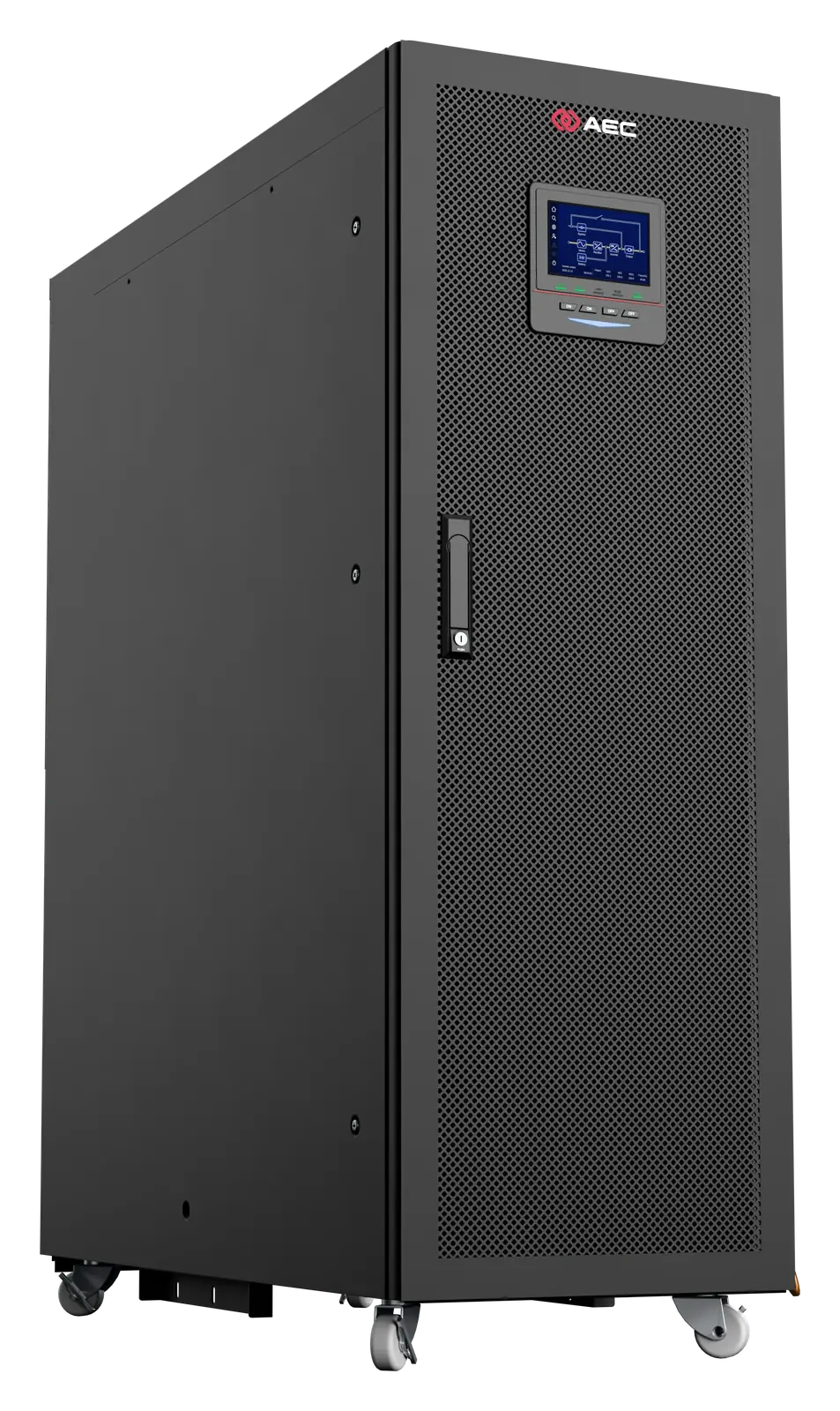
IST7 60–200
Three-phase online UPS, double conversion, 60–200 kVA
Details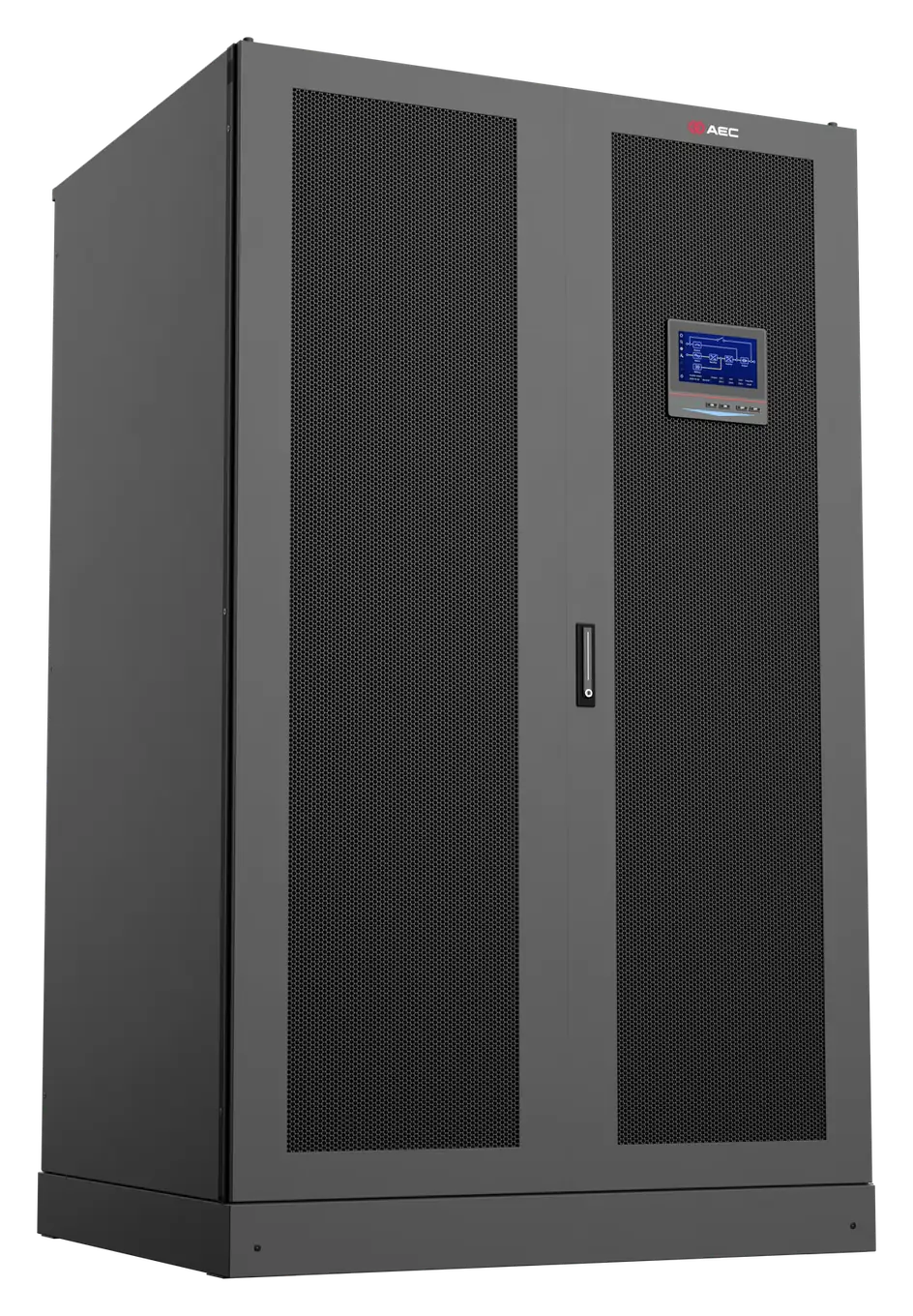
IST6 400–1200
Modular online UPS, double conversion, 400–1200 kVA
Details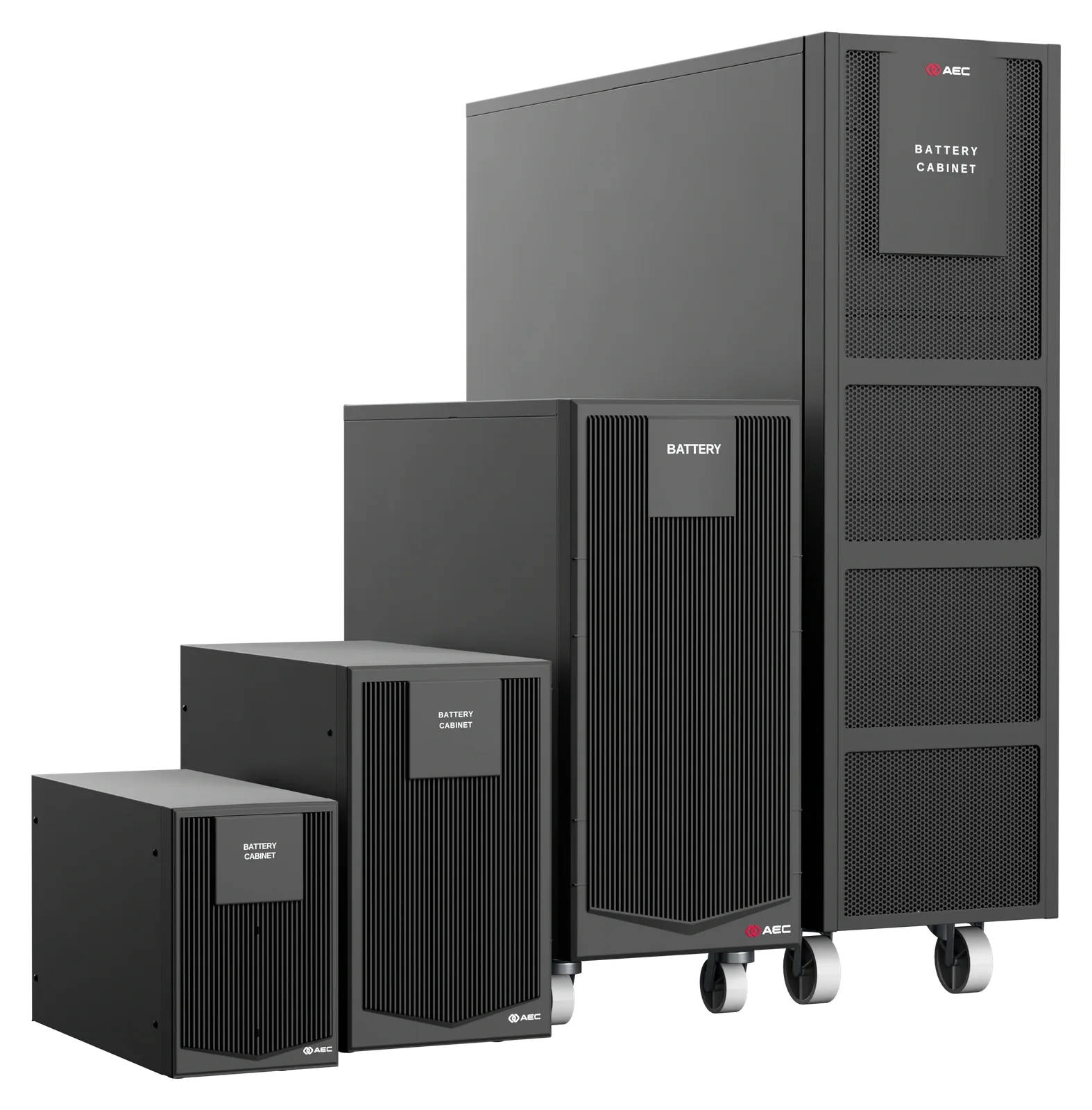
Battery cabinets
Battery cabinets and VRLA batteries for AEC UPS
DetailsBlog
Keep reading
Talk to an AEC engineer
Tell us the load, the supply and the backup time you need: we answer with the model and the batteries that fit.