



















5 July 2022 · updated 17 November 2026 · 7 min
UPS vs CPSS: which one does a building need?
The difference between a UPS and a CPSS is the job they do. A UPS (uninterruptible power supply) keeps equipment and data running through power cuts and disturbances. A CPSS (central power supply system) keeps a building's safety systems, such as emergency lighting, working so people can leave safely.
They share batteries and inverters, but they follow different standards and one cannot simply replace the other.
In brief
- A UPS protects IT, communications, medical and production equipment; its standard series is IEC / EN 62040.
- A CPSS supplies safety loads such as emergency lighting and smoke extraction; its standard is EN 50171.
- A CPSS must meet extra requirements on autonomy, battery life, recharge, overload, monitoring and the enclosure.
- For safety loads where EN 50171 applies, a standard UPS is not an acceptable substitute.
- Many buildings need both: a UPS for the server room and a CPSS for the escape routes.
What is a UPS?
An uninterruptible power supply protects equipment such as servers, networks, medical devices and industrial controls from power cuts and mains disturbances. Its aim is continuity: no lost data and no stopped processes.
An online double-conversion UPS first turns the incoming AC into DC, then back into clean AC with its inverter. The load is always supplied by the inverter, so there is no break when the mains fails. IEC 62040-3 calls this the VFI class (voltage and frequency independent). Other UPS types switch over to the battery only when the mains fails; our guide to UPS types explains the differences.
UPS are covered by the IEC / EN 62040 series: part 1 for safety, part 2 for electromagnetic compatibility (EMC) and part 3 for performance. The battery is usually sized for minutes, enough to ride through short cuts or to bridge the gap until a generator takes over.
What is a CPSS?
A central power supply system supplies safety equipment in buildings when the normal supply fails. In Italy it is often called a soccorritore. Its aim is the safety of people: it powers emergency lighting for escape routes and exit signs, and other safety systems such as fire-fighting, smoke extraction, alarms and carbon monoxide detection.
In Europe, the requirements for a CPSS are set by EN 50171, "Central power supply systems". It applies to systems permanently connected to low-voltage AC supplies that use batteries as the alternative source. The required duration, often 1 or 3 hours for emergency lighting, comes from national rules and the building's fire safety design. Our guide on CPSS and EN 50171 covers the standard in more depth.
UPS vs CPSS: the key differences
| Aspect | UPS | CPSS |
|---|---|---|
| Purpose | Continuity of equipment and data | Safety of people in an emergency |
| Typical loads | Servers, networks, medical and industrial equipment | Emergency lighting, fire and smoke systems, alarms |
| Main standard | IEC / EN 62040 | EN 50171 |
| Typical autonomy | Minutes, or until a generator starts | The full duration set by the fire design, often 1 or 3 hours |
| Battery sizing | For the runtime needed, with a margin | For the full duration at the end of battery life |
| Design focus | Power quality, efficiency, zero transfer time | Battery life, recharge time, overload capacity, monitoring, fire-resistant enclosure |
| Installation | Equipment room, data centre, near the loads | Protected room, with fire-resistant safety circuits to the loads |
| Where | Data centres, offices, factories, hospitals | Public buildings, workplaces, places where people gather |
The table shows the core idea. A UPS is judged on how well it protects the load. A CPSS is judged on whether the safety load is certain to have power for the required time, even after years of service.
What EN 50171 adds to a UPS design
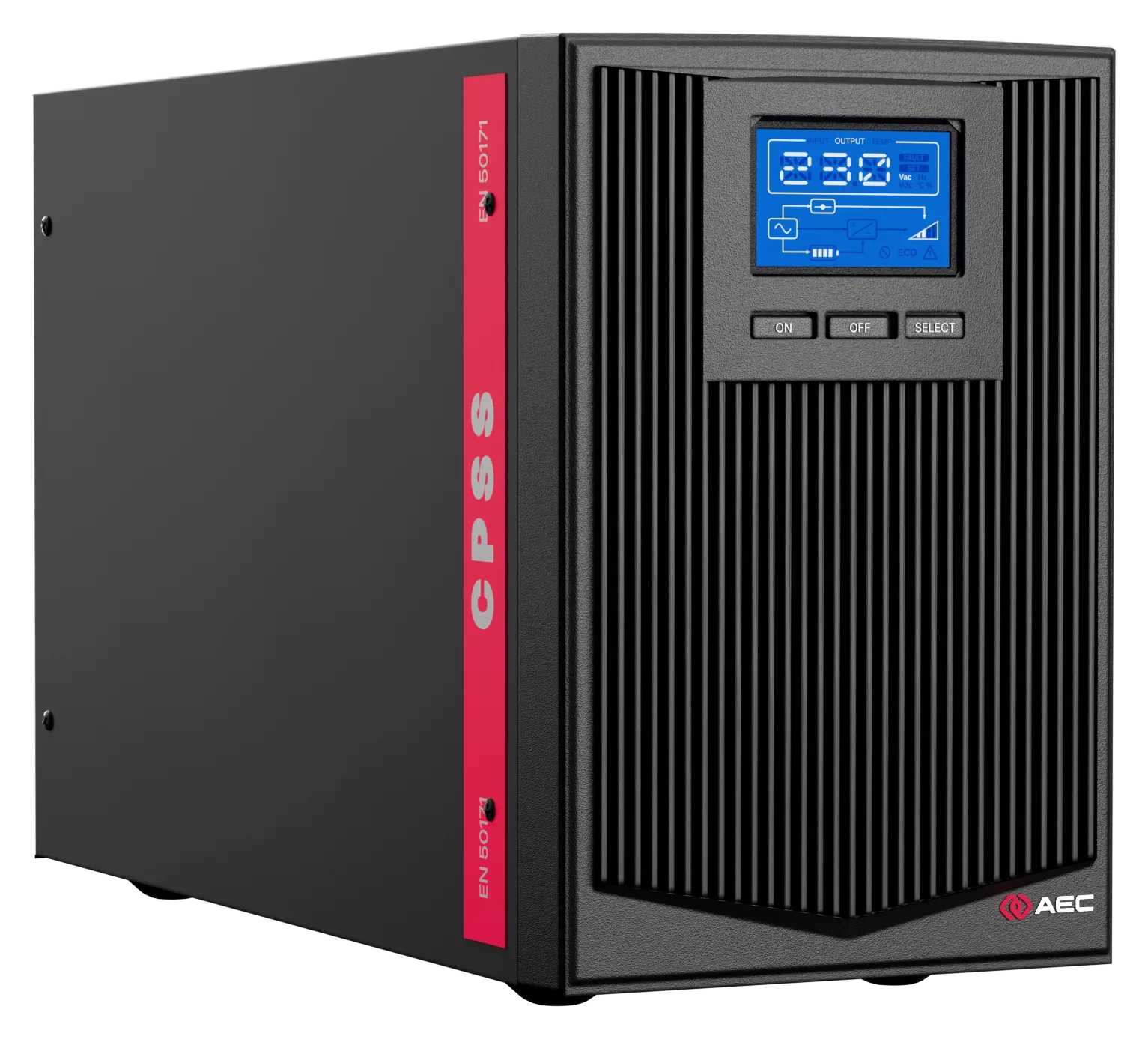
A CPSS uses the same building blocks as a UPS: charger, battery, inverter and control. Manufacturers often build it to the UPS standards as well: AEC, for example, declares its CPSS ranges with a structure compliant with CEI EN 62040. EN 50171 then adds requirements a UPS does not normally have to meet, on battery design life, recharge time, overload, monitoring and the enclosure; our guide on CPSS and EN 50171 goes through them clause by clause. In AEC's ranges the difference shows in three figures: the CPSS 1–10 kVA and CPSS 10–200 kVA both hold a constant overload of up to 120%, use batteries with a 10–12 year expected life and recharge in under 12 hours.
Can a UPS be used for emergency lighting, or a CPSS for IT?
A UPS for emergency lighting: where EN 50171 applies, the safety supply must be a CPSS that meets it. A standard UPS, however good, is not designed or declared for that role. Using one exposes the building owner to a non-compliant safety installation.
A CPSS for IT: a CPSS uses conversion technology similar to a UPS, and some CPSS platforms are also listed for other loads. AEC's CPSS 10–200, for example, lists data centres, IT server rooms and precision equipment among its applications, as well as emergency lighting. Even so, putting safety and non-safety loads on one system is a design decision. Agree it with the fire safety designer and the authority; do not assume it.
A generator does not replace either. A generator takes seconds to start and cannot cover the gap on its own. A UPS bridges that gap for IT. For safety loads, plan for the CPSS to cover the full duration by itself unless national rules state otherwise. See UPS and generator for how they work together.
Worked example: a building that needs both
A small office building has a server room with 5 kW of IT load and a generator. It also has 3 kW of emergency lighting. The fire safety design asks for 1 hour of emergency lighting.
The UPS for the server room
- Load with margin: 5 kW × 1.2 = 6 kW.
- Choose the UPS: the 6 kVA IST3 delivers 6,000 W, so it covers 6 kW, but only at full load. The 10 kVA IST3 delivers 10,000 W, so it covers 6 kW with room to spare.
- Runtime: the UPS only needs to bridge until the generator takes over and to allow a safe shutdown if it fails. Allow 10 minutes: 6 kW × 10 ÷ 60 h = 1 kWh at the load.
- Check the battery: confirm the runtime at 6 kW with the datasheet or our backup time guide; the long-backup version with external batteries may be needed.
The CPSS for the emergency lighting
- Load with margin: 3 kW × 1.2 = 3.6 kW.
- Choose the CPSS: the CPSS3-3K delivers 2,400 W, too little. The CPSS3-6K delivers 4,800 W, so it covers 3.6 kW.
- Energy at the load: 3.6 kW × 1 h = 3.6 kWh.
- Losses and ageing: assume, for illustration, 90% conversion efficiency and an ageing factor of 1.25. 3.6 ÷ 0.9 × 1.25 = 5 kWh of battery energy.
The lighting load is smaller than the IT load (3.6 kW against 6 kW with margin), yet it needs 3.6 times the energy at the load: 3.6 kWh against 1 kWh. With losses and ageing, the CPSS battery must store about 5 kWh. That is the difference between the two systems in one figure: the CPSS is sized for duration and end of life, the UPS for continuity and a short bridge.
The battery runtime calculator checks the minutes of a VRLA bank at your load, new and at the end of its life, for either system.
Which one do you need? Checklist
- Are the loads safety systems covered by the fire strategy (escape lighting, smoke extraction, alarms)? You need a CPSS to EN 50171.
- Are the loads IT, communications, medical or production equipment? You need a UPS.
- Does the building have both? Plan two systems, with separate circuits and batteries.
- What duration does each system need? Ask the fire safety designer for the CPSS, and the IT or process owner for the UPS.
- Is there a generator? Size the UPS to bridge until it starts; size the CPSS for the full duration unless national rules allow otherwise.
- Where will each system sit? A protected room for the CPSS, a suitable equipment room for the UPS.
- How will each be tested and monitored? Plan tests, alarms and logbooks from the start.
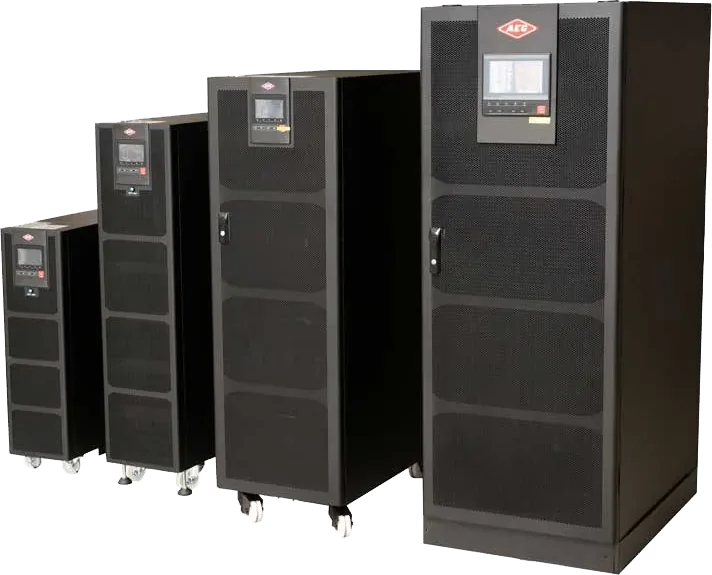
For IT and process loads, AEC's EMEA ranges are online double-conversion UPS from 1 kVA with the IST3 up to 1.2 MW per cabinet with the modular IST6 400–1200 kVA. For safety loads, the CPSS 1–10 kVA and CPSS 10–200 kVA are designed to meet the requirements of EN 50171. If you are unsure which system your project needs, ask AEC's technical team.
Common mistakes
- Treating a UPS as a CPSS. Similar hardware does not make a UPS compliant with EN 50171.
- Relying on the generator for safety lighting. Unless national rules state otherwise, the CPSS must cover the safety loads for the required duration on its own.
- Sizing the CPSS battery like a UPS battery. A CPSS needs the full duration at end of life, not a few minutes when new.
- Mixing loads without a decision. Adding IT or general loads to a safety supply needs the designer's agreement.
- Confusing kVA and W. Check the output power in watts for both systems.
- Forgetting maintenance. Both systems need battery checks and tests; the CPSS also needs a test logbook.
Questions
Questions people ask
What is the difference between a UPS and a CPSS?
A UPS keeps equipment and data running through power cuts, and follows IEC / EN 62040. A CPSS supplies safety systems such as emergency lighting so people can leave a building safely, and follows EN 50171. They share components but are not interchangeable.
Can I use a UPS for emergency lighting?
Not where EN 50171 applies. Safety lighting must be supplied by a CPSS that meets that standard. A standard UPS is designed for equipment continuity, not for safety systems.
Does a CPSS have to comply with EN 62040?
No, EN 50171 is the standard a CPSS is declared to. Because a static CPSS uses the same converter technology as a UPS, manufacturers often refer to the IEC / EN 62040 series as well: AEC's CPSS ranges, for example, are declared with a structure compliant with CEI EN 62040. Check the project requirements with the system designer.
Which buildings need a CPSS?
Typically workplaces and places where many people gather, such as shopping centres, hospitals, museums and schools. The fire safety design and national rules decide whether a central system is needed and for how long it must run.
Why is a CPSS battery usually larger than a UPS battery?
A CPSS must supply the safety load for the full required duration, often 1 or 3 hours, at the end of battery life. A UPS often only needs minutes, for example to bridge until a generator starts.
Does a generator remove the need for a UPS or CPSS?
No. A generator takes time to start, so a UPS is still needed to keep IT loads running without a break. Unless national rules state otherwise, the CPSS must supply the safety loads for the required duration on its own.
Blog
Keep reading
Talk to an AEC engineer
Tell us the load, the supply and the backup time you need: we answer with the model and the batteries that fit.