



















IST6-120 · Modular UPS
IST6-120, 4 × 30 kVA Modular UPS, 30 kVA modules
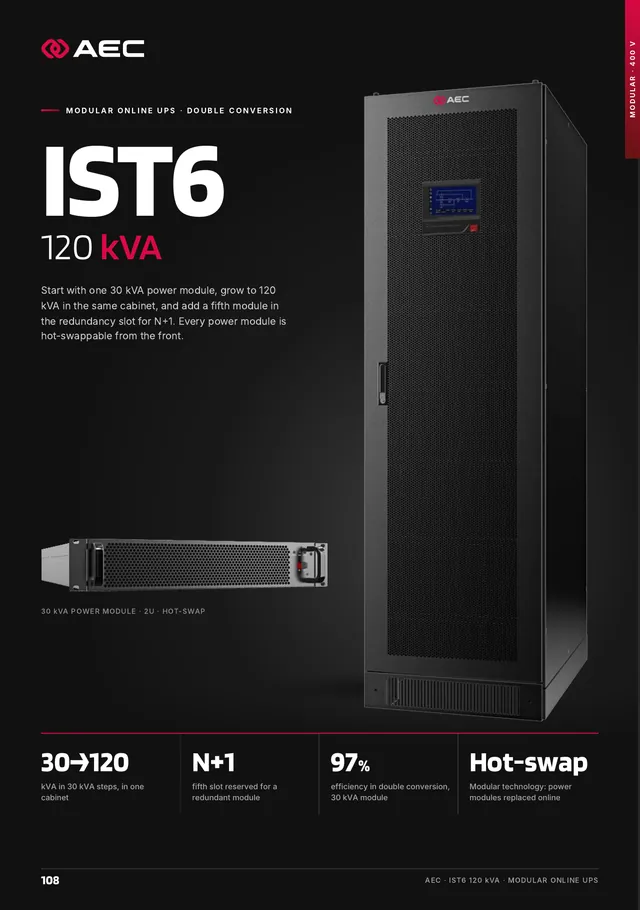
The IST6-120 with four 30 kVA power modules is the full 120 kVA / 120 kW modular online UPS, with a fifth slot for an N+1 module. For data centres and critical buildings of 90 to 120 kW per cabinet, alone or with more cabinets in parallel.

Quick answers
IST6-120, 4 × 30 kVA: quick answers
- What it is
- The IST6-120 with four 30 kVA power modules is the full 120 kVA / 120 kW modular online UPS, with a fifth slot for an N+1 module.
- Who it is for
- For data centres and critical buildings of 90 to 120 kW per cabinet, alone or with more cabinets in parallel.
- Supply and configuration
- 3 ph + N + PE · 220 / 230 / 240 V L-N · 220 / 230 / 240 V L-N · 380 / 400 / 415 V L-L
- Size and weight
- 600 × 860 × 2000 mm · 195 kg + 4 × 24 kg modules
- Ordering code
- IST6-120 + 4 × IST6-30-J (+1 in the redundancy slot)
IST6-120
What sets apart the IST6-120, 4 × 30 kVA
At 120 kVA all four power slots are used and the fifth, the redundancy slot, takes the N+1 module. The catalogue's cable table is for this rating: mains input 213 A on 4 × 120 mm², bypass and output 182 A on 4 × 95 mm², battery (±16 blocks) 330 A nominal and 377 A maximum on 3 × 95 mm². Charging reaches 40 A.
The catalogue's operating-cost example uses this cabinet at 80% load, 96 kW: 2.97 kW of losses and about 26,010 kWh a year at 97%, against 0.97 kW and 8,490 kWh in ECO mode at 99%. Beyond 120 kVA, cabinets work in parallel with ring cables, one display can monitor the whole system and a common battery can be shared.
Planning data
IST6-120, 4 × 30 kVA: currents, breakers, cables, batteries
The rows and columns of the EMEA 2026 catalogue's and AEC manuals' tables that concern the IST6-120, 4 × 30 kVA.
Power added one 30 kVA module at a time
| Load up to | Modules (N) | Modules for N+1 |
|---|---|---|
| 120 kVA | 4 | 4 + redundancy slot |
Installation
Installing the IST6-120, 4 × 30 kVA: space, heat, cables
Each figure with its source. Heat is the power lost at the peak efficiency stated.
| Item | Figure | Source |
|---|---|---|
| Clearances | front 800 mm, rear 800 mm, top 500 mm; left and right: not given | IST6 user manual Fig. 3-2 p.44 |
| Cable entry | Bottom (standard); Top, with the top wiring accessory (cables up to 120 mm²) | IST6 user manual Fig. 3-2 p.44 |
| Heat at full load | 3.71 kW at 120 kW load, 97 % efficiency | EMEA 2026 catalogue p.109, 122; output PF 1 (EMEA 2026 catalogue) |
| Operating temperature | −5 to 40 °C | IST6 30–120 user manual |
| Switches and terminals | Mains, SPD and output switches (796 mm up) and bypass and maintenance bypass (549 mm up) inside the front door. | IST6 user manual Fig. 2-3 p.13, Fig. 3-2 p.44 |
| Door | One leaf, hinged on the right | IST6 user manual Fig. 2-3 p.13, Fig. 3-2 p.44 |
| Module withdrawal | 700 mm in front of the cabinet to withdraw a module | IST6 user manual Fig. 2-6 p.15; EMEA 2026 catalogue p.125–126 |
Size and floor
How big it is
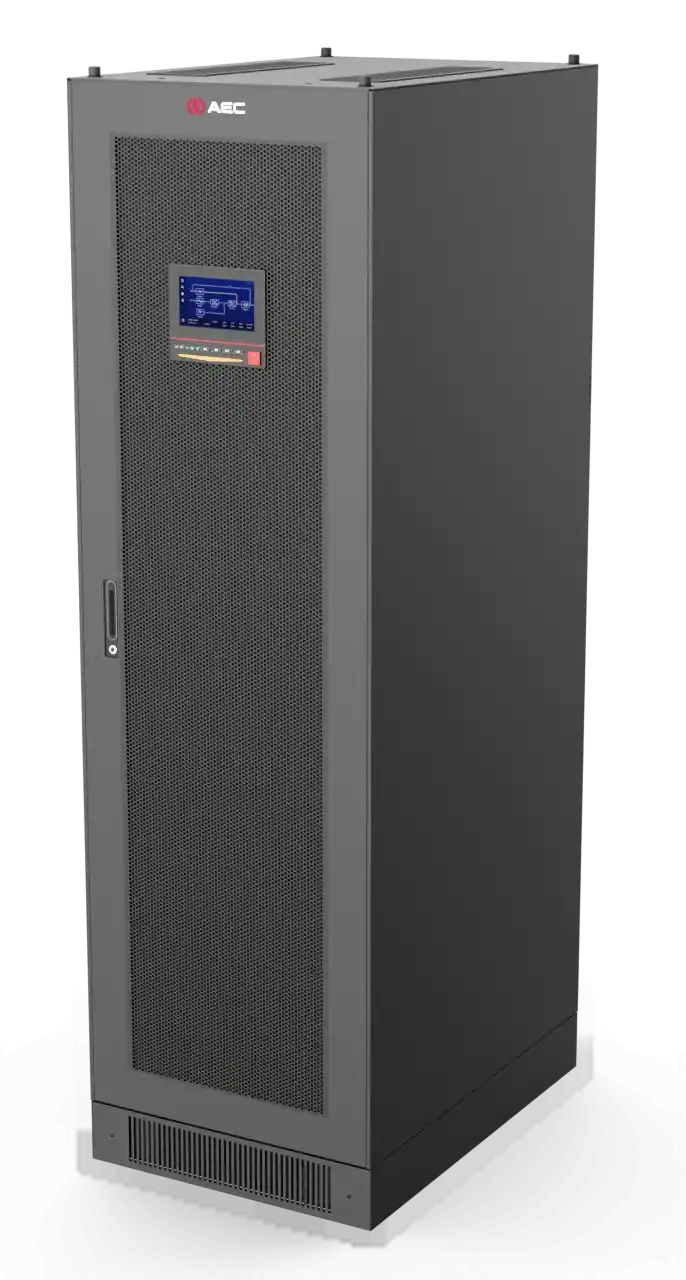
600 × 860 × 2000 mm · 195 kg + 4 × 24 kg modules.
Floor load = weight ÷ footprint: cabinet and modules, 195 + 4 × 24 = 291 kg.
Efficiency
How efficient is the AEC IST6-120, 4 × 30 kVA at your load?
IST6-120, 4 × 30 kVA, 120 kW at its rating, online, double conversion (typical curve, AEC's method). Heat to remove on this curve: 25%: 1.12 kW (η 96.4%) · 50%: 1.86 kW (η 97%) · 75%: 3.07 kW (η 96.7%) · 100%: 4.48 kW (η 96.4%). At 50% load, 24/7, it loses about 16,256 kWh a year.
How the curve is drawn and where each figure comes from: the IST6-120 range page.
- Load
- —
- Lost as heat
- —
- Energy lost in a year, 24/7
- —
- Its cost in a year at € per kWh
- —
- The catalogue's examples use €0.20 per kWh.
Where each figure comes from
| Mode | Efficiency | Kind | Models | Source |
|---|---|---|---|---|
| Online, double conversion | 25%: 96.4% · 50%: 97% · 75%: 96.7% · 100%: 96.4% | Typical curve, derived from the datasheet efficiency of 97% (AEC method) | all | AEC datasheet: AC/AC efficiency of the IST6-PM100 100 kW power module (the curve's shape) |
| ECO | 99% | Datasheet figure, load not stated | all |
EMEA 2026 catalogue figures: Online, double conversion up to 97% · ECO up to 99%.
 Drag to turn
Technical data
Technical data IST6-120, 4 × 30 kVA
Only this model's values, from the EMEA 2026 catalogue table.
| General | |
|---|---|
| Model | IST6-120 with IST6-30-J power modules |
| Rated power | 30 to 120 kVA / kW in 30 kVA steps (1–4 modules) + 1 redundancy slot |
| Topology | online double conversion, modular, hot-swap power modules, removable bypass module |
| Input | |
| Connection · voltage | 3 ph + N + PE · 220 / 230 / 240 V L-N |
| Voltage range | 176–280 V full power · 80–176 V derated (linear load) |
| Frequency · power factor · THDi | 40–70 Hz · ≥ 0.99 · ≤ 2% resistive, ≤ 3% non-linear full load |
| Bypass | 220 / 230 / 240 V L-N; synchronisation 50 / 60 Hz ± 6 Hz |
| Battery | |
| Voltage · blocks | ±168 … ±276 V DC · ±14 … ±23 × 12 V (default ±16; below ±16 load 80%) |
| Charging current | 10 A × number of modules (max.) |
| Functions | cold start · standard / deep test · common battery · lithium with BMS card |
| Output | |
| Connection · voltage | 3 ph + N + PE · 220 / 230 / 240 V L-N, 380 / 400 / 415 V L-L |
| Power factor · THDv | 1 · ≤ 1% linear, ≤ 4% non-linear |
| Frequency · phase error | tracks the bypass; 50 / 60 Hz ± 0.2% without mains · ≤ 1° (balanced load) |
| Transfer · dynamic response | 0 ms synchronised, < 15 ms not synchronised · < 5% for 0↔100% step |
| Inverter overload (PF 1) | ≤ 105% continuous · 106–110% 60 min · 111–125% 10 min · 126–150% 1 min · > 151% to bypass |
| Bypass overload | < 130% continuous · 131–150% 5 min · 151–200% 1 s · 201–300% 100 ms |
| Unbalanced load | 100% |
| System | |
| Efficiency | 97% double conversion · up to 99% ECO |
| Display · records | 7" colour touch screen · 10,000 events · 5 LEDs · status light bar |
| Communication | Modbus · RS232 · RS485 · 4 dry-contact inputs, 3 outputs · options: SNMP, dry-contact expansion, BMS card |
| Parallel | with parallel kit, ring cables; BSC dual bus |
| Environment | −5 … 40 °C · 0–95% RH · ≤ 2000 m · IP20 · < 65 dB · EMC class C3 |
| Dimensions W × D × H | 600 × 860 × 2000 mm · cable entry bottom (top with accessory) |
| Weight | cabinet without power modules 195 kg · power module 24 kg · bypass module 17 kg |
| Item | IST6-120, 4 × 30 kVA |
|---|---|
| Modules (N) | 4 |
| Modules for N+1 | 4 + redundancy slot |
Data from the IST6 120 kVA user manual. Specifications are subject to change without notice.
More technical detailshow it works, range tables, ordering codes
Diagrams
How the power flows: AEC IST6-120, 4 × 30 kVA
Pick an operating mode: the path the power takes to the load lights up.
Normal. Double conversion: the rectifier feeds the DC bus, the inverter rebuilds a clean voltage and the load always runs on the inverter. The battery stays on charge. Efficiency up to 97%.
Battery. The mains fails: the battery feeds the DC bus and the inverter carries on without a break. The load does not notice. Transfer: mains → battery with no break; inverter ↔ bypass 0 ms synchronised.
Bypass. Overload or internal fault: the static switch moves the load to the bypass line, fed by the mains.
ECO. The load runs on the bypass and the inverter stands ready: if the mains leaves the set window, the load goes back to the inverter. Higher efficiency, less protection. Efficiency up to 99%.
Maintenance. The maintenance bypass feeds the load straight from the mains, so the UPS can be isolated for service without switching the load off.
Modules and redundancy
Move the slider: the modules the load needs light up, and the spare slot holds the N+1 redundancy. Each slot takes one 30 kVA module.
modules working · redundant · free slot
Planning data
IST6-120 range tables
Quick to install, supported for years
Footprint 600 × 860 mm, height 2000 mm; four Ø14 mm holes to floor or U-steel base.
| Line | Current | Cable |
|---|---|---|
| Mains input | 213 A | 1 × (4 × 120) mm² |
| Bypass input | 182 A | 1 × (4 × 95) mm² |
| Output | 182 A | 1 × (4 × 95) mm² |
| Battery (±16 blocks) | 330 A nom. · 377 A max. | 1 × (3 × 95) mm² |
Ordering codes
Ordering codes IST6-120, 4 × 30 kVA
| Code | Description |
|---|---|
| IST6-120 | Modular cabinet, max. 4 × 30 kVA power modules, supplied without modules |
| IST6-30-J | 30 kVA / 30 kW power module |
| PAR - IST6 | Parallel kit |
Questions
Questions about the IST6-120, 4 × 30 kVA
What cables does a full IST6-120 need?
From the user manual: mains input 213 A, 1 × (4 × 120) mm²; bypass input and output 182 A, 1 × (4 × 95) mm²; battery at ±16 blocks 330 A nominal, 377 A maximum, 1 × (3 × 95) mm². Size on site to local rules and cable length.
Can a 120 kVA IST6 be redundant in one cabinet?
Yes: four modules carry 120 kVA and a fifth module goes in the dedicated redundancy slot (N+1). Two system control cards and a centralised, removable bypass module complete the redundancy.
How long does a 120 kVA UPS like the IST6-120, 4 × 30 kVA run?
3 to 221 minutes at full load (120 kW), and 9 to 442 minutes at half load, with the AEC battery options in the table: the battery chosen sets the figure. With 34 × 12 V 80 Ah (IST6-120-34X80): 3 minutes at 100% and 9 at 50%. For other loads and batteries use the backup-time tool.
How big is the AEC IST6-120, 4 × 30 kVA and how much does it weigh?
The AEC IST6-120, 4 × 30 kVA measures 600 × 860 × 2000 mm; weight: 195 kg + 4 × 24 kg modules (EMEA 2026 catalogue).
Talk to an AEC engineer
Tell us the load, the supply and the backup time you need for the AEC IST6-120, 4 × 30 kVA: we answer with the model and the batteries that fit. AEC International sells through distributors in about 80 countries and an agency in every Italian region: ask AEC which one serves your area.