



















20 October 2026 · 19 min
UPS glossary: 87 UPS terms and acronyms explained
UPS stands for uninterruptible power supply: a device that keeps equipment running from a battery when the mains fails, and cleans up the supply while the mains is present. This UPS glossary explains, in plain words, the UPS terms and acronyms you will meet on datasheets, specifications and installation manuals.
Each definition stands on its own and links to a deeper guide where there is one.
In brief
- The UPS acronym means uninterruptible power supply.
- Most UPS terms fall into six groups: power, topology, battery, protection and standards, monitoring, and installation.
- Three acronyms do most of the work on a datasheet: VFI (the online class), PF (power factor) and THDi (input current distortion).
- A UPS has two power ratings, kVA and kW, and you must check both against the load.
- The table below lists the most common UPS acronyms; the sections after it define each term.
Common UPS acronyms at a glance
Use this table as a quick reference. Each acronym has a full definition further down the page.
| Acronym | Stands for | In one line |
|---|---|---|
| UPS | Uninterruptible power supply | Keeps the load powered through a mains failure |
| VA / kVA | Volt-ampere / kilovolt-ampere | Apparent power rating |
| W / kW | Watt / kilowatt | Real power rating |
| PF | Power factor | Ratio of kW to kVA |
| VFI | Voltage and frequency independent | Online double conversion class |
| VI | Voltage independent | Line-interactive class |
| VFD | Voltage and frequency dependent | Offline (standby) class |
| PFC | Power factor correction | Input stage that draws near-sinusoidal current |
| THDi / THDv | Total harmonic distortion of current / voltage | How far a waveform is from a pure sine wave |
| IGBT | Insulated-gate bipolar transistor | Fast power switch in rectifiers and inverters |
| VRLA / AGM | Valve-regulated lead-acid / absorbent glass mat | Sealed lead-acid battery |
| LFP | Lithium iron phosphate (LiFePO4) | Lithium chemistry used in UPS batteries |
| BMS | Battery management system | Electronics that supervise lithium cells |
| EPO | Emergency power off | Input that cuts the UPS output at once |
| SNMP | Simple Network Management Protocol | Network monitoring of the UPS |
| CPSS | Central power supply system | Emergency lighting supply to EN 50171 |
| EMC | Electromagnetic compatibility | Limits on interference, IEC 62040-2 |
| IP | Ingress protection | Protection against solids and water, e.g. IP20 |
Power and electrical terms
These UPS terms describe how much power a UPS can deliver and what kind of supply it takes and gives. They are the first lines of any datasheet.
UPS (uninterruptible power supply)
A UPS (uninterruptible power supply) is a device that feeds a load from a battery when the mains fails or goes out of tolerance, without the load switching off. Most UPS also filter disturbances while the mains is present. The basics are in our guide what a UPS is and how it works.
VA and kVA (apparent power)
VA (volt-ampere) is the unit of apparent power: voltage multiplied by current, VA = V × A. A kVA is 1,000 VA. Apparent power is what the UPS components and cables must carry, so it is one of the two ratings on every UPS.
W and kW (real power)
W (watt) is the unit of real power, the part of the power that does useful work and turns into heat. A kW is 1,000 W. A UPS must be checked against the load in kW as well as in kVA.
Power factor (PF)
Power factor (PF) is the ratio of real power to apparent power: kW = kVA × PF. For example, a 10 kVA UPS with output PF 0.9 delivers 9 kW, while one with PF 1 delivers 10 kW. Our guide to kVA vs kW and power factor works through more examples.
Input power factor
Input power factor is the power factor the UPS presents to the mains or a generator. A value close to 1, such as ≥ 0.99, means the UPS draws little reactive current, so cables, breakers and generators can be smaller.
Single-phase
Single-phase is a supply with one phase conductor and a neutral, typically 230 V in Europe. Single-phase UPS usually cover small and medium loads, as explained in single-phase vs three-phase UPS.
Three-phase
Three-phase is a supply with three phase conductors, usually with a neutral, typically 400 V between phases in Europe. Three-phase power is P = √3 × V × I × PF: at 400 V, 20 A and PF 0.9 that is 1.732 × 400 × 20 × 0.9 ≈ 12.5 kW.
L-N and L-L voltage
L-N voltage is measured between a phase (line) and neutral, for example 230 V. L-L voltage is measured between two phases, for example 400 V; on a three-phase system L-L = √3 × L-N.
3/3, 3/1 and 1/1 configuration
3/3, 3/1 and 1/1 describe the number of phases at the UPS input and output. 3/3 means three-phase in and out, 3/1 three-phase in and single-phase out, and 1/1 single-phase in and out.
Neutral (N) and protective earth (PE)
Neutral (N) is the return conductor of a single-phase or three-phase supply. Protective earth (PE) is the safety conductor that connects metal parts to earth. A datasheet line such as "3 + N + PE" means three phases, neutral and earth.
Non-linear load
A non-linear load is equipment that draws current in pulses rather than as a smooth sine wave. Switch-mode power supplies in IT equipment are typical non-linear loads, and they generate harmonics.
Harmonics
Harmonics are currents or voltages at whole multiples of the mains frequency, for example 150 Hz or 250 Hz on a 50 Hz grid. They come from non-linear loads and rectifiers, and they heat cables and transformers.
THDi (total harmonic distortion of current)
THDi (total harmonic distortion of current) is a measure of how far the input current of a device is from a pure sine wave, given as a percentage. A UPS with a low THDi, such as ≤ 3%, pollutes the supply less and works better with generators.
THDv (output voltage distortion)
THDv (total harmonic distortion of voltage) is a measure of how far a voltage is from a pure sine wave. On a UPS datasheet it describes the output, usually at full linear load and at full non-linear load.
Crest factor
Crest factor is the ratio between the peak value and the RMS (effective) value of a current. IT loads draw peaky currents, so UPS datasheets often state the crest factor the inverter can handle, for example 3:1.
Inrush current
Inrush current is the short surge of current that some equipment draws when it is switched on, for example motors, transformers and power supplies. It is one reason to keep headroom when you size a UPS.
Overload
Overload is a load above the UPS rating. A UPS datasheet gives an overload table: how long the inverter or bypass can carry, for example, 110% or 150% of rated power before it transfers or shuts down.
Derating
Derating is the reduction of a UPS rating under less favourable conditions, such as low input voltage, high altitude, high temperature or a lower battery voltage. A datasheet states when derating applies and by how much.
Unbalanced load
An unbalanced load is a three-phase load that draws different power on the three phases. The datasheet states how much imbalance the UPS accepts, and you should check the load on each phase as well as the total.
UPS topology and operating modes
Topology is the internal architecture of a UPS. It decides how well the load is protected from mains problems. The three classic types are compared in our guide to online, line-interactive and offline UPS.
Offline (standby) UPS
An offline or standby UPS feeds the load directly from the mains and switches to its inverter only when the mains fails. It is simple and efficient but gives a short break at transfer and little filtering. It corresponds to the VFD class.
Line-interactive UPS
A line-interactive UPS feeds the load from the mains through an automatic voltage regulator that corrects sags and swells. It switches to battery only for larger problems. It corresponds to the VI class.
Online double conversion UPS
An online double conversion UPS converts the mains to DC and then back to AC, so the load is always fed by the inverter. There is no break when the mains fails, because the battery is already connected to the DC bus. It corresponds to the VFI class.
VFD (voltage and frequency dependent)
VFD (voltage and frequency dependent) is the IEC 62040-3 class in which the UPS output follows the mains voltage and frequency in normal operation. It is the class of offline (standby) UPS.
VI (voltage independent)
VI (voltage independent) is the IEC 62040-3 class in which the UPS regulates the output voltage within limits, but the output frequency still follows the mains. It is the class of line-interactive UPS.
VFI (voltage and frequency independent)
VFI (voltage and frequency independent) is the IEC 62040-3 class in which the UPS output voltage and frequency do not depend on the mains. It is the highest class and the one of online double conversion UPS.
Rectifier
The rectifier is the input stage of an online UPS that converts AC from the mains into DC for the DC bus. In many UPS it also supplies the battery charger.
PFC (power factor correction)
PFC (power factor correction) is a rectifier design that draws a near-sinusoidal current in phase with the voltage. It gives an input power factor close to 1 and a low THDi.
DC bus
The DC bus is the internal direct-current link between rectifier and inverter in an online UPS. The battery connects to it, directly or through a converter, which is why the switch to battery has no break.
Inverter
The inverter is the stage that converts DC back into a clean AC sine wave for the load. In an online UPS it runs all the time.
Three-level inverter
A three-level inverter is an inverter design that switches between three voltage levels instead of two. It produces a cleaner waveform with lower losses, which helps efficiency.
IGBT (insulated-gate bipolar transistor)
An IGBT (insulated-gate bipolar transistor) is a fast semiconductor switch used in UPS rectifiers and inverters. An "IGBT rectifier" can control the input current and so keep the input power factor high.
Static switch
A static switch is an electronic switch, usually thyristor-based, that transfers the load between inverter and bypass in a few milliseconds or less. It acts on overload or inverter fault.
Bypass (static bypass)
The bypass, or static bypass, is a path that feeds the load directly from the mains, around the rectifier and inverter. The UPS uses it on overload, on inverter fault and in ECO mode.
Maintenance bypass
A maintenance bypass is a manual switch that feeds the load from the mains while the UPS is isolated for service. It can be inside the UPS or external, as with the AEC external maintenance bypass.
Transfer time
Transfer time is the time the load goes without supply when the UPS changes source. An online UPS has 0 ms from mains to battery; inverter-to-bypass transfers are given separately: a synchronised transfer, with inverter and bypass in phase, is faster than a non-synchronised one.
ECO mode
ECO mode is an operating mode in which the load runs from the bypass while the mains is within the set limits, and the inverter takes over when it is not. It raises efficiency but reduces conditioning of the supply. See UPS efficiency and ECO mode.
Isolation transformer
An isolation transformer is a transformer with separate primary and secondary windings, so there is no direct electrical connection between input and output. In a UPS it gives galvanic isolation and a separately derived neutral; see UPS with isolation transformer.
Transformerless UPS
A transformerless UPS is a UPS without a heavy low-frequency transformer in the power path. It is lighter, smaller and usually more efficient; isolation, if needed, is added separately.
Modular UPS
A modular UPS is a UPS built from plug-in power modules in a common cabinet. You add modules to grow power or to add redundancy, as described in our modular UPS guide.
Power module
A power module is a self-contained rectifier, inverter and charger unit that slides into a modular UPS cabinet. On the AEC IST6 120 each power module is 30 kVA.
Hot-swap
Hot-swap means a module can be removed or inserted while the system keeps supplying the load. It applies to power modules and, on some systems, to battery modules.
Parallel operation
Parallel operation is the connection of two or more UPS to the same load bus, sharing the load. It is used to increase power or to add redundancy.
Redundancy, N+1 and 2N
Redundancy is spare capacity that keeps the load supplied when one unit fails. N+1 means one unit more than the load needs; 2N means two complete, independent systems. Our guide to UPS redundancy and N+1 explains the options.
CPSS (central power supply system)
A CPSS (central power supply system) is a battery-backed supply for emergency lighting and safety systems built to EN 50171. In Italy it is called a soccorritore; see UPS vs CPSS.
UPS battery terms
The battery sets the backup time and much of the maintenance. The chemistries are compared in VRLA vs lithium UPS batteries.
VRLA (valve-regulated lead-acid)
VRLA (valve-regulated lead-acid) is a sealed lead-acid battery that recombines its gases internally and needs no topping up. A pressure valve releases gas only when the internal pressure rises too high, for example on overcharge. It is the most common UPS battery.
AGM (absorbent glass mat)
AGM (absorbent glass mat) is a VRLA construction in which the electrolyte is held in glass-fibre mats between the plates. AEC OZ Power batteries use AGM technology.
LFP / LiFePO4 (lithium iron phosphate)
LFP or LiFePO4 (lithium iron phosphate) is a lithium battery chemistry known for thermal stability and long cycle life. It is the chemistry of AEC L6 lithium modules.
BMS (battery management system)
A BMS (battery management system) is the electronics that monitors the voltage, temperature and current of lithium cells and protects them. It also reports battery status to the UPS.
Cell
A cell is the basic electrochemical unit of a battery. A lead-acid cell has a nominal voltage of 2 V, so UPS datasheets often state the battery in number of cells.
Block (monobloc)
A block, or monobloc, is a battery case containing several cells in series. A 12 V lead-acid block contains six 2 V cells.
String
A string is a set of blocks connected in series to reach the battery voltage the UPS needs. Several strings in parallel give more capacity, and so more backup time.
Battery voltage (Vdc)
Battery voltage (Vdc) is the nominal DC voltage of the battery string. A value such as ±240 Vdc means a string split into two halves around a centre neutral point.
Ah (ampere-hour)
Ah (ampere-hour) is the unit of battery capacity: the current a battery can deliver multiplied by the time. Capacity in Ah falls at high discharge currents and low temperatures.
Backup time (autonomy)
Backup time, or autonomy, is how long the UPS can supply a given load from its battery. It depends on battery capacity, load, temperature and battery age; see UPS backup time.
Float charge
Float charge is the constant voltage, lower than the equalising or boost voltage, that keeps a fully charged battery topped up. It compensates for self-discharge without overcharging.
Equalising charge
Equalising charge is a controlled charge at a higher voltage that brings all cells of a lead-acid string to the same state of charge. The UPS applies it periodically or after a discharge.
Charge current
Charge current is the current the UPS charger supplies to the battery. A higher charge current shortens recharge time for large batteries, within the limits the battery maker allows.
Recharge time
Recharge time is the time a battery needs to go back to a stated charge level after a discharge, for example 90%. It matters when outages can come close together.
End-of-discharge voltage
End-of-discharge voltage is the battery voltage at which the UPS stops discharging to protect the battery from deep discharge. It is usually given per cell, for example around 1.60–1.75 V for lead-acid: lower values for short, high-current discharges and higher values for long ones.
Design life
Design life is the service life a battery maker expects under ideal conditions, typically float charge at 20-25 °C. AEC OZ Power 40-200 Ah models have a 12-year design life in float; real life is shorter in heat.
Service life
Service life is how long a battery actually lasts on site before its capacity drops too far, often taken as 80% of rated capacity. For VRLA it is typically 3-5 years in many installations, and heat shortens it a lot.
Battery cabinet
A battery cabinet is a separate enclosure that holds the battery strings, with protection and connections to the UPS. External cabinets are used when the backup time needs more batteries than the UPS can hold.
DC start (cold start)
DC start, or cold start, is the ability to switch the UPS on from the battery when there is no mains. It is useful to restore power to a critical load during a long outage.
Protection, safety and standards
These terms tell you how the UPS protects people and equipment, and which standards it is built and tested to.
IEC/EN 62040-1
IEC/EN 62040-1 is the safety standard for UPS. It covers electric shock, fire, mechanical hazards and markings.
IEC/EN 62040-2
IEC/EN 62040-2 is the electromagnetic compatibility (EMC) standard for UPS. It sets limits on the interference a UPS may emit and the disturbances it must withstand.
EMC categories C1, C2 and C3
EMC categories C1, C2 and C3 are the IEC 62040-2 classes that say where a UPS may be installed. C1 has the tightest emission limits and allows use without restriction, including in homes. C2 also covers the first environment (residential and commercial sites) but may need restrictions or extra measures, stated in the manual. C3 applies to the second environment: sites, usually industrial, that are not connected to the public low-voltage network that feeds homes.
IEC/EN 62040-3
IEC/EN 62040-3 is the performance standard for UPS. It defines the VFI, VI and VFD classes, test methods and the way performance must be declared.
IEC 62040-3 classification code
The IEC 62040-3 classification code is a three-part label such as VFI-SS-111. The first part is the class, the two letters describe the output waveform in normal and battery mode, and the three digits give the dynamic performance class (1 is the best) for a change of operating mode, a linear load step and a non-linear load step.
EN 50171
EN 50171 is the European standard for central power supply systems (CPSS) that feed emergency lighting and other safety equipment. It sets requirements for backup time, recharge and monitoring; see CPSS and EN 50171.
IEC 60364
IEC 60364 is the international standard for low-voltage electrical installations. It covers earthing systems, protection and cable sizing for the circuits around the UPS.
EPO (emergency power off)
EPO (emergency power off) is an input that cuts the UPS output at once, usually wired to a red button at the room exit. Some fire safety procedures require one.
Back-feed protection
Back-feed protection is a device inside the UPS that prevents dangerous voltage from flowing back to the input terminals during a mains failure. It protects people working on the upstream circuit.
Short-circuit protection
Short-circuit protection is the UPS function that limits or cuts the output current when a fault occurs downstream. It protects the UPS; selective protection of the downstream circuits must be designed with the installation.
IP rating (ingress protection)
The IP rating (ingress protection) is a two-digit code for protection against solid objects and water. IP20 means protection against objects larger than 12.5 mm, such as fingers, and no protection against water, which is normal for indoor UPS.
Monitoring and communication
A UPS that nobody watches can fail silently. These terms describe how a UPS reports its status and how it can shut down servers in good time.
SNMP (Simple Network Management Protocol)
SNMP (Simple Network Management Protocol) is a standard network protocol for monitoring and managing devices. A UPS with an SNMP card can be read by network management software and send alerts.
SNMP card (network card)
An SNMP card is a plug-in network interface that connects the UPS to a LAN, with its own web page for status and settings. AEC offers an SNMP card for remote monitoring and safe shutdown.
RS485 and RS232
RS485 and RS232 are serial communication interfaces. RS232 links one device to one PC over short distances; RS485 supports longer cables and several devices on one bus.
Dry contacts (relay contacts)
Dry contacts are potential-free relay contacts that open or close to signal UPS states, such as "on battery" or "battery low". They can be normally open (NO) or normally closed (NC). They connect easily to building management systems and alarm panels; see the AEC dry-contact card.
Intelligent slot
An intelligent slot is a bay on the UPS that takes an optional communication card, such as SNMP or extra dry contacts. The number of slots limits how many cards you can fit.
Remote ON/OFF
Remote ON/OFF is an input that lets an external signal switch the UPS on or off. It differs from EPO, which is an emergency stop.
Shutdown software
Shutdown software runs on servers and receives the UPS status over the network, USB or serial port. When the battery runs low, it closes applications and shuts the server down cleanly.
Installation and environment
The last block of a datasheet describes where the UPS can live. These terms explain what the room must provide.
Efficiency
Efficiency is output power divided by input power, as a percentage. A UPS at 96% efficiency turns 4% of what it takes into heat; check the value at the load level you expect, not only the maximum.
Losses and heat dissipation
Losses are the power a UPS turns into heat: losses = P × (1/η − 1), where P is the output in kW and η the efficiency. At 32 kW and 96%, that is about 1.33 kW of heat the room must remove; see UPS heat output and cooling.
Operating temperature
Operating temperature is the ambient temperature range in which the UPS works to specification. Batteries prefer 20-25 °C even when the UPS electronics accept more.
Relative humidity (non-condensing)
Relative humidity (RH) is the moisture in the air as a percentage of the maximum it can hold. "Non-condensing" means water must never form droplets on the equipment.
Altitude derating
Altitude derating is the reduction of UPS power above a stated altitude, often 1,000 or 2,000 m, because thinner air cools less. IEC 62040-3 gives the method.
Generator compatibility
Generator compatibility is how well a UPS works when fed by a generator. A wide input voltage and frequency window and a low THDi help; see UPS and generator.
Common mistakes with UPS terms
Most errors on UPS projects come from reading a familiar term in the wrong way. These are the ones we see most often.
- Treating kVA as kW. A 10 kVA UPS at PF 0.9 gives 9 kW, not 10 kW. Check the load against both ratings.
- Reading "up to" efficiency as typical. The maximum value applies at one load point; ask for the figure at your load.
- Confusing design life with service life. A 12-year design life does not mean 12 years in a warm room.
- Mixing up the bypass and the maintenance bypass. The static bypass is automatic and electronic; the maintenance bypass is a manual switch for service.
- Assuming "online" always means VFI. Check the IEC 62040-3 class or code on the datasheet.
- Confusing EPO with remote OFF. EPO is an emergency stop; remote OFF is a normal control input.
When you read a datasheet, use this short checklist:
- Find the rating in kVA and kW and the output PF.
- Check the class: VFI, VI or VFD.
- Read the input voltage window, THDi and input PF.
- Note the battery voltage, type and charge current.
- Read the overload table and transfer times.
- Check efficiency, temperature range and communication options.
Our step-by-step guide on how to read a UPS datasheet applies this checklist to a real AEC datasheet.
Where these terms appear in AEC ranges
You will meet every term in this UPS glossary on AEC datasheets. A few examples show how they fit together.
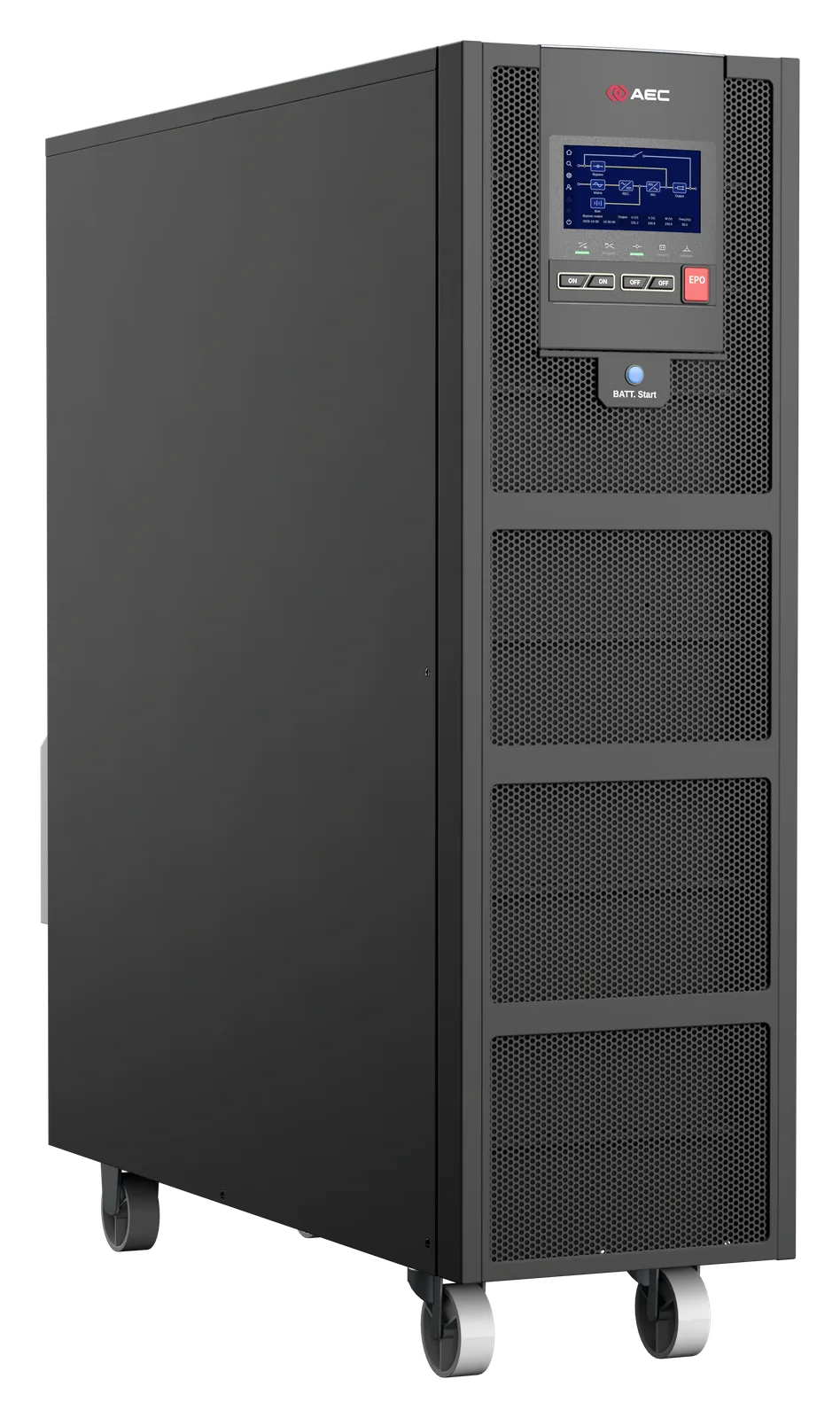
- The IST7 10–40 is an online double conversion UPS with output PF 1 (settable to 0.9), a 3/3 or 3/1 configuration (also 1/1 on 10–20 kVA), a three-level inverter and efficiency up to 96%, or 99% in ECO mode on a single UPS.
- The IST6 120 is a modular UPS with 30 kVA hot-swap power modules, from 30 to 120 kVA, and a fifth slot for an N+1 module.
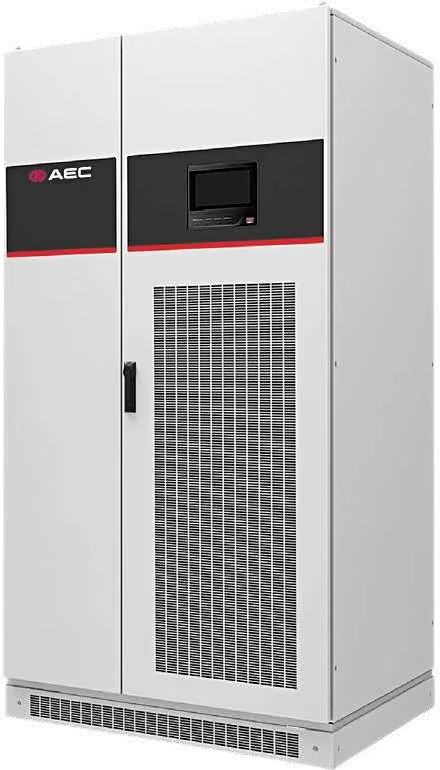
- The IST7 T has a built-in output isolation transformer and an IGBT rectifier, from 100 to 200 kVA.
- The L6 lithium system uses hot-swap LFP modules for AEC UPS from 6 to 1200 kVA.
To find a range from your load and backup time, try the UPS finder. If a term on a datasheet or drawing is still unclear, send us your question and we will explain it with your project in mind.
Questions
Questions people ask
What does the UPS acronym stand for?
UPS stands for uninterruptible power supply. It is a device that keeps equipment running from a battery when the mains fails, and filters disturbances while the mains is present.
What does VFI mean on a UPS?
VFI means voltage and frequency independent. It is the IEC 62040-3 class in which the UPS output does not depend on the mains voltage or frequency. Online double conversion UPS belong to this class.
What is the difference between kVA and kW on a UPS?
kVA is apparent power and kW is real power; kW = kVA × power factor. A 10 kVA UPS with PF 0.9 delivers 9 kW, while one with PF 1 delivers 10 kW. Check the load against both ratings.
What is THDi in UPS terms?
THDi is the total harmonic distortion of the input current, as a percentage. A low value, such as 3% to 5%, means the UPS draws a near-sinusoidal current. That puts less stress on cables, transformers and generators.
What does EPO mean on a UPS?
EPO means emergency power off. It is an input, often wired to a red button, that cuts the UPS output at once. It is different from remote OFF, which is a normal control signal.
What is the difference between a bypass and a maintenance bypass?
The static bypass is an automatic electronic path that feeds the load from the mains on overload or inverter fault. The maintenance bypass is a manual switch that feeds the load while the UPS is isolated for service. The IST7 10–40, for example, has both.
Products
Products in this guide


Blog
Keep reading
Talk to an AEC engineer
Tell us the load, the supply and the backup time you need: we answer with the model and the batteries that fit.