



















Battery cabinets · Batteries and cabinets
BB5 Battery cabinet for UPS, 24 · 40 Ah
The BB5 is a slim floor-standing battery cabinet, 460 × 800 × 1400 mm and 110 kg empty, for 30 to 40 batteries of 12 V 24 or 40 Ah, or 100–120 of 9 Ah. For IST7 UPS of 10 to 60 kVA, and the IST3 10 kVA, where floor space is short and backup is in the tens of minutes.

Quick answers
BB5: quick answers
- What it is
- The BB5 is a slim floor-standing battery cabinet, 460 × 800 × 1400 mm and 110 kg empty, for 30 to 40 batteries of 12 V 24 or 40 Ah, or 100–120 of 9 Ah.
- Who it is for
- For IST7 UPS of 10 to 60 kVA, and the IST3 10 kVA, where floor space is short and backup is in the tens of minutes.
- Supply and configuration
- 12 V VRLA AGM blocks · string split at the neutral (+, N, −)
- Battery and backup
- 30–40 × 24 / 40 Ah
- Size and weight
- 460 × 800 × 1400 mm · 110 kg empty
- Ordering code
- BB5-11 · BB5-10k … BB5-60k
Battery cabinets
What sets apart the BB5
At 460 mm the BB5 is the narrowest floor-standing cabinet. Five levels hold the batteries, the top one also carrying the disconnect Q1, which on the BB5 has fuses on +, N and − (50 to 125 A, UPS up to 60 kW). The front is a screwed panel; cables enter on the right side, top or bottom. Its largest layout stores 18.2 kWh nominal.
Loaded weights run from 340 kg (30 × 24 Ah) to 580 kg (38 × 40 Ah); with 38 × 40 Ah the floor load reaches 1576 kg/m². It is the cabinet in the catalogue's IST7 codes such as IST7-20-32X40 and IST7-10-150X9.
- Against the BB6 (one size up): W × D × H 460 × 800 × 1400 mm against 800 × 800 × 1400 mm; Weight, empty 110 kg against 140 kg; Front screwed panel against door with lock; Battery levels 4 + Q1 level against 3 + Q1 level; Internal frame 458 × 785 mm, 5 levels against 745 × 765 mm, 2–4 levels.
Planning data
BB5: currents, breakers, cables, batteries
The rows and columns of the EMEA 2026 catalogue's and AEC manuals' tables that concern the BB5.
One design, four sizes
| UPS kW | Fuse F1/F2 | Size | Cu mm² | PE mm² | BB5 |
|---|---|---|---|---|---|
| 10 | 50 A | NH00 | 10 | 10 | ● |
| 20 | 63 A | NH00 | 16 | 16 | ● |
| 40 | 100 A | NH00 | 25 | 16 | ● |
| 60 | 125 A | NH00 | 35 | 16 | ● |
| 80 | 160 A | NH00 | 70 | 35 | |
| 100 | 250 A | NH1 | 120 | 60 | |
| 120 | 250 A | NH1 | 120 | 60 | |
| 160 | 400 A | NH2 | 240 | 120 | |
| 200 | 400 A | NH2 | 240 | 120 |
Ventilation of the battery cabinet
| Example | BB5 · 40 × 40 Ah |
|---|---|
| Q float | 0.48 m³/h |
| Q boost | 3.8 m³/h |
| Openings | 108 cm² |
Installation
Installing the BB5: space, cables
Each figure with its source.
| Item | Figure | Source |
|---|---|---|
| Clearances | rear 100 mm, left 100 mm, right 100 mm; front and top: not given | BB user manual / drawings 2026-10-10 (MD-001, user manual §5) |
| Cable entry | Right side, top and bottom knock-outs | BB user manual / drawings 2026-10-10 (MD-001, user manual §5) |
| Operating temperature | 0 to 40 °C, best 20–25 °C | AEC BB5–BB8 user manuals §3.3 |
| Switches and terminals | Screwed steel front panel (no door). | BB user manual / drawings 2026-10-10 (MD-001, user manual §5) |
Size and floor
How big it is
460 × 800 × 1400 mm · 110 kg empty.
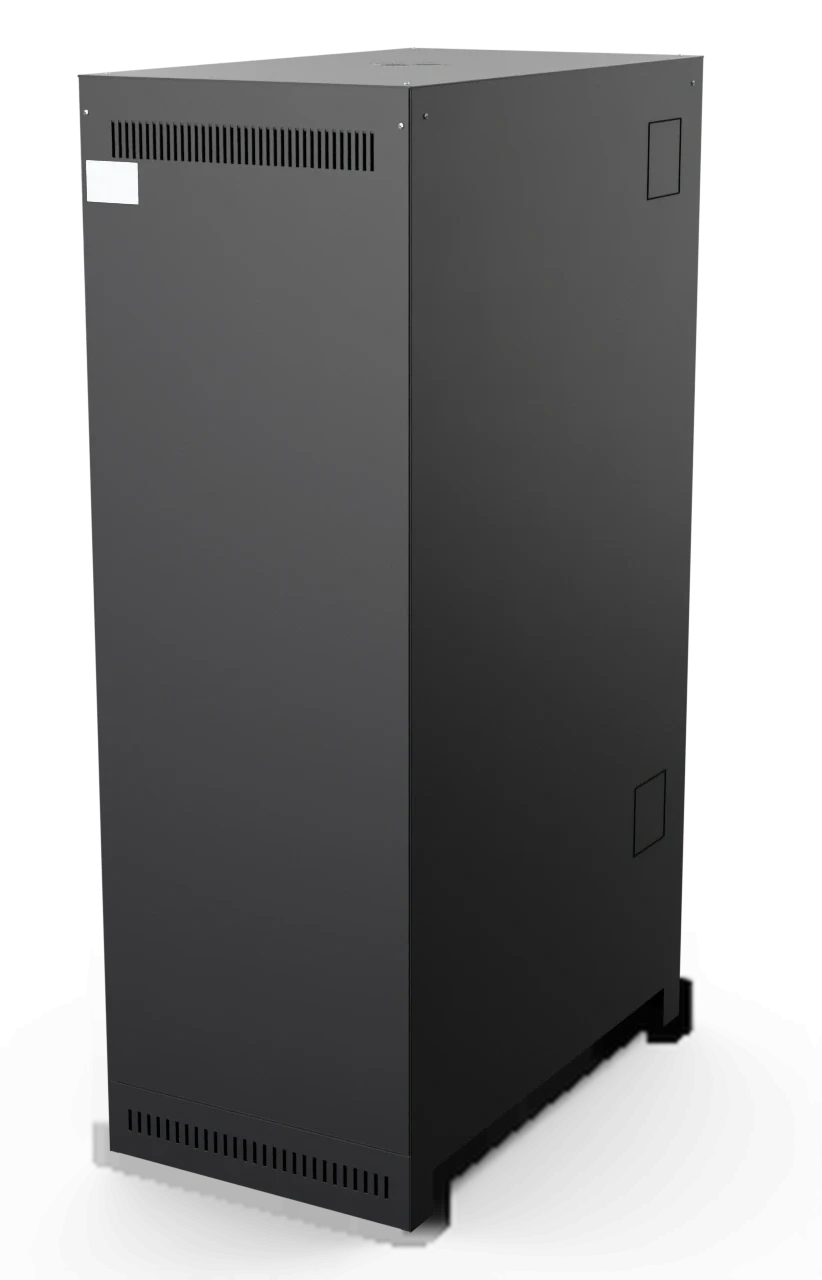 Drag to turn
Technical data
Technical data BB5
Only this model's values, from the EMEA 2026 catalogue table.
| Mechanical | |
|---|---|
| W × D × H (mm) | 460 × 800 × 1400 |
| Weight, empty | 110 kg |
| Front | screwed panel |
| Battery levels | 4 + Q1 level |
| Internal frame | 458 × 785 mm, 5 levels |
| Cable entry | right side, top and bottom |
| Floor fixing | through the base |
| Batteries | |
| Battery | 12 V 24 / 40 Ah · 9 Ah |
| Configurations | 30–40 · 100 / 120 × 9 Ah |
| String voltage | ±180 … ±240 V |
| Electrical | |
| Disconnect Q1 (3-pole) | fuses on +, N, − |
| Fuses F1 / F2 | 32–125 A |
| UPS power (code) | 10–60 kW |
| Float · max. charge (per battery) | 13.5–13.7 V · 14.4 V |
| General | |
| Colour | RAL 9005 |
| Protection | IP20 · IP21–IP44 option |
| Standards | IEC/EN 62040-1 · EN IEC 62485-2 · CE |
| Warranty (cabinet) | 3 years |
From the AEC BB5, BB6, BB7 and BB8 user manuals and installation manuals (Rev. 1.0, 2026). VRLA batteries have a 1-year warranty for 9 Ah blocks and 2 years for larger blocks. Specifications are subject to change without notice.
More technical detailsrange tables, ordering codes
Planning data
Battery cabinets range tables
Slim cabinet, 24 to 40 Ah
Only 460 mm wide, with a screwed front panel. Five levels: four battery shelves and the top shelf with the disconnect Q1, which also takes batteries in the 34–40 configurations.
| Batteries | Total kg | UPS kVA |
|---|---|---|
| 30 · 32 · 34 × 24 Ah | 340 · 356 · 372 | 10 · 20 |
| 36 · 38 · 40 × 24 Ah | 388 · 400 · 420 | 10 · 20 · 30 · 40 |
| 30–38 × 40 Ah | 480–580 | 10 · 20 · 30 · 40 · 60 |
| 100 × 9 Ah | 355 | IST3 10 |
| 120 × 9 Ah | 405 | IST7 10 · 20 · 30 · 40 |
Ordering codes
Ordering codes BB5
| Code | Description |
|---|---|
| BB4-11 · BB5-11 | Cabinets for single-phase UPS: max 80 × 9 Ah (BB4) · 120 × 9 Ah (BB5) |
| BB5-10k … BB5-60k | BB5 for UPS up to 10 · 20 · 40 · 60 kW; 24 / 40 Ah or up to 120 × 9 Ah; 3 fuse holders |
| OZ Power 12 V | 9 · 24 · 40 · 60 · 80 · 100 · 200 Ah · code on request |
Catalogue
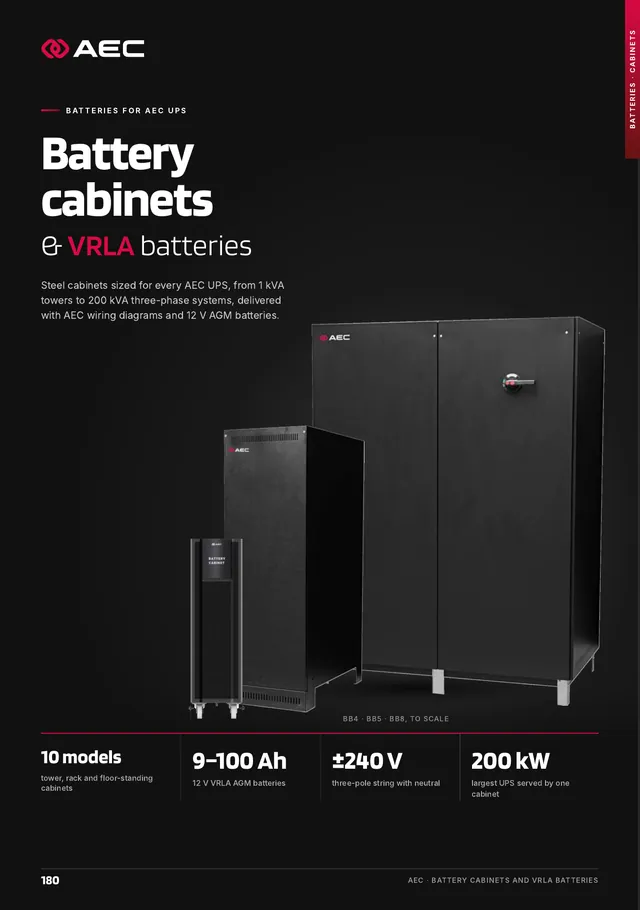
This range's pages of the catalogue.
Questions
Questions about the BB5
Which UPS can use a BB5?
IST7 from 10 to 60 kVA (codes BB5-10k to BB5-60k) and the IST3 10 kVA with 100 × 9 Ah. With 24 Ah batteries the catalogue lists 10–20 kVA for 30–34 blocks and 10–40 kVA for 36–40; with 40 Ah, 10 to 60 kVA.
How much ventilation does a BB5 need?
The catalogue's EN IEC 62485-2 example for a BB5 with 40 × 40 Ah: 0.48 m³/h on float, 3.8 m³/h on boost charge, and natural ventilation openings of at least 108 cm² each for inlet and outlet.
How big is the AEC BB5 and how much does it weigh?
The AEC BB5 measures 460 × 800 × 1400 mm; weight: 110 kg empty (EMEA 2026 catalogue).
Talk to an AEC engineer
Tell us the load, the supply and the backup time you need for the AEC BB5: we answer with the model and the batteries that fit. AEC International sells through distributors in about 80 countries and an agency in every Italian region: ask AEC which one serves your area.