



















Operating guide
IST3 1–10 kVA operating guide
A three-key LCD panel on a single-phase tower UPS from 1 to 10 kVA: ON, OFF and SELECT do everything, from start-up to the battery test. SELECT held for 5 s opens the settings: the operating mode and the output voltage, 208 to 240 V. Every step names the manual's section and page.
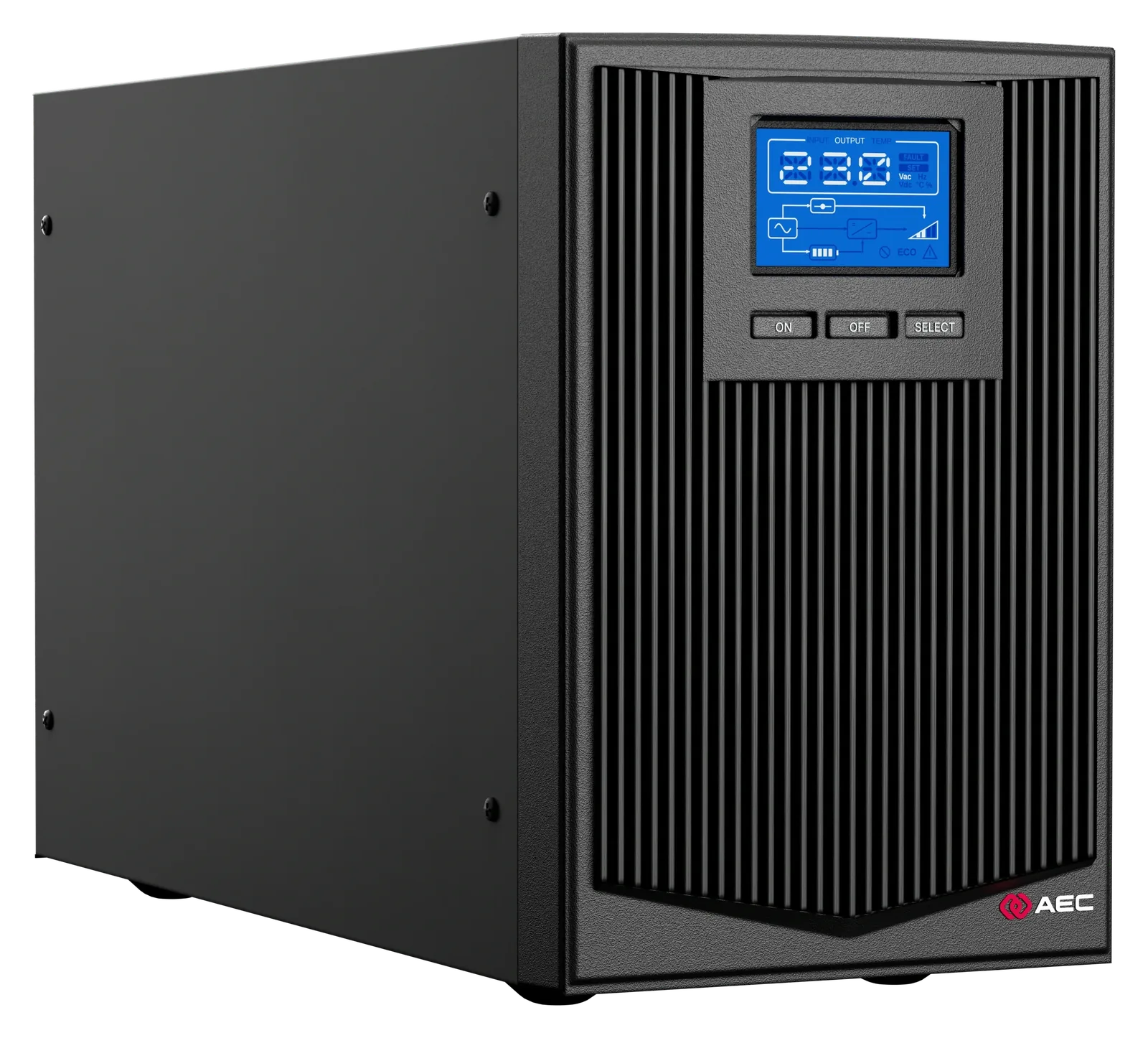
The display
The display, page by page.
The real screens, recorded from AEC's display simulator. Tap a screen to enlarge it. Keys and icons as in section 2.2.1 of the manual (page 9).
Keys and controls
- ON, held 1 s
- UPS off: switches it on.
- ON, held 3 s
- Mains mode: runs a battery test. Battery mode: silences the mains-failure alarm.
- OFF, held 1 s
- UPS on: switches it off.
- SELECT
- Each press shows the next reading: output voltage and frequency, input voltage and frequency, battery voltage, internal temperature, load, fault information. Held 5 s it opens the setting page.
- SELECT, held 5 s
- Setting page: ECO or INV mode, output voltage 208, 220, 230 or 240 V; hold ON for more than 1 s to save. No key for 20 s leaves without saving (§2.3.2).
Passwords are not printed here: the settings pages need the administrator access that AEC technical service gives.
Procedures
Start-up, shutdown, maintenance bypass, battery test, battery care.
From the AEC-UM-IST3 Rev. 01 user manual. The link on each procedure opens the PDF on its page.
Checks before start-upWiring, earth and load, before the first start.Manual §4.1 · p. 27 · 4 steps
Check that the connections are tight and the AC wire colours follow the wiring rules.
Check that the UPS is earthed and that the voltage between neutral and earth is below 5 V AC.
Long-backup models: check the wiring between the UPS and the battery cabinet.
Check that the output has no short circuit and the load is within the UPS rating.
Start-upMains in, ON for 1 s, then the loads.Manual §4.2 · p. 27 · 3 steps
Plug the UPS into the mains socket (1, 2 and 3 kVA) or switch on the mains, bypass and battery breakers (6 and 10 kVA).
On the display: Output voltage Hold ON on the panel for 1 s to start the UPS.
After about 10 s, when the UPS runs steadily, switch on the loads.
Caution Switch on the largest loads first, then the smaller ones, so that a starting load does not trip the overload protection.
ShutdownLoads off, 10 minutes to cool, OFF for 1 s.Manual §4.3 · p. 27 · 3 steps
Switch off the loads and leave the UPS running without load for about 10 minutes to cool down.
Hold OFF on the panel for 1 s.
Unplug the UPS (1, 2 and 3 kVA) or switch off the battery, bypass and mains breakers (6 and 10 kVA).
Maintenance bypass (6 and 10 kVA standard models)Service the UPS or replace its batteries without cutting the load.Manual §4.6 · p. 28 · 3 steps
Switch off the UPS (OFF for 1 s): it transfers to bypass mode.
Remove the maintenance bypass cover and turn the maintenance bypass switch to the maintenance bypass position.
Switch off the mains and bypass breakers on the rear panel. The load now runs from the mains through the maintenance bypass switch.
Caution In maintenance bypass, hazardous voltage stays on the input, output and filter board terminals.
Battery testFrom the panel, with the mains present.Manual §2.2.1 · p. 9 · 2 steps
With the UPS on and in mains mode, hold ON for 3 s: the battery test starts.
On the display: Battery voltage Read the battery voltage with SELECT. Replace batteries that show a short backup time or fail the test; replacement is for authorised personnel (§4.5).
Battery careFirst charge, periodic discharge, long storage.Manual §4.5 · p. 28 · 3 steps
Charge the batteries for 10 hours before first use; a mains failure during that time gives a shorter backup time.
Every four to six months run the UPS on battery until the low-battery shutdown, then recharge; every two months in hot areas.
If the UPS is not used for a long time, charge the batteries for more than ten hours every three months. Battery life is typically three to five years.
Alarms
Alarms and what to check.
From Table 4-2 of the manual, page 30. If an alarm stays, or the cause is inside the UPS, call AEC service.
| Shown | Buzzer | Meaning and what to check |
|---|---|---|
| EPO | Long beep | Emergency power off active (if fitted): bypass and inverter outputs are off. |
| BUS | Long beep | DC bus voltage fault: the inverter output is off. |
| TMP | Long beep | Over-temperature protection: the inverter output is off. Check the cooling fans and that the vents are free. |
| FAN | Rapid beep (every 0.2 s) | Fan fault alarm: the inverter output is about to shut down for protection. Check the cooling fans. |
| FAN | Long beep | Fan fault protection: the inverter output is off. |
| OUT | Long beep | Output fault: check the output for a short circuit or too much load. |
| BAT | Long beep | Battery fault: battery voltage too low or too high (protection). |
| PWR | Long beep | Power failure inside the UPS: have it repaired promptly. |
| CHG | Rapid beep (every 0.2 s) | Charger over-temperature (check the charger board's fan) or charger output short circuit. |
| BYP | Slow beep (every 2 s) | In mains mode, bypass voltage or frequency abnormal: check that the bypass breaker is on. |
| All load bars flash | Rapid beep | Overload alarm: the output will switch off shortly. Reduce the load. |
| All battery bars flash | Slow beep (every 2 s) | Battery voltage too high: check the battery and the charger. |
| Battery bars off, frame flashing | Rapid beep | Battery nearly exhausted: save your data and shut down the connected equipment. |
Common symptoms.
Table 4-1 of the manual, page 29: simple checks before you call service.
Mains present, the UPS runs on battery and beeps intermittently
Check the plug, socket and input wiring for a poor contact, and whether the input voltage or frequency on the LCD is outside the UPS input range. Check whether the over-current protector on the rear panel has tripped; press it to reset.
The output stops as soon as the load is switched on
Severe overload or a short circuit on the output (often a faulty power strip or load). Or the loads were not started largest first: restart the UPS and, once it runs steadily, switch on the largest load first.
Long beep, fault icon on, UPS on bypass
Output overload: reduce the load. A short transfer to bypass when a load starts, with a return on its own, is normal. Or over-temperature: check that the air inlets and outlets are free and the room within its limits.
At a mains failure there is no output, or the UPS shuts down soon on low battery
Aged batteries with lost capacity, a charger fault, or a battery cable loose or not connected. Replacement is for authorised personnel.
Practice
The IST3 1–10 kVA display simulator.
The same display, before you stand in front of the UPS: the operating states and the main pages.
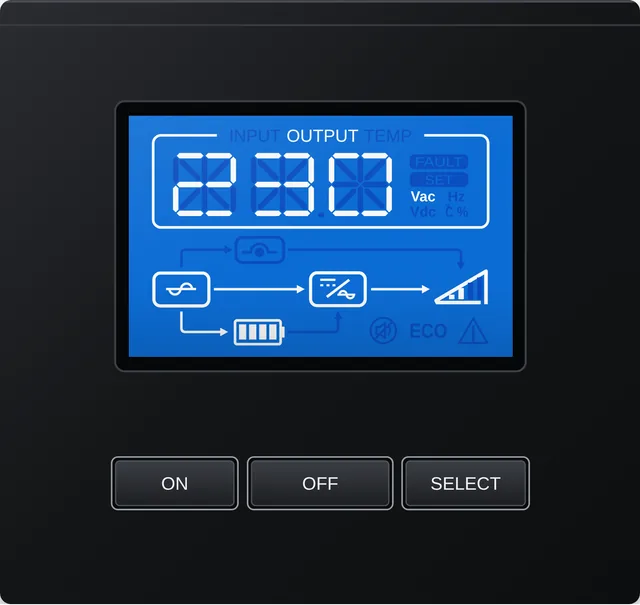
IST3 1–10 kVA · the real display
Output voltage
Talk to an AEC engineer
Tell us the load, the supply and the backup time you need: we answer with the model and the batteries that fit.