



















Operating guide
IST3-J 1–3 kVA operating guide
The rack and tower IST3-J of 1 to 3 kVA, with a three-key LCD: everyday operation, the battery test and the hot-pluggable battery pack. Every step names the manual's section and page.
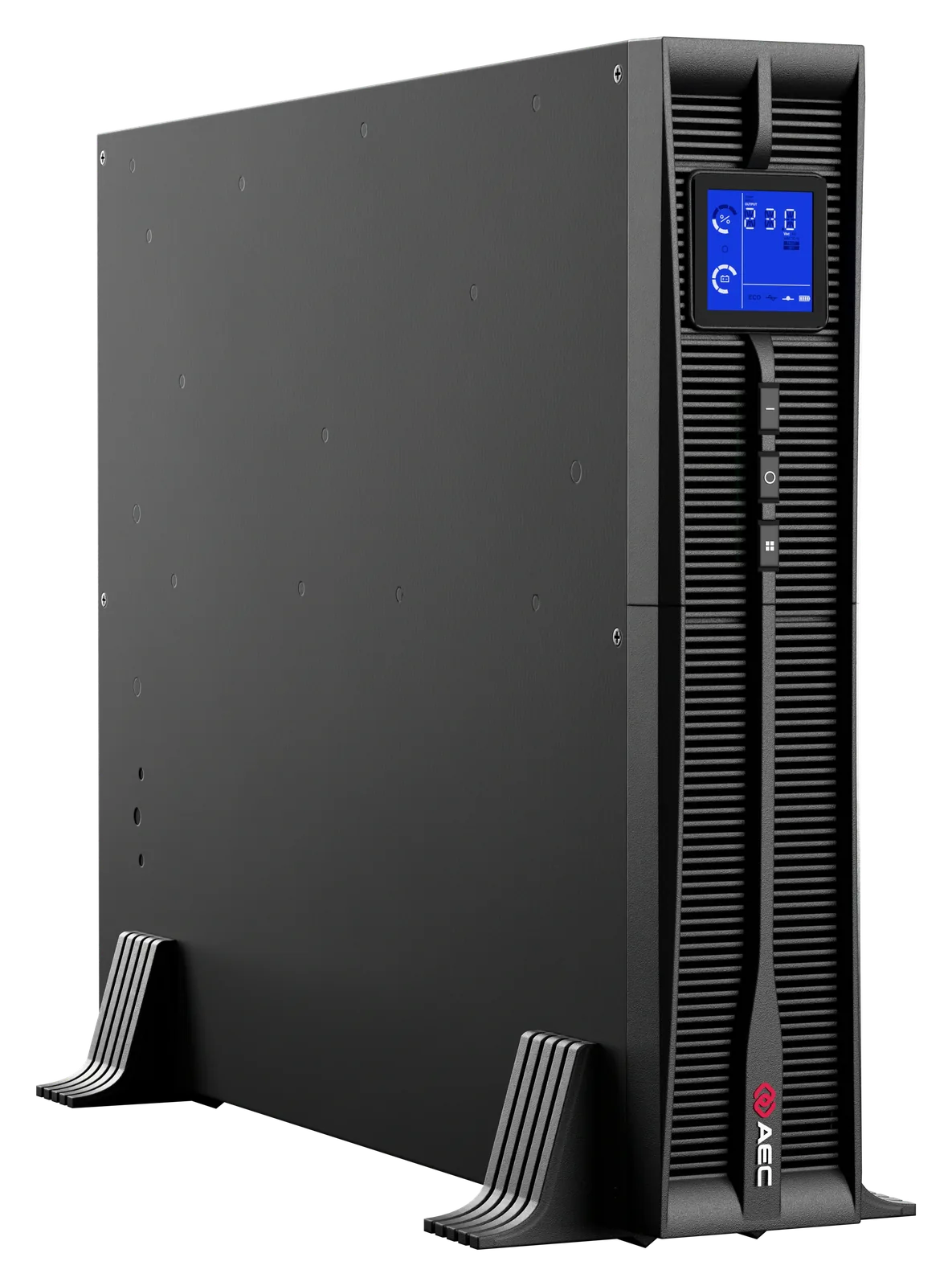
The display
The display, page by page.
The real screens, recorded from AEC's display simulator. Tap a screen to enlarge it. Keys and icons as in section 2.2.1 of the manual (page 10).
Keys and controls
- ON, held 1 s
- UPS off: switches it on.
- ON, held 3 s
- Mains mode: runs a battery test. Battery mode: silences the mains-failure alarm; 3 s again turn it back on.
- OFF, held 1 s
- UPS on: switches it off.
- SELECT
- Each press shows the next reading: output voltage and frequency, input voltage and frequency, battery voltage, internal temperature, load, fault information. Held 5 s it opens the setting page.
- SELECT, held 5 s
- Setting page: ECO or INV mode, TWR (tower) or RCK (rack) display, charging current 1 to 8 A (default 1 A), output voltage 208 to 240 V (default 230 V) (§2.3.2).
Passwords are not printed here: the settings pages need the administrator access that AEC technical service gives.
Procedures
Start-up, shutdown, battery test, battery care, battery replacement.
From the AEC-UM-IST3J-1-3 Rev. 01 user manual. The link on each procedure opens the PDF on its page.
Checks before start-upInput, output, load and battery.Manual §4.1 · p. 33 · 4 steps
Input and output installed correctly, the input on a supply that matches the rating.
No short circuit on the output, the load within the UPS capacity and switched off.
Battery voltage normal.
No inductive loads on the UPS output: supply them from the mains.
Start-upMains in, ON for 1 s, then the loads.Manual §4.2 · p. 33 · 3 steps
Plug the UPS into the mains socket.
On the display: Output voltage Press the ON key on the panel for 1 s to start the UPS.
After about 10 s, when the UPS runs steadily, switch on the loads.
Caution Switch on the loads from the highest power to the lowest, so a starting load does not trip the overload protection.
ShutdownLoads off, 10 minutes to cool, OFF for 1 s.Manual §4.3 · p. 33 · 3 steps
Switch off the loads and leave the UPS running without load for about 10 minutes to cool down.
Press the OFF key for 1 s to shut down the UPS.
Unplug the UPS from the mains socket.
Battery test and buzzerTwo holds of the ON key.Manual §2.2.1 · p. 11 · 2 steps
Mains mode: hold ON for 3 s to run a battery test.
On the display: Mains failure: on battery Battery mode, or with the low-battery alarm on: hold ON for 3 s to silence the buzzer; 3 s again turn it back on.
Battery care and the discharge time limitCharging, storage and what limits the backup time on the 2 and 3 kVA.Manual §5.2 · p. 34 · 4 steps
Before first use, switch on the UPS and charge the battery for ten hours.
Every four to six months discharge the battery to a third of its capacity and recharge it for at least ten hours; every two months in hot climates; every three months if the batteries stay unused.
After a long mains failure, press OFF so that the battery does not keep discharging.
The 2 and 3 kVA limit the discharge time above 75 % load: T (min) = 18000 / (2 × L − 100) / 60 with L the load in %, so 6 min at 75 % and 3 min at 100 %. The 1 kVA has no limit.
Battery pack replacement: the safety rulesThe pack is hot-pluggable; the manual shows each step with drawings.Manual §5.3 · p. 35 · 3 steps
Use a new battery of the same capacity, model and maker as the one replaced.
Before touching the battery, check that there is no dangerous voltage between its terminals and earth.
Follow §5.3.2 of the manual for the pack of the UPS and §5.3.3 for the external battery box; recycle the old batteries through an authorised collection point.
Caution Qualified personnel only. Never touch both battery connectors or bare terminals at the same time.
Alarms
Alarms and what to check.
From Table 5-2 of the manual, page 42. If an alarm stays, or the cause is inside the UPS, call AEC service.
| Shown | Buzzer | Meaning and what to check |
|---|---|---|
| EPO | Long beep | Emergency power off active (if fitted): bypass and inverter outputs are off. |
| BUS | Long beep | DC bus voltage fault: the inverter output is off. |
| TMP | Long beep | Over-temperature protection: the inverter output is off. Check the cooling fans and that the vents are free. |
| OUT | Long beep | Output fault: check the output for a short circuit or too much load. |
| BAT | Long beep | Battery fault: battery voltage too low or too high (protection). |
| FAN | Rapid beep (every 0.2 s) | Fan fault alarm: the inverter output is about to shut down for protection. Check the cooling fans. |
| All load bars flash | Rapid beep | Overload alarm: the output will switch off shortly. Reduce the load. |
| All battery bars flash | Slow beep (every 2 s) | Battery voltage too high: check the battery and the charger. |
| Battery bars off, frame flashing | Rapid beep | Battery nearly exhausted: save your data and shut down the connected equipment. |
Common symptoms.
Table 5-1 of the manual, page 41: simple checks before you call service.
Mains present, the UPS runs on battery and beeps intermittently
Check the plug, socket and input wiring for a poor contact, and whether the input voltage or frequency on the LCD is outside the UPS input range.
The output stops as soon as the load is switched on
Severe overload or a short circuit on the output (often a faulty power strip or load). Or the loads were not started largest first: restart the UPS and, once it runs steadily, switch on the largest load first.
Long beep, fault icon on, UPS on bypass
Output overload: reduce the load. A short transfer to bypass when a load starts, with a return on its own, is normal. Or over-temperature: check that the air inlets and outlets are free and the room within its limits.
At a mains failure there is no output, or the UPS shuts down soon on low battery
Aged batteries with lost capacity, a charger fault, or a battery cable loose or not connected. Replacement is for authorised personnel.
The LCD is blank
Loose wiring to the display board, or a display board fault: call AEC service.
Practice
The IST3-J 1–3 kVA display simulator.
The same display, before you stand in front of the UPS: the operating states and the main pages.
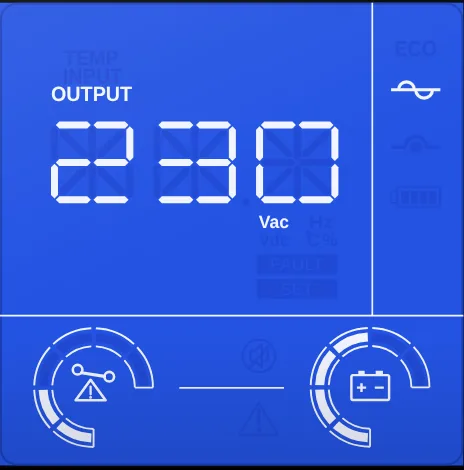
IST3-J 1–3 kVA · the real display
Output voltage
Talk to an AEC engineer
Tell us the load, the supply and the backup time you need: we answer with the model and the batteries that fit.