



















IST3-J · Single-phase UPS
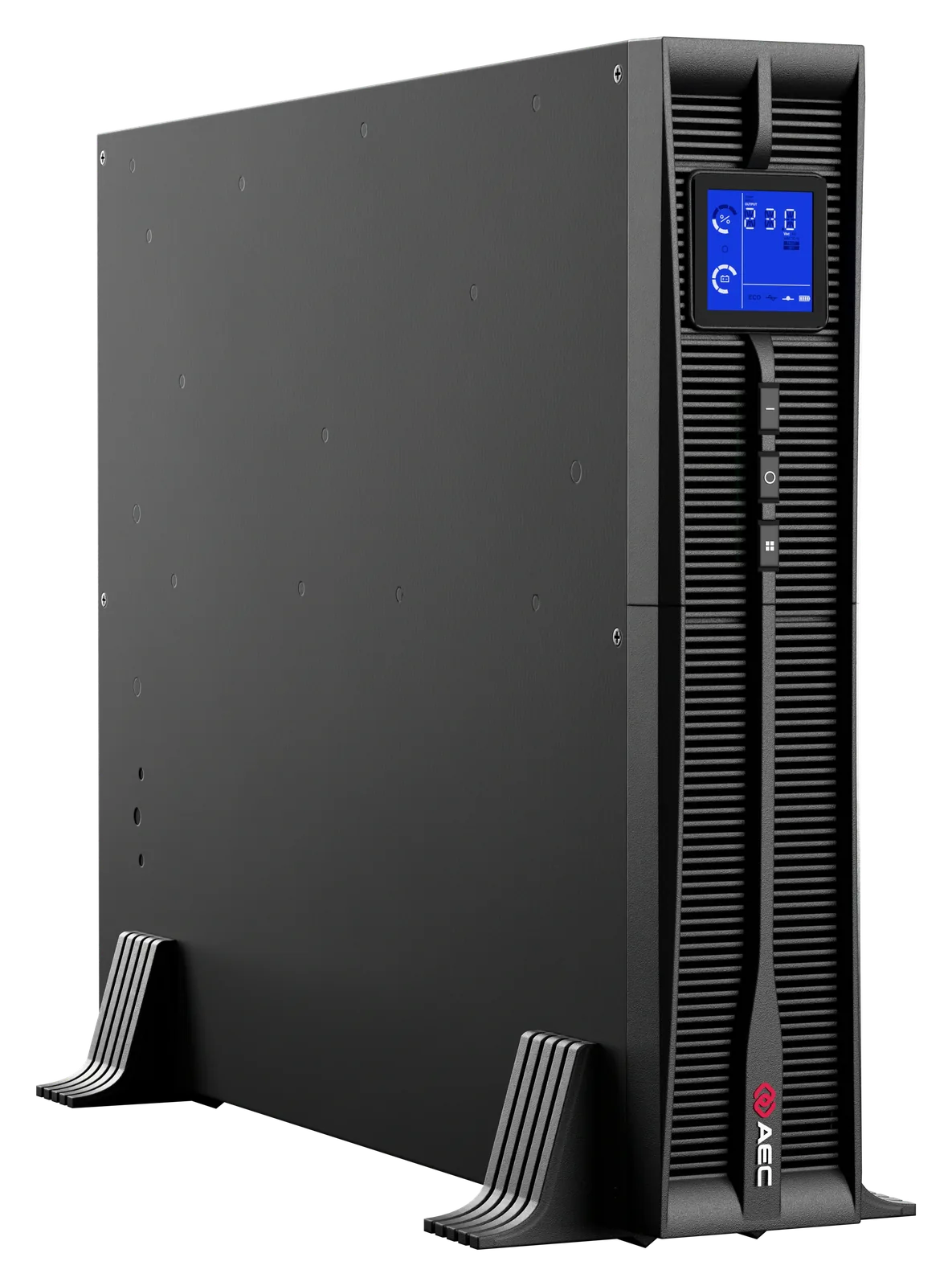
IST3-J 3 kVA Online rack UPS 3 kVA, 2U, 230 V
The IST3-J 3 kVA is a 3 kVA / 3 kW single-phase online double-conversion UPS in 2U, with six internal 12 V 9 Ah batteries. For a fully loaded server or network rack up to about 2.7 kW, with the battery boxes in the same rack.
Quick answers
IST3-J 3 kVA: quick answers
- What it is
- The IST3-J 3 kVA is a 3 kVA / 3 kW single-phase online double-conversion UPS in 2U, with six internal 12 V 9 Ah batteries.
- Who it is for
- For a fully loaded server or network rack up to about 2.7 kW, with the battery boxes in the same rack.
- Supply and configuration
- 208 / 220 / 230 / 240 V
- Battery and backup
- 72 V · 3 min full load · < 10 h
- Size and weight
- 438 × 572 × 86 mm · 26 kg
- Ordering code
- IST3J-3-6X9
IST3-J
What sets apart the IST3-J 3 kVA
The 3 kVA has the 2 kVA's chassis and outlets (8 × C13 + 1 × C19) but six batteries for a 72 V string, which brings it to 26 kg; each matching battery box holds 2 × (6 × 12 V 9 Ah) and weighs 40 kg, so the rack must carry it low and on rails rated for the weight.
The input breaker grows to 32 A (18 A maximum input current) on a 2.5 mm² cable. Like the 1 and 2 kVA it works from −5 to 50 °C, with derating between 40 and 50 °C, and up to 2000 m.
- Against the IST3-J 2 kVA (one size down): Power 3000 VA / 3000 W against 2000 VA / 2000 W; Battery voltage 72 V against 48 V; Weight 26 kg against 20 kg.
- Against the IST3-J 6 kVA (one size up): Power 3000 VA / 3000 W against 6000 VA / 6000 W; Voltage range 176–295 V > 75% load · 154–176 V 50–75% · 120–154 V < 50% against 176–275 V full load · 80–176 V linear derating; Voltage 208 / 220 / 230 / 240 V ± 1%, settable against 220 V ± 2% default · 208 / 220 / 230 / 240 V; Voltage distortion THD < 2% (linear load) against THD < 1% linear · < 4% non-linear; Overload 105–110% 10 min · 110–130% 1 min · 130–150% 1 s · > 150% 200 ms against 115–130% 10 min · 130–150% 30 s · > 150% 500 ms.
Planning data
IST3-J 3 kVA: currents, breakers, cables, batteries
The rows and columns of the EMEA 2026 catalogue's and AEC manuals' tables that concern the IST3-J 3 kVA.
From 1 to 10 kVA, always 2U
| UPS | 3 kVA |
|---|---|
| Battery box: batteries | 2 × (6 × 12 V 9 Ah) |
| W × D × H (mm) | 438 × 570 × 87 |
| kg | 40 |
In the rack or on the floor
| Model | 3 kVA |
|---|---|
| AC input max. (A) | 18 |
| AC breaker (A) | 32 |
| DC input max. (A) | 42.6 (rated) |
| DC breaker (A) | — |
| AC cable (mm²) | 2.5 |
| DC cable (mm²) | 6 |
Installation
Installing the IST3-J 3 kVA: space, cables
Each figure with its source.
| Item | Figure | Source |
|---|---|---|
| Clearances | front 300 mm (recommended 500), rear 300 mm (recommended 500), left 300 mm (recommended 500), right 300 mm (recommended 500), top 500 mm | AEC IST3-J 1–3 user manual p.22 §3.1 |
| Cable entry | Plugs and sockets at the rear | AEC IST3-J 1–3 user manual |
| Operating temperature | −5 to 40 °C, best 20 °C | AEC IST3-J 1–3 user manual p.22 §3.1, p.24 |
| Switches and terminals | Input socket, IEC outputs, over-current protector and the battery port on the rear panel. | AEC IST3-J 1–3 user manual p.22 §3.1 |
Size and floor
How big it is
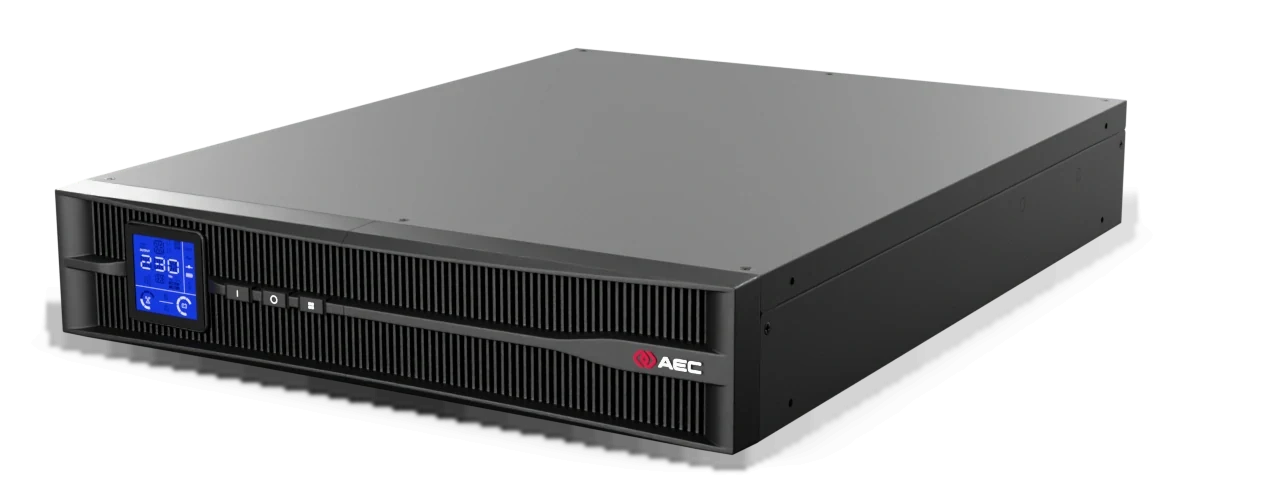
438 × 572 × 86 mm · 26 kg.
Floor load = weight ÷ footprint (26 kg).
Efficiency
How efficient is the AEC IST3-J 3 kVA at your load?
IST3-J 3 kVA, 3 kW at its rating, online, double conversion (AEC's measured curve). Heat to remove on this curve: 50%: 0.13 kW (η 91.85%) · 75%: 0.16 kW (η 93.3%) · 100%: 0.22 kW (η 93.1%). At 50% load, 24/7, it loses about 1,166 kWh a year.
How the curve is drawn and where each figure comes from: the IST3-J range page.
- Load
- —
- Lost as heat
- —
- Energy lost in a year, 24/7
- —
- Its cost in a year at € per kWh
- —
- The catalogue's examples use €0.20 per kWh.
Where each figure comes from
| Mode | Efficiency | Kind | Models | Source |
|---|---|---|---|---|
| Online, double conversion | 30%: 90.84% · 50%: 91.85% · 75%: 93.3% · 100%: 93.1% | Measured (AEC datasheet) | IST3-J 3 kVA | AEC technical datasheet IST3-J 1–3 kVA: AC/AC efficiency |
| ECO | 98.3% | Datasheet figure, load not stated | all | AEC technical datasheet IST3-J 1–3 kVA: AC/AC efficiency |
| Online, double conversion | 30%: 86.14% · 50%: 88.7% · 75%: 90.06% · 100%: 90.83% | Measured (AEC datasheet) | IST3-J 1 kVA | AEC technical datasheet IST3-J 1–3 kVA: AC/AC efficiency |
| Online, double conversion | 30%: 89.36% · 50%: 91.23% · 75%: 92.16% · 100%: 92.56% | Measured (AEC datasheet) | IST3-J 2 kVA | AEC technical datasheet IST3-J 1–3 kVA: AC/AC efficiency |
| Online, double conversion | 30%: 93.04% · 50%: 94.05% · 75%: 95.5% · 100%: 95.3% | Typical curve, derived from the datasheet efficiency of 95.5% (AEC method) | IST3-J 6 kVA · IST3-J 10 kVA | AEC technical datasheet IST3-J 1–3 kVA: AC/AC efficiency |
EMEA 2026 catalogue figures: Online, double conversion up to 95.5%.
 Drag to turn
Technical data
Technical data IST3-J 3 kVA
Only this model's values, from the EMEA 2026 catalogue table.
| Rating | |
|---|---|
| Power (VA / W) | 3000 / 3000 |
| Efficiency (AC/AC) | up to 93.3% · 98.3% in ECO mode |
| Input | |
| Voltage range | 176–295 V > 75% load · 154–176 V 50–75% · 120–154 V < 50% |
| Frequency · connection | 50 / 60 Hz ± 10%, self-adapting · single phase, L + N + PE, TN system |
| Output | |
| Voltage | 208 / 220 / 230 / 240 V ± 1%, settable |
| Frequency · waveform · transfer | 50 / 60 Hz ± 0.2% in battery mode · sine wave · 0 ms |
| Voltage distortion | THD < 2% (linear load) |
| Power factor | 1.0 (kVA = kW) |
| Overload | 105–110% 10 min · 110–130% 1 min · 130–150% 1 s · > 150% 200 ms |
| Output outlets | 8 × C13 (1 kVA) · 8 × C13 + 1 × C19 (2–3 kVA) |
| Battery | |
| Battery voltage | 72 V |
| Backup · recharge | 3 min full load · < 10 h |
| General | |
| Communication | RS232 + USB · options: RS485 + dry contact, protocol card, SNMP |
| Protections | battery under-voltage, overload, short circuit, over-temperature, input overvoltage |
| Noise | < 50 dB |
| Environment | −5 … 50 °C (derated 40–50 °C) · 0–95% RH · IP20 · 2000 m |
| Dimensions W × D × H (mm) | 438 × 572 × 86 |
| Weight (kg) | 26 |
Specifications are subject to change without notice.
More technical detailsordering codes
Ordering codes
Ordering codes IST3-J 3 kVA
| Code | Description |
|---|---|
| IST3J-1-3X9 · IST3J-2-4X9 · IST3J-3-6X9 | UPS with internal 12 V 9 Ah batteries (3 · 4 · 6) |
| IST3J-[kVA]-[n]X9 | 1–3 kVA with internal batteries plus BBJ / BBJ2 rack cabinets, n × 12 V 9 Ah in total |
| BBJ · BBJ2 | Rack battery cabinet, max. 8 × 12 V 9 Ah (2U) · max. 16 × 12 V 9 Ah (3U) |

Questions
Questions about the IST3-J 3 kVA
How long does the IST3-J 3 kVA run on battery?
2 minutes at full load and 8 at half load on its six internal 12 V 9 Ah batteries, in AEC's data (the catalogue prints 3 minutes). Battery boxes or BBJ cabinets extend it: the codes IST3J-3-[n]X9 give the total number of 9 Ah blocks, and AEC sizes the number for your load.
Can the IST3-J 3 kVA batteries be changed with the load on?
Yes: on 1–3 kVA the battery packs of the UPS and of the battery box are hot-pluggable from the front, after removing the plastic panel and the battery plate. Use packs of the same capacity, model and make.
How long does a 3 kVA UPS like the IST3-J 3 kVA run?
2 to 30 minutes at full load (3 kW), and 8 to 78 minutes at half load, with the AEC battery options in the table: the battery chosen sets the figure. With 6 × 12 V 9 Ah (IST3J-3-6X9): 2 minutes at 100% and 8 at 50%. For other loads and batteries use the backup-time tool.
How big is the AEC IST3-J 3 kVA and how much does it weigh?
The AEC IST3-J 3 kVA measures 438 × 572 × 86 mm; weight: 26 kg (size from AEC's CAD drawing, weight from the EMEA 2026 catalogue).
What is the ordering code of the AEC IST3-J 3 kVA?
In the EMEA 2026 catalogue the AEC IST3-J 3 kVA is listed as IST3J-3-6X9; AEC gives the full code, batteries included, from the load and the backup time.
Talk to an AEC engineer
Tell us the load, the supply and the backup time you need for the AEC IST3-J 3 kVA: we answer with the model and the batteries that fit. AEC International sells through distributors in about 80 countries and an agency in every Italian region: ask AEC which one serves your area.