



















IST9 · Three-phase UPS
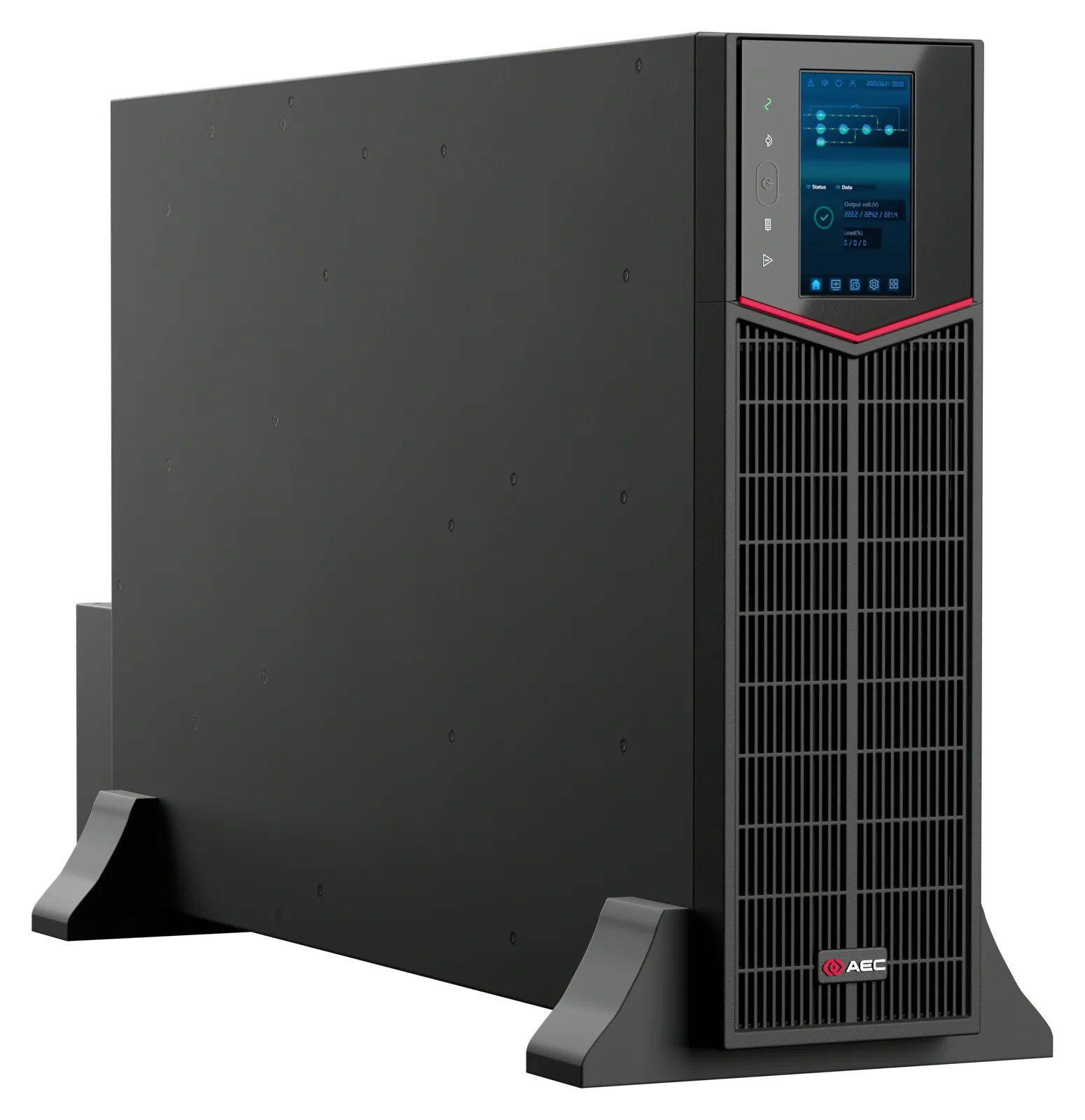
IST9 30 kVA Three-phase rack UPS 30 kVA, 3U, 400 V
The IST9 30 kVA is a 30 kVA / 30 kW online double-conversion UPS in a 3U chassis 720 mm deep, for 3/3 or 3/1. For deep racks in data rooms and industrial sites with a three-phase supply and 20 to 30 kW of load.
Quick answers
IST9 30 kVA: quick answers
- What it is
- The IST9 30 kVA is a 30 kVA / 30 kW online double-conversion UPS in a 3U chassis 720 mm deep, for 3/3 or 3/1.
- Who it is for
- For deep racks in data rooms and industrial sites with a three-phase supply and 20 to 30 kW of load.
- Supply and configuration
- 3W + N + PE · 220 / 230 / 240 V L-N · 380 / 400 / 415 V L-L
- Size and weight
- 438 × 720 × 130 mm (3U) · 34.1 kg
- Ordering code
- IST9-30
IST9
What sets apart the IST9 30 kVA
At 30 kVA the IST9 moves to the deep chassis: 438 × 720 × 130 mm and 34.1 kg, with a PE terminal on the rear. The input must be three-phase (3/3 or 3/1, no 1/1), and the 30 kVA has no low-voltage rating in the catalogue. The charger goes up to 20 A (default 15 A).
With short strings of ±48 to ±90 cells the full-load point is derated to 100 × 0.0625 × N / 6 % (N = cells), a rule that applies to the 30 and 40 kVA. It draws 59 A per phase and up to 83 A from the battery, on 100 A 3P AC breakers and a 160 A 3P DC breaker.
- Against the IST9 20 kVA (one size down): Rated power 30 kVA / 30 kW against 20 kVA / 20 kW; Configuration 3/3 · 3/1 against 3/3 · 3/1 · 1/1; Connection 3W + N + PE against 3W + N + PE (settable 1W + N + PE); Charging current 1–20 A (default 15 A) against 1–10 A (default 4 A); Noise (20–25 °C) ≤ 55 dB half load · ≤ 58 dB 75% · ≤ 60 dB full load against ≤ 50 dB half load · ≤ 55 dB 75% and full load.
- Against the IST9 40 kVA (one size up): Rated power 30 kVA / 30 kW against 40 kVA / 40 kW; Weight 34.1 kg against 34.2 kg.
Planning data
IST9 30 kVA: currents, breakers, cables, batteries
The rows and columns of the EMEA 2026 catalogue's and AEC manuals' tables that concern the IST9 30 kVA.
Connected, and ready for redundancy
| Model | Mode | AC input (A) | Bypass input (A) | DC input (A) | AC output (A) |
|---|---|---|---|---|---|
| 30 kVA | 3/3 | 100 × 3P | 100 × 3P | 160 × 3P | 100 × 3P |
| 30 kVA | 3/1 | 100 × 3P | 200 × 1P | 160 × 3P | 200 × 1P |
Currents, codes and options
| Model | Mode | AC input (A) | Bypass input (A) | DC input (A) | AC output (A) |
|---|---|---|---|---|---|
| 30 kVA | 3/3 | 59 | 46 | 83 | 46 |
| 30 kVA | 3/1 | 59 | 138 | 83 | 138 |
Installation
Installing the IST9 30 kVA: space, heat, cables
Each figure with its source. Heat is the power lost at the peak efficiency stated.
| Item | Figure | Source |
|---|---|---|
| Cable entry | At the rear | EMEA 2026 catalogue p.64 |
| Heat at full load | 1.25 kW at 30 kW load, 96 % efficiency | EMEA 2026 catalogue p.64; output PF 1 (EMEA 2026 catalogue) |
| Operating temperature | −5 to 40 °C | EMEA 2026 catalogue p.64 |
Size and floor
How big it is
438 × 720 × 130 mm · 34.1 kg.
Floor load = weight ÷ footprint (34.1 kg).
Efficiency
How efficient is the AEC IST9 30 kVA at your load?
IST9 30 kVA, 30 kW at its rating, double conversion, high-voltage mode (typical curve, AEC's method). Heat to remove on this curve: 25%: 0.36 kW (η 95.4%) · 50%: 0.63 kW (η 96%) · 75%: 1.01 kW (η 95.7%) · 100%: 1.45 kW (η 95.4%). At 50% load, 24/7, it loses about 5,475 kWh a year.
How the curve is drawn and where each figure comes from: the IST9 range page.
- Load
- —
- Lost as heat
- —
- Energy lost in a year, 24/7
- —
- Its cost in a year at € per kWh
- —
- The catalogue's examples use €0.20 per kWh.
Where each figure comes from
| Mode | Efficiency | Kind | Models | Source |
|---|---|---|---|---|
| Double conversion, high-voltage mode | 25%: 95.4% · 50%: 96% · 75%: 95.7% · 100%: 95.4% | Typical curve, derived from the datasheet efficiency of 96% (AEC method) | all | AEC datasheet: AC/AC efficiency of the IST6-PM100 100 kW power module (the curve's shape) |
| ECO | 99% | Datasheet figure, load not stated | all | |
| Double conversion, low-voltage mode | 25%: 93.4% · 50%: 94% · 75%: 93.7% · 100%: 93.4% | Typical curve, derived from the datasheet efficiency of 94% (AEC method) | IST9 10 kVA · IST9 20 kVA · IST9 40 kVA | AEC datasheet: AC/AC efficiency of the IST6-PM100 100 kW power module (the curve's shape) |
EMEA 2026 catalogue figures: Double conversion, high-voltage mode up to 96% · Double conversion, low-voltage mode up to 94% · ECO up to 99%.
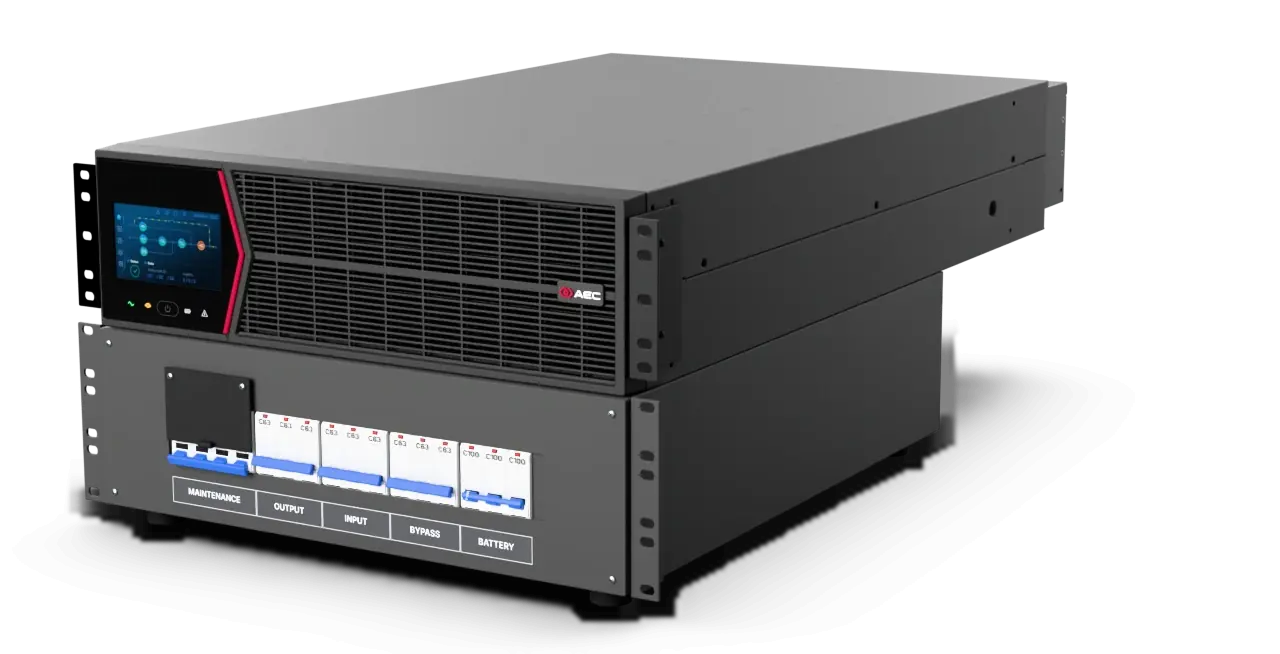 Drag to turn
In 3D
Look around the IST9 30 kVA
The turntable shows the IST9 40 kVA; the full 3D view opens on the IST9 30 kVA.
Technical data
Technical data IST9 30 kVA
Only this model's values, from the EMEA 2026 catalogue table.
| General | |
|---|---|
| Rated power (kVA / kW, high-voltage mode) | 30 / 30 |
| Configuration | 3/3 · 3/1 |
| Input | |
| Connection | 3W + N + PE |
| Voltage range (phase) | high-voltage mode 176–280 V full load, 80–176 V linear derating · low-voltage mode 90–155 V full load, 70–90 V derating |
| Frequency · power factor · THDi | 40–70 Hz · ≥ 0.99 · ≤ 3% resistive, ≤ 5% non-linear full load |
| Bypass | 50 / 60 Hz ± 10% · voltage ± 20% |
| Battery | |
| Voltage | high-voltage mode ± 96 … ± 240 V DC (± 48 … ± 120 cells of 2 V, default ± 96) · low-voltage mode ± 96 … ± 120 V (± 48 … ± 60 cells, default ± 60) |
| Full-load derating by cells | ± 48 … ± 90 cells: 100 × 0.0625 × N / 6 % |
| Charging current | 1–20 A (default 15 A) |
| Output | |
| Voltage | 220 / 230 / 240 V L-N, 380 / 400 / 415 V L-L (low-voltage mode 110 / 115 / 120 V); 3W + N + PE, settable 1W + N + PE |
| Frequency | tracks the bypass; 50 ± 0.1 or 60 ± 0.1 Hz in battery mode |
| Waveform · distortion · power factor | sine wave · ≤ 2% resistive full load · 1.0 |
| Transfer inverter ↔ bypass | < 1 ms synchronised · < 10 ms not synchronised |
| Inverter overload | ≤ 105% continuous · 105–110% 60 min · 110–130% 10 min · 130–155% 1 min · > 155% 200 ms · > 200% immediate |
| Bypass overload | < 130% continuous · 130–155% 1 min · > 155% 200 ms |
| System | |
| Efficiency | up to 96% (high-voltage mode) · 94% (low-voltage mode) · 99% ECO |
| Display · cold start | touch screen · battery cold start fitted |
| Communication | RS232 · options: SNMP, RS485 + dry contact, protocol card for the approved lithium system, parallel card |
| Noise (20–25 °C) | ≤ 55 dB half load · ≤ 58 dB 75% · ≤ 60 dB full load |
| Environment | −5 … 40 °C · 0–95% RH non-condensing · ≤ 2000 m |
| Dimensions (W × D × H) | 438 × 720 × 130 mm (3U) |
| Weight | 34.1 kg |
| Item | IST9 30 kVA |
|---|---|
| kVA / kW (high-voltage mode) | 30 / 30 |
| kVA / kW (low-voltage mode) | — |
| Configuration | 3/3 · 3/1 |
| W × D × H (mm) | 438 × 720 × 130 |
| Weight | 34.1 kg |
— not stated in the user manual. Specifications are subject to change without notice.
More technical detailsordering codes
Ordering codes
Ordering codes IST9 30 kVA
| Code | Description |
|---|---|
| IST9-10 · IST9-30 · IST9-40 | Code on request |
| PAR-IST9 | Parallel board |
| DRYCNT-IST3/9 · SNMP | Dry-contact relay board · internal SNMP board |
| BBJ2 | Rack battery cabinet, max. 16 × 12 V 9 Ah, 3U |
Questions
Questions about the IST9 30 kVA
Will the IST9 30 kVA fit my rack?
Yes, if it has 3U and 720 mm of usable depth, plus room at the rear for terminals and cables. The 10–20 kVA models are 535 mm deep. Its weight, 34.1 kg, calls for rails rated for it.
How loud is the IST9 30 kVA?
At 20–25 °C: up to 55 dB at half load, 58 dB at 75% and 60 dB at full load. Fan speed follows the load, so a lightly loaded unit is quieter.
How big is the AEC IST9 30 kVA and how much does it weigh?
The AEC IST9 30 kVA measures 438 × 720 × 130 mm (3U); weight: 34.1 kg (EMEA 2026 catalogue).
Talk to an AEC engineer
Tell us the load, the supply and the backup time you need for the AEC IST9 30 kVA: we answer with the model and the batteries that fit. AEC International sells through distributors in about 80 countries and an agency in every Italian region: ask AEC which one serves your area.