



















Technology · battery
Lithium LiFePO4 batteries and the BMS in AEC UPS
AEC lithium is lithium iron phosphate: the chemistry chosen for stationary power because it is thermally stable, lasts thousands of cycles and keeps its capacity for years. Every module is watched by a battery management system.
Inside the module
Open the 40, 50 and 100 Ah modules: their cells, their BMS and why every module works on its own, in parallel.

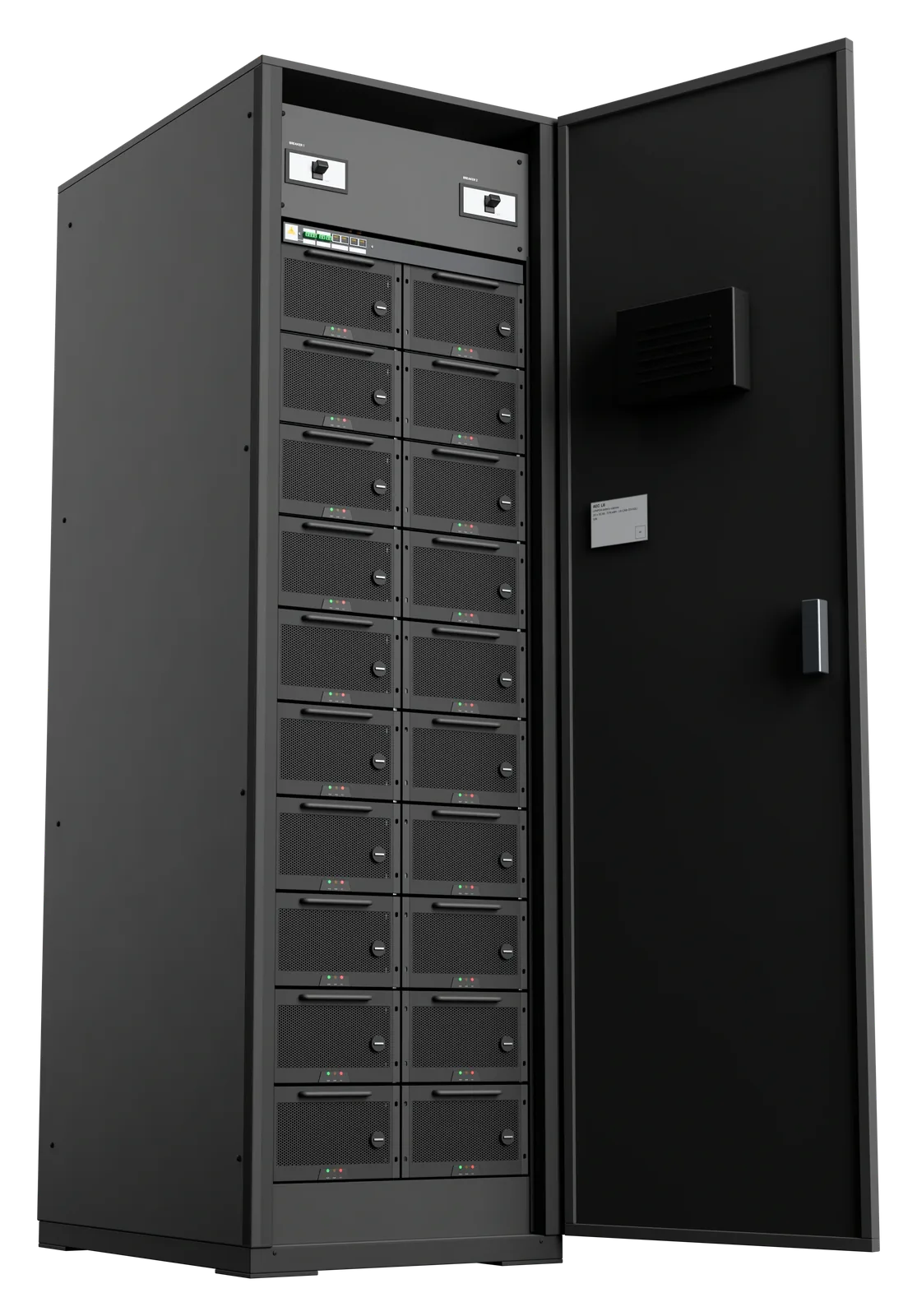
L6 lithium cabinet
Open the cabinet
- AEC L6 modular lithium battery cabinet: up to 20 hot-swappable LiFePO4 modules of 40 or 50 Ah, or 12 modules of 100 Ah.
- 10-inch touch screen on the master cabinet, three-layer BMS (module, cabinet, system), a bidirectional DC/DC converter in every module, physical isolation between the modules and the UPS, and module-level fire control.
- 5,000 cell cycles at 50% depth of discharge. For AEC IST7 and IST6 UPS, 6–1200 kVA.
- Specifications: cabinet 600 × 850 × 2000 mm; 41, 58 or 69 kWh with 40, 50 or 100 Ah modules; 36, 37 or 52 kg per module; IP20, < 65 dB.
Up to 15 cabinets work in parallel as master and slaves, joined through a combiner cabinet: model L6-C-2000 (up to 4 cabinets, 2000 A, 120 kg) or L6-C-4000 (up to 8 cabinets, 4000 A, 140 kg); both 400 × 850 × 2000 mm, top or bottom wiring.
Battery management system
How the BMS keeps it safe.
From the L6 catalogue pages. Click to open each diagram.
See it
The L6 system touch screen, cell by cell: the health of every module, cell voltages and temperatures, charge and discharge curves.
Standards
Standards for the battery side
The AEC catalogue gives IEC/EN 62040-1 and EN IEC 62485-2 for the battery cabinets: IEC 62040-1 is the safety part of the UPS standard, and IEC 62485-2 sets the safety requirements of stationary batteries and battery installations, ventilation included. For the L6 lithium cabinets the data give the derating above 2000 m of altitude per IEC 62040-3, as for the UPS.
Size a lithium system
Tell us the UPS, the load and the minutes: we size the modules and cabinets.