



















IST7 10–40 · Three-phase UPS
IST7-10 Three-phase UPS 10 kVA, 400 V
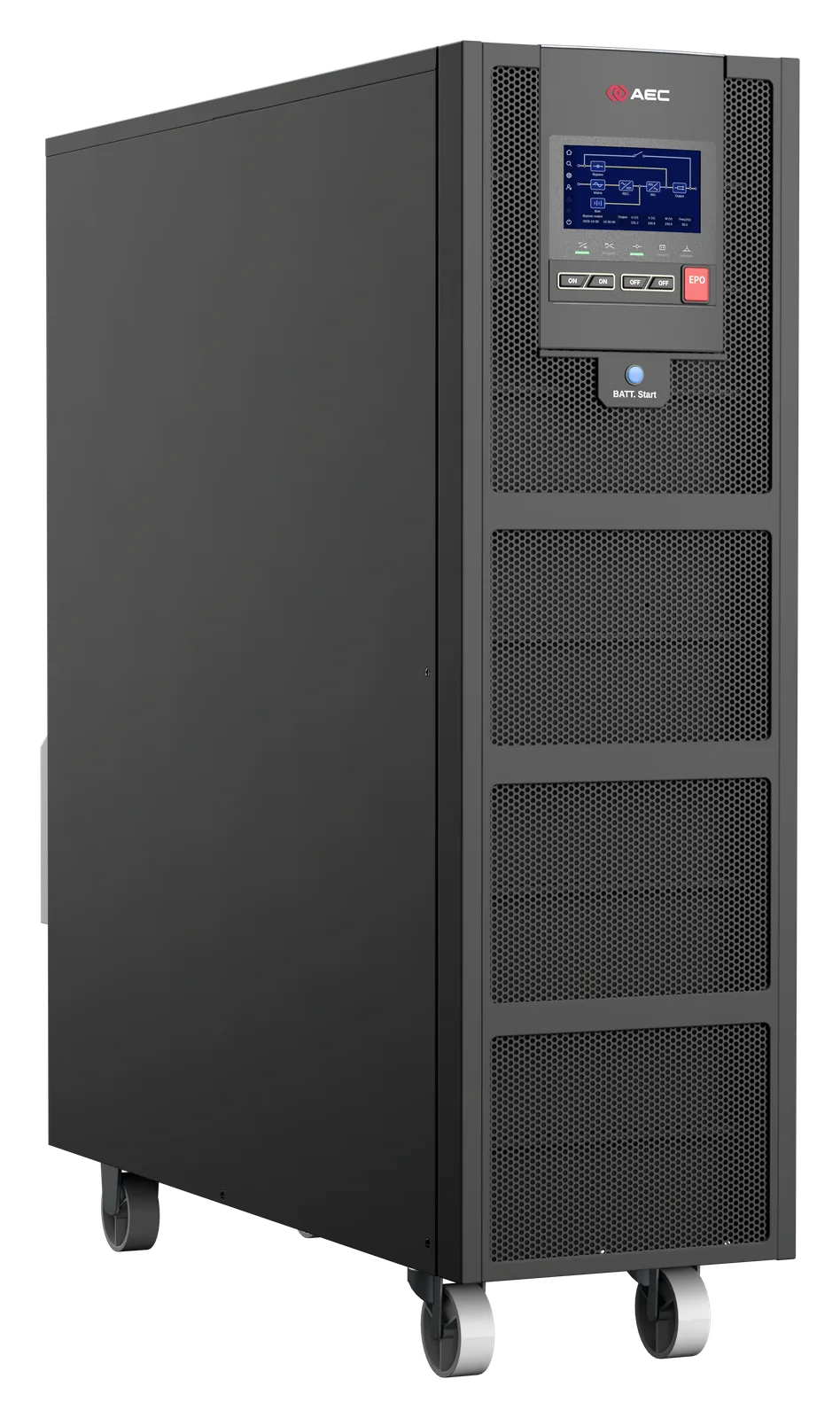
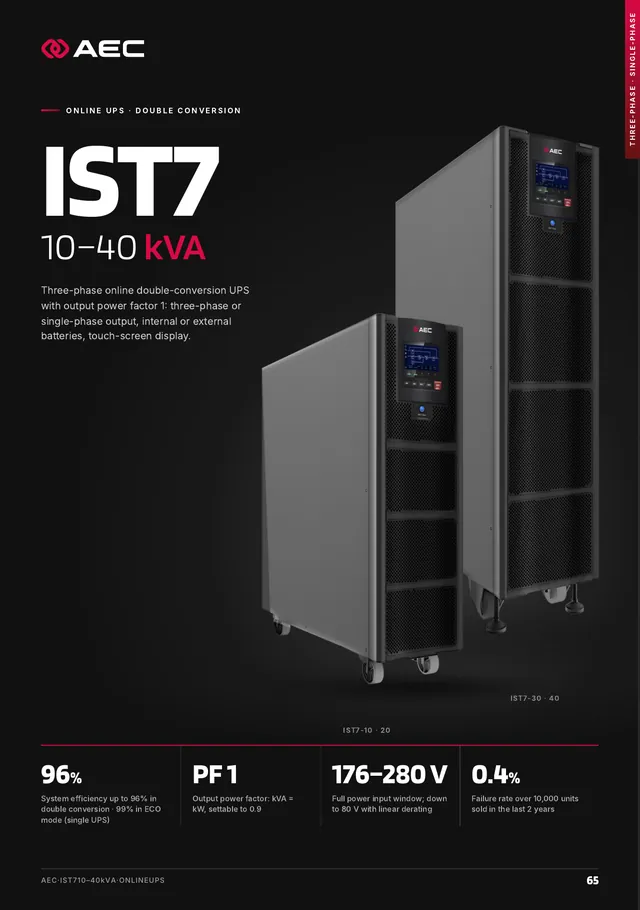
The IST7-10 is a 10 kVA / 10 kW online double-conversion UPS in the small IST7 frame, 250 mm wide. For server rooms, network cabinets and small plants that need three-phase or single-phase output and want the battery inside the UPS.
Quick answers
IST7-10: quick answers
- What it is
- The IST7-10 is a 10 kVA / 10 kW online double-conversion UPS in the small IST7 frame, 250 mm wide.
- Who it is for
- For server rooms, network cabinets and small plants that need three-phase or single-phase output and want the battery inside the UPS.
- Supply and configuration
- 3/3 · 3/1 · 1/1 · L-N 220 / 230 / 240 V · L-L 380 / 400 / 415 V
- Battery and backup
- ± 96 … ± 240 V DC
- Size and weight
- 250 × 806 × 880 mm · 64 / 95 kg
- Ordering code
- IST7-10 · IST7-10-32X9 · IST7-10-150X9
IST7 10–40
What sets apart the IST7-10
The IST7-10 is the only IST7 that runs at full power from 16 batteries: its string can be set from 16 to 40 blocks of 12 V (±48 to ±120 cells, ±96 to ±240 V DC), where the 20–40 kVA models need at least 24 and reach full power from 32. That makes it the simplest IST7 to fit with an internal battery: the S model takes 16, 24, 30, 32, 36 or 40 blocks of 9 Ah inside the same 250 × 806 × 880 mm cabinet.
It accepts all three wiring configurations: 3/3, 3/1 and 1/1. In 1/1 the input current rises to 58.6 A on a 16 mm² cable, against 19.5 A per phase in 3/3: check which supply the site has before choosing. With 64 kg (standard) or 95 kg (S) it stands on castors and is moved by two people.
- Against the IST7-20 (one size up): Rated power 10 kVA / 10 kW against 20 kVA / 20 kW; Battery voltage ± 96 … ± 240 V DC against ± 144 … ± 240 V DC; Cells (2 V), settable · default ± 48 … ± 120 · ± 48 against ± 72 … ± 120 · ± 96; Weight standard / S 64 / 95 kg against 64 / 137.6 kg.
Planning data
IST7-10: currents, breakers, cables, batteries
The rows and columns of the EMEA 2026 catalogue's and AEC manuals' tables that concern the IST7-10.
Two frames, one family
| Difference | IST7-10 · 20 |
|---|---|
| Ratings · kVA = kW | 10 · 20 |
| Input / output | 3/3 · 3/1 · 1/1 |
| Set on site with | wiring, connector jumpers, screen |
| Cabinet W × D × H | 250 × 806 × 880 mm |
| Weight standard / S | 64 / 95 kg (10) · 64 / 137.6 kg (20) |
| Internal batteries (S), 12 V 9 Ah | 16 – 40 blocks (10) · 36 or 40 (20) |
| Battery cells, settable | ±48 … ±120 (10) · ±72 … ±120 (20) |
| Charge current | 1–10 A, default 1 A |
| Output distortion, resistive load | ≤ 2% |
| Max. input current, 3/3 | 19.5 A (10) · 35.5 A (20) |
| Max. battery current | 54.8 A |
| Feet | castors |
Front, rear and footprint
| Model | IST7-10 |
|---|---|
| W × D × H (mm) | 250 × 806 × 880 |
| Standard | 64 kg |
| S | 95 kg |
Ready for the site, cables and breakers sized
| Model | IST7-10 |
|---|---|
| AC input (A) | 19.5 |
| AC output (A) | 15.2 |
| Battery (A) | 54.8 |
| Input · output breaker | 32 A 3P |
| Battery breaker | 100 A 3P |
| AC cables (mm²) | 4 |
| Battery (mm²) | 10 |
| PE (mm²) | 4 |
Single-phase output · 3/1 and 1/1
| Model | IST7-10 |
|---|---|
| AC input (A) (3/1) | 19.5 |
| Bypass input (A) | 58.6 |
| AC output (A) | 45.6 |
| Bypass · output breaker | 80 A 1P · 80 A 1P |
| N, bypass, output (mm²) | 16 |
| PE (mm²) | 2 × 10 |
BB5 to BB8, matched to every IST7
| UPS | IST7-10 · 20 |
|---|---|
| BB5 | 30–40 × 24 Ah · 30–38 × 40 Ah |
| BB6 | 30–36 × 60 Ah |
| BB7 | 30–36 × 80 / 100 Ah |
| BB8 | 40 / 60 × 80 / 100 Ah |
One code for the UPS and its batteries
| Battery | Cabinet | IST7-10 |
|---|---|---|
| Internal 9 Ah · S | — | 16 · 24 · 30 · 32 · 36 · 40 |
| Internal 9 Ah + BB5 | BB5 | 150 · 160 |
| 24 Ah | BB5 | 30 – 40 |
| 40 Ah | BB5 | 30 – 38 |
| 60 Ah | BB6 | 30 – 36 |
| 80 Ah · 100 Ah | BB7 | 30 – 36 |
| 80 Ah · 100 Ah | BB8 | 40 · 60 |
Installation
Installing the IST7-10: space, heat, cables
Each figure with its source. Heat is the power lost at the peak efficiency stated.
| Item | Figure | Source |
|---|---|---|
| Clearances | rear 300 mm (recommended 500), left 300 mm (recommended 500), right 300 mm (recommended 500); front and top: not given | AEC IST7 10–40 user manual p.24 §3.2.3; p.6 §1.3 |
| Cable entry | Rear terminals, cables tied down to the bottom | AEC IST7 10–40 user manual |
| Heat at full load | 0.42 kW at 10 kW load, 96 % efficiency | AEC IST7 10–40 user manual p.83 §A; output PF 1 (EMEA 2026 catalogue) |
| Operating temperature | −5 to 40 °C, best 20–25 °C | AEC IST7 10–40 user manual p.6 §1.3 |
| Switches and terminals | Input, bypass, battery, output and maintenance bypass breakers on the rear panel; terminals behind the wiring cover. No front door. | AEC IST7 10–40 user manual p.24 §3.2.3; p.6 §1.3 |
| Units in parallel | Up to 4 units | AEC IST7 10–40 user manual p.71 §4.5.7 |
Size and floor
How big it is
250 × 806 × 880 mm · 64 / 95 kg.
Floor load = weight ÷ footprint: 318 kg/m² at the lowest weight given (64 kg), 471 kg/m² at the highest (95 kg).
Efficiency
How efficient is the AEC IST7-10 at your load?
IST7-10, 10 kW at its rating, online, double conversion (typical curve, AEC's method). Heat to remove on this curve: 25%: 0.12 kW (η 95.4%) · 50%: 0.21 kW (η 96%) · 75%: 0.34 kW (η 95.7%) · 100%: 0.48 kW (η 95.4%). At 50% load, 24/7, it loses about 1,825 kWh a year.
How the curve is drawn and where each figure comes from: the IST7 10–40 range page.
- Load
- —
- Lost as heat
- —
- Energy lost in a year, 24/7
- —
- Its cost in a year at € per kWh
- —
- The catalogue's examples use €0.20 per kWh.
Where each figure comes from
| Mode | Efficiency | Kind | Models | Source |
|---|---|---|---|---|
| Online, double conversion | 25%: 95.4% · 50%: 96% · 75%: 95.7% · 100%: 95.4% | Typical curve, derived from the datasheet efficiency of 96% (AEC method) | all | AEC datasheet: AC/AC efficiency of the IST6-PM100 100 kW power module (the curve's shape) |
| ECO | 99% | Datasheet figure, load not stated | all |
EMEA 2026 catalogue figures: Online, double conversion up to 96% · ECO up to 99%.
 Drag to turn
In 3D
Look around the IST7-10
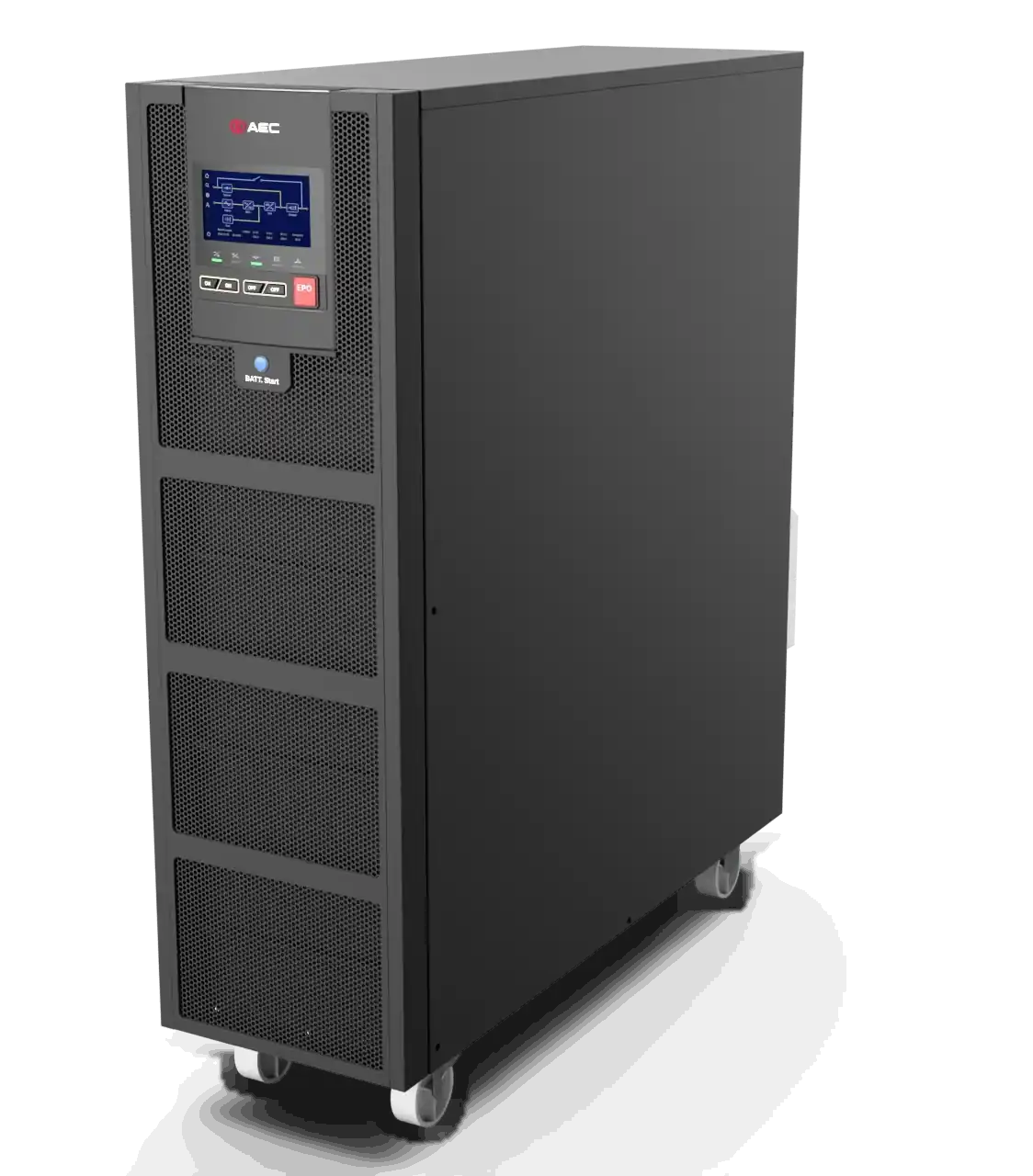
The turntable shows the IST7-20; the full 3D view opens on the IST7-10.
Technical data
Technical data IST7-10
Only this model's values, from the EMEA 2026 catalogue table.
| General | |
|---|---|
| Rated power (kVA / kW) | 10 / 10 |
| Input / output configuration | 3/3 · 3/1 · 1/1 |
| Input | |
| Connection | 3 + N + PE (settable 1 + N + PE) |
| Voltage range | 176–280 V at 100% load · 80–176 V with linear derating |
| Frequency range | 39.5–70.5 Hz |
| Bypass synchronisation range · bypass voltage range | 50 / 60 Hz ± 10% (self-adapting) · 10 / 15 / 20% (default 20%) |
| Power factor · THDi | ≥ 0.99 · ≤ 3% resistive full load, ≤ 5% non-linear full load |
| Battery | |
| Battery voltage (Vdc) | ± 96 … ± 240 |
| Cells (2 V), settable · default | ± 48 … ± 120 · ± 48 |
| Charge current (A) | 1–10 (default 1) |
| Output | |
| Connection | 3 + N + PE (settable 1 + N + PE) |
| Voltage | L-N 220 / 230 / 240 V · L-L 380 / 400 / 415 V |
| Frequency | tracks the bypass; with bypass absent or out of range 50 ± 0.1 or 60 ± 0.1 Hz (default 50) |
| Waveform · power factor | sine wave · 1 (settable 0.9) |
| Voltage distortion (resistive / non-linear) | ≤ 2% / ≤ 4% |
| Transfer time inverter ↔ bypass | < 1 ms synchronised · < 10 ms not synchronised |
| Inverter overload (PF 1) | < 105% continuous · 105–110% 60 min · 110–130% 10 min · 130–155% 1 min · 155–200% 200 ms · > 200% immediate |
| Bypass overload | < 130% continuous · 130–155% 1 min · > 155% 200 ms |
| System | |
| System efficiency | up to 96% · 99% in ECO mode (single UPS) |
| Parallel | up to 4 units with the optional parallel kit |
| Display · communication | touch screen · RS485 · dry contacts: EPO, 1 input, 5 outputs · optional cards: SNMP, protocol transfer, dry-contact kit |
| DC start · alarms | battery start fitted · battery low voltage, mains abnormal, UPS fault, output overload |
| Environment | −5 … 40 °C · 0–95% RH non-condensing · IP20 · noise < 55 dB (25 °C) · up to 2000 m |
| Dimensions W × D × H | 250 × 806 × 880 mm |
| Weight standard / S | 64 / 95 kg |
| Item | IST7-10 |
|---|---|
| Rated power (kVA / kW) | 10 / 10 |
| Input / output | 3/3 · 3/1 · 1/1 |
| W × D × H (mm) | 250 × 806 × 880 |
| Weight standard | 64 kg |
| Weight S | 95 kg |
S: with internal battery. Outer dimensions in mm: 10–20 kVA width 250 (308 with feet), depth 756 (806 overall), height 802 (880 overall); 30–40 kVA width 300 (358 with feet), depth 787 (842 overall), height 1143 (1250 overall). Ratings are kVA = kW at output PF 1; PF 0.9 settable. Battery voltage and capacity set on the screen at commissioning. Specifications are subject to change without notice.
More technical detailsordering codes
Ordering codes
Ordering codes IST7-10
| Code | Description |
|---|---|
| IST7-10 · IST7-20 · IST7-30 · IST7-40 | Standard models, external batteries only (e.g. IST7-30: 30 kVA, external batteries). |
| IST7-10-32X9 | 10 kVA S model, 32 × 12 V 9 Ah inside. |
| IST7-10-150X9 | 10 kVA, 30 × 9 Ah inside + 120 in BB5. |
| Parallel kit | Option: built-in card with parallel cables, CAN communication, up to 4 units. |
| SNMP card | Option: network monitoring in an intelligent slot, configured through its web page. |
| Dry-contact kit | Option: 3 outputs and 2 inputs in an intelligent slot. |
| Protocol transfer card | Option: RS485 + RS232 on DB9; RS485 reserved for lithium battery communication. |
Questions
Questions about the IST7-10
Can the IST7-10 run from a single-phase supply?
Yes. The IST7-10 is set to 1/1 (single-phase in and out) through the wiring, the connector jumpers and the screen; it also works 3/3 and 3/1. In 1/1 the catalogue gives 58.6 A at the bypass input and 45.6 A at the output.
How many internal batteries can the IST7-10 hold?
The S model holds 16, 24, 30, 32, 36 or 40 batteries of 12 V 9 Ah (code IST7-10-32X9, for example). For longer backup the S model also takes a BB5 cabinet: IST7-10-150X9 is 30 blocks inside plus 120 in the BB5.
Which breakers does the IST7-10 need?
In 3/3 the catalogue recommends 32 A 3P at input and output and a 100 A 3P battery breaker, with 4 mm² AC cables and 10 mm² battery cables for about 5 m. In 3/1 and 1/1 bypass and output take 80 A 1P breakers.
How long does a 10 kVA UPS like the IST7-10 run?
2 to 400 minutes at full load (10 kW), and 5 to 958 minutes at half load, with the AEC battery options in the table: the battery chosen sets the figure. With 16 × 12 V 9 Ah (IST7-10-16X9): 2 minutes at 100% and 5 at 50%. For other loads and batteries use the backup-time tool.
How big is the AEC IST7-10 and how much does it weigh?
The AEC IST7-10 measures 250 × 806 × 880 mm; weight: 64 / 95 kg (size from AEC's CAD drawing, weight from the EMEA 2026 catalogue).
What is the ordering code of the AEC IST7-10?
In the EMEA 2026 catalogue the AEC IST7-10 is listed as IST7-10, IST7-10-32X9, IST7-10-150X9; AEC gives the full code, batteries included, from the load and the backup time.
Talk to an AEC engineer
Tell us the load, the supply and the backup time you need for the AEC IST7-10: we answer with the model and the batteries that fit. AEC International sells through distributors in about 80 countries and an agency in every Italian region: ask AEC which one serves your area.