



















IST7 60–200 · Three-phase UPS
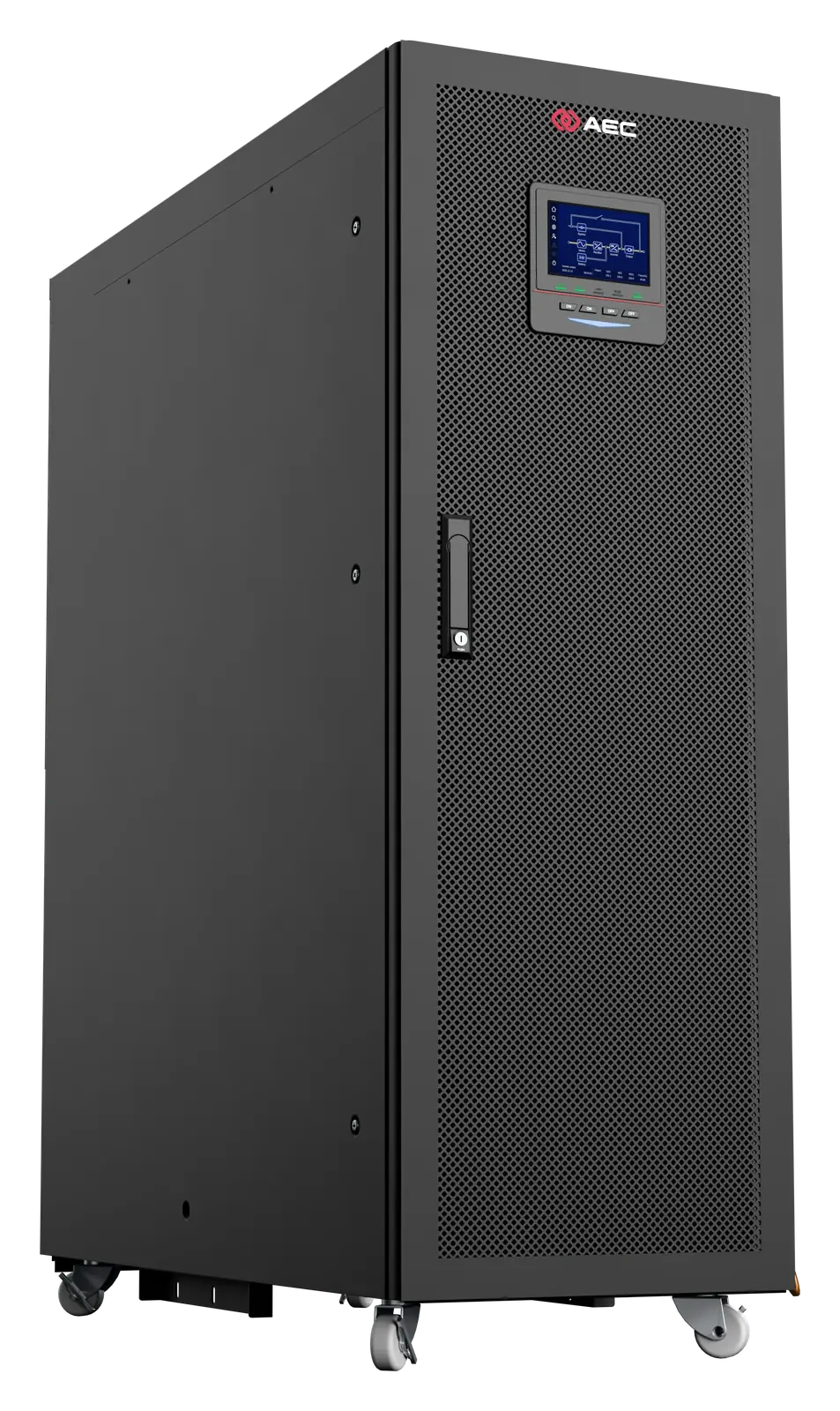
IST7-80 Three-phase online UPS 80 kVA, 400 V
The IST7-80 is an 80 kVA / 80 kW three-phase online UPS built on the IST7-100's hardware, upgradable to 100 or 120 kVA from the display. For sites at 60–80 kW today that expect to grow, and want the extra power without a new UPS or more floor space.
Quick answers
IST7-80: quick answers
- What it is
- The IST7-80 is an 80 kVA / 80 kW three-phase online UPS built on the IST7-100's hardware, upgradable to 100 or 120 kVA from the display.
- Who it is for
- For sites at 60–80 kW today that expect to grow, and want the extra power without a new UPS or more floor space.
- Supply and configuration
- 3 phases + N + PE · 220 / 230 / 240 V L-N · 380 / 400 / 415 V L-L
- Battery and backup
- ±192 V
- Size and weight
- 400 × 960 × 1193 mm · 163 kg
- Ordering code
- IST7-80
IST7 60–200
What sets apart the IST7-80
The IST7-80 is the model to buy for growth: the same 400 × 960 × 1193 mm cabinet as the IST7-100, at 163 kg (the IST7-100 is 165 kg), with the rated capacity set at engineering level from the display. Raised to 100 or 120 kVA, it keeps its footprint. The catalogue's battery-connection table lists it at up to 241 A nominal and 279 A maximum, the IST7-100's values, on 50 mm² cables.
Its default battery is ±192 V (32 blocks), like the IST7-60; the 100–200 kVA default to ±216 V (36 blocks). Cabinet fuses are chosen for the UPS model, so tell AEC the final rating when ordering batteries for a unit that will be upgraded.
- Against the IST7-60 (one size down): Rated power 80 kVA / 80 kW against 60 kVA / 60 kW; Weight 163 kg against 153 kg.
- Against the IST7-100 (one size up): Rated power 80 kVA / 80 kW against 100 kVA / 100 kW; Capacity upgrade to 100 / 120 against to 120; Nominal DC voltage (default) ±192 V against ±216 V; Weight 163 kg against 165 kg.
Planning data
IST7-80: currents, breakers, cables, batteries
The rows and columns of the EMEA 2026 catalogue's and AEC manuals' tables that concern the IST7-80.
Front, rear and footprint
| Model | W × D × H (mm) | Weight |
|---|---|---|
| IST7-80 | 400 × 960 × 1193 | 163 kg |
BB5 to BB8, matched to every IST7
| UPS | IST7-80 · 100 · 120 |
|---|---|
| BB5 | — |
| BB6 | 30–36 × 60 Ah |
| BB7 | 30–36 × 80 / 100 Ah |
| BB8 | 60 / 64 × 80 / 100 Ah |
| 2 × BB8 | 120 / 128 × 80 / 100 Ah |
Battery connection by UPS model
| UPS | IST7-80 |
|---|---|
| I nom. (A) | ≤ 241 |
| I max. (A) | ≤ 279 |
| +/N/− mm² | 50 |
| PE mm² | 35 |
Installation
Installing the IST7-80: space, heat, cables
Each figure with its source. Heat is the power lost at the peak efficiency stated.
| Item | Figure | Source |
|---|---|---|
| Clearances | front 800 mm, rear 800 mm, left 800 mm, right 800 mm, top 800 mm | AEC IST7 60–200 user manual p.35 §3.2.3 |
| Cable entry | Bottom, through the base | AEC IST7 60–200 user manual |
| Heat at full load | 2.90 kW at 80 kW load, 96.5 % efficiency | AEC IST7 60–200 user manual p.87 §A; output PF 1 (EMEA 2026 catalogue) |
| Operating temperature | −5 to 40 °C, best 20–30 °C | AEC IST7 60–200 user manual p.34–35 §3.2.2 |
| Switches and terminals | Mains, bypass, output and maintenance bypass switches behind the lockable front door; terminals behind the front and rear wiring covers. | AEC IST7 60–200 user manual p.13 Fig. 2-2/2-3 (handle on the left edge) |
| Door | One leaf, hinged on the right | AEC IST7 60–200 user manual p.13 Fig. 2-2/2-3 (handle on the left edge) |
Size and floor
How big it is
400 × 960 × 1193 mm · 163 kg.
Floor load = weight ÷ footprint (163 kg).
Efficiency
How efficient is the AEC IST7-80 at your load?
IST7-80, 80 kW at its rating, online, double conversion (typical curve, AEC's method). Heat to remove on this curve: 25%: 0.86 kW (η 95.9%) · 50%: 1.45 kW (η 96.5%) · 75%: 2.37 kW (η 96.2%) · 100%: 3.42 kW (η 95.9%). At 50% load, 24/7, it loses about 12,709 kWh a year.
How the curve is drawn and where each figure comes from: the IST7 60–200 range page.
- Load
- —
- Lost as heat
- —
- Energy lost in a year, 24/7
- —
- Its cost in a year at € per kWh
- —
- The catalogue's examples use €0.20 per kWh.
Where each figure comes from
| Mode | Efficiency | Kind | Models | Source |
|---|---|---|---|---|
| Online, double conversion | 25%: 95.9% · 50%: 96.5% · 75%: 96.2% · 100%: 95.9% | Typical curve, derived from the datasheet efficiency of 96.5% (AEC method) | all | AEC datasheet: AC/AC efficiency of the IST6-PM100 100 kW power module (the curve's shape) |
| ECO | 99% | Datasheet figure, load not stated | all |
EMEA 2026 catalogue figures: Online, double conversion up to 96.5% · ECO up to 99%.
 Drag to turn
In 3D
Look around the IST7-80
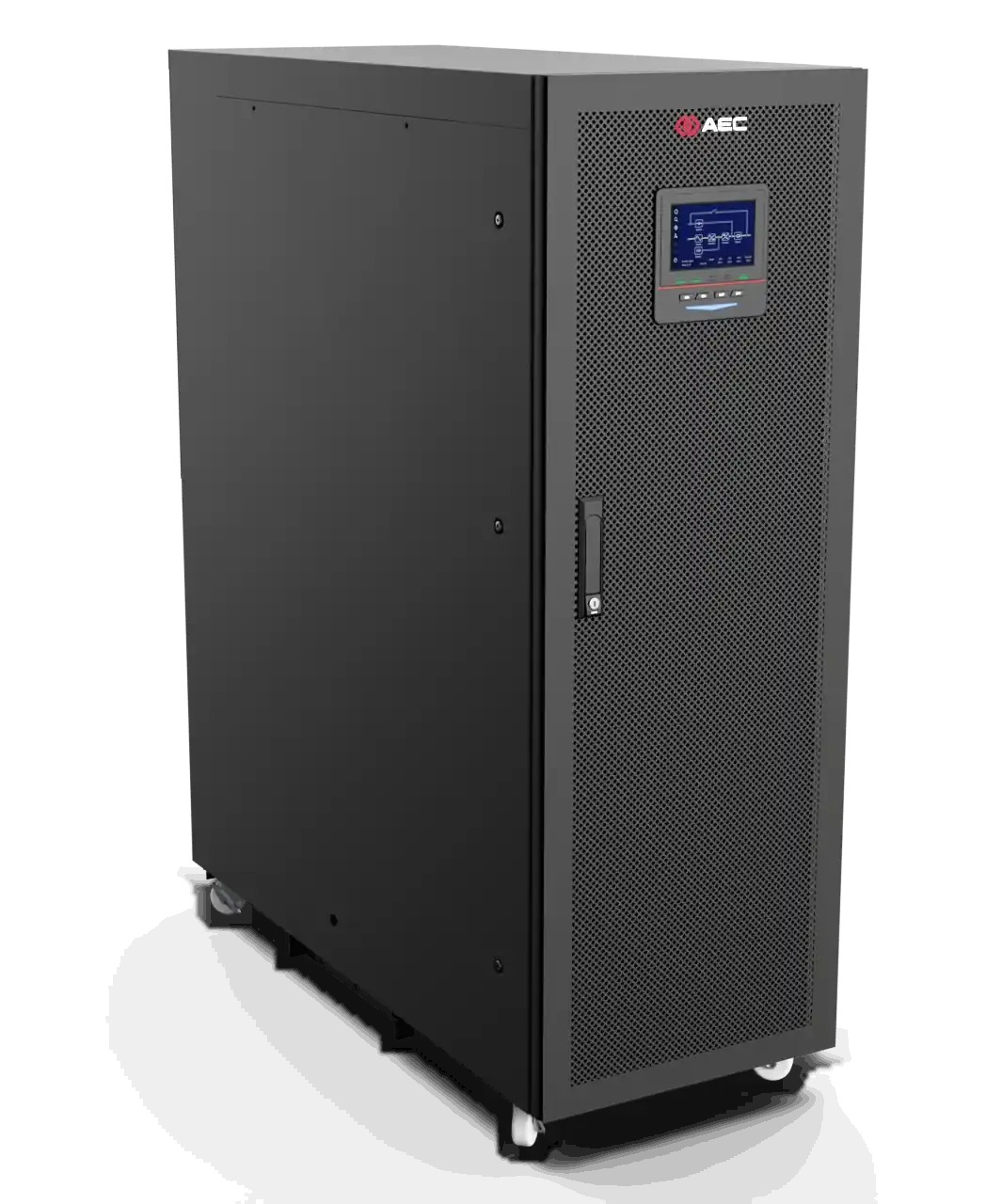
The turntable shows the IST7-120; the full 3D view opens on the IST7-80.
Technical data
Technical data IST7-80
Only this model's values, from the EMEA 2026 catalogue table.
| General | |
|---|---|
| Rated power (kVA / kW) | 80 |
| Capacity upgrade | to 100 / 120 |
| Input | |
| Connection | 3 phases + N + PE |
| Rated voltage | 220 / 230 / 240 V phase (380 / 400 / 415 V line) |
| Voltage range | 187–280 V phase at full power · 80–186 V with linear derating |
| Frequency · power factor · THDi | 40–70 Hz · ≥ 0.99 · ≤ 3% at full load |
| Bypass synchronisation range | 50 / 60 Hz ± 6 Hz |
| Battery | |
| Nominal DC voltage (default) | ±192 V |
| String length | 28–48 × 12 V blocks, set on site · VRLA or lithium (BMS card) |
| Max. charge current | 30 A |
| Output | |
| Voltage · frequency | 220 / 230 / 240 V phase · 50 / 60 Hz (± 0.1 Hz on battery) |
| Power factor · THDv | 1 (settable 0.9) · ≤ 1% linear, ≤ 4% non-linear load |
| Transient · unbalance · phase error | ≤ 5% for 0–100–0% step · 100% unbalanced load · ≤ 1° |
| Transfer time inverter ↔ bypass | < 1 ms synchronised · < 15 ms not synchronised |
| Inverter overload | ≤ 105% continuous · ≤ 110% 60 min · ≤ 125% 10 min · ≤ 150% 1 min (IST7-120: > 125% immediate) |
| Bypass overload | ≤ 130% continuous · ≤ 150% 5 min · ≤ 200% 1 s · ≤ 300% 100 ms |
| System | |
| Efficiency AC/AC | up to 96.5% double conversion · 99% ECO mode |
| Parallel | Up to 8 units, capacity or N+X · BSC dual-bus synchronisation |
| Communication | RS485 · Modbus RTU · RS232 · 4 IN / 3 OUT dry contacts · EPO · SNMP slot · expansion slot |
| Display | Colour touch screen, 5 status LEDs, ambient light bar, 10,000 events and 10,000 user-log entries |
| Environment | −5 … 40 °C · 0–95% RH · IP20 · < 65 dB at 1 m · forced-air cooling |
| Cable entry | bottom (all models) |
| EMC | IEC 62040-2:2016 · category C3 (not for residential use without additional measures) |
| Dimensions W × D × H | 400 × 960 × 1193 mm |
| Weight | 163 kg |
| Item | IST7-80 |
|---|---|
| Rated power (kVA / kW) | 80 |
| Capacity upgrade | to 100 / 120 |
| Power units | 1 |
| Nominal DC voltage (default) | ±192 V |
| Max. charge current | 30 A |
| W × D × H (mm) | 400 × 960 × 1193 |
| Weight | 163 kg |
Specifications are subject to change without notice.
More technical detailsordering codes
Ordering codes
Ordering codes IST7-80
| Code | Description |
|---|---|
| IST7-80 | 80 kVA, upgradable to 100 or 120 kVA |
| PAR-IST7-60/200 | Parallel kit |
| IST7-[kVA]-[n]X[Ah] | UPS with battery cabinet, n × 12 V [Ah] (e.g. IST7-160-64X100 = IST7-160 + BB8 with 64 × 12 V 100 Ah) |
Questions
Questions about the IST7-80
How is the IST7-80 upgraded to 100 or 120 kVA?
The rated capacity is set from the display at engineering level, on the same hardware: no new power unit and no new cabinet. AEC service configures the upgrade.
Which battery cabinets go with the IST7-80?
From BB6 (30–36 × 60 Ah) upwards: BB7 with 30–36 × 80 / 100 Ah, BB8 with 60 / 64 × 80 / 100 Ah, or two BB8. The BB5 is not listed for the 80–120 kVA.
How long does a 80 kVA UPS like the IST7-80 run?
2 to 60 minutes at full load (80 kW), and 8 to 167 minutes at half load, with the AEC battery options in the table: the battery chosen sets the figure. With 30 × 12 V 60 Ah (IST7-80-30X60): 2 minutes at 100% and 8 at 50%. For other loads and batteries use the backup-time tool.
How big is the AEC IST7-80 and how much does it weigh?
The AEC IST7-80 measures 400 × 960 × 1193 mm; weight: 163 kg (size from AEC's CAD drawing, weight from the EMEA 2026 catalogue).
What is the ordering code of the AEC IST7-80?
In the EMEA 2026 catalogue the AEC IST7-80 is listed as IST7-80; AEC gives the full code, batteries included, from the load and the backup time.
Talk to an AEC engineer
Tell us the load, the supply and the backup time you need for the AEC IST7-80: we answer with the model and the batteries that fit. AEC International sells through distributors in about 80 countries and an agency in every Italian region: ask AEC which one serves your area.